Sugawara No Michizane Became the God Students Still Pray To
· 17 min read
Sugawara no Michizane was a Heian scholar and poet who was exiled to Dazaifu and died in disgrace, yet within a century he was worshipped as Tenjin, the god of learning, and students still pray to him before exams today.
Every winter, as entrance exams approach, thousands of Japanese students travel to shrines to pray for a pass. They write a wish on a small wooden plaque, buy a paper amulet, and bow before a god who was once a living man. That god is Sugawara no Michizane, a scholar of the Heian period who died in exile more than a thousand years ago and is still the first name students call on when the future is decided by an exam.
It is a strange fate for a man who spent his life with books. Sugawara no Michizane never led an army, never ruled a province as a warlord, and never claimed any power beyond his learning. He wrote poems, taught students, drafted documents for the court, and rose to high office on the strength of his mind alone. Then politics destroyed him in a single stroke, and he died far from home, stripped of rank and separated from his family. By any ordinary measure, that should have been the end of his story.
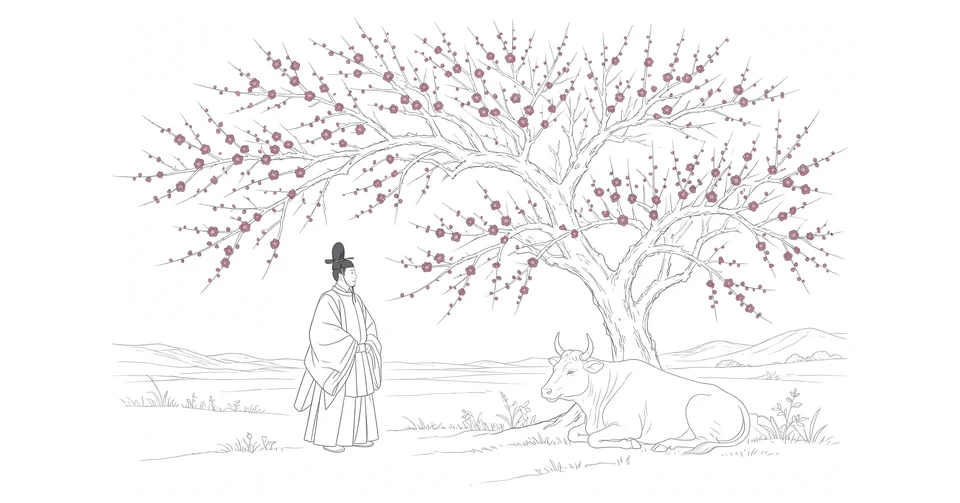
Instead, it was the beginning. Within a few decades of his death, the court that had exiled Sugawara no Michizane was building shrines to him, restoring his rank, and begging his spirit for forgiveness. Within a century he was a god. Today there are about 12,000 Tenmangu shrines across Japan dedicated to him, and his name is written on more exam amulets than that of any other figure in Japanese history. This is the story of how a scholar became a god, and why students still need him.
The scholar from a family of teachers
Sugawara no Michizane was born in 845 into a family that had made learning its trade. His grandfather, Sugawara no Kiyotomo, had taught history at the national academy and reached the third rank at court. His father, Sugawara no Koreyoshi, ran a private school in the family mansion, preparing young men for the entrance examination to the national academy and for careers as court officials. The boy grew up in a house where books were not ornaments but tools, and where a good sentence was a form of power.
He was a gifted child. Tradition says Sugawara no Michizane began composing waka poetry at the age of five, and whether or not that detail is exact, the adult record leaves no doubt about his talent. Sugawara no Michizane passed the entrance examination and entered the Daigaku, the national academy, and after graduation he began his court career in 870 at the senior sixth rank. His skill with classical Chinese language and literature gave him work that mattered: drafting edicts, handling correspondence for senior officials, and receiving delegations from the kingdom of Parhae, where his Chinese proved useful in diplomacy and in the exchange of poems.
Alongside his court duties, Sugawara no Michizane ran the school his father had founded, the Kanke Roka, or Sugawara Family Hall. In 877 he became professor of literature at the academy, and later he was appointed monjo hakushi, Doctorate of Literature, the highest professorial office at the Daigaku and the greatest honour a scholar of his kind could achieve. The Wikipedia entry on Sugawara no Michizane traces this rise in detail, from his first post to the doctorate that crowned his academic career.
There is something quietly impressive about this part of his life, and it is worth pausing on. Sugawara no Michizane did not inherit a great estate or a famous sword. He inherited a school and a reputation for study, and he built on both with patience. In a court where birth mattered enormously, he rose because he could read, write, and think better than almost anyone around him. That is a hopeful story in any century, and it is the part of his life that students today would recognise at once: the long grind of study, the examination passed, the teacher who becomes a mentor.
Rise at court and the fall that followed
In 886, Sugawara no Michizane was appointed governor of Sanuki Province, on the island of Shikoku. A term in a distant province was a normal step for a court official, and he served there for four years. His time as governor was not a triumph. Records suggest his administration met with only middling success, and he had to petition and pray to relieve a drought in 887. But the years in Sanuki were fertile for his poetry. A remarkable share of his surviving verse, up to a quarter of it, was composed during that short provincial posting, as if distance from the capital had sharpened his pen.
Sugawara no Michizane returned to Kyoto in 890, and his rise then was swift. The court was in the middle of a power struggle. Emperor Uda wanted to restore authority to the imperial family, away from the Fujiwara clan that had come to dominate the court, and he promoted capable men from outside the Fujiwara circle. Sugawara no Michizane was one of them. In 888, during the Ako controversy over the role of Fujiwara no Mototsune, he sent a letter of censure to Mototsune, defending the court scholars and the emperor, and won Uda's favour. From 891 onward he climbed fast, reaching the senior third rank in 897.
In 894 Sugawara no Michizane was appointed ambassador to the Tang dynasty in China, but he advised the emperor to abolish the imperial embassies to China instead. The Tang dynasty was in decline, and some historians also see a political motive: a posting to China would have removed Sugawara no Michizane from the centre of power in Kyoto, where his rival Fujiwara no Tokihira was waiting. Whatever the mix of reasons, the embassies were abolished, and he stayed in the capital. It was a clever move, and it bought him a few more years. It could not buy him safety.
Emperor Uda abdicated, and Sugawara no Michizane lost his protector. In 901, Fujiwara no Tokihira accused him of favouring Prince Tokiyo over the crown prince as successor to the throne. The charge was a political weapon, not a proven crime, but it was enough. Sugawara no Michizane was demoted from the junior second rank to a minor official post at Dazaifu, in Chikuzen Province on Kyushu, and he and his entire family were banished. He left Kyoto that year, and he never saw it again.
I find this part of the story hard to read without anger, even after a thousand years. A man spends his life in service to the court, rises on merit, and is destroyed by a rival who simply wants him gone. There was no trial that history remembers as fair, no chance to answer the charge, only exile. It is an old pattern, and it has not gone away: the scholar who trusts that good work will protect him, and discovers that it does not.
Exile, death, and the storms that followed
Sugawara no Michizane arrived in Dazaifu as a broken man. He had lost his rank, his home, and his place at court, and his family shared his disgrace. Sugawara no Michizane continued to write Chinese poetry in exile, compiling a later anthology that he sent to a friend shortly before his death. Sugawara no Michizane died in Dazaifu in 903, two years after his banishment, at the age of fifty eight. Sugawara no Michizane was buried there, far from the capital he had served.
Then, according to the histories, the capital began to suffer. Plague and drought spread. Sons of Emperor Daigo died in succession. The Great Audience Hall of the Imperial Palace was struck repeatedly by lightning, and the city endured weeks of rainstorms and floods. The court attributed these disasters to the vengeful spirit of the exiled scholar, and fear did what justice had not. The court built a shrine in Kyoto, Kitano Tenmangu, and dedicated it to Sugawara no Michizane to appease his anger. His title and office were posthumously restored, and all mention of his exile was struck from the record.
It was not enough. About seventy years later, Sugawara no Michizane was deified as Tenjin, a god of the sky and storms. Over time, the storm god softened into something gentler: Tenjin became the benign kami of scholarship, learning, and culture, the patron of everyone who studies. He joined Taira no Masakado and Emperor Sutoku as one of the Three Great Onryo of Japan, vengeful spirits who became gods through ritual pacification and posthumous honours. Of the three, he is by far the most loved today.
The transformation is worth thinking about. A society that had wronged a man could not simply apologise; the dead do not accept apologies. So it built him shrines instead, and it turned its guilt into worship. There is something honest in that, and something uncomfortable too. The court honoured Sugawara no Michizane only after he was dead and feared. It is a reminder that recognition often arrives too late, and that the living should not wait for ghosts to tell them who mattered.
The plum tree that flew to Dazaifu
The most beloved story about Sugawara no Michizane is not about politics at all. It is about a plum tree. Before leaving Kyoto in 901, Sugawara no Michizane wrote a farewell poem to the plum tree in the garden of his residence, a tree he loved and would never see again. The poem asks the blossoms, when the east wind blows, to send out their fragrance and not to forget spring, even though their master is gone.
Legend says the plum tree loved its master so much that it flew to Dazaifu overnight to be with him. That tree became known as the tobi-ume, the flying plum, and it still stands at Dazaifu Tenmangu, to the right of the main hall, flowering earlier than the other plum trees on the grounds. A more realistic version of the story says that Sugawara no Michizane, or a friend, transplanted a seedling to Dazaifu. Both versions agree on what matters: the tree and the man belong together, and the blossom is his emblem.
The grounds of Dazaifu Tenmangu now hold about 6,000 plum trees in more than 200 varieties, and they bloom from late January to early March. The shrine's Plum Blossom Festival is held on 25 February, the anniversary of his death. It is a fitting season. The plum is the first flower of the year, blooming while the air is still cold, and it has become the flower of perseverance in Japanese culture: beauty that arrives before the weather is ready for it. A scholar who kept writing in exile would have understood that.
The poetry of Sugawara no Michizane outlived his disgrace in another way too. One of his waka was chosen by Fujiwara no Teika for the Ogura Hyakunin Isshu, the anthology of one hundred poems that later became the card game karuta. The poem was written on a journey, at Mount Tamuke, where the poet had no silk streamers to offer the gods and asked them to accept the autumn maple leaves instead. That single poem keeps Sugawara no Michizane present in the game that Japanese schoolchildren still play at New Year, as the story of hyakunin-isshu gave karuta its hundred poems explains. A man who was erased from the record now appears in a game played by children who may not know his name but know his verse.
Dazaifu and Kitano Tenmangu
Two shrines anchor the worship of Sugawara no Michizane, and they could hardly be more different in character. Dazaifu Tenmangu stands in the city of Dazaifu, about 15 kilometres southeast of central Fukuoka, on the very spot where he was buried. A small shrine was built over his grave in 905, a larger one followed in 919, and the present main hall dates from 1591. Because it stands on his burial site, it is the head shrine of about 12,000 Tenjin shrines across Japan, and more than 10 million people visit each year. A guide to Dazaifu Tenmangu Shrine describes the approach, the three arched bridges over the sacred pond, the flying plum tree, and the bronze ox statues whose heads visitors rub for wisdom.
Kitano Tenmangu, in Kyoto, is the shrine the court built to calm his spirit. It stands in the city that exiled him, and its existence is a kind of public confession: the capital admitting, in stone and timber, that it had done wrong. Together the two shrines tell the whole story. Dazaifu is where the man died, and Kitano is where the court repented. Pilgrims visit both, and many students visit Dazaifu in particular, because it is the head shrine and because the grave itself is there.
The grounds at Dazaifu are worth a slow visit. Three red bridges cross the Shinji-ike pond, standing for the past, present, and future. Bronze oxen wait to have their heads rubbed, a habit born from the legend of the ox that carried the scholar's body and lay down, refusing to move, on the spot where he was buried. Teahouses along the approach sell umegae mochi, a grilled rice cake filled with sweet red bean paste and pressed with a plum blossom pattern. The shrine museum holds about 50,000 objects related to the shrine and to Sugawara no Michizane, including a National Treasure. It is a place where history is not kept behind glass but walked through, eaten, and touched.
What strikes me about Dazaifu is how ordinary the devotion there feels. The visitors are not mostly scholars or priests. They are parents with teenagers, students with backpacks, and grandparents who remember their own exams. The shrine does not demand grandeur from its visitors. It asks only that they come, write a wish, and keep studying. That modesty suits its god, a man whose whole life was built on study rather than display.
Why students still pray to Sugawara no Michizane
The exam season is the heart of the worship of Sugawara no Michizane, and it is easy to see why. Japan's entrance examinations decide a great deal: which high school, which university, which company, which life. The pressure on students is enormous, and the shrine offers something that no cram school can sell, which is the feeling that someone is on your side. Students buy gokaku amulets, charms for passing, and hang ema plaques covered in wishes. Parents buy them too, sometimes one to send to the child and one to keep at the family altar.
It would be easy to dismiss this as superstition, and it would be a mistake. The amulet does not answer the exam questions. Everyone who buys one knows that. What it does is give the student a small, physical reminder that their effort matters to someone, even to a god who died a thousand years ago. When a student is studying alone at midnight, an amulet on the desk is a companion. It says: you are not the first person to be afraid of this exam, and you are not facing it alone.
There is also a deeper reason why Sugawara no Michizane is the right god for students. He was not born a god. He was a student himself, the son of a teacher, a boy who passed an examination and rose by study. He knew what it felt like to sit before a test that would decide his future, because he had done it. And he knew what it felt like to fail, to be judged unfairly, and to lose everything. A god who has suffered is easier to pray to than a god who has only ever triumphed. Students do not pray to Sugawara no Michizane because he was perfect. They pray to Sugawara no Michizane because he understands what it costs to try.
The shrine's busiest months are January through March, when high school and university applicants arrive in waves, and the plum trees bloom at the same time. The timing is no accident of the calendar. It is a small mercy that the season of examinations is also the season of the plum blossom, so that the walk to the shrine is lined with flowers. A student walking to pray for a pass is walking through the blossom of the god's own tree, and that must feel, in some small way, like encouragement.
The kakizome connection
There is one more thread tying Sugawara no Michizane to the lives of Japanese students, and it is a quiet one. In the early days of kakizome, the first calligraphy of the new year, the writing was often done before an image of the scholar, the god of scholarship himself. Children wrote their first characters of the year beneath his gaze, and their sheets were displayed on the walls of Tenmangu shrines. The custom is described in the story of kakizome turns the first brushstroke of the year into a wish, where the link between the scholar and the schoolchild is still visible.
That image stays with me: a child, brush in hand, writing a single character for the year ahead, with the portrait of a man who died a thousand years earlier watching from the wall. The child may not know the history of exile and lightning and deification. The child knows only that this is the god of study, and that the first writing of the year should be done properly. It is a small ritual, and it has survived for centuries, because it gives a child something that a textbook cannot: a sense that study is not a chore but a tradition, and that the child belongs to it.
Kakizome and the exam amulet are the same prayer in different forms. One is written in ink at the start of the year, the other is written on a wooden plaque at the start of an exam. Both say: I am going to try, and I want my effort to be seen. Sugawara no Michizane is the witness for both, because he was the first student in the story, and he never stopped studying, not even in exile.
What his story still teaches
The life of Sugawara no Michizane is not a simple tale of triumph. Sugawara no Michizane rose, he fell, he died in disgrace, and only then was he honoured. If the lesson were only that hard work is rewarded, the story would be a lie, because his hard work was not rewarded in his lifetime. The real lesson is stranger and more useful: a life built on learning and honesty cannot be erased, even by exile and disgrace. The court struck his name from the record, and the record could not hold. The poems survived. The plum tree survived. The students kept coming.
That is worth remembering in a time when success is measured in public and failure feels permanent. Sugawara no Michizane failed in the eyes of his world, completely and publicly, and his reputation was restored only after his death. Yet the thing he actually cared about, study itself, never left him, and it is the thing that made him immortal. Sugawara no Michizane did not become a god because he won. He became a god because he kept writing, kept teaching, and kept faith with learning when learning gave him nothing back.
So when students bow at Dazaifu Tenmangu, they are not only asking for a pass. They are standing in front of a man who knew what it was to prepare for years and lose anyway, and who kept going regardless. That is a better prayer than a wish for luck. It is a request for the strength to study well, to endure the result, and to keep learning whatever happens. A thousand years after his death, that is still the most useful thing a god of scholarship can offer.
More in Culture & Society
- Japanese Pottery and the Six Kilns That Turned Clay into Culture
- Meijin Is the Title Every Karuta Player Dreams of Wearing
- Dazaifu Tenmangu Is Where Japan Still Prays to a Scholar God
- Wakamizu Is the First Water Japan Draws for Good Luck
- Kakizome Turns the First Brushstroke of the Year Into a Wish
- Ujigami Is the Guardian God Who Watches Over One Neighbourhood
Latest posts
- Japanese Kabuki and the Theatre That Paints Its Actors
- Omi Jingu Is Where Karuta Crowns Its Champions
- Hagoita-ichi Turns Asakusa Into a Forest of Paddles
- The Two Lives of Japanese Coffee
- Chihayafuru Made a Card Game Feel Like a Sport
- Oshi-e Hagoita Turns Silk Into a Picture You Can Touch
- Hyakunin Isshu Gave Karuta Its Hundred Poems
- Hagoita Is the Paddle Japan Turns Into New Year Art
- Takoage Sends New Year Wishes Up on a Paper Kite
- Hanetsuki Keeps New Year in the Air With a Wooden Paddle
- Japanese Stationery and the Small Tools Japan Takes Seriously
- Karuta Turns a Hundred Poems Into Japan's Fastest Card Game
- Hatsuyume Is the First Dream Japan Reads Like a Fortune
- Japanese Manga and How It Became the World's Most Read Comics
- Toshikoshi Soba Is the Long Noodle Japan Eats at Midnight