Japanese Pottery and the Six Kilns That Turned Clay into Culture
· 14 min read
Japanese pottery runs from 14,000-year-old Jomon pots to the six ancient kilns and the porcelain of Arita. Here is how to tell Bizen from Raku, and what to look for in your first piece.
The first time I held a piece of Japanese pottery, I almost put it back. It was a small tea bowl in a Kyoto shop, rough to the touch, uneven at the rim, and glazed in a grey-green that seemed to change colour every time I turned it. Next to the smooth, perfect porcelain on the shelf beside it, the bowl looked unfinished, as if the potter had stopped halfway. Then the shopkeeper poured hot tea into it, and I understood. The bowl warmed slowly in my hands, the glaze deepened, and the roughness became the whole point. Japanese pottery is not trying to be perfect. It is trying to be honest about what clay, fire, and a human hand can do together.
That bowl cost less than a dinner in Tokyo, and I still use it. It taught me something no museum label could: Japanese pottery is best understood by holding it, not by reading about it. The weight tells you about the clay. The rim tells you about the potter. The colour tells you about the fire. Once you know what to look for, a shelf of bowls stops being decoration and starts being a map of Japan itself, because every great tradition of Japanese pottery is named after the place where it was made.
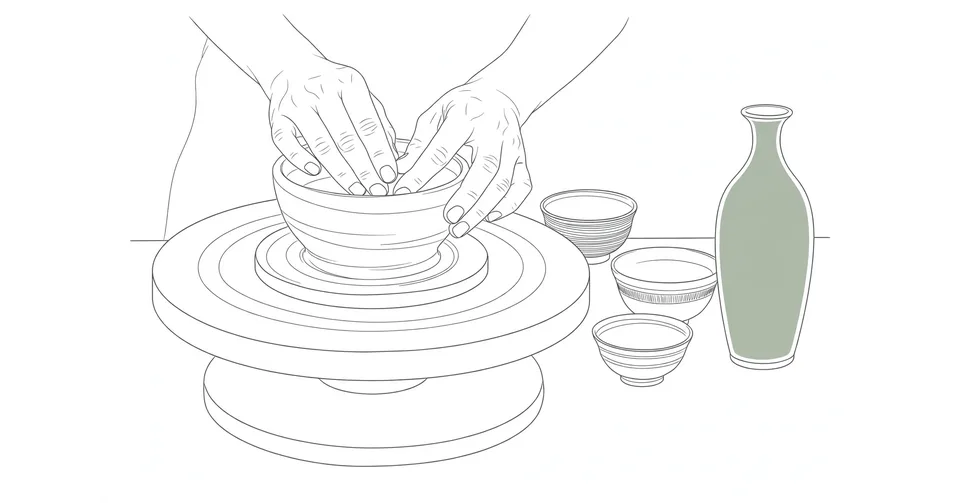
The story of Japanese pottery is one of the longest in the world. People were making pots on these islands more than 14,000 years ago, pressing cords into wet clay to leave patterns that gave the Jomon period its name. Jomon means cord-marked, and those early pots, with their flame-like rims and rope patterns, are among the oldest ceramics anywhere. Japan has been shaping clay ever since, and the craft has never really stopped. It changed with tea, with trade, with war, and with fashion, but the thread runs unbroken from a Jomon cooking pot to the bowl on a Kyoto cafe table today. That continuity is part of the appeal. When you buy a piece of Japanese pottery, you are not buying a trend. You are buying into a conversation that started before writing arrived in Japan.
Why Japanese Pottery Names Are Places, Not Styles
Ask a Japanese potter what style a bowl is and you will get the name of a town. Bizen, Hagi, Shigaraki, Karatsu, Arita, Mashiko. Not a technique, not a period, not a school. A place, usually a small one, sometimes a single valley. Japanese pottery is classified by where the clay came out of the ground, because the clay is what decides how the piece behaves in the fire. The potter's job has always been read as a negotiation with a specific local material rather than the imposition of a personal style on neutral clay.
The names carry the suffix yaki, which means fired. Bizen-yaki is what was fired at Bizen. Hagi-yaki is what was fired at Hagi. The name tells you the geology, the kiln tradition, and usually a five-hundred-year continuity of families doing the same thing in the same valley. A Bizen jar and an Arita plate are not competing versions of the same craft. One is unglazed stoneware fired for over a week in a wood kiln, the other is painted porcelain fired once at high temperature in a controlled atmosphere, and they belong to different economies, different centuries, and different rooms. Learning the names is the fastest way to learn the craft, because each name is a shortcut to a whole way of making things.
This is also why Japanese pottery rewards travel in a way few other crafts do. The kiln towns are the destinations, not the museums. You go to Bizen to see the wood kilns, to Mashiko to walk the pottery streets, to Arita to see the porcelain workshops. The craft is still where it has always been, in the towns that gave it its name. A bowl bought in its home town carries a story that the same bowl bought in a Tokyo department store does not, even when the two are identical.
The Six Ancient Kilns of Japanese Pottery
The phrase you will meet everywhere is the Six Ancient Kilns, Nihon Rokkoyo: Seto and Tokoname in Aichi, Echizen in Fukui, Shigaraki in Shiga, Tamba in Hyogo, and Bizen in Okayama. Six regions that have fired pots continuously from medieval times to now. The grouping is real. The label is modern. It was coined around 1948 by the ceramics historian Koyama Fujio, in emulation of the Five Great Kilns of Song China, in order to give Japanese ceramics a comparable lineage. In 2017 the six were designated Japan Heritage sites by the Agency for Cultural Affairs.
| Kiln | Prefecture | Character |
|---|---|---|
| Seto | Aichi | The glazed-ware centre, origin of the word setomono |
| Tokoname | Aichi | Iron-rich red clay, famous for kyusu teapots |
| Echizen | Fukui | Unglazed, robust jars with natural ash finishes |
| Shigaraki | Shiga | Coarse clay, warm tones, famous tanuki statues |
| Tamba | Hyogo | Long wood firings, natural ash glaze |
| Bizen | Okayama | No glaze at all, surface made by fire and ash |
The six are not the whole of Japanese pottery, and the list itself is a decision about what counts as Japanese in origin. It excludes Hagi, Karatsu, Arita, Satsuma, and Takatori, the kilns founded or transformed by Korean potters, and their absence says something about how the story was told in 1948. But as a starting point for a visitor, the six are still the best map. They cover the oldest traditions, they are all still working, and each one looks and feels completely different from the others. Visit two of them and you will never again think of Japanese pottery as one thing.
Fire, Ash, and No Glaze at All
The oldest aesthetic in Japanese pottery uses no glaze at all. The surface is produced by fire, ash, and chance, and the potter's control is exercised days before the result appears. Bizen is the clearest example. Bizen ware carries no glaze whatsoever. Pieces are fired for a week or more in a wood kiln, and everything you see on the surface is a record of where the piece stood in that kiln. Two identical pots put in different parts of the same kiln come out as different objects, and the potter accepts that as the point rather than as a loss of control.
Shigaraki works the same way, with a coarse clay full of feldspar grains that sparkle through the warm, orange-scorched surface, and Tokoname with its iron-rich red clay, best known today for kyusu teapots, the small side-handled pots used for green tea. The unglazed wares are the ones that most surprise first-time buyers, because they feel almost primitive next to porcelain. They are also the pieces of Japanese pottery that age most visibly. A Bizen sake cup darkens with use. A Shigaraki vase gathers a patina that no glaze could fake. The potter fires the piece once, and then the owner finishes it, slowly, over years of use. I think that is the deepest charm of Japanese pottery. The object is not finished when it leaves the kiln. It keeps changing in your hands.
The Tea Bowl That Changed Everything
The sixteenth century is the most important turning point in the history of Japanese pottery, because that is when ceramics fused with tea. The tea master Sen no Rikyu and his successors placed ceramics at the centre of cultural life and established a value system summed up in a saying every tea student still learns: first Raku, second Hagi, third Karatsu. The ranking is not about price. It is about what a tea bowl should feel like in the hand.
Raku sits apart from everything else, because it is the only major Japanese ware invented for a single purpose by a single circle of people. Raku bowls are not thrown on a wheel. They are hand-formed, pinched and shaped by hand, then fired quickly at low temperature and pulled from the kiln while still glowing. The result is a thick, soft, warm bowl that fits the palm the way a stone fits a riverbed. The Raku family kiln in Kyoto has made them for fifteen generations, and the bowls still look startlingly modern: black or red, uneven, quiet. Hagi ware, second in the ranking, is prized for soft glazes that crackle and change colour over years of use, so a Hagi bowl you use for tea today will look different in ten years. Karatsu, third, is admired for expressive, rustic forms and glazes that seem to have happened by accident, even when they were planned.
Tea changed Japanese pottery because it changed what a pot was for. Before tea, a pot held things. After tea, a pot was something to look at, hold, and think about. That shift is why the Japanese tea ceremony and Japanese pottery belong together in any honest account of either. The ceremony gave the pot a stage, and the pot gave the ceremony something real to hold. The same attention to a single object runs through Japanese ikebana, where one vase and one stem are enough, and it is worth remembering when you look at a Bizen vase. The empty space around it is part of the design.
When Porcelain Arrived from Arita
Everything so far has been stoneware and earthenware, clay fired until it is hard but still opaque. Porcelain is different. It is made from a white, kaolin-rich clay that fires to a glassy, translucent white, and Japan did not make it until the early seventeenth century. The story starts with war. Toyotomi Hideyoshi, who had unified Japan, invaded the Korean peninsula at the end of the sixteenth century. The invasion failed, but Korean potters were brought back to Japan, and with them came the knowledge that changed Kyushu. At Arita in 1616, the pottery stone that is the raw material of porcelain was found, and Japan's porcelain industry opened.
Arita ware is Japan's oldest porcelain, in production in the town of Arita in Saga Prefecture since the early seventeenth century. Its white, glass-like base and vivid overglaze painting made it an export sensation. Wares shipped from the nearby port of Imari became known in Europe as Imari ware, and the dense, gold-heavy Ko-Imari style decorated European palaces. Kakiemon, a family of Arita potters, developed a sparse enamel style on a milky white ground, with deliberate empty space, that was widely copied in Europe. Kutani, in Ishikawa Prefecture, went the other way, with bold overglaze palettes of green, yellow, and purple that are unmistakable on a shelf.
The porcelain story is a reminder that Japanese pottery has never been sealed off from the world. Korean potters founded its porcelain, Chinese kilns inspired its ancient-kiln scholars, and European collectors shaped its export styles. The craft absorbed all of it and stayed recognisably Japanese, because the potters kept making for Japanese hands and Japanese rooms even when they were selling to the world. That balance, between outside influence and local habit, is one of the most Japanese things about it.
Mingei and the Beauty of Everyday Bowls
By the twentieth century, Japanese pottery faced a new problem: industrialisation. Factories could make perfect bowls by the thousand, and the old kilns looked slow and expensive by comparison. The answer came from the philosopher Yanagi Soetsu, who in the 1920s advanced the idea of mingei, folk craft. The most essential beauty, Yanagi argued, lies in ware that nameless craftspeople make for daily life. A rice bowl used every day, made well and without pretension, is more beautiful than a showpiece made for a collector, because its beauty comes from use.
The potter Hamada Shoji became the movement's great practitioner. He moved to Mashiko, a small town in Tochigi Prefecture, in the Taisho era and made it a base for mingei, and Mashiko became known nationwide for generous, thick, plain forms with a strength that comes from the clay itself, often finished with persimmon and rice-straw white glazes. Mashiko and its neighbour Kasama are now open regions where makers gather from Japan and abroad, and Mashiko's twice-yearly pottery market draws hundreds of thousands of visitors. The mingei idea saved Japanese pottery from becoming a museum craft. It gave the old kilns a reason to keep making everyday things, and it gave buyers a reason to use them rather than display them.
Mino ware, from Gifu Prefecture, is the quiet giant of this story. It accounts for over half of all Japanese ceramics production and encompasses more than fifteen distinct styles, including the famous green-glazed Oribe and the white Shino glazes. Most of the bowls and plates in Japanese restaurants are Mino ware, and most people eating from them never know it. That is the mingei ideal in practice: beauty so ordinary you do not notice it until someone points it out.
How to Read a Piece Before You Buy It
If you want to start with Japanese pottery, start with a bowl you will actually use. A rice bowl, a tea cup, a small plate. Hold it before you buy it. The weight should feel honest, not heavy for its size. The rim should be smooth where your lip will touch it, even if the rest is rough. Turn it over and look at the foot, the unglazed ring on the bottom. A potter who cares about the foot cares about the whole piece. Look for the signature or stamp, but do not overvalue it. Many fine pieces are unsigned, and many signed pieces are ordinary.
Prices vary wildly, and that is normal. A Mashiko rice bowl from a young potter can cost a few thousand yen. A Bizen tea bowl from a recognised maker can cost a hundred times more. The difference is not always visible, and that is fine. Buy the piece you like holding, not the piece with the most impressive label. Your first piece should be one you will use every day, because Japanese pottery is made to be used, and use is what makes it beautiful. My Kyoto tea bowl is chipped at the rim now, from a clumsy morning three years ago, and the chip is my favourite part. It is where the bowl stopped being a purchase and became mine.
Where you buy matters too. Kiln towns are best, because you meet the makers and see the kilns. Mashiko's markets, Bizen's pottery streets, and Arita's porcelain shops are all worth a detour, and the prices at the source are often kinder than in Tokyo. Department store craft floors are a good second choice, with careful curation and honest labelling. And if you are buying a piece to carry home, remember that Japanese pottery travels well if you pack it properly, and that a bowl bought as omiyage carries a story no airport souvenir can match. A practical guide to Japanese pottery styles, with photographs of each kiln's work, is worth reading before a kiln-town trip, and two of the clearest are the style guide at Japan Clothing and the ceramics overview from Kyoto Nokaze. They will help you tell a Hagi bowl from a Karatsu one before you spend anything, and they are both written for people who are about to buy their first piece, not for collectors.
Japanese pottery is not a subject you finish learning. The more you hold, the more you notice: the way a Shigaraki glaze catches the light, the way a Raku bowl warms in the hand, the way an Arita plate looks different against dark wood than against white. The kilns have been firing for a thousand years, and they are still firing. The best way to understand Japanese pottery is the simplest one. Go to a kiln town, pick up a bowl, and see if it feels right in your hands. If it does, take it home and use it. The potter did the first half of the work. The rest is yours.
More in Culture & Society
- Meijin Is the Title Every Karuta Player Dreams of Wearing
- Dazaifu Tenmangu Is Where Japan Still Prays to a Scholar God
- Sugawara No Michizane Became the God Students Still Pray To
- Wakamizu Is the First Water Japan Draws for Good Luck
- Kakizome Turns the First Brushstroke of the Year Into a Wish
- Ujigami Is the Guardian God Who Watches Over One Neighbourhood
Latest posts
- Japanese Kabuki and the Theatre That Paints Its Actors
- Omi Jingu Is Where Karuta Crowns Its Champions
- Hagoita-ichi Turns Asakusa Into a Forest of Paddles
- The Two Lives of Japanese Coffee
- Chihayafuru Made a Card Game Feel Like a Sport
- Oshi-e Hagoita Turns Silk Into a Picture You Can Touch
- Hyakunin Isshu Gave Karuta Its Hundred Poems
- Hagoita Is the Paddle Japan Turns Into New Year Art
- Takoage Sends New Year Wishes Up on a Paper Kite
- Hanetsuki Keeps New Year in the Air With a Wooden Paddle
- Japanese Stationery and the Small Tools Japan Takes Seriously
- Karuta Turns a Hundred Poems Into Japan's Fastest Card Game
- Hatsuyume Is the First Dream Japan Reads Like a Fortune
- Japanese Manga and How It Became the World's Most Read Comics
- Toshikoshi Soba Is the Long Noodle Japan Eats at Midnight