Kitano Tenmangu Turns Plum Blossom Into a Prayer for Exams
· 18 min read
kitano tenmangu in Kyoto turns the plum blossom of a disgraced scholar into a prayer for exam success, and February is when the whole story blooms at once.
Every February, a shrine in the northwest of Kyoto fills with two kinds of visitors who seem to want opposite things. Students arrive with exam dates circled on their calendars, carrying the tight worry of a test that will decide the next years of their lives. Sightseers arrive with cameras, looking for plum blossom. At kitano tenmangu, both groups get what they came for, because the flower and the prayer grew from the same root.
kitano tenmangu is the head shrine of Tenjin worship, the first shrine built to the deified scholar Sugawara no Michizane, and the place where his favorite flower still sets the calendar. The grounds hold about 1,500 plum trees in roughly 50 varieties, and when they bloom in late winter, the shrine becomes a garden of white, pink, and red. Students come to pray for exams. Everyone else comes to stand under the blossom. The shrine holds both purposes without choosing between them.
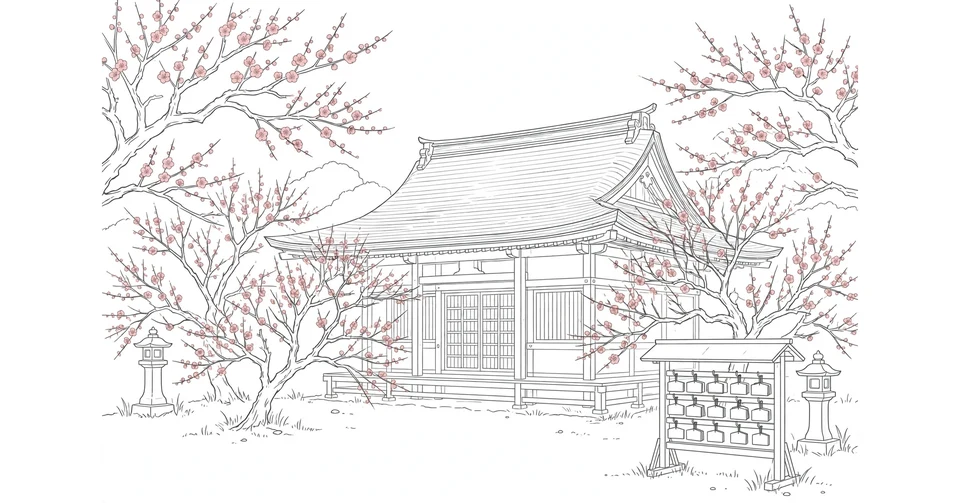
That double purpose is the whole point of the place. Kitano Tenmangu was not built as a garden, and it was not built as a school. It was built in 947 to calm the angry spirit of a man the imperial court had wronged, and over the centuries the fear softened into something gentler. The plum trees that now draw crowds were planted because Michizane loved them. The prayers that now fill the shrine are offered because he was a scholar. A shrine that began with lightning now runs on hope, and February is when you can see the change most clearly.
The shrine that began with fear
To understand Kitano Tenmangu, you have to start with the man it honors. Sugawara no Michizane was born in 845 into a family of scholars, and he rose through the imperial court on the strength of his learning. He wrote poetry in Chinese and Japanese, helped revise official histories, and reached the post of Minister of the Right, one of the highest offices in the land. Then, in 901, his rivals in the Fujiwara clan accused him of plotting against the throne. The charge was almost certainly false, but it was enough. Michizane was stripped of his rank, demoted to a distant post at Dazaifu in Kyushu, and died in exile two years later, in 903.
The full story of that fall, and of the god who grew out of it, is told in Tenjin Is the Storm God Who Became Japan's Patron of Learning, and it is worth reading before a visit, because Kitano Tenmangu only makes sense once you know whose spirit it was built to calm. Within twenty years of Michizane's death, the capital began to suffer. Princes died young. Plagues and droughts struck. Then, on July 21, 930, a violent storm broke over Kyoto, lightning struck the imperial palace, and several leading Fujiwara died while fires and floods destroyed their residences. To the court, the message was clear. Michizane had not gone quietly.
The court's answer was a shrine. Kitano Tenmangu was built in 947 to appease Michizane's angry spirit, and in 986 the title of Tenjin was formally conferred on him there. The name means sky deity, and it tells you exactly what the court thought it was dealing with. This was not a quiet memorial. It was an apology to a storm, built in wood and stone, and it worked so well that the storm god became a national presence. Today, more than 12,000 shrines across Japan are dedicated to Tenjin, and Kitano Tenmangu remains their headquarters, the first and most significant of them all.
What strikes me about this beginning is how honest it is. The court did not build Kitano Tenmangu because it suddenly believed in Michizane's innocence. It built the shrine because lightning had killed its leaders and it needed the storms to stop. Religion here was crisis management, and the solution was to give the wronged dead man the highest honor available. There is something deeply human about that, and something hopeful too. A society that builds a shrine to a man it destroyed is a society admitting, in its own way, that it went too far.
Why kitano tenmangu smells of plum in February
The plum is not decoration at Kitano Tenmangu. It is the thread that ties the shrine to the man. Plum blossom, ume in Japanese, was Michizane's favorite flower, and in exile he wrote a famous poem lamenting the absence of a particular plum tree he had loved in Kyoto. The legend that grew from that poem says the tree uprooted itself and flew to Dazaifu to be with him, and that tree, the tobi-ume or flying plum, still stands at Dazaifu Tenmangu, to the right of the main hall. You can read that story in full in Dazaifu Tenmangu Is Where Japan Still Prays to a Scholar God, which tells how the same flower marks both ends of Michizane's journey, the capital he lost and the place where he died.
At Kitano Tenmangu, the plum is planted on a scale that matches the story. About 1,500 plum trees of roughly 50 varieties fill the grounds, and from February into March they bloom in succession, white, pink, and deep red, filling the cold air with scent. The timing is part of the meaning. The trees bloom in the same season when Japanese exam results are announced, and that coincidence has tied the flower to the god in the minds of generations of students. A blossom becomes a calendar, and a calendar becomes a prayer.
The plum garden at Kitano Tenmangu, the Baikoen, is where this is most visible. In peak season the garden is crowded with visitors walking slowly between the trees, stopping every few steps for another photograph, another deep breath of cold air and plum scent. It is not a solemn place, exactly. It is a joyful one, full of families and couples and students taking a break from their revision. That feels right for a shrine dedicated to a poet. Michizane loved beauty as much as he loved learning, and the garden lets visitors love both at once.
I think there is a quiet wisdom in the choice of flower. A cherry blossom is spectacular and brief, and it belongs to spring. A plum blossom opens in the cold, weeks earlier, when winter has not yet let go. It is a flower for people who are still waiting, still working, still hoping for a result that has not arrived. That is exactly who comes to Kitano Tenmangu in February. The trees bloom before the answer comes, and that is the whole message. Keep going. Spring is closer than it looks.
Baikasai and the tea served under the blossom
The great day at Kitano Tenmangu is February 25, the anniversary of Michizane's death. On that day the Baikasai, or Plum Blossom Festival, is held, and it has been held on the same date for about 900 years. For nine centuries, Tenjin has been thanked on the same winter day, first out of fear and now out of gratitude. The festival is a memorial service as much as a celebration, held while the trees Michizane loved are in full flower.
The heart of the Baikasai is an open air tea ceremony, a nodate held outdoors in the plum garden. Geiko and maiko from the nearby Kamishichiken district serve green tea and sweets to visitors beneath the blossom, continuing a tradition that reaches back to the great tea ceremony Toyotomi Hideyoshi hosted at the shrine. According to the shrine's history, the outdoor tea ceremony as it is held today dates to 1952, when a large festival marked the 1,050th anniversary of Michizane's death and revived Hideyoshi's historic Kitano Ochakai. Tea and sweets are served to about 3,000 guests by the geiko and maiko, a number that tells you how large this festival is, and how seriously Kyoto takes it.
That number deserves a pause. Three thousand bowls of tea, served outdoors, in February, by women in kimono, under plum trees. It is an enormous act of hospitality, and it is also an act of memory. The tea ceremony remembers Hideyoshi, the great unifier who held his famous gathering at the shrine in the sixteenth century, and it remembers Michizane, the scholar who loved the plum. The past is not displayed here. It is served, one bowl at a time, to people who have come to pray for their children's exams.
If you go to the Baikasai, go early. The festival draws large crowds, and the tea ceremony is popular enough that waiting is part of the experience. The shrine's own guidance for Kitano Tenmangu, and the experience of past visitors, both point the same way. Arrive in the morning, walk the plum garden first while the light is soft, and then join the tea line with patience. The ceremony is not a performance to be watched from a distance. It is an invitation to sit down, hold a warm bowl in cold hands, and remember that the man being honored was a poet who understood the value of a quiet moment.
The hall, the scroll, and the treasures
The building at the center of Kitano Tenmangu is as much a part of the story as the trees. The main hall was built in 1607 under the patronage of Toyotomi Hideyori, the son of Hideyoshi, and it is a National Treasure, a prime example of Momoyama period architecture. Its large, elegant roof covers multiple buildings in a style known as yatsumune-zukuri, and its wood carvings, attributed to the legendary artisan Hidari Jingoro, are elaborate enough to reward a long look. The approach is marked by a massive stone torii gate, a two storey Romon gate from the Momoyama period, and the Sankomon, or Gate of Three Lights, known for colorful carvings of mythical and real animals.
The main hall is not only beautiful. It is a record of who valued this shrine. Emperors, shoguns, and influential families all offered patronage to Kitano Tenmangu over the centuries, and the 1607 rebuilding is the most visible proof of that. Hideyoshi and his son were significant patrons, and their support gave the shrine the architectural grandeur it still carries. A shrine that began as an apology to an angry spirit had, within seven centuries, become a place that the most powerful family in Japan wanted to be seen supporting.
Inside the treasure hall, the Homotsu-den, Kitano Tenmangu keeps the objects that carry its history. The most famous is the Kitano Tenjin Engi Emaki, an illustrated scroll of Michizane's life and the history of the shrine, itself classified as a National Treasure. The collection also holds ancient documents, sacred swords, maki-e lacquer artworks, folding screens, and tea ceremony utensils, gathered over centuries of patronage. For a full visitor guide to the shrine, its history, and its festivals, see the Japan Experience guide to Kitano Tenmangu.
The scroll matters more than it might seem. The Kitano Tenjin Engi Emaki does not only record what happened. It records how the story was told, how a disgraced scholar became a god in the imagination of medieval Japan. Painted versions of Michizane's life, his exile, the disasters that followed, and his deification gave ordinary people a way to hold the whole story in their hands. That is how a god survives for a thousand years, not only in ritual, but in pictures that can be unrolled and read.
The ox, the ema, and the exam season
Walk the grounds of Kitano Tenmangu and you will meet the second of Tenjin's symbols, the ox. Cattle are regarded as Tenjin's sacred messengers, a belief rooted in the legend of Michizane's funeral procession. The story says that the ox pulling the cart carrying his body suddenly stopped and refused to move, indicating where Michizane wished to be buried. Today, ox statues stand throughout the grounds of Kitano Tenmangu, and visitors rub them for good luck. The custom is specific. Rubbing the statue's head is believed to impart wisdom, which is exactly the kind of practical magic a student wants the night before an exam.
The third symbol is the ema plaque, and it is less a symbol than a habit. Students buy small wooden plaques, write their wishes in their own handwriting, and hang them on racks beside the main hall. The plaques carry the names of universities, Tokyo, Kyoto, Keio, Waseda, and every regional university in the country, each one a small, specific hope written by hand. There is no priest in the middle of that moment. It is a direct conversation between a young person and the god of Kitano Tenmangu, a scholar who knew what it felt like to be judged.
Exam season at Kitano Tenmangu runs through January, February, and March, when high school and university applicants sit their entrance tests, and the shrine fills with students and their parents. They buy omamori, protective charms, for academic success, and they write their wishes on ema and hang them where other students can read them. The pressure of Japanese entrance exams is real, and it weighs heavily on teenagers. What Kitano Tenmangu offers is not a guarantee but a place to put the anxiety down for a little while, to say the hope out loud, and to feel that someone is listening.
I have a quiet admiration for the way this shrine handles the crowds of exam season. It does not hurry anyone, it does not sell false certainty, and it does not turn the students into a spectacle. The priests perform blessings, the families pray, and the teenagers write their plaques and walk away a little lighter. If you visit during this season, be respectful of that. Do not photograph students while they are writing, and do not read their plaques out loud. Their wishes are private, even when they are hanging in public.
Tenjin-san and the 25th of every month
There is also a monthly rhythm at Kitano Tenmangu, and it turns a memorial date into a neighborhood habit. On the 25th of every month, the shrine hosts a large flea market, known locally as Tenjin-san, one of the biggest in Kyoto. The date is no accident. The 25th marks both Michizane's birthday, June 25, and the day of his death, February 25. The market offers antiques, traditional crafts, street food, and modern goods, and it draws a crowd that looks very different from the exam season visitors, collectors, dealers, families browsing for bargains, and regulars who come every month.
The market is so well known that it gave Kyoto a proverb. Together with the similar festival at To-ji, a temple in the same city, it inspired the saying that fair weather at the Toji market means rainy weather at the Tenjin market, a joke about Kyoto's fickle weather that has survived for generations. A god of thunder becomes a reason to browse antiques on a Sunday, and a memorial date becomes a reason to meet your neighbors. That is perhaps the most Japanese part of the whole story. The sacred and the ordinary share the same ground, and nobody finds the combination strange.
The market also keeps Kitano Tenmangu connected to the neighborhood around it. The Kamishichiken district, where the geiko and maiko who serve tea at the Baikasai live and work, is the oldest geiko district in Kyoto, and its presence next to the shrine is not a coincidence. Kitano Tenmangu has always been a neighborhood shrine as well as a national one, a place where the people who live nearby come to buy, to pray, and to meet. The market is the most visible proof of that. It is the shrine at its most ordinary, and its most alive.
Autumn maples and the quieter seasons
Kitano Tenmangu is famous for February, but it is worth visiting in every season. In autumn, the shrine becomes a popular spot for viewing fall foliage. The Momiji-en, the autumn maple garden, holds about 350 maple trees that turn vibrant shades of red and gold, and the garden is often illuminated in the evenings, creating a quiet, glowing landscape that feels very different from the crowded plum season. The contrast is part of the shrine's character. February is loud with festivals and markets. Late November is soft with color and evening light.
The rest of the year is quieter still, and that is when Kitano Tenmangu is easiest to meet on its own terms. The grounds are open year round, and on an ordinary weekday morning you can walk from the great torii gate through the Romon and the Sankomon to the main hall without a crowd, bow twice, clap twice, make a wish, and bow once more, and hear your own footsteps on the gravel. The plum trees are green then, the maple garden is green, and the shrine is simply a shrine, a place where a man who died in exile has been remembered for more than a thousand years.
That quiet visit to Kitano Tenmangu is worth making, because it shows what remains when the festivals leave. The festivals are wonderful, and the blossom is beautiful, but the heart of Kitano Tenmangu is not an event. The heart of Kitano Tenmangu is a promise. It is a decision that a community has renewed every year since 947, to remember a scholar who was wronged, and to ask him for help with the thing he valued most. The trees change with the season. The decision does not.
How to visit kitano tenmangu well
Kitano Tenmangu stands in the Kamigyo-ku district of Kyoto, and it is easy to reach. The shrine can be reached by bus from Kyoto Station in about 30 minutes, or by the Keifuku Line to Kitano-Hakubaicho Station, followed by a short walk. Entry to the main shrine grounds is free, though there may be fees for special exhibitions or for entering the plum garden at peak season. The grounds are open daily from 5:00 AM to 6:00 PM from April to September, and from 5:30 AM to 5:30 PM from October to March.
The best times to come to Kitano Tenmangu depend on what you want. Late February to early March brings the plum blossom and the largest crowds. Late November to early December brings the autumn foliage. The 25th of every month brings the flea market. If you want a serene experience, consider visiting early in the morning or on a weekday, when the shrine is quiet and the light is soft. The basic form of a visit follows the pattern of any Shinto shrine. Bow slightly at the torii gate, purify your hands and mouth at the water pavilion, approach the main hall, bow twice, clap twice, make your wish silently, and bow once more.
A few practical notes will make a visit to Kitano Tenmangu better. If you buy an ema, write your wish clearly and hang it on the rack. If you buy an omamori, keep it with you rather than opening it. If you want to rub the ox statue, touch it gently, as the others do, and remember what it marks. An ox stopped on a road in Kyushu, and a grave became a shrine, and a shrine became the head of twelve thousand others. Small moments carry long histories, and this is one of them. The history of the shrine, from its founding in 947 to the conferring of the Tenjin title in 986, is set out on Wikipedia's Kitano Tenmangu page, which is worth reading before you go.
A prayer that blooms before the answer
Kitano Tenmangu is a shrine that started in fear and learned to be kind. The court built it to calm an angry spirit, and a thousand years later students arrive with the opposite feeling, not dread but hope. That change did not come from rebuilding the shrine or rewriting the story. It came from people returning, year after year, with small wishes written by hand, until the place that once marked a punishment became a place that marks a beginning. A shrine can change its meaning without changing its stones, and this one did.
February is the best time to see it happen. The plum trees are in flower, the exam season is at its sharpest, and the grounds fill with people who are nervous and hopeful in the same breath. Stand under the branches for a while and watch the ema plaques move in the wind. Each one is a small, honest sentence about a future someone wants. The blossom opens before anyone knows the result, and that is the whole point of the prayer. You do not wait for certainty to ask. You ask, and then you keep studying, and spring arrives whether you were ready or not.
More in Culture & Society
- The Flying Plum Tree That Followed a Scholar Into Exile
- Japanese Geisha and the World Behind the Painted Face
- Tenjin Is the Storm God Who Became Japan's Patron of Learning
- Queen Is the Crown Japan Gives Its Best Woman Karuta Player
- Japanese Pottery and the Six Kilns That Turned Clay into Culture
- Meijin Is the Title Every Karuta Player Dreams of Wearing
Latest posts
- Dazaifu Tenmangu Is Where Japan Still Prays to a Scholar God
- Sugawara No Michizane Became the God Students Still Pray To
- Wakamizu Is the First Water Japan Draws for Good Luck
- Japanese Kabuki and the Theatre That Paints Its Actors
- Kakizome Turns the First Brushstroke of the Year Into a Wish
- Ujigami Is the Guardian God Who Watches Over One Neighbourhood
- Omi Jingu Is Where Karuta Crowns Its Champions
- Hagoita-ichi Turns Asakusa Into a Forest of Paddles
- The Two Lives of Japanese Coffee
- Chihayafuru Made a Card Game Feel Like a Sport
- Oshi-e Hagoita Turns Silk Into a Picture You Can Touch
- Hyakunin Isshu Gave Karuta Its Hundred Poems
- Hagoita Is the Paddle Japan Turns Into New Year Art
- Takoage Sends New Year Wishes Up on a Paper Kite
- Hanetsuki Keeps New Year in the Air With a Wooden Paddle