Queen Is the Crown Japan Gives Its Best Woman Karuta Player
· 11 min read
Queen is the title Japan has awarded to its best woman karuta player since 1957, decided each January at Omi Jingu in a title match that rewards memory, speed, and nerve.
Every January, in a hall at Omi Jingu shrine in Otsu, two women kneel on tatami and wait for a reader's voice to finish the first syllable of a poem. The winner of the match that follows will be called Queen for the next year, the highest title a woman can hold in competitive karuta. It is a short word for a large achievement. In seventy years, only 22 women have held it.
The title of Queen has been awarded since 1957, two years after the men's title, Meijin, began. It is decided in the same place every year, in front of the same shrine, by the same hundred poems. This article follows the title from its first holder to the woman who holds it now, explains how the match is won, and looks at why a single English word came to sit at the top of such a Japanese game.
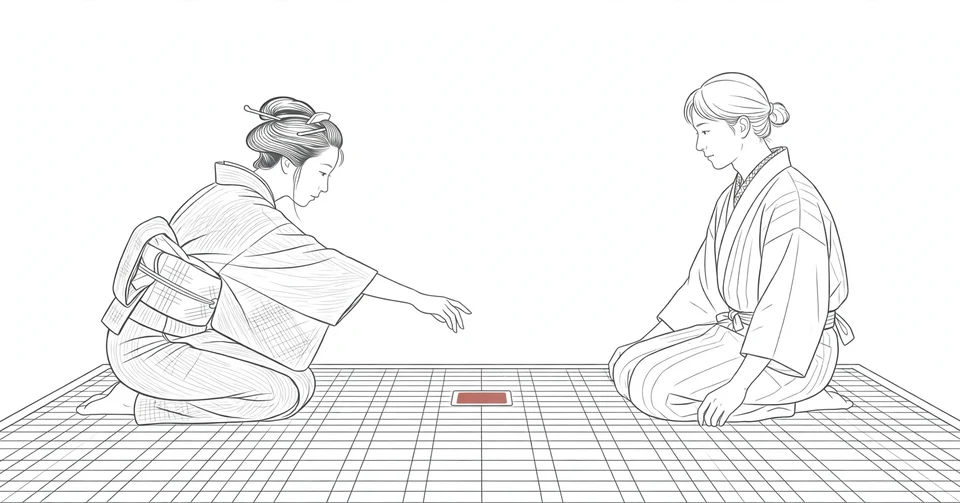
The game looks simple from the side. A reader recites poems from the Ogura Hyakunin Isshu, and two players race to touch the card that carries the matching lines. In practice it is a test of memory under pressure. A player must know all one hundred poems, remember where fifty cards lie on the mat, and move before the reader finishes a syllable. The Queen is the woman who does that better than every other woman in Japan, and the match that decides the title is played as if the whole year depends on it, because for the two players on the mat, it does.
What the Queen title actually means
Karuta itself is older than the title. The game took its modern competitive form in the early twentieth century, when regional rules were unified and the first tournament was held in 1904. The All Japan Karuta Association was founded in 1957, and in that same year the women's championship began. The first Queen was Chieko Amano, who won the title in 1957 and kept it the following year. The men's title, Meijin, had started two years earlier, in 1955, so the women's game arrived with its own crown almost from the start.
Both winners are known as Grand Champions, and a player who wins seven titles earns the name Eternal Master. That is a rare honour. In seventy editions of the women's championship, only 22 women have ever held the title of Queen, which means the average reign lasts more than three years. A title that changes hands so rarely is not really a prize for one good season. It is a record of dominance, and the women who hold it tend to hold it for a long time.
The pairing of the two titles is worth a moment of thought. Meijin is a Japanese word with centuries of weight behind it, a master of an art. Queen is a borrowed English word, plain and direct, and it sits beside Meijin without apology. I find that pairing honest. Karuta is a Japanese game built on Japanese poetry, and it does not pretend otherwise, but it also does not dress its women's champion in borrowed ceremony. The title is short, it is clear, and it tells you exactly where its holder stands. In a sport that rewards precision, that feels right.
How a Queen is made in January
The title match is held every January at Omi Jingu, the shrine in Otsu that honours Emperor Tenji, the author of the first poem in the Hyakunin Isshu. The reigning Queen faces a single challenger, the woman who has won through the qualifiers during the previous year. The match is a series, not a single game, and since 2019 it has been played as best of five, with the first player to win three games taking the title. Before 2019 the women's match was best of three, so the change gave the challenger more room to fight back and gave the champion more room to recover from a bad day.
Each game in the series is a full contest on its own. Fifty torifuda cards are drawn at random from the hundred, and each player takes 25 of them, arranged in three rows inside a territory 87 centimetres wide. The players get fifteen minutes to memorise the layout, then the reader begins. A game lasts about ninety minutes, and a player who reaches the title match has usually already played five to seven matches in the national tournament to get there. Winning the Queen title therefore means surviving a week of that pressure, and then surviving up to five more games against the best challenger in the country.
That structure explains why the title changes hands so slowly. A challenger does not only need to be better than the champion on one afternoon. She needs to be better across a series, in a hall full of spectators, with the reader's voice setting a pace she cannot control. A single fast hand is not enough. The match rewards the player who can stay calm when the score is level and the next card decides the game, and that is a different skill from speed alone. The rules of the game, from the fifty cards on the mat to the fifteen minutes of memorising, are set out in the overview of competitive karuta.
The women who set the standard for Queen
Every long lived title has a small group of players who define it, and the Queen title has three. The first is Fumie Watanabe, who won fourteen titles in total, including eleven in a row from 1992 to 2002. Eleven consecutive years at the top of any sport is an extraordinary run. It means that for more than a decade, every challenger in Japan knew exactly who she had to beat, and none of them could do it.
The second is Saki Kusunoki, who took the title in 2005 at the age of fifteen, the youngest champion in the history of the game, and then won ten titles in a row without losing a single game in a Queen match. Ten straight titles, from 2005 to 2014, with no defeat in the final at all. Records like that are usually broken by a rival. Kusunoki's run ended because she stepped away, not because someone beat her, and that is why her name still comes up first whenever the great champions are discussed.
The third is Kumiko Horisawa, who held the title for eight consecutive years from 1977 to 1984. Her run is less famous outside karuta circles, but it matters because it came before the game had television coverage or a bestselling manga to carry it. She defended the title in quiet halls, year after year, when the only reward was the title itself. I think that is the purest form of the achievement. There was no audience to impress and no fortune to win, only the knowledge that you were the best, and the work of proving it again each January.
Seira Yajima and the new generation of Queen
The current holder of the title is Seira Yajima, and her story reads like the opening of a manga because it nearly is one. She won the 69th Queen title on January 11, 2025, while she was still a high school senior, becoming the first high school student to win the title in seventeen years, since Kusunoki. A year later, in January 2026, she defended the title to become the 70th Queen, this time as a first year student at Keio University, where she had enrolled precisely because its karuta club is the strongest university team in Japan. Keio University reported her defence as her first successful defence of the title, and quoted her saying she wanted to keep defending it during her time at the university.
Yajima started karuta in the fourth grade, and she has said that memorising the Hyakunin Isshu was so difficult it brought her to tears. She won her age division at the national elementary school tournament the following year, rose to Class A, the highest rank, in junior high school, and won national titles in high school before she ever played for the Queen title. Her path is not a shortcut. It is the ordinary road of a karuta player, walked faster than most.
What makes her reign interesting is not only her age but the moment it arrives in. Competitive karuta has about ten to twenty thousand players in Japan, and only around two thousand of them are ranked above C class, so the game is small and serious at the same time. The manga and anime Chihayafuru brought it a wider audience after 2007, and the title matches are now streamed online, which means a high school student can watch the Queen match on a phone and imagine herself on that mat. Yajima is the first champion of that streaming era, a Queen whose reign began in front of an audience that is younger and larger than any holder before her had. The men's title has its own story of long reigns and hard defences, told in the article about Meijin.
Why the title matters beyond the cards
It would be easy to treat the Queen title as a curiosity, a quaint survival from a slower Japan. That would miss what it actually is. The match is played every January, without fail, in the same shrine, and the title is defended by whoever holds it, however young or old. There is no age limit and no retirement rule. A champion keeps the title until someone better arrives, and someone better always arrives eventually. That is a clean system, and clean systems are rare in sport.
I also think the title does quiet work for the women who play the game. Karuta is one of the few competitive pursuits in Japan where the women's championship is as old, as formal, and as respected as the men's, and where the women's champion is known by a title of her own rather than as a version of the men's. The Queen is not the women's Meijin. She is the Queen, and the word carries its own weight. For a schoolgirl memorising poems after class, that distinction is not abstract. It is a picture of where the game can take her.
The game itself deserves some of the credit. Competitive karuta asks for memory, speed, and composure in equal measure, and none of those belongs more to one sex than the other. The title match is decided on the same mat, with the same poems, under the same rules. The result is a championship that feels earned in the plainest sense, and the women who win it are remembered by name for decades after they stop playing.
Watching the Queen match
The title matches are held in early January at Omi Jingu, and the hall is open to spectators. The atmosphere is closer to a concert than to a sports arena. The audience is silent while the reader speaks, and the only sound is the slap of a hand on a card. Recent matches have also been streamed online, so the easiest way to see the Queen match is to watch the stream and listen for the moment a single syllable decides a game. If you ever visit Otsu, the shrine is worth the trip in any season, and the hall where the match is played is the same hall you can stand in on an ordinary day.
Queen is a small word, and that is its strength. It does not explain itself, and it does not need to. For seventy years it has meant the same thing, the best woman karuta player in Japan, decided on a tatami mat in January by memory and nerve. The names change. The word stays, and every January someone new has to earn the right to be called by it.
More in Culture & Society
- The Flying Plum Tree That Followed a Scholar Into Exile
- Kitano Tenmangu Turns Plum Blossom Into a Prayer for Exams
- Japanese Geisha and the World Behind the Painted Face
- Tenjin Is the Storm God Who Became Japan's Patron of Learning
- Japanese Pottery and the Six Kilns That Turned Clay into Culture
- Meijin Is the Title Every Karuta Player Dreams of Wearing
Latest posts
- Dazaifu Tenmangu Is Where Japan Still Prays to a Scholar God
- Sugawara No Michizane Became the God Students Still Pray To
- Wakamizu Is the First Water Japan Draws for Good Luck
- Japanese Kabuki and the Theatre That Paints Its Actors
- Kakizome Turns the First Brushstroke of the Year Into a Wish
- Ujigami Is the Guardian God Who Watches Over One Neighbourhood
- Omi Jingu Is Where Karuta Crowns Its Champions
- Hagoita-ichi Turns Asakusa Into a Forest of Paddles
- The Two Lives of Japanese Coffee
- Chihayafuru Made a Card Game Feel Like a Sport
- Oshi-e Hagoita Turns Silk Into a Picture You Can Touch
- Hyakunin Isshu Gave Karuta Its Hundred Poems
- Hagoita Is the Paddle Japan Turns Into New Year Art
- Takoage Sends New Year Wishes Up on a Paper Kite
- Hanetsuki Keeps New Year in the Air With a Wooden Paddle