Plum Blossom Opens Japan's Year Before the Cherry Trees Wake
· 12 min read
The plum blossom opens Japan's year in late winter, weeks before the cherry trees wake, and it carries a history of poetry, shrines, and festivals that sakura never replaced.
Japan's year does not begin with the cherry blossom. It begins earlier, in the cold weeks of late winter, when the plum blossom opens on bare branches while snow is still possible and most gardens are asleep. In most of Japan the plum blossom appears in February and March, with the earliest trees flowering in late January in the warm south, and it stays in bloom for weeks, long enough for the season to feel unhurried. If you want to see Japan wake up, this is the flower to watch, because it arrives before the crowds, before the forecasts, and before the country has decided that spring has come.
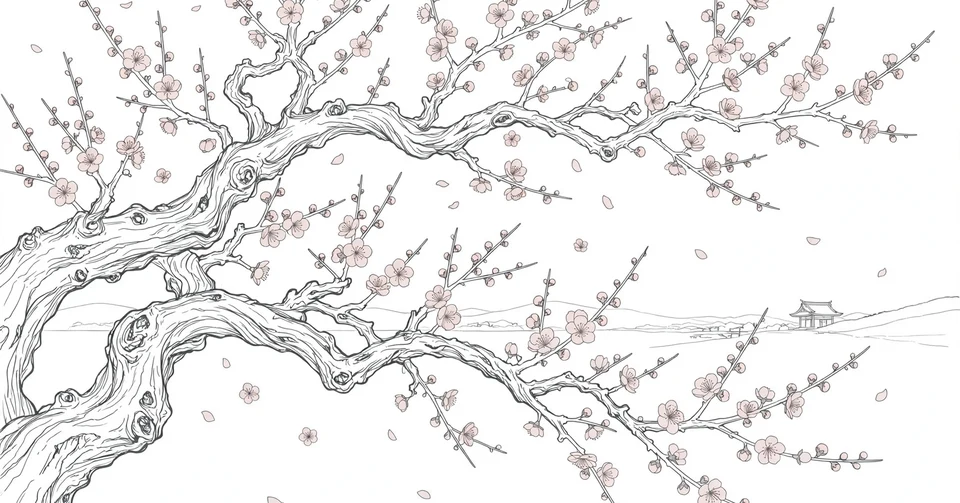
The flower has a Japanese name, ume, and a habit that explains its place in Japanese culture. Ume blooms when the weather is still against it, and that stubborn timing made it a symbol of perseverance long before it became a subject for poetry. This article follows ume through its season: what the tree really is, how to tell it from a cherry blossom, the scholar whose exile tied it to the shrines of learning, the festivals that gather around it, and the food and drink that carry it into summer.
The first flower of the year
The tree behind the plum blossom is Prunus mume, a member of the rose family that botanists place in the apricot section of the genus Prunus. That makes ume, strictly speaking, the flower of a Japanese apricot rather than a true plum, and it is certainly not a cherry, though the two flowers are often confused by visitors seeing them for the first time. The tree came to Japan from China, where it grew in the region around the Yangtze River, and it has been cultivated for both its flowers and its fruit for a very long time. The botanical profile of Prunus mume notes the same small flowers and strong scent that visitors notice first, and it records that the tree can grow to between four and ten metres tall.
The flowers themselves are small, only about two centimetres across, and they come in white, soft pink, and deep red. Most have five petals, though gardeners have bred double flowered forms and weeping branches over the centuries. What sets the plum blossom apart from the cherry blossom is its scent. Cherry blossom has almost no smell, while ume carries a strong, sweet fragrance that you notice before you see the flowers, especially on a still, cold morning.
The tree flowers in midwinter, typically from January into late February in East Asia, and the leaves appear only after the petals fall. The fruit ripens in early summer, around June and July, at the same time as the early summer rains, which are known in East Asia as the plum rain. A single tree therefore marks three seasons: the flowers in winter, the fruit in early summer, and the rain that arrives with it.
I find something reassuring in a tree that does so much quiet work without asking for attention. The plum blossom does not announce itself with pink clouds over a riverbank. It opens on dark, bare branches, in small numbers at first, and you have to be looking for it. That is a good habit for a flower, and a better one for a person. Begin before the conditions are perfect, and let the season catch up with you.
How to tell a plum blossom from a cherry blossom
The simplest difference is the calendar. The plum blossom opens in late winter, from late January to early March depending on the region, while the cherry blossom follows in late spring, from late March into April. If you are looking at blossom in February, you are almost certainly looking at ume, and if you are looking at blossom in April, it is almost certainly cherry.
The second difference is the nose. A plum blossom is strongly scented, and a grove of them in full flower perfumes the air around it. A cherry blossom, for all its beauty, has very little scent, and a grove of cherry trees is a sight rather than a smell. Walk into a plum grove with your eyes closed and you will know where you are. Walk into a cherry grove with your eyes closed and you might not.
The third difference is time. A cherry blossom blooms for just a few days, and the whole country watches the forecasts to catch it. A plum blossom season stretches across weeks, from the first tree in January to the last in March, and no single day carries the whole event. That slower pace changes how people behave around it. Cherry blossom viewing is a party with a deadline. Ume viewing is a walk, and it can wait until tomorrow.
The fourth difference is colour and shape. Ume ranges from white to deep pink and red, and most flowers have five round petals. Cherry blossom is usually pale pink or white, and its petals are often split at the tip. None of these marks is decisive on its own, and the two flowers can confuse a first time visitor, but taken together with the calendar and the scent, they are usually enough.
The flower that hanami began with
The custom of viewing flowers in Japan did not begin with the cherry. In the Nara period, from 710 to 794, the plum blossom was the flower people gathered to admire, and the practice of hanami, flower viewing, was done under plum trees. It was only in the Heian period, from 794 to 1185, that the cherry blossom took over as the favourite, and the older custom of viewing ume became known by its own name, umemi.
The plum blossom never quite left Japanese poetry. In haiku and linked verse it is a season word for early spring, and it is paired with the Japanese bush warbler on one of the suits of hanafuda, the traditional flower cards. The pairing is a small piece of good sense. The warbler sings as the plum blossom opens, and the two together say that winter is ending, even when the air is still cold enough to see your breath.
There is a lesson in the way Japan kept the plum blossom in its poetry after the cherry took the crowds. A culture can love a spectacular thing and still remember the quieter one that came first. Ume lost the popularity contest and kept the calendar, and that seems like the better prize. Popularity is loud and brief. A place in the language lasts for centuries.
Michizane and the shrines that keep the plum blossom
The plum blossom owes its place in Japanese religion to one man, Sugawara no Michizane, a scholar and statesman of the Heian period who lived from 845 to 903. In 901 his rivals at court accused him of plotting against the throne, and he was stripped of his rank and exiled to Dazaifu, a government outpost in Kyushu. He died there two years later, and the court that had wronged him spent the next century making amends, building shrines and finally worshipping him as Tenjin, the god of learning.
Michizane loved the plum blossom, and before he left Kyoto he wrote a farewell poem to the plum tree in his garden, asking the blossoms to send him their fragrance on the east wind and not to forget spring because their master was gone. According to legend, the tree could not bear the parting, so it uprooted itself and flew through the night to be with him in Dazaifu. That tree is still pointed out at Dazaifu Tenmangu, to the right of the main hall, and the full story is told in our article on the flying plum tree that followed a scholar into exile.
The plum blossom is also the crest of Dazaifu Tenmangu, and it has become the symbol of the city of Dazaifu and of Fukuoka Prefecture itself. The shrine grounds hold about 6,000 plum trees in 167 varieties, blooming in succession from late January into early March, with the peak usually falling between mid February and the first week of March. The flower grew from one scholar's favourite into the identity of a whole city, and that is a rare thing for a tree to achieve.
The other great plum shrine is Kitano Tenmangu in Kyoto, the head shrine of Tenjin worship, built in 947 to calm the spirit of the wronged scholar. Its grounds hold about 1,500 plum trees in roughly 50 varieties, and students come there in February to pray for success in entrance exams, walking under the blossom on their way to the main hall. The story of how that shrine turns the plum blossom into a prayer is told in our article on Kitano Tenmangu, where plum blossom becomes a prayer for exams.
What moves me about this story is that it began with a punishment and ended with a blessing. A man was exiled for a crime he did not commit, and a thousand years later students stand under his favourite flower and ask him for help with their exams. The plum blossom is the part of the story that anyone can hold onto, because it is not about rank or revenge. It is about a tree that would not leave, and a place that decided never to forget.
Festivals of the plum blossom season
The great day of the plum blossom calendar is February 25, the anniversary of Michizane's death. On that day both Dazaifu Tenmangu and Kitano Tenmangu hold the Baikasai, the Plum Blossom Festival, a memorial service held while the trees are in full flower. At Kitano Tenmangu the festival includes a large outdoor tea ceremony, where geiko and maiko from the nearby Kamishichiken district serve green tea and sweets to visitors beneath the blossom, a tradition that has run for about nine centuries.
The festivals are not confined to the Tenjin shrines. Kairakuen, a garden in Mito about 100 kilometres north of Tokyo and ranked as one of Japan's three finest landscape gardens, holds more than 3,000 plum trees of 100 varieties, and its plum festival runs from mid February into late March. Yushima Tenjin in Tokyo, a shrine popular with students, holds its own plum festival from early February to early March. Atami, on the coast of Shizuoka, is famous for the earliest blooming plum trees in Japan, with flowers opening in January while the rest of the country is still in deep winter. The Japan Guide overview of ume viewing lists the main viewing spots around Tokyo, Kyoto, and Osaka, and it is a useful check before planning a trip, since the peak moves with the weather from year to year.
The best way to enjoy a plum festival is to treat it as the opposite of cherry blossom season. There are no tarps spread under the trees, no crowds racing a forecast, and no sense that the whole event will be gone by the weekend. Ume viewing is a slow walk through a garden or a shrine, with warm drinks in hand, and the flowers reward the people who come early in the morning, when the air is cold and the scent is strongest.
After the petals fall, umeboshi and umeshu
The flower is not the end of the tree's year. The fruit ripens in early summer, and the unripe green plums are harvested in late May or June for the kitchen. The most famous result is umeboshi, the pickled plum. The fruit is layered with coarse salt, weighed down until late summer, and then dried in the sun for several days, and the red colour comes from purple shiso leaves. Umeboshi are salty and sour, and they are eaten sparingly, usually with rice, or as the filling of a rice ball.
The other classic is umeshu, a sweet liqueur made by steeping green plums in shochu, the clear Japanese spirit. It is smooth and fragrant, and it is served on the rocks, with soda, or with hot water, depending on the season. The same fruit that flowered in the cold of February becomes a summer drink, a lunchbox staple, and a small sour note in a rice ball. Few flowers manage a second career as food, and ume does it without fuss.
There is a quiet honesty in the way Japan uses the whole tree. The flower is admired, the fruit is eaten, and nothing is wasted. A blossom that is only looked at is a decoration. A blossom that becomes dinner is part of a life, and I think that is why the plum blossom has lasted in Japanese culture while fashions in flowers have come and gone.
A quieter kind of spring
The cherry blossom will always have the bigger crowds, and it deserves them. But the plum blossom has something the cherry does not, which is time. It opens while winter is still in the ground, it stays for weeks, and it asks nothing of the people who come to see it except that they arrive a little earlier and walk a little more slowly. That is a fair trade for the first flower of the year.
If you are in Japan in February, find a plum grove before you look for a cherry forecast. Stand under the branches, breathe in the scent, and remember that the year began here, in the cold, with a small flower that refused to wait for spring. The plum blossom opens Japan's year, and it has been doing so for longer than anyone can remember, one cold morning at a time.
More in Culture & Society
- Baikasai Serves Tea Under the Plum Blossom at Kitano Tenmangu
- Tenjin Engi Emaki Paints a Storm God Into a Saint of Learning
- The Flying Plum Tree That Followed a Scholar Into Exile
- Kitano Tenmangu Turns Plum Blossom Into a Prayer for Exams
- Japanese Geisha and the World Behind the Painted Face
- Tenjin Is the Storm God Who Became Japan's Patron of Learning
Latest posts
- Hello Kitty and the Cat Who Conquered the World
- Umeboshi Is the Sour Plum Japan Puts in Every Bento
- Queen Is the Crown Japan Gives Its Best Woman Karuta Player
- Japanese Pottery and the Six Kilns That Turned Clay into Culture
- Meijin Is the Title Every Karuta Player Dreams of Wearing
- Dazaifu Tenmangu Is Where Japan Still Prays to a Scholar God
- Sugawara No Michizane Became the God Students Still Pray To
- Wakamizu Is the First Water Japan Draws for Good Luck
- Japanese Kabuki and the Theatre That Paints Its Actors
- Kakizome Turns the First Brushstroke of the Year Into a Wish
- Ujigami Is the Guardian God Who Watches Over One Neighbourhood
- Omi Jingu Is Where Karuta Crowns Its Champions
- Hagoita-ichi Turns Asakusa Into a Forest of Paddles
- The Two Lives of Japanese Coffee
- Chihayafuru Made a Card Game Feel Like a Sport