Baikasai Serves Tea Under the Plum Blossom at Kitano Tenmangu
· 16 min read
Baikasai is the plum blossom festival at Kitano Tenmangu in Kyoto, where geiko and maiko serve matcha beneath 1,500 plum trees every 25 February.
Every year on 25 February, a shrine in the northwest of Kyoto turns grief into hospitality. The day marks the death of Sugawara no Michizane, a scholar who died in exile more than a thousand years ago, and the shrine built to calm his spirit answers with an open air tea ceremony beneath the plum trees he loved. That is baikasai in a single image, a bowl of warm matcha held in cold hands under branches full of blossom.
The festival has been held on the same date for about 900 years, which makes it one of the oldest annual events in Kyoto. Baikasai is not a reenactment and it is not a show put on for tourists. It is a memorial service and a neighborhood celebration held at the same time, in the same garden, and the tea is the bridge between the two. Inside the main hall, priests perform solemn rites for Michizane. Outside, geiko and maiko from the nearby Kamishichiken district serve tea and sweets to thousands of visitors, and the line for a bowl moves slowly through the plum grove.
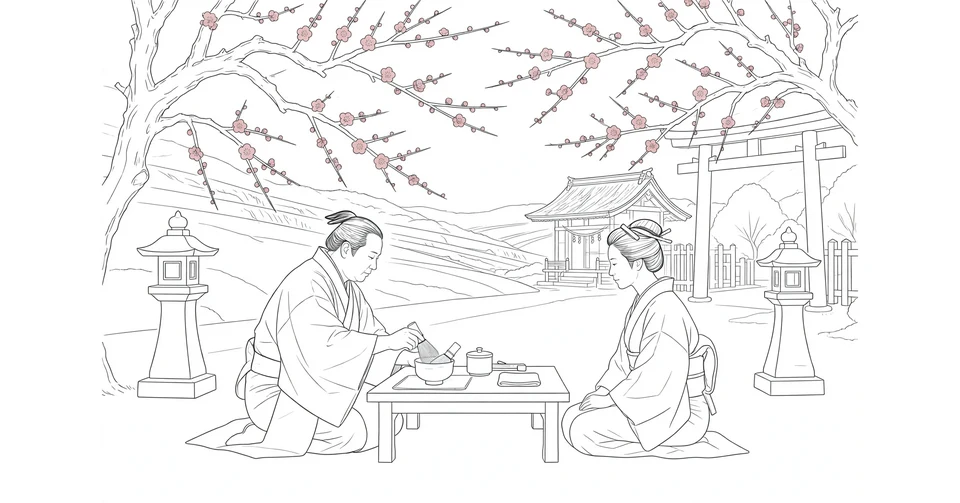
What makes baikasai worth a journey is not only the beauty of it, although the beauty is real. It is the way the festival refuses to separate the sacred from the ordinary. A death anniversary becomes a day of tea, a god of learning is remembered with a sweet, and strangers who have never met share a table under trees that bloom before spring has properly arrived. If you go once, you will understand why Kyoto has kept baikasai for nine centuries.
Baikasai and the date that never moved
The first thing to understand about baikasai is the date. It is always 25 February, and the reason is simple. Michizane died on 25 February in 903, and the festival is held on the anniversary of his death. The shrine has kept that date for about 900 years, through wars, fires, earthquakes, and every change of government Japan has known. The plum trees change, the priests change, the city around the shrine changes, and the date does not.
That stubbornness is part of the meaning. A festival that moves to suit the calendar, or the weather, or the convenience of visitors, is a different kind of event. Baikasai stays put, and in staying put it says something about memory. Some things are worth remembering on the day they happened, not on the nearest convenient weekend. The shrine insists on the real anniversary, and Kyoto respects it, turning up in large numbers on a cold February day to mark a death that happened more than eleven centuries ago.
The date carries a second meaning too, because the 25th is also the day of the shrine's monthly market. On the 25th of every month, Kitano Tenmangu hosts Tenjin-san, one of the great flea markets of Kyoto, where antiques, crafts, and street food fill the grounds. On 25 February the market and baikasai fall on the same day, so the solemn rites, the tea ceremony, and the market all happen at once. The result is a shrine that feels crowded in the best sense, full of students, collectors, families, and visitors who have come for entirely different reasons and end up sharing the same gravel paths.
The coincidence is not an accident of scheduling. The 25th marks both Michizane's birthday, 25 June, and the day of his death, 25 February, so the monthly rhythm of the shrine is built around his life. Baikasai is the most important day in that rhythm, the one day of the year when the monthly market meets the annual memorial, and the whole neighborhood turns out. If you want to see Kitano Tenmangu at its most alive, this is the day to come.
The scholar who loved the plum
To understand why tea is served under plum trees, you have to know the man. Sugawara no Michizane was born in 845 into a family of scholars, and he rose through the imperial court on the strength of his learning. He wrote poetry in Chinese and Japanese, helped revise official histories, and reached the post of Minister of the Right, one of the highest offices in the land. Then, in 901, his rivals in the Fujiwara clan accused him of plotting against the throne. The charge was almost certainly false, but it was enough. Michizane was stripped of his rank, sent into exile at Dazaifu in Kyushu, and died there two years later. Baikasai exists because Kyoto never forgot him.
Before he left Kyoto, Michizane wrote a famous poem to a plum tree he loved, urging it to keep blossoming in his absence. The legend that grew from that poem says the tree uprooted itself and flew to Dazaifu to be with him, and that tree, the tobi-ume or flying plum, still stands at Dazaifu Tenmangu. The full story of his fall, and of the god who grew out of it, is told in Tenjin Is the Storm God Who Became Japan's Patron of Learning, and it is worth reading, because baikasai only makes sense once you know whose spirit it was built to calm.
Within a few decades of Michizane's death, the capital began to suffer. Princes died young, plagues and droughts struck, and then a violent storm broke over Kyoto and lightning struck the imperial palace. To the court, the message was clear. Michizane had not gone quietly. The answer was a shrine. Kitano Tenmangu was built in 947 to appease his angry spirit, and in 986 the title of Tenjin was formally conferred on him there. The name means sky deity, and it tells you exactly what the court thought it was dealing with.
That beginning matters for baikasai, because the festival is, at its heart, an act of remembering a wrong. The court destroyed a good man, and then spent the next thousand years honoring him. The plum is the thread that ties the shrine to the man, because it was his favorite flower, and the trees that now fill the grounds were planted because he loved them. When the geiko serve tea at baikasai beneath those trees, they are serving it in the shade of a scholar's favorite flower, on the anniversary of his death, in a garden that exists because a court once realized it had gone too far.
I find that history strangely hopeful. A society that builds a shrine to a man it destroyed is a society admitting, in its own way, that it made a mistake. The admission took the form of a garden, and the garden became a festival, and the festival became a day when thousands of people drink tea together. The apology never ends, and that is the point. Baikasai does not close the book on Michizane. It opens it again, every year, on the same date, and invites everyone to read it.
Tea under the blossom, served by geiko and maiko
The heart of baikasai is the nodate, the open air tea ceremony held outdoors in the plum grove. Geiko and maiko from Kamishichiken, the oldest geiko district in Kyoto, serve matcha and traditional sweets to visitors beneath the blossom. Kamishichiken sits just south of the shrine, and its presence next door is not a coincidence. The district and the shrine have been neighbors for centuries, and on this one day a year, the women of the district come into the shrine grounds to serve.
The scale of baikasai is what surprises first time visitors. Tea and sweets are served to about 3,000 guests, and the serving cap is set at 3,000, so the tea ceremony runs from 10:00 in the morning to 15:00 in the afternoon, with a long and patient line. Three thousand bowls of tea, served outdoors, in February, by women in kimono, under plum trees. It is an enormous act of hospitality, and the details matter. The geiko and maiko wear colorful kimono with plum themed hair accessories, and the guests receive a bowl of matcha and a traditional sweet, usually wagashi, to eat before drinking. The sweet is not decoration. In the tea ceremony, the sweet prepares the palate and softens the bitterness of the matcha, and at baikasai it also gives cold hands something to hold onto first.
The ceremony reaches back to a famous moment in Japanese history. In 1587, the great unifier Toyotomi Hideyoshi hosted a grand outdoor tea gathering at Kitano Tenmangu, the Kitano Ochakai, inviting people from all walks of life to drink tea together in the shrine grounds. The outdoor tea ceremony as it is held today dates to 1952, when a large festival marking the 1,050th anniversary of Michizane's death revived Hideyoshi's historic gathering. The full history of that revival, and of the tea ceremony at the festival, is set out in the Japan Inside guide to the Baikasai festival, which traces the nodate from Hideyoshi's 1587 gathering to its revival in 1952.
That chance to exchange a few words is what makes the nodate different from a performance. In a teahouse, meeting a geiko usually requires an introduction and a great deal of money. At baikasai, a ticket buys a bowl of tea, a sweet, and a few minutes in the company of a woman who has spent years learning an art that most people only read about. The ceremony is not watched from a distance. It is an invitation to sit down, hold a warm bowl in cold hands, and be served by someone whose whole training is devoted to making a guest feel welcome.
I think there is something quietly radical about that. Hideyoshi's original gathering in 1587 was open to people of all ranks, which was unusual in a society as strictly ordered as sixteenth century Japan. The modern baikasai keeps that spirit. Students, tourists, collectors from the market, and elderly regulars from the neighborhood all queue for the same tea, served by the same hands, under the same trees. For a few hours at baikasai, the distinctions that usually organize a Kyoto day fall away, and everyone is simply a guest. The plum grove becomes a room with no walls, and the tea ceremony becomes a piece of public kindness.
The plum grove in late winter
The setting of baikasai is as important as the ceremony. The grounds of Kitano Tenmangu hold about 1,500 plum trees in roughly 50 varieties, and from February into March they bloom in succession, white, pink, and deep red, filling the cold air with scent. The plum garden, the Baikoen, is where this is most visible, and on the day of the festival it is crowded with visitors walking slowly between the trees, stopping every few steps for another photograph and another deep breath.
The timing is part of the meaning. Plum blossom opens in the cold, weeks before the cherry blossom, when winter has not yet let go. It is a flower for people who are still waiting, still working, still hoping for a result that has not arrived. That is exactly who comes to Kitano Tenmangu in February. The exam season runs through January, February, and March, when high school and university applicants sit their entrance tests, and the shrine fills with students and their parents. The trees bloom before the answer comes, and that is the whole message. Keep going. Spring is closer than it looks.
The story of the shrine, the plum, and the exam season is told in full in Kitano Tenmangu Turns Plum Blossom Into a Prayer for Exams, which explains how the flower and the prayer grew from the same root. Students come to pray for exams, sightseers come for the blossom, and at baikasai both groups meet in the same garden on the same day. The students buy omamori charms for academic success and write their wishes on wooden ema plaques. The sightseers queue for tea. The two purposes do not compete. They share the ground, just as they have for centuries.
The scent is worth mentioning, because it is the first thing visitors notice and the hardest thing to describe. Plum blossom smells sweet and a little spicy, quite different from cherry blossom, and on a cold February morning it carries across the garden in a way that makes people stop and close their eyes. The trees are not tall, and the blossom hangs low enough to walk beneath, so the whole garden feels enclosed, like a room with a ceiling of flowers. At baikasai, the scent becomes part of the ceremony, rising from the trees and mixing with the steam from the bowls.
What a visitor actually does on 25 February
If you plan to attend baikasai, go early, because the festival draws large crowds and the tea ceremony is popular enough that waiting is part of the experience. The tea service runs from 10:00 to 15:00, and tickets are sold on the day, with the serving cap set at 3,000 guests. Arrive in the morning, walk the plum garden first while the light is soft, and then join the tea line with patience. The queue moves steadily, and the waiting itself is part of baikasai, a slow walk through the grove with time to look at the trees.
Inside the main hall, the day is quieter and more solemn. Priests perform the memorial rites for Michizane, and visitors can offer prayers in the usual form of a Shinto shrine, bowing twice, clapping twice, making a wish silently, and bowing once more. The contrast between the hall and the garden is the whole festival in miniature. Inside, the mood is remembrance. Outside, the mood is celebration. Baikasai holds both at once, and asks visitors to hold both as well.
The treasure hall, the Homotsu-den, is open on the 25th of each month, and on the day of baikasai it is worth a visit. It holds the Kitano Tenjin Engi Emaki, an illustrated scroll of Michizane's life and the history of the shrine, itself classified as a National Treasure, along with ancient documents, sacred swords, lacquer artworks, and tea ceremony utensils gathered over centuries of patronage. The scroll matters because it records how the story was told, how a disgraced scholar became a god in the imagination of medieval Japan. Painted versions of his life gave ordinary people a way to hold the whole story in their hands.
Getting there is straightforward. The shrine stands in the Kamigyo-ku district of Kyoto, and it can be reached by bus from Kyoto Station in about 30 minutes, or by the Keifuku Line to Kitano-Hakubaicho Station, followed by a short walk. Entry to the main shrine grounds is free, though there is a separate fee for entering the plum garden at peak season. The grounds are open daily, and on the 25th of every month the hours extend into the evening. The history of the shrine, from its founding in 947 to the conferring of the Tenjin title in 986, is set out on Wikipedia's Kitano Tenmangu page, which is worth reading before you go, because it confirms the facts that make the festival what it is, the date, the nodate, the 3,000 guests, and the 900 year tradition.
A few practical notes will make the day better. Dress warmly, because February in Kyoto is cold and the tea ceremony is outdoors. Wear shoes that are easy to walk in on gravel, and bring cash, because the market stalls and the tea tickets are not always set up for cards. If you buy an ema, write your wish clearly and hang it on the rack. If you buy an omamori, keep it with you rather than opening it. And if you join the tea line at baikasai, remember that the wait is not wasted time. It is a slow walk through a garden that has been blooming on this date for nine centuries.
Why a festival of grief feels joyful
There is a question that baikasai seems to ask, and it is worth sitting with. How does a memorial for a man who died in exile become a joyful day? The answer, I think, is that the festival never pretends the grief is gone. The rites inside the hall are real, and the date is a real anniversary of a real death. But the festival refuses to let grief have the last word. It answers the death with tea, with flowers, with a market, and with neighbors meeting each other on a cold morning. The joy is not a denial of the sorrow. It is what the sorrow grew into, over nine hundred years of people returning.
That is a useful way to think about tradition in general. We often imagine that old customs survive because they are preserved, kept behind glass like museum objects. Baikasai survives because it is used, because people drink the tea, buy from the market, write their wishes on plaques, and bring their children to see the blossom. A festival that is only remembered will fade. A festival that is lived, year after year, by people who have somewhere else they could be, will last. The 25th of February is not kept alive by the shrine alone. Baikasai is kept alive by everyone who turns up.
There is also a lesson in the plum itself. The tree blooms in the cold, before spring, before the answer, before anyone knows how the year will turn out. The students who come to baikasai in February do not know whether they will pass. The visitors who queue for tea do not know what the year will bring. The blossom opens anyway, and the tea is served anyway, and the festival is held anyway. That is not optimism, exactly. It is something steadier, a decision to go on with the beautiful and the kind even when the outcome is uncertain.
If you are lucky enough to be in Kyoto on 25 February, go to Kitano Tenmangu for baikasai, walk the plum garden while the light is soft, join the line for tea, and sit for a while with a warm bowl in your hands. You will be taking part in something that began as an apology to a wronged scholar and became, over nine centuries, a day when a whole city drinks tea under the trees he loved. The blossom opens before the answer comes, and the tea is served before spring arrives, and that is the whole point of baikasai. You do not wait for certainty to begin. You begin, and spring follows.
More in Culture & Society
- Plum Blossom Opens Japan's Year Before the Cherry Trees Wake
- Tenjin Engi Emaki Paints a Storm God Into a Saint of Learning
- The Flying Plum Tree That Followed a Scholar Into Exile
- Kitano Tenmangu Turns Plum Blossom Into a Prayer for Exams
- Japanese Geisha and the World Behind the Painted Face
- Tenjin Is the Storm God Who Became Japan's Patron of Learning
Latest posts
- Hello Kitty and the Cat Who Conquered the World
- Umeboshi Is the Sour Plum Japan Puts in Every Bento
- Queen Is the Crown Japan Gives Its Best Woman Karuta Player
- Japanese Pottery and the Six Kilns That Turned Clay into Culture
- Meijin Is the Title Every Karuta Player Dreams of Wearing
- Dazaifu Tenmangu Is Where Japan Still Prays to a Scholar God
- Sugawara No Michizane Became the God Students Still Pray To
- Wakamizu Is the First Water Japan Draws for Good Luck
- Japanese Kabuki and the Theatre That Paints Its Actors
- Kakizome Turns the First Brushstroke of the Year Into a Wish
- Ujigami Is the Guardian God Who Watches Over One Neighbourhood
- Omi Jingu Is Where Karuta Crowns Its Champions
- Hagoita-ichi Turns Asakusa Into a Forest of Paddles
- The Two Lives of Japanese Coffee
- Chihayafuru Made a Card Game Feel Like a Sport