Tenjin Is the Storm God Who Became Japan's Patron of Learning
· 15 min read
Tenjin is the storm god of Japan who began as the exiled scholar Sugawara no Michizane, and this is how fear of his lightning turned into prayers for exam success.
Few gods in Japan have changed their job description as completely as Tenjin. Today, students bow before him with wooden prayer plaques covered in wishes for exam success. A thousand years ago, the imperial court bowed before him for a very different reason. They were afraid of him.
Tenjin is the deified form of Sugawara no Michizane, a scholar, poet, and politician of the Heian period who lived from 845 to 903. In life he was one of the finest minds of his age. In death he became a storm god, and then, slowly, the patron of learning itself. That journey from feared spirit to beloved protector is one of the strangest and most human stories in Japanese religion, and it is the story of Tenjin from exile to enshrinement to the exam season.
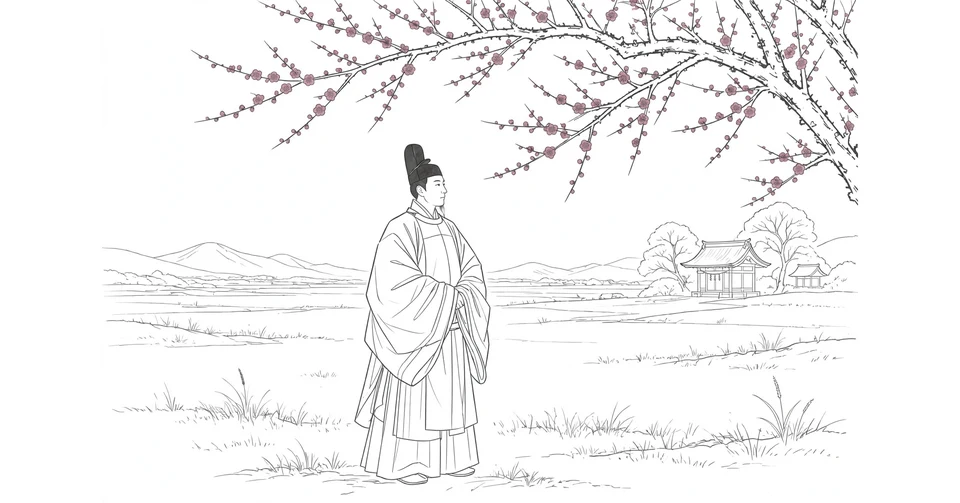
Walk into a shrine dedicated to Tenjin on a winter morning and you will see the modern side of the story first. Teenagers in school uniforms tie ema plaques to wooden racks, each one carrying a handwritten wish. Parents stand beside them, quietly reading the messages other families left behind. Bronze oxen sit near the hall, their heads and backs polished bright by thousands of hands rubbing them for luck. Nothing here looks frightening. Yet every one of these gentle rituals began with thunder.
The scholar who became Tenjin
Sugawara no Michizane was born in 845 into a family of scholars, and his talent was obvious from childhood. Legend says he could read and compose poetry by the age of five, and the adult record supports the legend. He rose through the imperial court on merit, helped revise official histories, and wrote poetry in both Japanese and Chinese. By the end of the ninth century he had reached the post of Minister of the Right, one of the highest offices in the land.
That rise made him enemies. The Fujiwara clan guarded its grip on power jealously, and Michizane, a scholar without their bloodline, was a threat to their control. In 901, under Emperor Daigo, his rivals accused him of plotting against the throne. The charge was almost certainly false, but it was enough. Michizane was stripped of his rank and demoted to deputy governor-general at Dazaifu, a distant post in Kyushu. He left Kyoto in disgrace and died in exile two years later, in 903, far from the capital he had served.
The story could have ended there, as the story of one more talented man destroyed by court politics. Instead, it became the beginning of a god. The full life of the man behind the deity is told in Sugawara no Michizane Became the God Students Still Pray To, and it is worth reading alongside this one, because the god only makes sense once you know the man.
Lightning over Kyoto and the birth of a god
Within twenty years of Michizane's death, the capital began to suffer. Crown Prince Yasuakira died in 923, and his death was widely blamed on Michizane's angry spirit. Prince Yoshiyori followed in 925. Then, on July 21, 930, a violent storm broke over Kyoto. Heavy rain fell, lightning struck the imperial palace, and several leading Fujiwara died while fires and floods destroyed their residences.
To the court, the message was clear. Michizane had not gone quietly. He had returned as an onryo, a vengeful spirit, and the disasters were his doing. The court responded the only way it knew how. It restored all of Michizane's offices and rank, burned the official order of exile, and ordered that he be worshipped under the name Tenjin, which means sky deity. The name itself tells the story. Ten means sky or heaven, and jin means god or deity. From that moment, Tenjin had a name, a shrine, and a reputation written in fear.
The cult that grew around him, known as Tenjin Shinko, did not start from nothing. An older thunder and weather deity, called tenjin raijin, was already worshipped before Michizane died, and the two figures merged in the popular mind. The scholar's spirit gave the storm a name and a history, and the storm gave the scholar a power no living minister had ever held. You can read the full account of this transformation in the Wikipedia article on Tenjin), which traces how the court moved from fear to worship in a single generation.
What strikes me about this episode is how practical it was. The court did not worship Michizane because it suddenly believed in his innocence. It worshipped him because lightning had killed its leaders and it needed the storms to stop. Religion here was crisis management, and the solution was to give the angry dead man the highest honor available. There is something deeply honest about that. Societies often dress their fears in ceremony, and Kyoto dressed its fear in a shrine.
One of the Three Great Onryo of Japan
Michizane was not the only wronged man Japan turned into a god. He is counted among the Three Great Onryo of Japan, alongside Emperor Sutoku and the warrior Taira no Masakado. All three died in anger after political ruin, all three were blamed for disasters that followed their deaths, and all three were eventually enshrined as kami to calm their spirits.
The pattern says something important about how Japan has historically handled injustice. When the living could not undo a wrong, they gave the wronged dead a shrine. It was an apology built in wood and stone, repeated every year in festivals and offerings. Whether you believe in vengeful spirits or not, the logic is humane. A society that builds a shrine to a man it destroyed is a society admitting, in its own way, that it went too far.
Of the three, Tenjin traveled the furthest. Sutoku and Masakado remained figures of fear and respect in their own regions. Tenjin became a national presence, with shrines in almost every corner of the country, because his story attached itself to something every family cares about.
How Tenjin became the patron of learning
For the first few centuries, Tenjin was worshipped mainly as a god of storms and disasters, someone to placate rather than to love. The change came slowly. Michizane had been a famous poet and scholar in life, one of the greatest of the Heian period, and during the Edo period scholars and educators began to remember that side of him. They started to regard him as a patron of scholarship, and the idea spread from classrooms outward until it reached the whole country.
By the present day, the scholar has completely overtaken the storm god in popular worship. Ask a Japanese teenager who Tenjin is and the answer will be about exams, not thunder. Tenjin is now regarded as especially powerful in helping students pass exams. School students and their parents pray at his shrines before important entrance exams and return afterward, when they can, to give thanks for success. The fear is gone. What remains is hope, which is a much better reason to visit a shrine.
I find this reversal moving, because it suggests that a reputation is never truly fixed. A man who died disgraced, blamed for lightning and plague, is now the first name a nervous teenager whispers before an exam. Given enough time, a culture can rewrite even a ghost story into a story about encouragement. That is not a small thing. It means that what a society chooses to remember about a person matters more than how that person died.
Kitano Tenmangu, the head shrine in Kyoto
The two great centers of Tenjin worship are Kitano Tenmangu in Kyoto and Dazaifu Tenmangu in Fukuoka. Kitano was the first. The shrine was built in 947 to appease Michizane's angry spirit, and in 986 the title of Tenjin was formally conferred on him there. It remains the head shrine of the Tenjin network, which counts around 12,000 shrines across Japan.
Kitano is also the most beautiful place to meet Tenjin in person. The grounds hold about 1,500 plum trees of roughly 50 varieties, and from February to March they fill the shrine with white, pink, and red blossom. The connection is personal. Plum blossom was Michizane's favorite flower, and the trees bloom at the same time of year that exam results are announced, which has tied the flower to the god in the minds of generations of students.
The shrine's great day is February 25, the anniversary of Michizane's death. On that day the Baikasai, or Plum Blossom Festival, is held, and it has been held on the same date for about 900 years. For nine centuries, Tenjin has been thanked on the same winter day, first out of fear and now out of gratitude. Geiko and maiko from the nearby Kamishichiken district serve tea outdoors in the plum garden, continuing a tradition that reaches back to the great tea ceremony Toyotomi Hideyoshi hosted at the shrine. The main hall itself, built in 1607 under the patronage of Toyotomi Hideyori, is a National Treasure, and the shrine's treasure hall keeps the Kitano Tenjin Engi Emaki, an illustrated scroll of Michizane's life. For a full visitor guide to the shrine, its history, and its festivals, see the Japan Experience guide to Kitano Tenmangu.
There is also a monthly rhythm. On the 25th of every month, Kitano hosts a large flea market, one of the biggest in Kyoto, and the date is no accident. The 25th marks both Michizane's birthday, June 25, and the day of his death, February 25. The market turns a memorial date into a neighborhood habit, which is perhaps the most Japanese part of the whole story. A god of thunder becomes a reason to browse antiques on a Sunday.
Dazaifu Tenmangu and the plum tree that flew
If Kitano is the head shrine, Dazaifu Tenmangu is the heart. It stands in Dazaifu, Fukuoka Prefecture, built over the grave of Michizane himself, and it is the shrine most closely tied to his exile and death. The story of the place is told in Dazaifu Tenmangu Is Where Japan Still Prays to a Scholar God, and the shrine rewards a slow visit.
Legend says that when Michizane died, an ox pulling the cart carrying his body suddenly stopped and refused to move any further. His followers took the sign seriously and buried him on that spot. The first small shrine on the site was built in 905, two years after his death, by his follower Umasake no Yasuyuki. A larger structure followed in 919, built by the Fujiwara clan itself, which tells you how quickly fear had turned into devotion. The Momoyama style hall visitors see today dates from 1591 and is an Important Cultural Property.
The grounds are famous for their plum trees. At Dazaifu, Tenjin is remembered less as a storm and more as a homesick poet. Around 6,000 ume trees of 167 varieties grow across the precinct, and the most beloved of them is the Tobiume, the flying plum tree, which stands directly to the right of the main hall. Legend says that after Michizane left Kyoto, he yearned so much for a plum tree he had loved in the capital that the tree uprooted itself and flew to Dazaifu to be with him. It is said to be the first plum tree to bloom in Japan each year. Whether or not you believe the tree flew, the story captures something true about exile. The thing Michizane missed most was not power or rank. It was a tree.
The shrine is also known for umegae mochi, a grilled cake filled with sweet bean paste and stamped with a plum flower pattern. Shops along the approach sell them, and the snack is tied to a gentle legend of its own. An elderly caretaker named Jomyoni is said to have prepared the cakes for Michizane during his exile and left one as an offering when he died. Food, flowers, and an ox. The great storm god of Kyoto is remembered in Dazaifu through small, tender things.
The plum, the ox, and the small rituals of Tenjin
Every god accumulates symbols, and Tenjin has three that any visitor will meet. The plum comes from Michizane's own poetry. In exile he wrote a famous poem lamenting the absence of a particular plum tree he had loved in Kyoto, and the legend of the flying tree grew from that poem. Today, shrines dedicated to Tenjin are often planted with many ume trees, and they blossom in February, the season when exam results are announced.
The ox comes from the funeral procession of the man who became Tenjin. Because the ox stopped at the place that became Michizane's grave, cattle are regarded as Tenjin's sacred messengers, and ox statues stand in shrine grounds across Japan. Visitors rub them for good luck, and at Kitano the custom is specific. Rubbing the statue's head is believed to impart wisdom, which is exactly the kind of practical magic a student wants the night before an exam.
The third symbol is the ema plaque itself, which is less a symbol than a habit. Students write their wishes in their own handwriting, in their own words, and hang them where other students can read them. There is no priest in the middle of that moment. It is a direct conversation between a young person and a god who was once a student himself, a scholar who knew what it felt like to be judged.
Why Tenjin still matters to students
It would be easy to treat all of this as history, something to admire from a distance. But Tenjin is not history. Every February, shrines fill with teenagers who have spent a year preparing for a single exam, and their parents stand behind them carrying the same worry. The pressure of Japanese entrance exams is real, and it is heavy, and the families who come to these shrines are not performing a tradition. They are asking for help.
What they are asking, I think, is not really for a miracle. Nobody believes the god will sit the exam for them. They are asking Tenjin to notice the work they have already done. They are asking for steadiness, for the feeling that their effort has been seen by someone. Michizane is a good person to ask, because his own life was a story of effort that was not rewarded fairly. He studied, he served, he was honest, and he was still destroyed by politics. A student who has worked hard and is afraid it will not be enough can look at that life and feel understood rather than judged.
That may be the real reason Tenjin survived while so many other gods faded. He is not distant or perfect. He is a man who failed in the eyes of the world and was given a second chance by the people who remembered him. Students do not need a god who never failed. They need a god who knows what failure feels like and kept going anyway.
There is also a quieter lesson in the way his worship changed. A community that once prayed to Tenjin out of fear now prays to him out of hope, and nothing about the god changed except what people chose to see in him. Fear made the shrine. Hope filled it. The same shrine, the same plum trees, the same ox statues, and a completely different relationship. That is worth remembering whenever we talk about traditions as if they were fixed. They are not fixed. They are conversations, and each generation gets to answer back.
A god who was once a student
Tenjin began as a scholar who lost everything, became a storm that frightened a capital, and ended as the gentlest figure in the Japanese exam season. The arc of that story is the reason his shrines still draw crowds more than a thousand years after his death. He reminds visitors that disgrace is not the end of a reputation and that fear, given enough time and enough plum blossom, can soften into something kinder. That is the promise Tenjin carries into every exam season.
If you ever stand under the plum trees at Kitano or Dazaifu in February, with the petals falling and the ema plaques fluttering in the wind, you will see the whole story at once. The storm is still there in the name. The scholar is still there in the poems. And the students are still there, writing their wishes by hand, trusting that a man who once knew exile will understand what it means to hope for a better result.
More in Culture & Society
- The Flying Plum Tree That Followed a Scholar Into Exile
- Kitano Tenmangu Turns Plum Blossom Into a Prayer for Exams
- Japanese Geisha and the World Behind the Painted Face
- Queen Is the Crown Japan Gives Its Best Woman Karuta Player
- Japanese Pottery and the Six Kilns That Turned Clay into Culture
- Meijin Is the Title Every Karuta Player Dreams of Wearing
Latest posts
- Dazaifu Tenmangu Is Where Japan Still Prays to a Scholar God
- Sugawara No Michizane Became the God Students Still Pray To
- Wakamizu Is the First Water Japan Draws for Good Luck
- Japanese Kabuki and the Theatre That Paints Its Actors
- Kakizome Turns the First Brushstroke of the Year Into a Wish
- Ujigami Is the Guardian God Who Watches Over One Neighbourhood
- Omi Jingu Is Where Karuta Crowns Its Champions
- Hagoita-ichi Turns Asakusa Into a Forest of Paddles
- The Two Lives of Japanese Coffee
- Chihayafuru Made a Card Game Feel Like a Sport
- Oshi-e Hagoita Turns Silk Into a Picture You Can Touch
- Hyakunin Isshu Gave Karuta Its Hundred Poems
- Hagoita Is the Paddle Japan Turns Into New Year Art
- Takoage Sends New Year Wishes Up on a Paper Kite
- Hanetsuki Keeps New Year in the Air With a Wooden Paddle