Meijin Is the Title Every Karuta Player Dreams of Wearing
· 19 min read
Meijin is the title awarded to the men's national champion of competitive karuta in Japan, a crown decided each January at Omi Jingu and held since 1955.
In Japan, a single word can change the way a whole room looks at you. In the world of competitive karuta, that word is Meijin. It means master, and it is the title given to the best male player in the country. Nobody is born a Meijin. Nobody buys the title, and nobody is appointed to it. It is won on the tatami, in silence, one card at a time, and it is defended the same way.
The national karuta championships decide who wears the titles of Meijin and Queen. That line comes from the earlier article on this site about Omi Jingu, the shrine where the championships are held, and it is the starting point for this story. The Queen title belongs to the women's champion. This article is about the Meijin title itself, the men's crown, and why it still matters after more than seventy years.
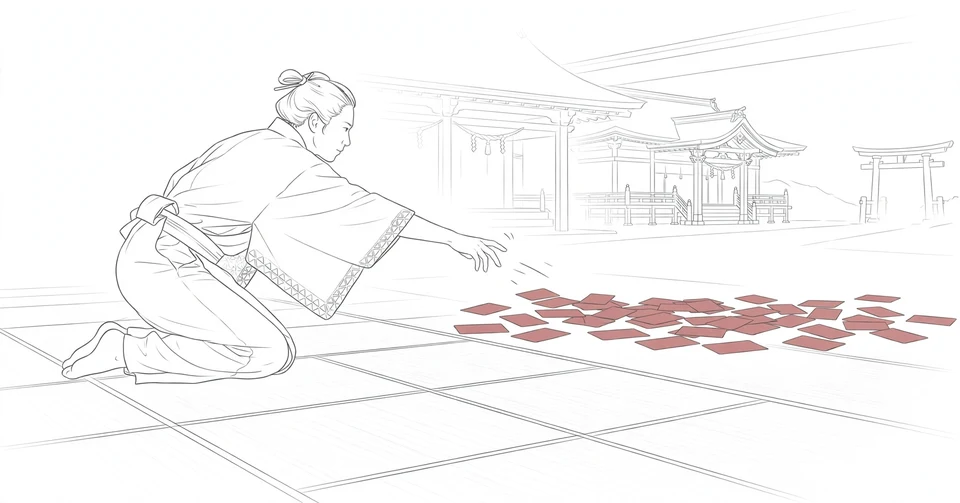
The Meijin title has been awarded every year since 1955, and the women's equivalent, Queen, followed two years later in 1957. In that time only fifteen men have held the title of Meijin, across seventy two championship matches held through January 2026. That is a small number for a title that is more than seventy years old, and it tells you something important. The Meijin is not a prize that circulates. It is a fortress, and most challengers leave empty handed.
What competitive karuta actually is
Competitive karuta, known in Japanese as kyogi karuta, is a card game built on the Ogura Hyakunin Isshu, a collection of one hundred tanka poems by one hundred poets, compiled by Fujiwara no Teika. The first poem in the collection is attributed to Emperor Tenji, the seventh century ruler enshrined at Omi Jingu. Each poem is split across two cards. One card carries the whole poem and is read aloud, while the other carries only the second half and lies on the floor waiting to be grabbed.
A match uses fifty of the one hundred grabbing cards. Each player takes twenty five and arranges them in three rows inside a space eighty seven centimetres wide. Both players then get fifteen minutes to memorise the position of all fifty cards on both sides of the board. When the reader begins to recite a poem, the players race to touch the matching card first. The first player to clear every card from their own territory wins. A single game lasts about ninety minutes, including the memorising time, and a player who wins a national tournament usually plays five to seven matches in a row.
Speed alone is not enough. A wrong touch is a fault, called otetsuki, and it is punished by sending a card to the opponent. So every player must balance two opposite instincts, the urge to strike instantly and the discipline to wait for certainty. The poems themselves make the task harder. Only seven of the one hundred poems can be identified from their first syllable. The rest share their opening sounds with other poems, so players must react to the decisive syllable, the kimariji, the exact point where one poem separates from the others. That is why the game looks so strange to a first time watcher. Two people sit perfectly still, and then explode into motion in a fraction of a second.
The game is old. Competitive karuta in something like its modern form dates to the start of the nineteenth century, though the rules varied by region. At the beginning of the twentieth century the Tokyo Karuta Association unified those rules, and the first competitive karuta tournament was held in 1904. The national body, the All Japan Karuta Association, was founded in 1957, and it has hosted tournaments for men since 1955 and for women since 1957. You can read the full history of the game in the competitive karuta article on Wikipedia, which covers the rules, the ranking system and the championship in detail. If you want the shorter version of how the game feels in play, this site has already covered it in Karuta Turns a Hundred Poems Into Japan's Fastest Card Game.
I find it remarkable that a game built on thirteenth century poetry is played like a sprint. There is no board to study, no clock to manage in the usual sense, and no teammate to blame. There are only a reader's voice, fifty cards, and two people who have memorised all of them. It is the most literary sport I know, and the most physical one too, since players sometimes injure their hands slamming them onto the floor.
January at Omi Jingu
Every January, shortly after the New Year, the national championship comes to Omi Jingu in Otsu, Shiga Prefecture. The shrine is dedicated to Emperor Tenji, and it has become known as the karuta shrine, because the anthology at the heart of the game opens with a poem attributed to him. The title matches are played in the Omi Kangakukan, a hall of tatami match rooms beside the shrine, and they are broadcast on television by NHK.
The setting matters. Omi Jingu is not a stadium. It is a quiet shrine on the western shore of Lake Biwa, and the championship is played in near silence, with the audience holding its breath while the reader sings the poems. The contrast is part of the appeal. Outside, the new year is just beginning. Inside, two players sit on the floor and fight for a title that has existed since before most of the audience was born. For the full story of the shrine itself, see Omi Jingu Is Where Karuta Crowns Its Champions.
The championship is the summit of the karuta calendar. There is also a national championship for high school students every July, and the All Japan Championship brings together the top A class players from across the country. But January at Omi Jingu is the event that decides the Meijin, and it is the one every serious player circles on the calendar.
The long road to a challenge
Nobody walks into Omi Jingu and asks for a shot at the Meijin title. The road is long, and it is built on the dan ranking system. Beginners start in E class. A first dan player competes in D class, a second dan in C class, a third dan in B class, and a fourth dan or above in A class, the top division. Players climb by earning results in lower classes, and they must register as official members of the All Japan Karuta Association to enter tournaments above C class.
There are about fifty official tournaments every year that count toward the dan rankings. That number is worth pausing over. Fifty tournaments means a serious player can compete almost every weekend of the year, travelling from city to city, collecting results, and slowly climbing the ladder. Most players never reach A class. Of the estimated ten thousand to twenty thousand competitive karuta players in Japan, only about two thousand are ranked above C class and registered with the association. The Meijin sits at the top of a pyramid that is far narrower than most people realise.
The challenger is decided through the qualifying path for the top A class players. Regional qualifiers in eastern and western Japan produce representatives from each side, and the east and west winners meet in a challenger deciding match in November. The winner of that match earns the right to face the reigning Meijin in January. I could not find a single official English language source that sets out every step of this qualifying path in one place, so the November deciding match detail comes from Japanese community reports of the 2026 qualifiers, and readers should treat the exact calendar as something that can shift from year to year. What is certain is the structure itself. The champion waits. Everyone else must fight through the field to reach him.
That waiting is part of what makes the Meijin title so hard to win. The challenger arrives at Omi Jingu after months of qualifying matches, while the champion has spent the year preparing for one opponent. The challenger must be in form on the day. The champion must be in form every year.
The challenger match, game by game
The Meijin match is a best of five series. The first player to win three games takes the title. If the challenger wins, the champion loses the title on the spot. If the champion wins, the title stays, and the challenger goes back to the qualifying tournaments to try again next year.
Each game follows the same rules as any competitive karuta match. Fifty cards, twenty five each, fifteen minutes of memorising, and then the race begins. But a title match is different in one important way. It is played over two days, and the players can study each other between games. A player who loses the first game can adjust the arrangement of their cards, change their tempo, or attack a weakness they spotted. A best of five series is therefore not just a test of speed. It is a test of adaptation, and of nerve, since a player who falls two games behind must win three in a row to survive.
The Queen match follows the same format today. Since 2019 it has also been a best of five series, with the first player to win three games taking the title. Before 2019 the Queen match was a best of three, with the first to two wins taking the crown. The change made the two title matches equal in length, and it made the Queen's defence just as demanding as the Meijin's.
Games in a title match can be decided by a single card. When both players are down to their last card, the match enters unmeisen, sudden death, where the next poem read decides everything. The 2024 Meijin match ended in three straight wins for the champion, Masayoshi Kawase, while the Queen match that year went the distance and was decided in sudden death games. Anyone who has watched a title match knows the feeling. The hall is silent, the reader draws a breath, and two people who have spent years preparing for this moment wait for a single syllable.
The men who made the Meijin title famous
In seventy two Meijin matches through January 2026, only fifteen men have held the title. That fact alone explains why the Meijin is spoken about with such respect. Most champions do not win the title once and disappear. They win it, defend it, and keep defending it until someone finally beats them.
The first Meijin was Ichiro Masaki. He won the first championship match in 1955 and then won ten titles in a row, holding the crown from 1955 to 1964. Ten straight titles is a record that has never been beaten in a single streak, and it set the standard for everything that followed. Masaki did not just win the first Meijin title. He defined what the title meant, by making it almost impossible to take from him.
The greatest Meijin of all is Naoki Saigo. He won fourteen titles, all of them consecutively, from 1999 to 2012. His first title match, in 1999, is still told as a story of impossible recovery. Facing the three time champion Yoshihiro Mochizuki, Saigo lost the first two games and stood on the edge of elimination. He then won the next three games to take the title. From those three closing games in 1999, Saigo went on to win twenty seven straight individual games in Meijin matches without defeat, a streak that ran until 2008. He retired in 2012 still holding the title, after beating the same man, Teruaki Miyoshi, who had ended his winning streak four years earlier. Miyoshi himself never won the Meijin title, despite reaching the title match three times.
Other long reigns fill out the history. Takashi Tanemura won nine titles between 1985 and 1992, eight of them consecutively. Hideo Matsukawa won eight titles from 1979 to 1982. Tatsuo Kawase won four titles in the 1970s, and Keitaro Kumehara won three straight titles from 2019 to 2021. These are not the records of a title that changes hands easily. They are the records of players who turned the Meijin crown into a personal era.
The current Meijin, as of January 2026, is Masayoshi Kawase. He won his fourth title in his fifth Meijin match, reclaiming the crown after losing it to Sojiro Jimi in 2025. Jimi is the only Meijin in history who never defended the title, holding it for a single year. Kawase is thirty two years old, which makes him a veteran by karuta standards, and his return to the title after a defeat says something about the mental strength the crown demands. Losing a Meijin match is a public event. Coming back and winning it again is rarer still.
I think the long reigns are the point. In most sports, a champion is someone who was the best on a given day. In karuta, a Meijin is someone who was the best for years, because the title can only be lost in January, to one challenger, in a series that rewards preparation over luck. A player can have a bad day in an ordinary tournament and lose in the early rounds. A Meijin can have a bad day in January and lose everything. That is why the names on the list of champions read like a hall of fame rather than a leaderboard.
Eternal master, the title above the title
Above the Meijin title sits an even rarer honour. A player who wins the grand championship seven times in their career is known as an Eternal Master, or Eisei Meijin. Only four men have ever reached that mark, and all four of them earned it by winning the Meijin title seven or more times.
Karuta community records also describe a second route to the same honour, winning five titles in a row, which means defending the crown four consecutive times. The two routes are usually described together, and both point to the same idea. The Eternal Master is not a prize for one great year. It is recognition of a career spent at the very top.
Naoki Saigo reached it twice over, with fourteen titles. Ichiro Masaki reached it with ten. Takashi Tanemura reached it with nine, and Hideo Matsukawa with eight. That is the entire list on the men's side. Four Eternal Masters in seventy two years. The title is so rare that it functions as karuta's own hall of fame, a list you can recite from memory.
The women's side has three Eternal Masters, which makes the honour just as rare there. The parallel matters, because the Queen title is every bit as demanding as the Meijin, and its greatest champions are remembered the same way.
Queen, the parallel crown
The Queen title has been awarded since 1957, two years after the first Meijin match, and in seventy Queen matches through January 2026, twenty two women have held it. The women's game has produced its own legends, and any account of the Meijin title would be incomplete without them, because the two titles are decided on the same stage, on the same January weekend, in front of the same hushed hall.
The most decorated Queen is Fumie Watanabe, who won fourteen titles between 1992 and 2002, eleven of them consecutively. Kumiko Horisawa won eight straight titles from 1977 to 1984. But the name every karuta fan knows is Saki Kusunoki. She became the youngest grand champion in history at fifteen years old in 2005, and she went on to win ten straight Queen titles until 2014, without losing a single game in any of her Queen series matches. She retired as the only undefeated champion in the history of national karuta. Six of her ten title match opponents were former Queens or would later become Queen themselves, which makes the perfect record even more remarkable.
The current Queen, as of January 2026, is Seira Yajima. She won her second title in her second Queen match appearance, at nineteen years old, and she was the first high school student to become Queen since Kusunoki seventeen years earlier. Her rise is a reminder that the Queen title, like the Meijin, is open to anyone who can survive the qualifying path, whatever their age.
The two titles are often spoken of together, as the grand championships, and the winners are together called the Grand Champions. That shared language is fitting. The Meijin and the Queen defend their crowns in the same hall, under the same rules, and with the same pressure. The only difference is the name of the crown.
The Chihayafuru effect
For most of its history, competitive karuta was a small world. The game was respected, but it was not famous, and the Meijin title was known mainly to people who already played. That changed with a manga.
Chihayafuru, by Yuki Suetsugu, began in 2007 and told the story of a group of high school students devoted to competitive karuta. The manga ran for fifteen years, the fiftieth and final volume was published in December 2022, and the fifty volumes have sold over twenty seven million copies in total. It was adapted into anime and three live action films, and it turned a niche card game into a national conversation. The story follows Ayase Chihaya, a girl whose dream is to become Queen, and her friends and rivals, including Wakamiya Shinobu, a character modelled on the real life queen Saki Kusunoki, and Suo Hisashi, a fictional Meijin.
The effect on the real game is well documented. The series boosted the popularity of competitive karuta in Japan and abroad, and the number of people overseas who have taken up the game has grown since the manga appeared. The first international tournament was held in September 2012, with players from the United States, China, South Korea, New Zealand and Thailand taking part. The manga's author has also worked with the All Japan Karuta Association, and a tournament named after the series, the Chihayafuru Ogurayama Cup, was established in 2020 to introduce new fans to the pleasure of watching the game. You can read a full account of the manga and the real game it portrays in this article from Nippon.com about competitive karuta and Chihayafuru.
What interests me most about the Chihayafuru effect is what it did not change. The manga brought new players, new audiences and new attention, but the Meijin title itself stayed exactly the same. It is still decided in January, at the same shrine, in a best of five series, by the same rules. Fame arrived, but the crown did not get easier to win. If anything, the new attention made the title harder to hold, because more young players now arrive at the qualifying tournaments dreaming of the same crown.
Why a title from 1955 still matters
The Meijin title is older than most of the people who compete for it. It was first awarded in 1955, when Japan was still rebuilding after the war, and it has been defended every year since, through economic booms and recessions, through the rise of television and the internet, and through the arrival of a manga that made the game famous around the world. The title survived all of that without changing its shape.
Part of the reason is the structure. A title that can only be challenged once a year, by one person, in a series of up to five games, cannot be won by accident. It rewards the player who is best over a long period, not the player who is lucky on a single afternoon. That is why only fifteen men have held it in seventy two years, and why four of them are remembered as Eternal Masters.
Another part of the reason is what the title is not. Karuta is not a professional sport in the way chess or go can be. Community accounts describe its tournaments as being run largely on donations from fans and local communities, with no large prize money attached to the title, so nobody competes for the Meijin crown to get rich. They compete for it because it is the crown, and because everyone in the karuta world knows what it means. A title that offers no fortune and still draws the best players in the country every January is a title that runs on pride alone, and pride is a durable fuel.
I also think the Meijin matters because it gives a small community a shared story. Every karuta player knows the names on the list of champions, and every player who has sat through a title match knows what the silence in the hall feels like. The title connects a beginner in E class to Naoki Saigo, because both of them are playing the same game, with the same hundred poems, under the same rules. The beginner may never reach A class, let alone Omi Jingu, but the title gives their practice a direction. It says that mastery has a name, and that the name is earned in public, once a year, in front of everyone.
The Meijin will be defended again next January, as it has been every January since 1955. A challenger will come out of the qualifying tournaments, travel to Otsu, and sit down across from the champion in the Omi Kangakukan. The reader will clear their throat, the hall will go quiet, and the first poem will be read. That is all the ceremony the title needs, and it has been enough for more than seventy years.
More in Culture & Society
- Japanese Pottery and the Six Kilns That Turned Clay into Culture
- Dazaifu Tenmangu Is Where Japan Still Prays to a Scholar God
- Sugawara No Michizane Became the God Students Still Pray To
- Wakamizu Is the First Water Japan Draws for Good Luck
- Kakizome Turns the First Brushstroke of the Year Into a Wish
- Ujigami Is the Guardian God Who Watches Over One Neighbourhood
Latest posts
- Japanese Kabuki and the Theatre That Paints Its Actors
- Omi Jingu Is Where Karuta Crowns Its Champions
- Hagoita-ichi Turns Asakusa Into a Forest of Paddles
- The Two Lives of Japanese Coffee
- Chihayafuru Made a Card Game Feel Like a Sport
- Oshi-e Hagoita Turns Silk Into a Picture You Can Touch
- Hyakunin Isshu Gave Karuta Its Hundred Poems
- Hagoita Is the Paddle Japan Turns Into New Year Art
- Takoage Sends New Year Wishes Up on a Paper Kite
- Hanetsuki Keeps New Year in the Air With a Wooden Paddle
- Japanese Stationery and the Small Tools Japan Takes Seriously
- Karuta Turns a Hundred Poems Into Japan's Fastest Card Game
- Hatsuyume Is the First Dream Japan Reads Like a Fortune
- Japanese Manga and How It Became the World's Most Read Comics
- Toshikoshi Soba Is the Long Noodle Japan Eats at Midnight