Japanese Geisha and the World Behind the Painted Face
· 12 min read
Japanese geisha are professional artists trained in music, dance, and conversation, not the courtesans of Western fiction. Fewer than 1,000 remain in Japan, most of them in Kyoto.
A Japanese geisha is a professional artist. She plays the shamisen, dances, pours tea, keeps a conversation alive for hours, and knows exactly when to stay silent. She is not a courtesan, and no Japanese geisha ever was one in the Kyoto tradition. That misunderstanding comes mostly from Western fiction, and it has stuck for more than a century.
The numbers tell the rest of the story. In April 2024, Kyoto counted 211 geiko and maiko across its five districts: 155 fully trained geiko and 56 apprentices. A century ago, Japan had around 80,000 geisha. Today the whole country has fewer than 1,000. What remains is small, formal, and fiercely protected, and that is exactly why it still matters.
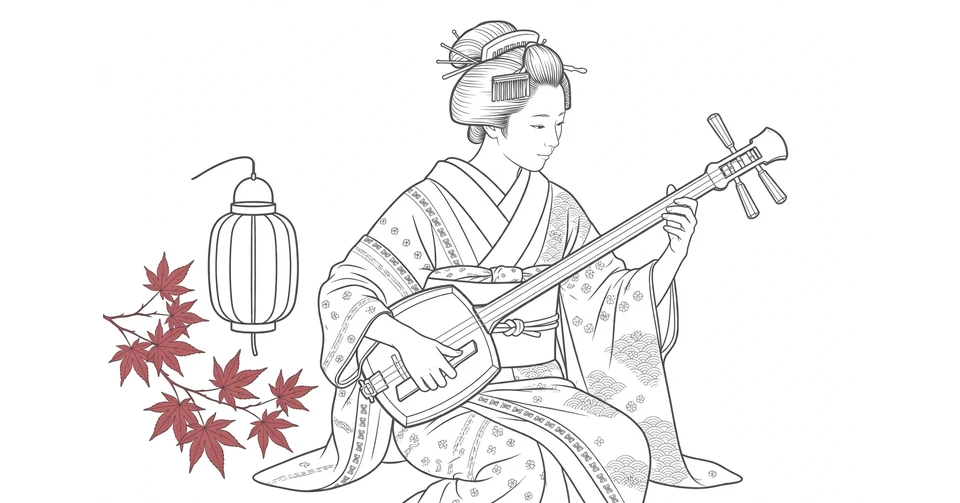
The painted face is the first thing a visitor notices, and the last thing worth judging a Japanese geisha by. The white makeup, the red lips, the elaborate hair ornaments, and the long trailing obi of an apprentice are a uniform, not a costume for tourists. Every detail signals rank, season, and district, and people inside the world read those details the way the rest of us read a business card.
The first Japanese geisha were men
The word itself gives the game away. Geisha combines gei, meaning art, and sha, meaning person. A geisha is literally a person of the arts, and the word was originally genderless. The first geisha were men, comic storytellers and musicians known as taikomochi, or hokan, who entertained guests at banquets with jokes, conversation, and music.
Women entered the trade in the mid-1700s, working first in the teahouses that served pilgrims on the roads leading to Yasaka Shrine in Kyoto. They sang, danced, and played the shamisen, and guests began asking for them by name. By around 1800 the profession had become almost entirely female, and the male taikomochi faded to a handful. Today only a few remain, four in Tokyo and one in Kyoto, according to reports from recent years.
The early history matters because it settles the oldest argument about the Japanese geisha. Prostitution was formally excluded from the profession in the 18th century. Geisha worked in the same pleasure districts as courtesans, wore similarly fine kimono, and entertained the same wealthy clients, so outsiders confused the two. The confusion was convenient for novelists and filmmakers, and it survived long after the facts were clear. Inside Japan, the distinction was never blurry: a Japanese geisha sells her art, not herself.
Maiko, geiko, and the five years in between
In Kyoto, a fully trained Japanese geisha is called a geiko. An apprentice is called a maiko, and the difference between the two is visible from across the street. A maiko wears brighter kimono with longer sleeves, a long obi that trails down her back, tall okobo sandals, and elaborate kanzashi hair ornaments. She styles her own hair into the wareshinobu bun. A geiko dresses in quieter colours, wears a wig instead of styling her own hair, and carries herself with the restraint that five years of training produce.
Training begins with a year or so as a shikomi, a trainee who lives in the okiya, the geisha house, and learns the basics: how to walk in kimono, how to sit, how to pour, how to listen. Only then does she debut as a maiko, usually between the ages of 15 and 20. For the next five years she studies shamisen, Japanese dance, tea ceremony, calligraphy, and the art of conversation, while working real evenings at banquets. Around the age of 20 she goes through eri-kae, the ceremony of turning the collar, when her red under-collar becomes white and she becomes a geiko.
The okiya is both a home and a business. The okami-san, the mother of the house, manages the finances, the bookings, and the discipline. The kenban, the district registry office, handles reservations and keeps the accounts. A guest does not simply walk into an ochaya, a teahouse, and order a Japanese geisha the way one books a table. Traditionally, a new customer needs an introduction from an existing one, and the bill goes to the introducer. That closed system is part of what kept the world small, and part of what kept it alive.
A night in the ochaya
An evening with a Japanese geisha, an ozashiki, is a private banquet, not a show. The guests sit on tatami, the food and sake arrive, and the geiko and maiko entertain between courses. A geiko might play the shamisen while a maiko dances, or the two might lead the room in drinking games that are silly on purpose, because a banquet that stays stiff all night is a failed banquet.
The skill on display is easy to underestimate. Keeping a table of strangers talking, laughing, and comfortable for three hours, while playing an instrument and remembering who prefers what, is a performance that looks effortless only because the effort is hidden. The tea ceremony teaches the same lesson in a different key: every movement is practised until it looks like nothing at all. Readers who want the full picture of that discipline should read about the Japanese tea ceremony and the art of slowing down, where the same philosophy runs the whole evening.
The price of an evening with a Japanese geisha reflects that scarcity. A full evening with several geiko and maiko, food, and drink can run into hundreds of thousands of yen, which is why most clients are companies entertaining guests, not tourists passing through. That is also why the most realistic way for a visitor to see a geisha perform is a public dance, not a private booking.
The five hanamachi of Kyoto
Kyoto has five active Japanese geisha districts, called hanamachi, flower towns. Gion Kobu is the largest and the most famous, centred on Hanamikoji street. Gion Higashi sits in the northern part of the same area. Miyagawacho lies across the Kamo River. Pontocho runs along its narrow alley beside the river. Kamishichiken, the oldest of the five, sits near Kitano Tenmangu Shrine in the northwest of the city.
Each district has its own okiya, its own ochaya, its own kenban, and its own public dance. Gion Kobu stages the Miyako Odori every April, the biggest and most polished of the five, a full month of performances that anyone can book a ticket for. The other districts hold their own spring and autumn dances, and these are the honest way to see geiko and maiko perform: on a stage, in daylight, with a programme in your hand.
Tokyo has its own Japanese geisha world, centred on Asakusa and the older districts of Shimbashi and Akasaka, but it is smaller and less formal than Kyoto. The capital's Japanese geisha, who are usually called geisha rather than geiko, work in a city that never stops rebuilding itself, and their world has always been more mixed with the modern entertainment business. Kyoto is where the tradition is most intact, and where the rules are strictest.
The numbers keep falling
The decline of the Japanese geisha is steep and easy to chart. Kyoto had roughly 1,200 geiko around 1960. In 1965 the city counted 548 geiko and 76 maiko. By 2019 the total had fallen to 175 geiko and 79 maiko, and by April 2024 it was 155 geiko and 56 maiko. The apprentice number matters most, because maiko are the next generation of geiko, and 56 is a thin pipeline.
The reasons a Japanese geisha is now so rare are not mysterious. The work demands years of training for a life that is strict, poorly paid at the start, and largely invisible to the public, and few young women choose it. Young women in Japan have far more choices than their grandmothers did, and few choose to live under the rules of an okiya. The pandemic closed the teahouses for months and pushed some geiko out of the profession entirely. In 1996 Kyoto set up a foundation, the Ookini Zaidan, to support the districts and train new performers, and it still operates today.
Then came the tourists. Gion's private alleys, where geiko and maiko walk between engagements at dusk, became a hunting ground for photographers. Visitors blocked their path, followed them, and photographed them without asking. In April 2024 the Gion Kobu community association closed its private streets to tourists, with fines of 10,000 yen for taking photos on private lanes. The public streets, including Hanamikoji itself, stayed open. The message was plain: you can visit the neighbourhood, but the neighbourhood is not a theme park.
In 2022 a former maiko went public with allegations of underage drinking and abuse inside the training system, and the story put the whole institution under national scrutiny. The districts responded with statements and reviews, and the debate about how much tradition should bend is still running. It is a fair debate. A world that survives by keeping outsiders at a distance also has to answer for what happens behind that distance.
How to see a geisha without ruining the evening
The realistic window for spotting a geiko or maiko on the street is dusk, roughly 5:30 to 6:30 in the evening, when they walk from their okiya to their engagements. Hanamikoji in Gion is the best-known place, and the walk from Yasaka Shrine down the stone-paved street is worth doing even if you see no one. The best time of year is April, when the Miyako Odori runs daily and the cherry blossoms are out. Spring in Kyoto is crowded for a reason, and the blossoms are part of it, as Japan's cherry blossoms and when to see them explains in detail.
If you do see a Japanese geisha, the rules are simple. Do not block her path. Do not follow her. Do not photograph her without permission, and never on a private lane. A Japanese geisha on her way to work is not a street performer, and treating her like one is exactly what got the alleys closed.
The better plan is to book a public performance. The Miyako Odori in April, the Gion Odori in November, and the dances of the other districts all sell tickets to anyone. Gion Corner, near Yasaka Shrine, runs a short evening show that includes dance, music, and tea ceremony, and it is designed for visitors who want a first look. It is a sample, not the real thing, and it is honest about that.
The other honest way in is through a travel agency or a hotel concierge that works with a registered ochaya. A few licensed operators now arrange ozashiki experiences for visitors, with an interpreter, at prices that reflect the real cost. It is expensive, and it should be. An evening with a geisha was never meant to be cheap.
The image of the Japanese geisha that most of the world carries comes from Arthur Golden's novel Memoirs of a Geisha, published in 1997, and the film that followed. The novel made the Japanese geisha famous and misunderstood in equal measure. Mineko Iwasaki, the most famous geiko of her generation, sued over the book's portrayal of her life and later wrote her own account, Geisha: A Life. Her version is drier, stricter, and less romantic, which is usually a sign that it is closer to the truth. Kabuki, the theatre that paints its actors, has shaped the outside world's idea of Japanese performance in a similar way, and Japanese kabuki and the theatre that paints its actors shows how that tradition handles the same tension between spectacle and discipline.
I think the world of the Japanese geisha survives because it refuses to scale. Everything about modern Japan pushes the other way: more visitors, more tickets, more content, more access. The hanamachi push back with closed doors, introductions, and rules that have barely changed in two centuries. That stubbornness looks like snobbery from the outside, and from the inside it looks like the only way a fragile thing stays alive. A tradition that opens itself completely to the market stops being a tradition and becomes a product, and Kyoto has decided, more than once, that it would rather have fewer geiko than a fake version of them.
The number of Japanese geisha will probably keep falling. Fifty-six maiko is not a comfortable margin, and the next decade will decide whether the pipeline holds. But the five districts are still there, the dances still run every spring, and on a April evening in Gion you can still hear a shamisen through a paper screen. That is a small thing to protect, and the people protecting it seem to know exactly what it costs.
What the evening teaches
A Japanese geisha is not a mystery to be solved or a photo to be taken. She is a working artist in a profession that began with male storytellers, and the Japanese geisha tradition is what those storytellers became., passed through the teahouses of old Kyoto, survived war, television, and mass tourism, and now numbers in the hundreds. The painted face is the least interesting thing about a Japanese geisha. The interesting thing is the discipline behind it, the five years of training, the closed doors, the music, the conversation, and the refusal to become a souvenir.
If you go to Kyoto, go to the Miyako Odori in April. Sit in the theatre, watch the dance, and listen to the shamisen. Then walk down Hanamikoji at dusk and leave your camera in your pocket. Some things are worth seeing precisely because you cannot take them home, and the geisha world is one of them. The quiet purpose that keeps a person practising one art for a lifetime is the same idea at the heart of ikigai, the Japanese idea of a reason to live, and it is worth more than any photograph.
More in Culture & Society
- The Flying Plum Tree That Followed a Scholar Into Exile
- Kitano Tenmangu Turns Plum Blossom Into a Prayer for Exams
- Tenjin Is the Storm God Who Became Japan's Patron of Learning
- Queen Is the Crown Japan Gives Its Best Woman Karuta Player
- Japanese Pottery and the Six Kilns That Turned Clay into Culture
- Meijin Is the Title Every Karuta Player Dreams of Wearing
Latest posts
- Dazaifu Tenmangu Is Where Japan Still Prays to a Scholar God
- Sugawara No Michizane Became the God Students Still Pray To
- Wakamizu Is the First Water Japan Draws for Good Luck
- Japanese Kabuki and the Theatre That Paints Its Actors
- Kakizome Turns the First Brushstroke of the Year Into a Wish
- Ujigami Is the Guardian God Who Watches Over One Neighbourhood
- Omi Jingu Is Where Karuta Crowns Its Champions
- Hagoita-ichi Turns Asakusa Into a Forest of Paddles
- The Two Lives of Japanese Coffee
- Chihayafuru Made a Card Game Feel Like a Sport
- Oshi-e Hagoita Turns Silk Into a Picture You Can Touch
- Hyakunin Isshu Gave Karuta Its Hundred Poems
- Hagoita Is the Paddle Japan Turns Into New Year Art
- Takoage Sends New Year Wishes Up on a Paper Kite
- Hanetsuki Keeps New Year in the Air With a Wooden Paddle