Umeboshi Is the Sour Plum Japan Puts in Every Bento
· 16 min read
Umeboshi is the salt pickled ume fruit at the center of countless Japanese bento boxes, a sour, salty, and deeply historic food that began as medicine and became a lunchbox staple.
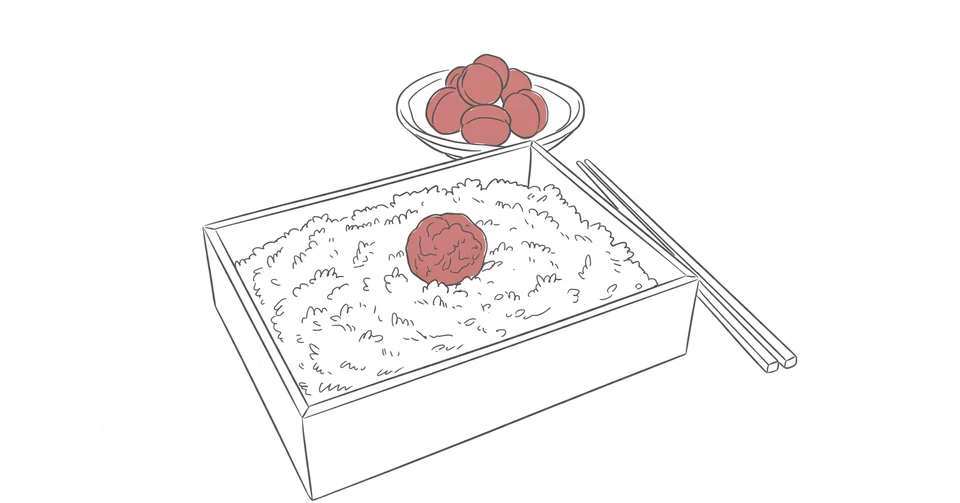
Open a bento box anywhere in Japan and you will probably find the same small red dot waiting in the middle of the rice. It is umeboshi, a salt pickled ume fruit, and it is the sharpest, saltiest, most stubborn little food in the Japanese lunchbox. One bite is enough to wake up your whole mouth, and one fruit can season an entire bowl of rice.
Umeboshi is not a snack you eat by the handful. It is a condiment, a preservative, and a piece of history all at once, and it has been all three for more than a thousand years. The fruit behind it is ume, the same tree whose blossom opens Japan's year in late winter, weeks before the cherry trees wake. Our article on the plum blossom that opens Japan's year before the cherry trees wake follows that flower through its season, and it notes that the same tree later gives Japan umeboshi, the pickled plum, eaten sparingly, usually with rice.
This article follows umeboshi from the orchard to the lunchbox: what it is, how it is made, why one prefecture grows most of it, how samurai carried it into battle, and how to eat it without wincing. If you have ever opened a bento and wondered why anyone would put something so sour next to plain rice, the answer is older and more practical than you might expect.
What umeboshi actually is
Umeboshi is ume fruit pickled in salt and then dried in the sun. The Japanese name says it plainly, since ume is the fruit and boshi comes from hoshi, meaning dried. In English it is usually called a pickled plum, but that name is a little misleading. Ume is Prunus mume, a tree botanists place closer to the apricot than to the Western plum, and its fruit is small, round, and intensely sour long before anyone pickles it.
A finished one is usually round and wrinkled, with a pit inside, and its colour ranges from pale gold to deep purple red. The red ones get their colour from purple shiso leaves, also called akajiso, added during pickling. The pale ones, called shiraboshi, are made with salt alone and no shiso at all, and under Japan's agricultural standard they are just as authentic as the red ones. What every umeboshi shares is the taste: extremely sour and salty, with a fruity edge underneath. The sourness comes largely from citric acid, which the fruit contains in large amounts, and the saltiness comes from the long cure in salt.
It is worth keeping it separate from its close relative, umezuke. Umezuke is ume pickled in salt but never dried, so it stays wet and softer. Umeboshi is that same fruit after sun drying, which concentrates the flavour and makes it keep for far longer. The seasoned kind goes one step further, since the maker soaks the dried fruit again in sugar, vinegar, or other seasonings. Most of the sweet, low salt products on the shelf belong to this seasoned group.
I think the simplest way to understand umeboshi is to stop thinking of it as a fruit and start thinking of it as a seasoning. Nobody sits down to a bowl of umeboshi the way they sit down to a bowl of grapes. It is there to wake up rice, to cut through oily fish, and to make a plain meal interesting. A food that small should not be able to do so much work, and yet it does.
How umeboshi is made
Making umeboshi takes weeks, and the calendar is fixed by nature. The fruit is harvested in June, when the ume ripen and their acid content is at its highest. The classic method, described in the Wikipedia entry on umeboshi, packs the fruit in barrels with salt equal to about 20 percent of the fruit's weight. The salt draws juice out of the fruit, and the ume then soak in that salty, sour liquid for about two weeks. The liquid is called umezu, often translated as ume vinegar, although it is not a true vinegar, and it is sold on its own as a seasoning.
Red shiso enters the process during the pickling stage. The leaves are salted and kneaded first to remove their bitterness, then packed in with the ume. Their pigments react with the acidic brine and dye the fruit that familiar deep red. After the pickling stage, the fruit is laid out in the sun for several days, traditionally during the hot spell of late July and early August, and turned regularly so it dries evenly. Only then is it packed away for storage.
Modern home recipes often use less salt, around 13 percent, with a little sugar added, and the pickling takes about a month before three days of drying. The trade off is real. Salt is what preserves the fruit, so a lower salt version has a shorter shelf life and usually needs refrigeration, while a traditional high salt one can keep for years. Some makers say their salt only shiraboshi carries no fixed best before date at all, while their seasoned products last about three to six months unopened. The old method was not being difficult for the sake of it. It was solving the problem of how to keep food safe through a hot summer without refrigeration.
There is something I admire about a recipe that has barely changed in centuries. The ingredients are ume, salt, sunshine, and patience, with shiso added if you want colour. No factory trick replaces the weeks of waiting, and no shortcut produces the same result. In a food culture full of careful technique, umeboshi is almost stubbornly simple, and that simplicity is part of its charm.
Wakayama, the home of umeboshi
If umeboshi has a capital, it is Wakayama Prefecture, on the Kii Peninsula south of Osaka. The central area of the prefecture is known throughout Japan for the quantity and quality of its ume, and the town of Minabe in particular grows more ume and produces more of it than any other town in Japan. The numbers back up the reputation. Preliminary ministry statistics for the 2025 harvest show Wakayama growing 43,000 of the nation's 73,900 tonnes of ume, or about 58 percent, with Minabe Town and Tanabe City growing about 80 percent of Wakayama's crop.
The region's star variety is Nanko ume, registered as a variety in 1965. Kishu is the old name for the area, so labels often read Kishu Nanko ume. Nanko ume produces large fruit with plenty of soft flesh, so umeboshi made from ripe Nanko ume can have a soft, almost melting texture. That matters, because a good umeboshi should yield to the teeth rather than fight them, and the flesh should come away from the pit cleanly.
In December 2015, the Food and Agriculture Organization recognized the Minabe-Tanabe Ume System as a Globally Important Agricultural Heritage System. The title covers the whole landscape, not one variety: ume orchards on poor, stony slopes beside oak woods used for charcoal, with Japanese honeybees pollinating the trees. It is a reminder that umeboshi is not just a product. It is the result of a landscape, a climate, and generations of farmers working slopes that would grow little else.
The red shiso style also traces back to this region. It was mainly in the Kishu Domain, as Wakayama was called during the Edo period, that umeboshi pickled with red shiso leaves came into being, and those reddish brown to bright purple red fruits became what most people picture when they hear the word. When you buy umeboshi labelled Kishu, you are buying into that history, and the label is usually worth the small premium.
From medicine to samurai rations
Umeboshi began as medicine, not as lunch. The earliest clear written reference comes from the Ishinpo, Japan's oldest surviving medical book, compiled in 984, which describes it as a medicine. Before that, the oldest processed form of ume was probably ubai, a smoked ume used in Chinese medicine, and the fruit itself came to Japan from China more than a thousand years earlier. The foodinjapan guide to umeboshi types, taste, and history traces this path from remedy to ration in detail, including the anecdote that Emperor Murakami, who reigned from 946 to 967, recovered after drinking tea with umeboshi and kombu, a story best read as culture rather than medical record.
During the Kamakura period, warrior banquets came with umeboshi, salt, and vinegar on the side. Later, in the age of civil wars, soldiers carried it as rations. It was light, compact, and slow to spoil, which made it useful as portable preserved food, and samurai valued it for combating fatigue, a use linked to its salt and citric acid content. According to the Ume Research Association, the oldest surviving umeboshi dates from 1576, a single fruit that outlasted the wars it was made for.
What strikes me about this history is how practical it is. Umeboshi was not invented to impress anyone. It was invented because people needed food that would survive a journey, a summer, and a war, and because a sour, salty fruit happened to keep rice safe and settle the stomach. The romance came later. The usefulness came first, and the usefulness is what kept it on the table for a thousand years.
The same tree that gave Japan this food also gave it one of its great legends. The scholar Sugawara no Michizane, exiled to Dazaifu in 901, loved the plum blossom so much that, according to legend, his garden tree uprooted itself and flew through the night to join him. That story is told in full in our article on the flying plum tree that followed a scholar into exile. The blossom belonged to poetry and prayer, and the fruit belonged to the kitchen, and the same tree supplied both.
The lunchbox flag: hinomaru bento
The most famous image of umeboshi is also the simplest. A hinomaru bento is a box of plain white rice with a single umeboshi in the center, and the red fruit on white rice resembles the Japanese flag, the hinomaru. The name means rising sun, and the lunch became a small patriotic symbol in the early Showa era, when it was eaten by soldiers and by households living on wartime rationing. Because it needed only two ingredients, it was also traditionally regarded as a low cost meal, the lunch of people who had little else.
The single fruit was not only decoration. Its salt, citric acid, and polyphenols have antimicrobial activity, so it helped keep the rice safe to eat through a long day outdoors, and that practical benefit is why the habit survived long after the patriotic symbolism faded. A bento packed in the morning and eaten at noon in summer is a race against bacteria, and the sour plum in the middle was doing quiet work all morning.
Today the hinomaru bento is more nostalgia than daily lunch, but the idea behind it is everywhere. A single umeboshi still sits in the middle of countless bento boxes and onigiri, not because anyone needs a flag in their lunch, but because one small, fierce fruit makes a box of plain rice taste like a meal. I find that oddly moving. A food born of poverty and war became a symbol of home, and the symbol outlived the hardship that created it.
How to eat umeboshi
The simplest way to eat it is on a bowl of plain rice. The rice softens the salt and acid, and one fruit can season a whole bowl. That is the whole technique, and it is enough. From there, the options widen, and most of them follow the same logic: a little umeboshi wakes up a lot of something mild.
The classic uses are onigiri, where one umeboshi is tucked into the center of a rice ball, and ochazuke, where it sits on rice and hot green tea is poured over the top. It is also served with okayu, plain rice porridge, which is the standard Japanese folk remedy for colds and flu, and it turns up in makizushi, sometimes as pitted fruit and sometimes as a cheaper paste, often with slivered fresh green shiso leaves. Cooks in Wakayama add one or two when simmering oily fish, to soften the smell, and the flesh can be mashed into salad dressings, cucumber dishes, pasta sauces, or a glaze for grilled meat. Dried ume flakes even appear in furikake rice seasoning.
Two practical points help beginners. First, the pit is not edible, so remove it before chopping or blending the fruit. Second, begin with a small portion, because traditional umeboshi can taste intensely salty and sour. If that proves too much, try a honey variety next, which is rounder and closer to a sweet and sour snack. My own advice is to start with a honey umeboshi in an onigiri, where the rice and the nori soften every sharp edge, and work your way toward the salt only kind. There is no prize for suffering through your first one.
The types on the shelf
Walk into a Japanese supermarket and the umeboshi shelf can be confusing, because the labels describe real differences in salt, sweetness, and seasoning. The five main types below cover most of what you will find, and the salt percentage printed on the package is the most useful number on it.
| Type | Seasoning | Salt level | Best with |
|---|---|---|---|
| Shiraboshi | Salt only | High | Plain rice, onigiri |
| Shiso-zuke | Salt and red shiso | Medium to high | Rice, bento |
| Honey | Honey or sugar | Low | On its own, with tea |
| Kombu | Kombu kelp | Varies | Ochazuke, rice |
| Katsuobushi | Dried bonito flakes | Varies | Rice, onigiri |
Shiraboshi is the plain, old style product: ume, salt, and sunshine, with nothing else. Shiso-zuke adds red shiso leaves for colour and a fresh scent, and it is the type most people picture when they think of umeboshi. Honey umeboshi suits people who prefer a milder, sweeter flavour, and you can eat it on its own. Kombu umeboshi is seasoned with kelp to add a mellow umami flavour, while katsuobushi types use dried bonito flakes.
Salt levels vary by maker, so check the percentage printed on the package rather than trusting the name alone. A lower salt figure usually means a sweeter product and a shorter shelf life, which is the trade off that runs through the whole story of umeboshi. The old salty kind keeps forever and shocks the mouth. The new sweet kind is gentle and needs the fridge. Neither is wrong, but they are different foods wearing the same name, and knowing which one you bought saves a surprise.
Salt, sourness, and a word of caution
The pickle is honest about what it is, and the numbers are part of that honesty. Salted umeboshi is low in calories and high in sodium. Japan's food composition tables list 7,200 milligrams of sodium per 100 grams for salted types, which equals 18.2 grams of salt, while seasoned types contain 3,000 milligrams of sodium, or 7.6 grams of salt. Since one fruit's edible flesh weighs about 10 grams, a single traditional umeboshi provides roughly 1.8 grams of salt, against the World Health Organization's recommendation of less than 5 grams of salt a day for adults.
That is why portion size matters, and why it is eaten sparingly. One fruit seasons a bowl of rice, and that is the point. People who must restrict salt, including those managing blood pressure, should follow their doctor's advice and check the label, and the seasoned types are the safer starting point for them.
The health claims around umeboshi deserve the same caution. It is believed to be a digestive aid and a remedy for nausea and hangovers, and it was given to samurai as part of a field ration to combat fatigue. A 2018 study suggested ume may have anti allergic effects, and laboratory studies have examined compounds in ume extract for blood flow. But tradition is not proof, and the presence of citric acid does not prove a health effect. The foodinjapan guide puts it well: the reputation is stronger than the evidence. What is certain is that umeboshi makes rice taste better and keeps it safer for longer, and that is already a lot for one small fruit to do.
Buying your first umeboshi
Supermarkets and department store food halls across Japan sell it, so finding them is easy. Choosing is harder, though, and a few label terms make the choice simpler. The salt percentage is printed as a number followed by the percent sign, and it is the single most useful thing on the pack. Shiraboshi means salt only, shiso-zuke means pickled with red shiso, chomi umeboshi means seasoned after pickling, hachimitsu means it contains honey, and gen-en means reduced salt.
Specialty shops offer a wider range and the chance to taste before buying. In Tokyo, the standing counter Tachikui Umeboshiya in Tokyo Solamachi lets visitors compare varieties from across Japan side by side, with tea alongside, and its tasting set of three umeboshi with hojicha tea cost 1,100 yen including tax as of October 2026. A tasting counter is the right place to learn what you like, because the difference between a salt only umeboshi and a honey one is the kind of thing you have to taste to understand.
If you are buying outside Japan, Japanese and other Asian grocery stores often stock umeboshi, and online retailers ship them too. The same label advice applies abroad: check the salt percentage, read the ingredient list, and follow the storage instructions. Basic umeboshi is plant based, since it contains only ume, salt, and sometimes shiso, but honey varieties contain honey and katsuobushi varieties contain fish, so flavoured products are not always vegan.
A small fruit that carries a whole culture
Umeboshi began as medicine in a book written in 984, became a soldier's ration, became a flag in a lunchbox, and ended up as the small red dot that makes a bowl of rice feel complete. Few foods carry that much history in so little space, and fewer still do it without ever changing their basic recipe. Ume, salt, sunshine, and patience are still the whole story, a thousand years later.
If you have never tried umeboshi, start the way Japan does: one fruit, a bowl of plain rice, and no expectations. Let the sourness hit, let the rice soften it, and notice how the whole bowl changes around it. The first bite may make you wince. The second one usually makes you reach for more rice. That is the point of umeboshi, and it has been the point all along. A small, sour, salty fruit that asks for nothing except a little rice and a little respect, and gives back a meal that tastes like Japan.
More in Food & Travel
- The Two Lives of Japanese Coffee
- Toshikoshi Soba Is the Long Noodle Japan Eats at Midnight
- Izakaya, the After-Work Pubs Where Japan Unwinds
- Japanese Street Food, From Takoyaki Stalls to Festival Yatai
- Namasu Turns Daikon and Carrot Into a Red and White Wish
- Ebi Bends Like an Old Back and Wishes You a Long Life
Latest posts
- Hello Kitty and the Cat Who Conquered the World
- Baikasai Serves Tea Under the Plum Blossom at Kitano Tenmangu
- Plum Blossom Opens Japan's Year Before the Cherry Trees Wake
- Tenjin Engi Emaki Paints a Storm God Into a Saint of Learning
- The Flying Plum Tree That Followed a Scholar Into Exile
- Kitano Tenmangu Turns Plum Blossom Into a Prayer for Exams
- Japanese Geisha and the World Behind the Painted Face
- Tenjin Is the Storm God Who Became Japan's Patron of Learning
- Queen Is the Crown Japan Gives Its Best Woman Karuta Player
- Japanese Pottery and the Six Kilns That Turned Clay into Culture
- Meijin Is the Title Every Karuta Player Dreams of Wearing
- Dazaifu Tenmangu Is Where Japan Still Prays to a Scholar God
- Sugawara No Michizane Became the God Students Still Pray To
- Wakamizu Is the First Water Japan Draws for Good Luck
- Japanese Kabuki and the Theatre That Paints Its Actors