Wakamizu Is the First Water Japan Draws for Good Luck
· 17 min read
Wakamizu is the first water drawn from the well on New Year's Day morning in Japan, believed to be pure and holy and used for offerings, tea, cooking, and calligraphy ink.
Before the sun is properly up on New Year's Day, someone in the house walks out to the well. The village is still quiet, the air is cold enough to sting, and the first sound of the year in that household is a wooden bucket going down into the dark. What comes back up is wakamizu, the first water of the year, and for the family waiting inside it is not ordinary water at all.
Wakamizu means young water, and it names both the act and the water itself: the drawing of the first water from the well on New Year's Day morning, and the water that is drawn. It was believed to be pure and holy, able to wash away bad fortune from the old year, and everything it touched on that first morning was meant to carry a little of that cleanliness into the months ahead.
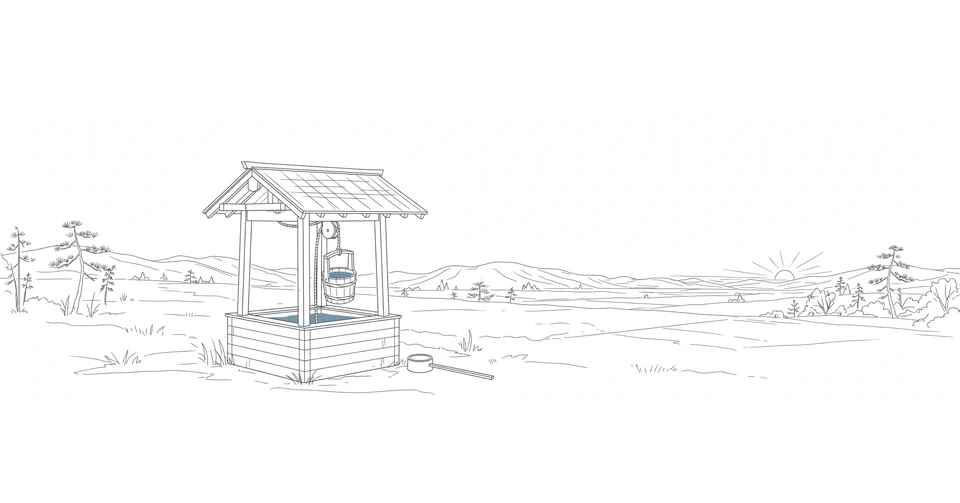
That is the whole custom in one image, a bucket, a well, and a household that has decided the year should begin with something clean. There is no crowd, no ticket, and no performance. The ritual belongs to the family, and its power comes from being first. The first water, the first tea, the first meal, and the first writing all follow from that single bucket, and wakamizu sets the standard for all of them, because the day is built around keeping each of those firsts unspoiled.
What wakamizu means
The word itself is simple. Waka means young, and mizu means water, so wakamizu is young water, water that is fresh because it is the first of the year. The Japanese Wiki Corpus entry on wakamizu defines it plainly as drawing water from a well early on New Year's Day morning and offering it at a household Shinto altar, and notes that the word also means the water that is drawn.
The belief behind the custom is that wakamizu is different from the water drawn on any other morning. A well sits still through the night, and the first bucket of the new year was thought to hold water that had rested untouched while the year turned. People believed wakamizu could remove bad influences, and that drinking it or cooking with it would protect the household. It was not a scientific claim. It was a way of saying that the year deserved a clean start, and that clean water was the most honest symbol of one.
The offering came first. Before anyone drank from the bucket, a portion of wakamizu was placed at the kamidana, the household Shinto altar, as an offering to Toshigami, the god of the incoming year. Only after the god had been served did the wakamizu pass to the family, for the morning meal, for rinsing the mouth, and for brewing tea. That order matters, because it shows what the custom really was. It was not a trip to fetch water. It was a small act of hospitality toward a guest who had just arrived, and the guest was the new year itself.
I find that order quietly moving. A family that has just finished the noise and expense of the old year begins the new one by serving someone else first, and the someone else is invisible. There is a generosity in that which has nothing to do with money. The household gives the best and freshest thing it has, which is water, and trusts that the year will answer in kind.
The morning of the first drawing
The drawing happened early, before the household met anyone else. There was a convention that the person sent to the well should go before meeting another person, and if they did meet someone on the way, they might not speak to them. Silence was part of keeping the wakamizu pure. A greeting, a piece of news, or a complaint from the old year could spoil the first water, or so people believed, and the walker kept their mouth shut until the bucket was safely home.
The tools were new. The bucket was new, and the ladle was new, bought or made for the occasion, because old tools carried the old year with them. Temarikai's guide to Oshogatsu describes how families prepared a new wooden bucket to draw the first water of the year, and how the head of the household would draw it from an auspicious well, bring it home in the new bucket, and dip it with a new ladle. The guide to Oshogatsu also notes that this water was used for the day's tea and for ozoni, the New Year soup with mochi rice cakes.
The well itself mattered too. Not every well would do. The wakamizu was drawn from the household well, or in some accounts from a temple well or another well considered auspicious, and the choice of the well was part of the ritual. A good well was a source of pride for a house, and drawing the first water from it was a way of saying that the house itself was in good order. The rope, the bucket, and the cold air were the same as on any other morning, but the intention turned them into something else.
There is a discipline in this that I admire. The custom does not ask for a grand gesture. It asks for someone to get up early, in the cold, and walk to the well in silence with a new bucket. That is a small hardship, and small hardships chosen freely are often the ones that hold a family together. The first morning of the year begins with effort rather than comfort, and the rest of the day tastes better for it.
Who draws the water and what they say
The duty of drawing wakamizu was not left to chance. According to the Japanese Wiki Corpus entry, it was assigned to the toshi-otoko, the man of the household born in the zodiac year then current, or a woman of the family drew it instead. The toshi-otoko was the year's man, the person whose birth sign matched the incoming year, and giving him the bucket of wakamizu was a way of putting the year itself in charge of its own first water.
That detail tells us something about how the custom was understood. It was not a chore to be handed to whoever happened to be awake. It was an honour, and it fell to the person whose year it was. The toshi-otoko carried the luck of the household for that year in his birth sign, and the first water passed through his hands before it reached anyone else.
As the bucket of wakamizu came up, an auspicious phrase was chanted, such as "I draw golden water." The words turned the water into gold, at least in speech, and the person drawing it said aloud what the household hoped for. The phrase is short, and its bluntness is part of its charm. It does not ask for gold in a roundabout way. It declares that the water in the bucket is golden, and then the household lives as if that were true.
I like the fact that the custom gives the drawer something to say. A silent walk to the well could feel lonely, and a short chant fills it with purpose. The words also mark the moment. Without them, drawing water is just drawing water. With them, it is the first act of the year, spoken out loud, and everyone in the house knows that the year has properly begun when they hear the bucket return.
What wakamizu is used for
Once the wakamizu was home and offered at the altar, it went to work. The Japanese Wiki Corpus entry lists its uses plainly: it was used to make an offering to Toshigami, to make a family meal, to rinse out the mouth, and to brew tea after it was offered at the household altar. Each use carried the same idea, that wakamizu should touch everything the family takes into itself on the first day.
The tea came first among the daily uses. The first cup of tea of the year, brewed with wakamizu, was a quiet ceremony inside the house, with no audience beyond the family. It was not a formal tea gathering with rules and guests. It was the ordinary morning tea made extraordinary by the water in it, and the difference was entirely in the mind of the drinker. The same leaves, the same pot, and the same cups, but the water had been drawn at dawn, in silence, from a well, and that was enough to make the cup feel like a blessing.
The cooking followed the same logic. The wakamizu went into the family meal and into ozoni, the soup with mochi that opens the New Year. Temarikai's guide records that the first water was used for the day's tea and also for ozoni, and that detail shows how thoroughly the custom reached into the day. The first meal of the year was not cooked with yesterday's water. It was cooked with the new year's water, and the family ate the year itself, or so it must have felt.
Rinsing the mouth with wakamizu was the most intimate of the uses. It was a small act of cleaning, done before eating or speaking, and it set the tone for the day. Whatever had been said in the old year, whatever quarrels or careless words, the mouth was washed with the new year's water before the new year's words began. I think there is wisdom in that which has nothing to do with superstition. A year that begins with a clean mouth is a year that begins with a choice about what to say.
Wakamizu and the first writing of the year
The most beautiful use of wakamizu is the one that leaves a mark. In the old way of doing kakizome, the first calligraphy of the year, the ink was rubbed with wakamizu, the first water drawn from the well on New Year's Day. The ink stick was ground against the stone with that water, in slow circles, until the ink was dark and smooth, and only then did the writer pick up the brush.
That connection matters, because it joins two firsts together. The wakamizu becomes the first ink, and the first ink becomes the first word, so the wish written on the paper carries the purity of the morning it was drawn in. The writer does not simply write a hopeful character. The writer writes it with the year's first water, and the whole chain, from the well to the bucket to the inkstone to the paper, is one unbroken act. If you want the full story of that writing, the tale of kakizome tells how the first brushstroke of the year becomes a wish for the months ahead.
The timing is worth noting. Kakizome is traditionally done on 2 January, the day after the wakamizu is drawn, so the water is kept overnight and used the next morning. That small delay is part of the ritual's patience. The water is not rushed into service. It rests, it is offered, it is used for tea and cooking, and then, on the second day, it becomes ink. The year opens slowly, one first at a time, and the writing waits its turn.
I find this the most convincing argument for the custom. A tradition that only produced a cup of tea would be pleasant but thin. A tradition that produces the ink for the year's first wish has a shape to it. The water is not an end in itself. It is the beginning of a sequence, and the sequence ends with a person sitting down, choosing a word, and writing it where it cannot be erased.
Where the custom came from
The honest answer is that nobody can point to a single inventor or a single year for wakamizu. It grew out of older Shinto ideas about purity, in which water washes away impurity, and out of the New Year itself, in which the household prepares to receive Toshigami, the god of the incoming year. The well was the centre of a household's water, and the first drawing of the year was the natural moment to join those two ideas together.
The custom belongs to a time when a well was not a decoration. Before piped water reached most homes, the well was where the household's drinking water came from every day, and everyone in the house knew the sound of the bucket and the weight of the rope. Drawing wakamizu was therefore not a symbolic trip to a distant shrine. It was the first use of something the family depended on, and that closeness is what gave the ritual its force. The sacred and the ordinary shared the same bucket.
Over time, the custom gathered the details that rituals gather: the new bucket, the silence, the toshi-otoko, the golden words. Each of those details solved a small problem. The new bucket kept the old year out. The silence kept gossip out. The toshi-otoko gave the duty to the right person. The chant gave the drawer words to say. None of these details needed a committee. They accumulated the way customs do, one sensible addition at a time, until the whole thing felt inevitable.
That slow growth is, to me, the most believable history the custom could have. A ritual invented in a single day would feel brittle. A ritual that grew over generations, as wells and households and New Year mornings repeated themselves, feels sturdy, and the sturdiness is the point. Wakamizu survived because it fitted the life around it, not because anyone ordered it to.
How the custom changes from place to place
Like most Japanese New Year customs, wakamizu was never exactly the same everywhere. The broad shape of wakamizu was shared: early morning, a well, a new bucket, an offering, and then tea and cooking. The details shifted with the place, the household, and what water was at hand.
The well itself varied. Some households drew from their own well in the yard, which was the most common pattern. Others drew from a temple well or from a well in the neighbourhood known to be lucky, and the walk to that well became part of the ritual. The difference was small, but it changed the feel of the morning. Drawing from your own well is a private act. Walking to a temple well is a small journey, and the silence on that journey carries a different weight.
Who drew the water varied too. The toshi-otoko was the honoured choice, but a woman of the family often drew it instead, and in many households the duty simply fell to whoever rose first or to the head of the household. The sources describe the rule and the exception side by side, and that is how customs usually work. There is a proper way, and there is the way it actually happens in a cold house on a January morning, and both are part of the tradition.
The uses of wakamizu also shifted a little from house to house. Everywhere the water was offered first, and everywhere it went into tea and the morning meal. Beyond that, some households put more weight on rinsing the mouth, and some on the ink for kakizome, and some on simply having the bucket in the house as a sign that the year had begun well. The variation is not a weakness. It is evidence that the custom belonged to families rather than to officials, and families adapt what they inherit.
Does wakamizu survive today
The literal custom has faded, and the reason is simple: the well has gone. Most homes in Japan now draw their water from a tap, and a tap has no bucket, no rope, and no silence to keep. There is no first drawing when the water arrives through a pipe, and the morning walk to the well has nowhere to go. The custom depended on a piece of household equipment that modern life removed, and when the well went, the ritual went with it for most families.
But wakamizu has not disappeared entirely. The word is still known, and the idea of wakamizu still appears wherever the New Year is described with care. Families who still have a well, especially in rural areas, can still draw the first water as their grandparents did. Tea practitioners keep the memory of it alive, because the first tea of the year still wants the best water, and the phrase "young water" still names something a tea drinker understands. And the custom survives inside kakizome, where the ink is still ground with the first water in the traditional telling, even when the water itself comes from a bottle rather than a bucket.
There is also a quieter survival, which is the habit of marking firsts. The New Year season is still full of them: the first shrine visit, the first sunrise, the first dream, the first writing. Wakamizu was the first of those firsts, the one that made the others possible by giving the household clean water to begin with. Even when the bucket is gone, the instinct behind it remains, and that instinct is to begin carefully, with something clean, rather than to stumble into the year half asleep.
The week the water belongs to is still marked as well. The pine decorations that welcome Toshigami stay up while the god is in residence, and the story of matsunouchi tells how long that welcome lasts and why the pine stays up for its guest. Wakamizu is drawn at the start of that week, and the water and the pine belong to the same welcome. One guards the door, and the other fills the cup, and between them the household is ready.
Why a bucket of water still matters
Wakamizu is a small custom, and its smallness is the reason it is worth remembering. It does not ask for money, for travel, or for an audience. It asks for an early morning, a new bucket, a silent walk, and a few words spoken over the water. Anyone with a well could do it, and anyone without a well can still understand it, because the wish behind it is universal.
The wish is that the year should begin clean. Not rich, not famous, and not even happy in any grand sense, but clean, like water drawn before anyone has had a chance to spoil it. That is a modest hope, and modesty suits the start of a year. Big resolutions fail because they ask too much on the first day. A bucket of clean water asks only that the household begin with care, and care is a habit that can last for twelve months if it is practised on the first morning.
I think that is why the custom still speaks to people who will never draw water from a well. Modern life has plenty of noise, plenty of hurry, and plenty of secondhand water, in the sense of days that begin with a phone screen and a rush. Wakamizu offers the opposite: a morning that begins with a walk, with silence, and with a task done properly for its own sake. The water itself is ordinary. The attention paid to it is not, and attention is the rarest thing a new year can receive.
So the bucket goes down into the dark, and it comes back up shining. The god is served first, the tea is brewed, the meal is cooked, the mouth is rinsed, and the ink is ground with wakamizu for the first word of the year. None of it is spectacular, and all of it is enough. A year that begins with clean water has begun well, and the rest of the year, whatever it brings, starts from that first clean drink.
More in Culture & Society
- Japanese Pottery and the Six Kilns That Turned Clay into Culture
- Meijin Is the Title Every Karuta Player Dreams of Wearing
- Dazaifu Tenmangu Is Where Japan Still Prays to a Scholar God
- Sugawara No Michizane Became the God Students Still Pray To
- Kakizome Turns the First Brushstroke of the Year Into a Wish
- Ujigami Is the Guardian God Who Watches Over One Neighbourhood
Latest posts
- Japanese Kabuki and the Theatre That Paints Its Actors
- Omi Jingu Is Where Karuta Crowns Its Champions
- Hagoita-ichi Turns Asakusa Into a Forest of Paddles
- The Two Lives of Japanese Coffee
- Chihayafuru Made a Card Game Feel Like a Sport
- Oshi-e Hagoita Turns Silk Into a Picture You Can Touch
- Hyakunin Isshu Gave Karuta Its Hundred Poems
- Hagoita Is the Paddle Japan Turns Into New Year Art
- Takoage Sends New Year Wishes Up on a Paper Kite
- Hanetsuki Keeps New Year in the Air With a Wooden Paddle
- Japanese Stationery and the Small Tools Japan Takes Seriously
- Karuta Turns a Hundred Poems Into Japan's Fastest Card Game
- Hatsuyume Is the First Dream Japan Reads Like a Fortune
- Japanese Manga and How It Became the World's Most Read Comics
- Toshikoshi Soba Is the Long Noodle Japan Eats at Midnight