Dazaifu Tenmangu Is Where Japan Still Prays to a Scholar God
· 18 min read
Dazaifu Tenmangu in Fukuoka is the head shrine of some 12,000 Tenmangu shrines, built over the grave of the scholar Sugawara no Michizane, and it still draws millions of visitors every year.
Most shrines in Japan ask you to pray for good fortune in general terms. Dazaifu Tenmangu asks for something specific. Students come here with an exam date circled on a calendar, parents come with a child who is losing sleep over an entrance test, and writers come with a manuscript that will not behave. The god they pray to was once a living scholar, and Dazaifu Tenmangu stands on his grave.
Dazaifu Tenmangu sits in the small city of Dazaifu, about fifteen kilometres southeast of central Fukuoka. It enshrines Sugawara no Michizane, a ninth century scholar, poet and statesman who was exiled from Kyoto and died here in 903. Today it is the head shrine of roughly 12,000 Tenmangu shrines across Japan, and the official site says it welcomes more than ten million visitors a year. That number is hard to picture until you stand on the approach road in February, when the plum trees are in bloom and the crowd moves slowly past the sweet shops, and you realise that a man dead for more than eleven centuries still sets the rhythm of a whole town.
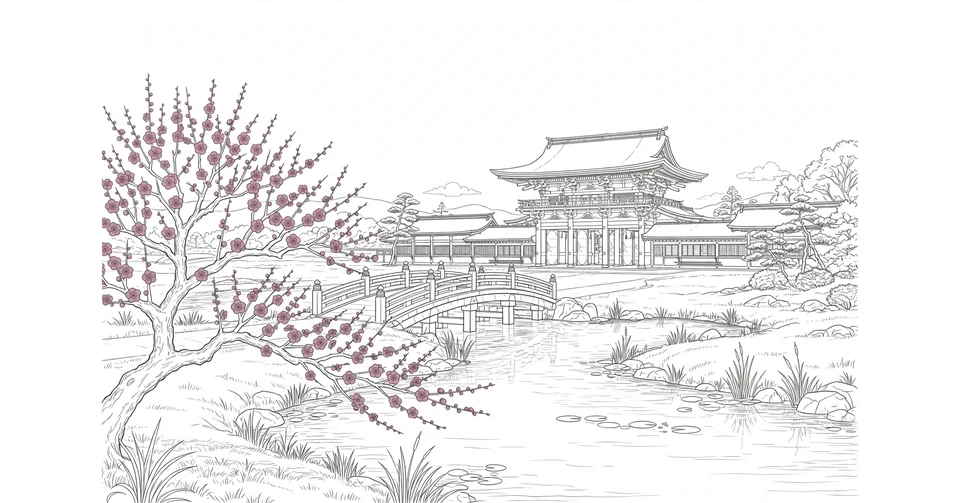
What makes Dazaifu Tenmangu different from the thousands of shrines that share its name is that this one is not a branch. The others look to it. Dazaifu Tenmangu was built where Michizane was buried, and the main hall still stands directly over his grave. Everything else, the plum groves, the arched bridges, the grilled plum cakes, the walls of wooden prayer plaques, grew out of that single fact. A scholar was punished, died far from home, and became a god. Japan never quite let the story go.
The scholar who was exiled and became a god
Sugawara no Michizane was born in 845 into a family of scholars, and he rose through the imperial court on the strength of his learning. He wrote poetry in Chinese, served as a minister, and reached a position that made powerful rivals uncomfortable. The Fujiwara clan, the family that dominated court politics in the Heian period, saw him as a threat. In 901 he was accused of plotting against the emperor, stripped of his rank, and exiled to Dazaifu, then a remote government outpost in Kyushu.
Exile in the Heian period was not a quiet retirement. It was a public disgrace, and it usually meant dying far from everything a person had built. Michizane spent his last two years in Dazaifu studying and writing, and he died there in 903 at the age of fifty seven. His body was carried on an ox cart toward a burial ground, and according to the legend the ox stopped near a Buddhist temple and refused to move further. His followers took the sign seriously and buried him on that spot. A statue of an ox still stands on the grounds to mark the moment, and visitors rub its head and horns for luck in their studies, a gesture that has polished the bronze smooth over the centuries.
The story did not end with the burial. Within a few years of Michizane's death, several members of the Fujiwara clan and the imperial family died, one of them by a lightning strike. People in Kyoto read the disasters as the anger of Michizane's spirit, and the court moved to make amends. His rank was restored after his death, and he was worshipped as Tenjin, a deity of learning, literature and calligraphy. Fear came first, and reverence followed. The full story of how a disgraced courtier became the god students still pray to is told in our article on Sugawara no Michizane, who became the god students still pray to, and it is worth reading before a visit, because Dazaifu Tenmangu makes far more sense once you know whose grave you are standing on.
Why Dazaifu Tenmangu was founded on a grave
A first hall was built over Michizane's grave in 905, two years after his death, and a larger shrine was constructed by imperial order in 919. Sources differ slightly on which year should count as the founding, and the honest answer is that both dates describe the same slow beginning. The small hall came first, and the formal shrine followed. The outline of this history is set out on Wikipedia's Dazaifu Tenmangu page, which records the 905 hall, the 919 shrine, and the 1591 rebuilding. Dazaifu Tenmangu grew from a burial mound into one of the most important shrines in Japan, and it has never moved from the spot where the ox stopped.
There is something quietly radical about that continuity. Japanese shrines are often rebuilt, moved, or merged, but the main hall of Dazaifu Tenmangu has stood over the same grave for more than eleven hundred years, through fires, wars, and the slow change of the town around it. Dazaifu Tenmangu was damaged repeatedly during the civil wars of the sixteenth century, and the present main hall was rebuilt in 1591 by Kobayakawa Takakage, the lord of Chikuzen province. Most sources credit Takakage with the rebuilding, though at least one gives the name of his relative Hidekane, so the family is certain and the individual is very likely Takakage. The building is a Momoyama period structure with a cypress bark roof and vermilion lacquered columns, and it is designated an Important Cultural Property of Japan.
The hall has also just lived through its first major restoration in 124 years. Work began in May 2023, and during the restoration worship moved to a temporary hall designed by the architect Sou Fujimoto, a striking structure with a roof planted as a living forest of 46 plant species. The temporary hall was dismantled in the spring of 2026, and worship at the front of the restored main hall resumed in September 2026. If you visit now, you will see the 1591 building again, its lacquer and paint renewed and its roof relaid, standing where it has always stood. The timing was deliberate. The year 2027 brings a grand festival marking 1,125 years since Michizane's death, and Dazaifu Tenmangu wanted its main hall ready.
I find that detail moving in a way that is hard to explain to someone who has never watched a shrine being repaired. A building that old is not preserved by leaving it alone. It is preserved by people who keep deciding, generation after generation, that it is worth taking apart and putting back together. The restoration was not nostalgia. It was a promise kept to a scholar who died in exile, renewed by carpenters and priests who never met him.
The flying plum tree and six thousand plum trees
The most famous tree at Dazaifu Tenmangu is not the oldest or the tallest. It is a plum tree called the tobi-ume, the flying plum, which stands to the right of the main hall. The legend says that when Michizane left Kyoto in exile, he longed so deeply for a plum tree in his garden that the tree uprooted itself and flew to Dazaifu to be with him. Our earlier article on Michizane records the same detail, noting that the tree "still stands at Dazaifu Tenmangu, to the right of the main hall, flowering earlier than the other plum trees on the grounds." The tree still blooms first, usually in mid to late January, and its early flowers are treated as the first plum blossom of the year in Japan.
The tobi-ume is only the beginning. The grounds of Dazaifu Tenmangu hold about 6,000 plum trees in 167 varieties, according to Dazaifu Tenmangu's own accounts, and they bloom in succession from late January into early March. The peak usually falls between mid February and the first week of March. Walking through the groves in that season is a slow business, because every few steps there is another tree worth stopping for, white blossoms, pink blossoms, deep red blossoms, and the scent of plum carried on a cold wind.
Dazaifu Tenmangu holds its Plum Blossom Festival, the Baikasai, on 25 February, the anniversary of Michizane's death. It is a solemn day as much as a celebration, a memorial service for the man at the centre of all of this, held while the trees he loved are in full flower. On the first Sunday of March Dazaifu Tenmangu holds the Kyokusui no En, a winding water banquet in which poets in Heian period dress compose verse as cups of sake float down a stream toward them, a ceremony that recreates the court culture Michizane knew in Kyoto. If you want to understand why the plum matters here, watch the festival rather than reading about it. A flower becomes a calendar, a memorial, and a poem all at once.
The ponds, the bridges and the walk to the main hall
A visit to Dazaifu Tenmangu follows a set path, and the path is part of the prayer. From the approach road, lined with shops and tea houses, you pass through the torii gate and cross the taiko-bashi, the arched drum bridges that span Dazaifu Tenmangu's ponds. There are three bridges, and crossing them is traditionally understood as a form of purification, a small symbolic cleansing before you stand before the god. The bridges are steep enough that you have to watch your step, which is probably the point. A prayer that begins with attention is a better prayer than one made on autopilot.
Below the bridges lies the Shinji pond, shaped to resemble the kanji character for heart. The pond holds a small island shrine, and the water reflects the bridges and the trees in a way that makes the whole scene feel suspended. Dazaifu Tenmangu's own map of the grounds lists the torii, the sacred ox, the taiko-bashi, the main hall, the guardian lion dogs, the tobi-ume, a smaller shrine on the island, the museum, and the Inari shrine on the hill behind. It is a large precinct, and it rewards walking slowly rather than hurrying to the main hall and back.
Past the bridges stands the romon, the two storey gate, rebuilt in 1911 after earlier versions burned. Beyond it is the walled courtyard of the main hall itself. The courtyard is where the atmosphere changes. The approach is a busy street, the ponds are a garden, and the courtyard is a place of quiet purpose, full of people who have come for a reason. I have always thought that the design of Dazaifu Tenmangu is a lesson in how to arrive somewhere slowly, and that the bridges and the pond are not decoration. They are a way of leaving the ordinary street behind, one step at a time.
Umegae mochi and the taste of the shrine
No visit to Dazaifu Tenmangu is complete without umegae mochi, the grilled rice cake filled with sweet azuki bean paste and stamped with the pattern of a plum blossom. Shops along the approach road grill them fresh, and the smell carries down the street before you can see the stalls. The cakes are strongly associated with Dazaifu Tenmangu through a legend. An elderly caretaker named Jomyoni is said to have prepared them for Michizane during his exile, and to have left one as an offering when he died.
The cakes cost very little, and they are best eaten hot, standing on the street with the steam rising into the cold air. That is not a trivial detail. A shrine can be admired from a distance, but a food that belongs to it has to be tasted to be understood. Umegae mochi is the shrine in edible form, plum shaped, bean filled, and made by the same families for generations. I think there is a kind of wisdom in the fact that the most famous product of a great shrine is a small, cheap, warm cake, and not something grand. The shrine feeds people before it impresses them.
The approach road also holds a famous Starbucks, designed by the architect Kengo Kuma with a lattice of interlocking wooden batons, and the contrast is worth a pause. A medieval shrine, a modern coffee shop built in traditional joinery, and a row of old sweet shops stand side by side on the same street, and nobody seems to find the combination strange. Dazaifu Tenmangu has always absorbed the present without losing the past, and the street outside its gate proves it.
Exam season, ema plaques and the god of learning
For much of the year Dazaifu Tenmangu is a pleasant historic shrine with beautiful gardens. In January, February and March it becomes something else entirely. That is exam season in Japan, when high school and university applicants sit their entrance tests, and Dazaifu Tenmangu fills with students and their parents. They buy omamori, protective charms, for academic success, and they write their wishes on ema, small wooden plaques, and hang them on racks beside the main hall. The plaques are covered in the names of universities, Tokyo, Kyoto, Keio, Waseda, and every regional university in the country, each one a small, specific hope written by hand.
Reading the ema racks is a lesson in how seriously Japan takes examinations, and also in how tenderly families handle them. A parent buys a charm for a child. A student writes a school name in careful characters. A grandparent comes along to pray on behalf of someone who could not make the trip. Dazaifu Tenmangu sells charms for general study success, for passing a specific exam, and for ongoing learning, and the most sought after are the ones for exam success, the gokaku omamori. Prices are modest, and the charms are small enough to carry in a pencil case or a bag, which is exactly where they end up.
There is a risk of treating all of this as quaint, and it would be a mistake. The pressure of entrance exams in Japan is real, and it weighs heavily on teenagers. What Dazaifu Tenmangu offers is not a guarantee but a place to put the anxiety down for a little while, to say the hope out loud, and to feel that someone, a god who was once a student himself, is listening. Michizane was a scholar who knew what it meant to be judged by others and to fail in public. That is why students trust him. He is not a distant god of fortune. He is a man who studied hard, rose high, lost everything, and was remembered for the learning rather than the disgrace.
I have a quiet admiration for the way Dazaifu Tenmangu handles the crowds of exam season. It does not hurry anyone, it does not sell false certainty, and it does not turn the students into a spectacle. The priests perform blessings, the families pray, and the teenagers write their plaques and walk away a little lighter. If you visit during this season, be respectful of that. Do not photograph students while they are writing, and do not read their plaques out loud. Their wishes are private, even when they are hanging in public.
Art, the museum and a shrine that looks forward
A shrine that is more than a thousand years old might be expected to look only backward. Dazaifu Tenmangu does not. The official site describes it as a sanctuary for learning, culture and the arts, and it runs a program of contemporary art events on the grounds, working with international artists and staging installations among the ancient trees and buildings. The temporary hall by Sou Fujimoto was the most visible example of this attitude, a piece of contemporary architecture built as an act of worship, not as a contrast to it. Dazaifu Tenmangu treats art as a form of devotion, which is exactly how Michizane would have understood it. He was a poet as well as a scholar, and the line between prayer and poetry was never sharp in his world.
The grounds also hold the Dazaifu Tenmangu Museum, which keeps treasures including a tenth century history and ethnography called the Kan'en, a National Treasure, along with Heian period swords and documents from the history of Dazaifu and Kyushu. The museum is small and easy to miss, but it is worth the visit, because it holds the objects that Dazaifu Tenmangu's long story is made of. A history book from the tenth century, a sword from the Heian court, a document in Michizane's own era: these are the things that turn a legend into a record.
The same forward looking spirit shows in Dazaifu Tenmangu's neighbourhood. The Kyushu National Museum stands about a kilometre away, a large modern building that holds the history of Japan's exchanges with Asia, and the combination makes Dazaifu a full day rather than a short stop. A visitor can pray at Dazaifu Tenmangu in the morning, look at the treasures of the region in the afternoon, and walk back through the plum groves at dusk. The old capital of Dazaifu, which once governed Kyushu on behalf of the imperial court, still rewards a slow visit.
How a visit to Dazaifu Tenmangu works today
Getting to Dazaifu Tenmangu is simple. Dazaifu Tenmangu is about five minutes on foot from Nishitetsu Dazaifu Station, and the walk from the station to the gate is itself part of the experience, a straight approach road lined with shops. Entry to the grounds is free, and the shrine is open year round. The best time to come depends on what you want. Late January to early March brings the plum blossom and the largest crowds. January brings the intensity of exam season. The rest of the year is quieter, and the grounds are beautiful in every season, with camphor trees, the pond, and the long walk under the torii.
The basic form of a visit follows the pattern of any Shinto shrine. Bow once at the torii, purify your hands and mouth at the water basin, approach the main hall, bow twice, clap twice, make your wish silently, and bow once more. If you buy an ema, write your wish clearly and hang it on the rack. If you buy an omamori, keep it with you rather than opening it. If you want a blessing from a priest, the shrine office can arrange it. None of this requires special knowledge, and the shrine's staff are used to first time visitors. The shrine's official site offers a guide for first time visitors, and it is worth reading before you go.
A practical note is that the shrine's calendar is full. The year opens with the Usokae and Onisube rites on 7 January, the plum festival follows on 25 February, the winding water banquet comes on the first Sunday of March, and a grand procession, the Jinkoshiki Taisai, is held in late September. The year 2027 will bring the grand festival marking 1,125 years since Michizane's death, and it is likely to be the largest gathering the shrine has seen in years. If you plan to visit then, come early and expect crowds.
There is also a small tradition worth knowing before you go. The sacred ox statue near the main hall is rubbed for good fortune in study, and the bronze has been polished bright by a thousand hands. Touch it gently, as the others do, and remember what it marks. An ox stopped on this spot, and a grave became a shrine, and a shrine became the head of twelve thousand others. Small moments carry long histories, and this is one of them.
A shrine built on a life, not only on a legend
Dazaifu Tenmangu endures because it is built on a life that feels real, not only on a legend that feels distant. Michizane studied, wrote, rose, fell, and died far from home, and Japan spent the next thousand years deciding what to do with that story. It chose to remember him as a god of learning, and to build a shrine over his grave where students could ask for the thing he valued most, the chance to learn and to be judged fairly for what they know.
That is why the shrine still matters, and why it will go on mattering. Examinations will change, the plum trees will bloom earlier or later with the weather, and the buildings will need repair again in another century. But the need that brings people here will not change. Someone will always be facing a test that decides the next part of their life, and someone will always want a quiet place to ask for help with it. Dazaifu Tenmangu is that place, and it has been that place for more than eleven hundred years.
If you go, go slowly. Cross the bridges, look at the pond, stand under the tobi-ume, and write your wish on a wooden plaque if you have one. Eat a warm umegae mochi on the way out. And if you have a moment for the first brushstroke of a new year, our article on kakizome, when the first brushstroke of the year becomes a wish is a good companion for the walk home, because Michizane was a calligrapher as well as a scholar, and the first writing of the year was always a prayer as much as a practice. The shrine will be there when you return, as it has been for everyone who came before you.
More in Culture & Society
- Japanese Pottery and the Six Kilns That Turned Clay into Culture
- Meijin Is the Title Every Karuta Player Dreams of Wearing
- Sugawara No Michizane Became the God Students Still Pray To
- Wakamizu Is the First Water Japan Draws for Good Luck
- Kakizome Turns the First Brushstroke of the Year Into a Wish
- Ujigami Is the Guardian God Who Watches Over One Neighbourhood
Latest posts
- Japanese Kabuki and the Theatre That Paints Its Actors
- Omi Jingu Is Where Karuta Crowns Its Champions
- Hagoita-ichi Turns Asakusa Into a Forest of Paddles
- The Two Lives of Japanese Coffee
- Chihayafuru Made a Card Game Feel Like a Sport
- Oshi-e Hagoita Turns Silk Into a Picture You Can Touch
- Hyakunin Isshu Gave Karuta Its Hundred Poems
- Hagoita Is the Paddle Japan Turns Into New Year Art
- Takoage Sends New Year Wishes Up on a Paper Kite
- Hanetsuki Keeps New Year in the Air With a Wooden Paddle
- Japanese Stationery and the Small Tools Japan Takes Seriously
- Karuta Turns a Hundred Poems Into Japan's Fastest Card Game
- Hatsuyume Is the First Dream Japan Reads Like a Fortune
- Japanese Manga and How It Became the World's Most Read Comics
- Toshikoshi Soba Is the Long Noodle Japan Eats at Midnight