Aojiso Is the Green Leaf Japan Eats Fresh and Raw
· 20 min read
Aojiso is the green perilla leaf Japan eats fresh and raw, the garnish under the sashimi, the wrapper around the onigiri, and the quiet herb in nearly every Japanese meal.
Look at a plate of sashimi in Japan and you will see the fish first. Look again and you will see the leaf underneath it, broad and green, with a serrated edge like a saw blade. That leaf is aojiso, and it is not a decoration. It is an ingredient, eaten in the same bite as the fish it carries, and it has been doing that job for more than a thousand years.
Aojiso is the green form of shiso, the Japanese perilla herb, and it is the half of the plant that Japan eats fresh and raw. Where its red sibling works in the pickle jar, aojiso works on the plate, as a garnish, a wrapper, a divider, and a seasoning all at once. If you have eaten Japanese food more than a few times, you have almost certainly met aojiso, whether or not you knew its name.
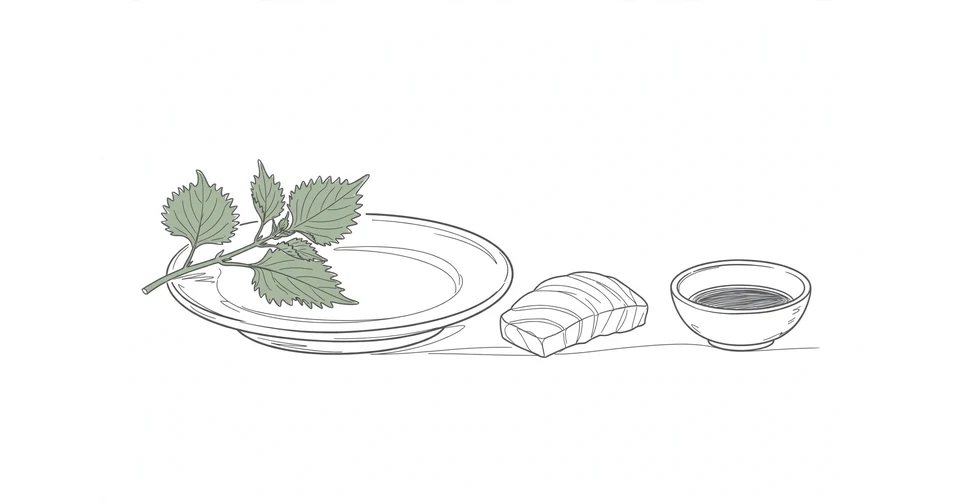
This article follows aojiso from the garden to the plate. It explains what the leaf is, how it differs from its red sibling, what it does on the sashimi plate, how it wraps and flavours rice and noodles, what it tastes like, and how to grow it or buy it if you live far from Japan. Aojiso is a small subject with a long reach, and it repays a closer look.
What aojiso actually is
Aojiso is the green form of Perilla frutescens var. crispa, a herb in the mint family Lamiaceae. The Japanese name breaks down simply: ao means blue, or green in the old Japanese sense of the word, and shiso comes from the Chinese zisu, meaning purple perilla. The leaf is also called oba, meaning big leaf, which is the name you will hear most often at a fish counter or in a home kitchen. Botanists call the flat green form f. viridis, to separate it from the ruffled green form that cooks know as chirimen-aojiso.
The plant behind the name aojiso is a cultigen of Perilla frutescens, native to the mountainous regions of China and India and now found worldwide. It was cultivated in ancient China, and one early mention comes from the Supplementary Records of Renowned Physicians, written around 500 AD, where it is listed as su with some of its uses described. It was introduced into Japan around the eighth to ninth centuries, and aojiso has been part of Japanese cooking ever since. That is more than a thousand years of continuous use, which is a long apprenticeship for a leaf.
An aojiso plant grows 40 to 100 centimetres tall, with broad ovate leaves that have pointy ends and serrated margins, arranged in opposite pairs on long leafstalks. Its seeds are tiny, about 1 millimetre across, and the plant is not frost hardy. The leaves are large for a kitchen herb, which is part of their usefulness. A single leaf is big enough to hold a slice of fish, to wrap a mouthful of rice, or to carry a dab of wasabi, and that size is exactly what the name oba celebrates.
The Wikipedia entry on shiso gives the fullest account of the plant, covering the varieties, the history, and the culinary uses across East Asia, and it is the best single reference for telling the green and red forms apart. For the kitchen side, the Just One Cookbook guide to shiso is the most practical source, with recipes, growing advice, and storage tips from a cook who grows the herb herself. Both sources agree on the point that matters most: the green leaves are suited for eating, and the red leaves are used in pickling.
I think the name oba tells you everything about how Japanese cooks see this leaf. It is not named for its flavour or its colour, but for its size, because its size is what makes it useful. A herb that can be a plate, a wrapper, and a seasoning at the same time earns a name that describes its shape, and aojiso wears that name well.
Aojiso and akajiso, two leaves with two jobs
Shiso comes in two main forms that behave like two different ingredients in the kitchen, and aojiso is one half of that pair. The green kind, called aojiso or oba, is eaten fresh and raw. The red kind, called akajiso, is a dyer and a pickler before it is ever a seasoning. Japanese cooks treat them as different tools, and confusing the two is the most common mistake a newcomer makes.
The green form is the common one, used all year round in Japanese cooking, much as basil and mint are used in Western cooking. It garnishes sashimi, frames cold noodles, and tops rice, and it is eaten in the same bite as the food it accompanies. Akajiso almost never appears on the plate that way. It goes into the jar, into the brine, and into the pot, and what reaches the table is the colour and flavour it left behind rather than the leaf itself. Our article on akajiso, the red leaf that dyes umeboshi red follows the red half of the story in full, and this article stays with the green half.
Several forms of shiso exist, defined by the colour and shape of their leaves, though colouring also appears on the stalk and flower buds. The table below gives the forms a Japanese cook is most likely to meet, and it shows where aojiso sits among them.
| Form | Japanese name | Main use |
|---|---|---|
| Green, flat leaves | Aojiso, oba | Eating fresh, garnish |
| Green, ruffled leaves | Chirimen-aojiso | Eating fresh, garnish |
| Red, flat leaves | Akajiso | Pickling and colouring |
| Red, ruffled leaves | Chirimen-jiso | Pickling and colouring |
| Green on top, red below | Katamen-jiso | Garnish, pickling |
| Mixed green and red | Madara-jiso | Garnish |
The difference between the two is not only colour but chemistry. The red colour of akajiso comes from shisonin, an anthocyanin pigment found in perilla, and that pigment is what lets the red leaf dye food. Aojiso has no such work to do, and it carries no such pigment. Its job is flavour and freshness, and it does that job in the open, on the plate, where you can see it and taste it in the same moment.
There is a second perilla in Japan that is worth keeping separate from aojiso. Perilla frutescens var. frutescens is called egoma in Japan and deulkkae in Korea, and its leaves are the Korean kkaennip used to wrap grilled meat. The leaves are giant and thick textured, with an intense, peppery, and earthy flavour, and they are used for side dishes and kimchi, with the seed oil used in cooking. Japanese cooks do not advise substituting it for Japanese shiso, because the two have different characteristics and different culinary uses. They are cousins, not twins, and aojiso belongs firmly on the shiso side of the family.
What I like about this division of labour is how practical it is. A kitchen that keeps both forms has a fresh herb and a natural dye in the same plant, and neither one tries to do the other's job. Western cooking tends to ask one herb to do everything, and this plant refuses. The green leaf is for eating, the red leaf is for colouring, and the cook who respects that split gets the best of both.
The leaf on the sashimi plate
Aojiso is most visible where it is least eaten, which is on the sashimi plate. A whole leaf often sits under the fish, and another may be used as a receptacle to hold wasabi, or as tsuma, the garnish that frames the main item. Whitebait sashimi is often garnished with the green leaf, and it appears with tataki, which is lightly seared fish, and namero, which is minced fish, and with hiyayakko, which is cold tofu. It is also used to garnish noodle dishes like hiyamugi and somen, where a few fine shreds bring aroma to a cold bowl.
The leaf earns its place on that plate by doing more than looking green. Aojiso has antibacterial properties, and tradition holds that it can help slow the spoilage of raw fish and seafood. That is why it has long been used to separate different items on a platter, keeping flavours fresh and from mixing. The strips of fake green plastic grass you see in sushi trays and bento boxes are meant to replicate the leaf. They look the part, but they do none of the work, and once you know what the real thing does, the plastic version feels like a small betrayal.
The flowers and sprouts of the same plant have their own roles, and they belong to the green leaf's world rather than the red leaf's. The flowers are called hojiso, and they are used as a garnish for sashimi. They are intended to be scraped off the stalk with chopsticks and added as flavouring to the soy sauce dip, and they can also be pickled. The sprouts, buds, and cotyledons are all called mejiso, and they are used as garnish. Red sprouts are called murame, and green sprouts are called aome. Although they are not often served in restaurants, mejiso are used as microgreens, and they carry the same flavour in a smaller, more delicate form.
The seed pods have a use as well. They are called shiso no mi, and they are salted and preserved like a spice. They can be combined with fine slivers of daikon radish to make a simple salad, and oil pressed from the seeds was once used for deep frying. Very little of the plant goes to waste, and that is a pattern you see across Japanese cooking: the leaf, the flower, the sprout, and the seed each have a job, and aojiso is the form that puts most of them on the plate.
What strikes me about the sashimi plate is the restraint. Aojiso is not piled on. One leaf, maybe two, placed with care, does the work. Japanese cooking often treats garnish as a seasoning rather than a decoration, and this herb is the clearest example I know. It earns its place by flavour and by function, and its beauty is a bonus rather than the point.
Aojiso as a wrapper and a seasoning in the kitchen
Away from the sashimi plate, aojiso is a workhorse, and its most distinctive talent is wrapping. A whole leaf can be folded around a piece of sashimi or a mouthful of rice and eaten in one bite, with the leaf acting as both wrapper and seasoning. The same idea carries into onigiri, where chopped aojiso is mixed into the rice or layered with a filling, and the classic pairing is ume shiso onigiri, where the sour pickled plum meets the fresh green leaf inside a ball of rice. The leaf does not hide the filling. It frames it, and the two flavours balance each other in a way neither manages alone.
Chopped aojiso is used to flavour fillings or batter for warm dishes, and the leaves are added to mixed rice and onigiri rice balls. They go into salads, into dipping sauces, and onto pasta, where dried or freshly chopped leaves are sometimes combined with raw tarako, which is pollock roe. The leaf has even been used as a pizza topping in place of basil, and in the summer of 2009 Pepsi Japan released a seasonal flavoured beverage, the green coloured Pepsi Shiso, which tells you how far the flavour had travelled from the kitchen into popular culture.
Whole leaves can be battered on one side and fried to make tempura, served with other fried items, and the result is airy and crisp, with the flavour concentrated by the heat. The batter clings to one side and leaves the other side green and tender, so a single leaf gives you two textures in one bite. It is a small piece of technique, and it shows how well Japanese cooks understand the leaf they are working with. Aojiso is not only a raw herb. Heat changes it, and the change is worth tasting.
Aojiso also works in places a Western cook would reach for mint. It can be used in drinks and desserts, in recipes that call for mint, like mojitos, cocktails, ice cream and sorbets, jellies, simple syrups, and granita. Dried and ground leaves can be used as a seasoning and sprinkled on rice and noodle dishes. A pesto made from the leaves, with pine nuts, garlic, Parmesan or Romano cheese, and extra virgin olive oil, is a favourite way to use up a garden glut, and it is served with pasta, grilled fish or meat, or in a sandwich. The Just One Cookbook guide to shiso lists these uses one by one, and calls the leaf an all around herb, and the list supports the claim. Raw, whole, or cut into fine shreds, aojiso finds a place in almost any dish that needs freshness.
My own favourite use is the simplest one: a few fine shreds over cold noodles on a hot day. The leaf does not need a recipe to justify itself. It needs a little rice or a little noodle, something plain for it to wake up. That is the test I apply to any herb I keep in the kitchen. If it can improve a plain bowl of rice, it belongs. If it needs a complicated dish to shine, it probably does not.
What aojiso tastes like
Describing the flavour of aojiso is harder than describing its colour, because the leaf does not taste like any single Western herb. Just One Cookbook calls it vibrant, herbaceous, and citrusy, with a mildly astringent taste and a bitter finish, and notes hints of mint, basil, cloves, licorice, and cinnamon. That list sounds crowded, but it is honest. The first bite is green and bright, then something warm and slightly spicy arrives, then a clean bitterness closes the taste. It is the kind of flavour that makes you pause, not because it is strong, but because it is unfamiliar.
The flavour is also why aojiso pairs so well with rich food. Fatty fish like salmon, yellowtail, and tuna are the classic partners, and a leaf or two of the green kind cut through the richness the way a squeeze of lemon cuts through fried food. The same logic explains its place next to tempura and oily dishes. It is not there to be the star. It is there to keep the star from getting tired.
There is a practical side to the flavour as well. The brightness of aojiso wakes up plain food, and that is why it appears so often beside rice, tofu, and cold noodles, the quietest foods in the Japanese kitchen. A leaf that can make white rice taste interesting without overpowering it is a leaf that understands its place. It seasons without shouting, and that restraint is rarer than it sounds.
I think the taste is an acquired one, and that is a compliment rather than a warning. The first time I tried it, I found the flavour odd, almost medicinal, and I understood why some people leave the leaf untouched on the plate. The second time, I noticed the citrus note. The third time, I missed it when it was absent. A herb that grows on you like that earns its place in a kitchen more honestly than a herb that impresses at once and bores by the fifth bite.
The ruffled cousin and the rest of the family
Not every aojiso leaf is flat. The ruffled green form, called chirimen-aojiso, has the same flavour as the flat leaf with a wavy surface and a little more texture in the mouth. Cooks use it the same way, as a garnish and as a fresh herb, and the ruffles catch sauce and dressing in a way the flat leaf does not. It is a small variation, but it shows how much attention Japanese growers have paid to a single plant over the centuries. The leaf was not only kept. It was refined.
The bicolor and variegated forms sit between the two worlds. Katamen-jiso is green on top and red below, and madara-jiso mixes green and red on both sides, and both are used as garnish. They are less common than the plain green leaf, and most cooks meet them as curiosities rather than staples, but they are a reminder that the plant does not divide neatly into two boxes. Aojiso is the form that matters most in the kitchen, and the others are variations on its theme.
One warning is worth keeping for anyone tempted to forage. Wild, weedy forms of the plant are not suitable for eating, as they do not have the characteristic fragrance, and they are high in perilla ketone, which is potentially toxic. Grow the cultivated forms from seed bought from a reputable supplier, and do not forage for the plant in the wild. The cultivated aojiso that Japanese cooks use is the one worth growing, and it is the one this article is about.
I find it reassuring that a plant with so many forms still has one clear favourite. Cooks could have chosen the ruffled leaf or the bicolor leaf as the standard, and they chose the plain flat green one instead. That choice says something about Japanese cooking. The simplest version of a thing, used well, beats the fancier version, and aojiso is the proof.
Growing aojiso at home
The good news for cooks outside Japan is that the plant is famously easy to grow, and aojiso is no exception. It is good for container growing and suitable for apartment or small space gardening, and a single pot on a balcony can supply a household through the summer. Perilla seeds are tough, so they must be softened in water overnight before sowing. Seedlings should be moved out to the garden when the nighttime temperatures are warmer than 7 degrees Celsius and all possible danger of frost has passed. If your spring is relatively cool, you may need to plant the seeds indoors for 4 to 6 weeks in mid spring.
The seeds should be planted about 6 millimetres below the surface and watered daily, since covering them with too much soil will delay germination. The ideal temperature for the plant to grow is above 20 degrees Celsius, so the timing depends on your climate. Seeds planted in May sprout about two weeks later and grow well, and leaves can be harvested as soon as they are a good size, about 3 to 4 inches long. Harvesting the leaves encourages the plant to produce more, so a few plants can keep a kitchen supplied for months.
Aojiso is a generous plant in the garden, and that generosity has a side effect worth knowing. It self seeds readily, and a pot left alone can come back the next year without any help. That is a gift if you have the space, and a nuisance if you do not, so it is worth keeping the plant in its own container rather than letting it loose in a shared bed. A herb that returns on its own asks for little and gives back a lot, and that is a fair trade.
I have never grown it myself, but the advice from cooks who do is consistent: it is one of the easiest herbs to keep alive, and it rewards a little neglect more than a lot of attention. That suits me. A herb that needs constant care is a herb I will eventually kill, but a herb that grows in a pot with daily water and a sunny spot is a herb I can keep. If you have a balcony and a taste for Japanese food, aojiso is a good place to start.
Buying and storing aojiso
Japanese grocery stores usually carry green aojiso leaves all year round in their produce section, but you may not find them at other Asian grocery stores, and it is worth checking local farmers markets. The year round availability is one reason the leaf is so common in Japanese cooking. Unlike its red sibling, which appears only in the summer months, aojiso is always there, and a cook can reach for it in any season without planning ahead.
Storage is simple. The best way to store fresh aojiso leaves is to cover them with a damp cloth or paper towel and put them in an airtight container or plastic bag, then place the container in the refrigerator in the crisper drawer. Use them as soon as possible, since the flavour fades with time. A leaf bought on Saturday and used on Saturday tastes noticeably brighter than one that has waited a week, and the difference is worth planning around.
If you cannot find the leaf fresh, the dried red seasoning yukari is easier to buy online and keeps well in a jar. It is not a substitute for the fresh green leaf, since it does a different job, but it brings the colour and some of the flavour to rice and noodles, and it is a good way to start. The fresh leaf is the goal, and the dried seasoning is a useful bridge until you find it. Nothing quite replaces aojiso picked the same day, and the search for it is part of the pleasure.
Our article on shiso, the leaf that paints umeboshi red tells the wider story of the plant, and the buying and growing advice there applies to the green leaf as much as to the red one. The two articles belong together, because the two leaves belong together, and a kitchen that understands both has the whole plant at its disposal.
Why aojiso is on nearly every Japanese plate
A thousand years is a long time for a leaf to stay in fashion, and aojiso has done it by being useful in more ways than one. It garnishes the fish, wraps the rice, flavours the noodle, seasons the pasta, and refreshes the summer drink. It asks for little, a pot, some water, and a sunny spot, and it gives back all summer. It is a herb that works as hard as a spice and as quietly as a garnish, and that combination is rare.
The next time you open a bento box and see a green leaf under the fish, you will know it is aojiso. The next time you see a leaf folded around a mouthful of rice, or a few fine shreds over a cold bowl of noodles, you will know it is not a decoration. It is a small piece of Japanese cooking history, still fresh, still fragrant, and still doing its work one leaf at a time.
More in Food & Travel
Latest posts
- Hello Kitty and the Cat Who Conquered the World
- Baikasai Serves Tea Under the Plum Blossom at Kitano Tenmangu
- Plum Blossom Opens Japan's Year Before the Cherry Trees Wake
- Tenjin Engi Emaki Paints a Storm God Into a Saint of Learning
- The Flying Plum Tree That Followed a Scholar Into Exile
- Kitano Tenmangu Turns Plum Blossom Into a Prayer for Exams
- Japanese Geisha and the World Behind the Painted Face
- Tenjin Is the Storm God Who Became Japan's Patron of Learning
- Queen Is the Crown Japan Gives Its Best Woman Karuta Player
- Japanese Pottery and the Six Kilns That Turned Clay into Culture
- Meijin Is the Title Every Karuta Player Dreams of Wearing
- Dazaifu Tenmangu Is Where Japan Still Prays to a Scholar God
- Sugawara No Michizane Became the God Students Still Pray To
- Wakamizu Is the First Water Japan Draws for Good Luck
- Japanese Kabuki and the Theatre That Paints Its Actors