The Flying Plum Tree That Followed a Scholar Into Exile
· 16 min read
The flying plum tree at Dazaifu Tenmangu is said to have uprooted itself and flown from Kyoto to join the exiled scholar Sugawara no Michizane, and it still blooms first each year beside the main hall.
There is a plum tree at Dazaifu Tenmangu that is said to have flown across Japan. The flying plum tree stands to the right of the main hall, an old tree with a gnarled trunk, and every year it is the first plum tree on the grounds to bloom. Its name is Tobiume, and in English that name is usually translated as the flying plum tree. The story behind it is one of the most loved legends in Japan, and it begins with a scholar who lost everything except his love of poetry.
The scholar was Sugawara no Michizane, a poet and statesman of the Heian period who was exiled from Kyoto to Dazaifu in 901 and died there two years later. Before he left the capital, he wrote a farewell poem to the plum tree in his garden. According to legend, the flying plum tree could not bear the parting, so it pulled up its roots and flew through the night to be with him. Whether you believe the legend or not, the flying plum tree that stands there today is treated with real affection, and visitors stop beside it before they pray.
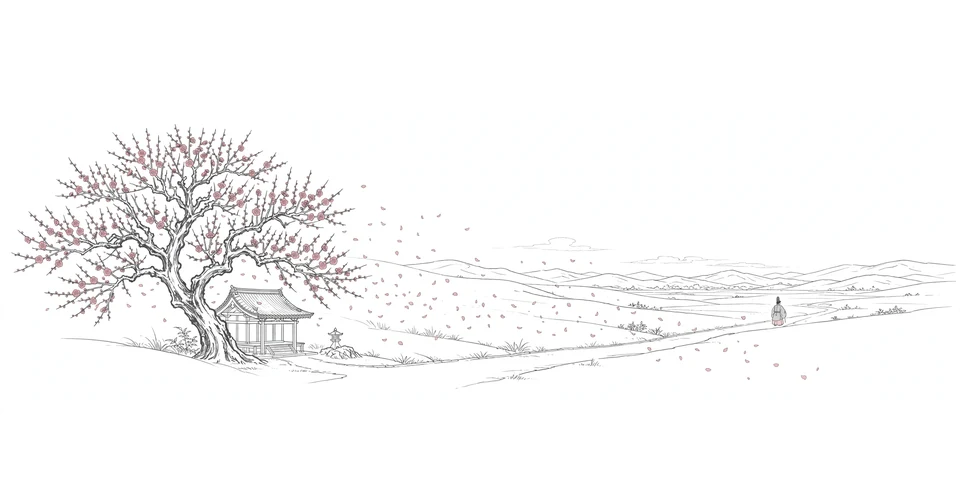
This is the story of that tree: the poem, the flight, the first blossom of the year, and the reason a single plum tree became the emblem of a god of learning. It is a small story inside a large one, and it tells you more about Japan than a shelf of history books might, because it is about loyalty, and about how a place remembers a person long after the person is gone.
The flying plum tree began with a poem
Sugawara no Michizane was born in 845 into a family that had made learning its trade. His grandfather taught history at the national academy, and his father ran a private school that prepared young men for the entrance examination. The boy grew up in a house where books were tools and a good sentence was a form of power, and he turned out to be a gifted child. He passed the entrance examination, entered the national academy, and rose through the court on the strength of his learning, writing poetry in Chinese, drafting edicts, and eventually reaching the highest professorial office a scholar of his kind could hold.
Michizane loved plum trees from childhood, and the plum became the flower he returned to again and again in his poetry. In the ninth century, cultivating plum trees and holding plum blossom viewing parties were marks of high culture, and Michizane was devoted to both. The plum was not a casual favourite. It was the flower he chose to write about when it mattered most, and that choice is the reason the flying plum tree still matters today.
His rise at court ended in a single stroke. In 901, his rival Fujiwara no Tokihira accused him of favouring another prince over the crown prince as successor to the throne. The charge was a political weapon, not a proven crime, but it was enough. Michizane was stripped of his rank and banished to Dazaifu, a government outpost in Kyushu, far from the capital he had served. He left Kyoto that year, and he never saw it again.
Before he left, he wrote a farewell poem to the plum tree in the garden of his residence, a tree he loved and would never see again. The poem asks the blossoms, when the east wind blows, to send out their fragrance, and not to forget spring even though their master is gone. In Japanese the poem reads, "Kochi fukaba, nioi okoseyo, ume no hana, aruji nashi tote, haru na wasure so." It is a short poem, only five lines, and it has outlived the court that exiled him, the rival who destroyed him, and almost everything else from that year except the flying plum tree itself.
There is something heartbreaking about the poem once you know what happened next. Michizane was not asking the tree to follow him. He was saying goodbye to the flying plum tree, and accepting that he would never see it bloom again. He wrote as a man who had lost his rank, his home, and his place at court, and who had only words left to give to the things he loved. The poem is gentle, not angry, and that gentleness is part of why people still remember it. He did not curse his enemies. He spoke to a tree.
A night flight from Kyoto to Dazaifu
Legend says the flying plum tree answered the poem. The flying plum tree loved its master so much that it could not bear to be separated from him, so it uprooted itself from the garden in Kyoto and flew through the night to Dazaifu to be with him. By morning it stood beside his new home, ready to bloom for him each spring. That tree became known as the tobiume, the flying plum tree, and the shrine's own guide to the grounds tells the same story, describing how the tree uprooted itself from the garden and flew to Dazaifu to be with Sugawara.
A more realistic version of the story says that Michizane, or a friend, transplanted a seedling from Kyoto to Dazaifu. Both versions agree on what matters: the flying plum tree and the man belong together, and the blossom is his emblem. I find the realistic version almost as moving as the legend, because it means someone cared enough to carry a young tree hundreds of kilometres so that an exiled man would have something familiar to look at in spring. Whether the flying plum tree flew or was carried, it arrived because it was loved.
The flying plum tree still stands to the right of the main hall, or honden, of Dazaifu Tenmangu, and the shrine grew up around the spot where Michizane was buried. He died in Dazaifu in 903, two years after his banishment, at the age of fifty seven. According to legend, his body was carried on an ox cart toward a burial ground, and the ox stopped and refused to move further, so his followers buried him on that spot. A small hall was built over his grave in 905, a larger shrine followed in 919, and the present main hall dates from 1591. Today Dazaifu Tenmangu is the head shrine of about 12,000 Tenmangu shrines across Japan, and its official site says it welcomes more than ten million visitors a year.
The full story of the scholar himself, his rise, his fall, and his deification as Tenjin, the god of learning, is told in our article on Sugawara no Michizane, who became the god students still pray to, and it is worth reading before you stand beside the tree, because the flying plum tree makes far more sense once you know whose garden it left. The flying plum tree is not a curiosity on its own. It is the last living witness to a farewell that happened more than eleven hundred years ago.
The flying plum tree that blooms before spring arrives
The most remarkable thing about the flying plum tree is not the legend but the calendar. Every year it is the first plum tree on the grounds to bloom, usually in mid to late January, while the air is still cold and the rest of the grove is bare. Its early flowers are treated as the first plum blossom of the year in Japan, and visitors come in the cold to see them open.
The flying plum tree leads a very large grove. The grounds of Dazaifu Tenmangu hold about 6,000 plum trees in 167 varieties, according to the shrine, and they bloom in succession from late January into early March, with the peak usually falling between mid February and the first week of March. Some accounts round the number of varieties up to about 200, so the exact count is less certain than the scale, but no visitor doubts the scale. Walking through the groves in that season is a slow business, because every few steps there is another tree worth stopping for, white blossoms, pink blossoms, deep red blossoms, and the scent of plum carried on a cold wind.
There is a reason the plum blooms first, and it is worth pausing on. The plum is the first flower of the year in Japan, opening while winter still holds the ground, and it has become the flower of perseverance in Japanese culture: beauty that arrives before the weather is ready for it. A scholar who kept writing in exile would have understood that. Michizane wrote poetry in Dazaifu until shortly before his death, and the flying plum tree that blooms first each year feels like a small echo of that habit, a refusal to wait for easier conditions.
The plum blossom is also the crest of the shrine, and it has become the symbol of the city of Dazaifu and of Fukuoka Prefecture itself. Plum trees are planted in the yards of neighbourhood houses across Dazaifu, and the flower has grown from a scholar's favourite into the identity of a whole city. That is a rare thing for a tree to achieve. Most flowers stay in gardens. This one became a civic emblem, and it did so because of one man's poem and one tree's legend.
If you want the practical outline of the shrine, its grounds, and the place of the flying plum tree among them, the guide to Dazaifu Tenmangu, where Japan still prays to a scholar god walks the whole precinct, from the arched bridges over the pond to the museum behind the main hall. The shrine's own page on the grounds describes the flying plum tree in the same place it has always stood, to the right of the main hall, and the official guide to the shrine grounds is the best place to confirm what stands where before a visit.
The plums of June and the cakes of the approach
The flying plum tree is not only admired in winter. In a special ceremony in June, priests and shrine maidens gather the plums it produces and use them to make a limited number of very special amulets that carry the blessings of Tenjin. The flying plum tree is therefore not only a monument to a legend. It still produces something, and what it produces is given to people as protection. That feels right for a flying plum tree that belongs to a god of learning. It keeps working.
The shrine's great plum festival is the Baikasai, the Plum Blossom Festival, held on 25 February, the anniversary of Michizane's death. It is a solemn day as much as a celebration, a memorial service for the man at the centre of all of this, held while the trees he loved are in full flower. On the first Sunday of March the shrine holds the Kyokusui no En, a winding water banquet in which poets in Heian period dress compose verse as cups of sake float down a stream toward them, a ceremony that recreates the court culture Michizane knew in Kyoto. If you want to understand why the plum matters here, watch the festival rather than reading about it. A flower becomes a calendar, a memorial, and a poem all at once.
There is another plum tradition at Dazaifu, and it is one you can taste. No visit is complete without umegae mochi, a grilled rice cake filled with sweet red bean paste and stamped with the pattern of a plum blossom. Shops along the approach road grill them fresh, and the smell carries down the street before you can see the stalls. The cakes are tied to the shrine through a legend about Michizane's exile. A kind old woman, remembered in tradition as Jomyoni, is said to have brought him mochi rice cakes skewered on a plum branch when he was suffering from hunger, and to have left one as an offering when he died. Today her kindness is remembered in every cake sold on the approach.
The cakes cost very little, and they are best eaten hot, standing on the street with the steam rising into the cold air. I think there is a kind of wisdom in the fact that the most famous product of a great shrine is a small, cheap, warm cake, and not something grand. The shrine feeds people before it impresses them, and the plum branch that once carried food to a hungry exile now carries the shrine's name into every visitor's hands. The flying plum tree and the cake belong to the same story, a story about care given quietly and remembered for a thousand years.
Why a tree became the emblem of perseverance
It is worth asking why this particular legend survived when so many others from the Heian period were forgotten. Japan has many stories of flying objects and miraculous journeys, and most of them are curiosities now, told to children and then set aside. The flying plum tree is different. It survived because it is not really about magic. It is about loyalty, and loyalty is a story every generation understands.
The flying plum tree did what a loyal friend would do. It refused to stay behind when the person it loved was sent away. It crossed a great distance, at great cost to itself, to be present. That is a simple story, and it is also a demanding one, because it asks the listener a quiet question: would you do the same? Most legends ask you to admire something impossible. This one asks you to imagine doing something difficult, and that is why it lasts.
There is also a gentler reason the story endures, and it has to do with how Japan remembers Michizane. He was wronged, and the court that wronged him spent the next century making amends, building shrines, restoring his rank, and finally worshipping him as a god. But guilt alone does not make a beloved god. What made Michizane beloved was that people could see themselves in him. He was a student who passed an examination, a teacher who ran a school, a poet who kept writing when writing gave him nothing back. The flying plum tree is the part of his story that anyone can hold onto, because it is not about rank or revenge. It is about a tree that would not leave.
I have a quiet admiration for the way the shrine treats the legend, too. It does not insist that you believe the tree flew. The shrine's own guide calls it a legend, plainly, and then points to the flying plum tree and lets you look at it. That honesty is part of the shrine's character. It offers the story, it offers the flying plum tree, and it leaves the belief to you. A place that trusts its visitors that much deserves the trust it receives.
The plum has also become a practical emblem for students, and this is where the legend meets daily life. Every year, as entrance exams approach, students travel to Dazaifu Tenmangu to pray for a pass, and they walk past the flying plum tree on their way to the main hall. The flying plum tree blooms in the same season as the examinations, so the walk to the shrine is lined with flowers at exactly the moment when students most need encouragement. A student walking to pray is walking through the blossom of the god's own tree, and that must feel, in some small way, like a sign that effort is noticed. The flying plum tree does not answer exam questions. It simply blooms early, in the cold, before anyone expects it to, and that is the whole lesson in one image.
Standing beside the flying plum tree today
A visit to the flying plum tree is simple. Dazaifu Tenmangu is about a five minute walk east of Dazaifu Station, and the walk from the station to the gate is itself part of the experience, a straight approach road lined with shops selling umegae mochi and souvenirs. Entry to the grounds is free, and the shrine is open year round. The best time to come depends on what you want. Late January brings the first blossom of the flying plum tree. Late January to early March brings the whole grove into flower and the largest crowds. The rest of the year is quieter, and the grounds are beautiful in every season, with camphor trees, the pond, and the long walk under the torii.
When you reach the main hall, look to the right. The flying plum tree stands there, older and more gnarled than the trees around it, fenced and cared for like the treasure it is. Take a moment before you move on. The main hall itself dates from 1591 and is designated an Important Cultural Property of Japan, and behind it stands the small Kanko Historical Museum, which tells the main events of Michizane's life in small dioramas. The shrine museum holds around 50,000 treasured items, including Michizane's original poems and his sword. But the flying plum tree is the thing to see first, because everything else at the shrine is, in a sense, an explanation of it.
For opening hours, admission details, and the layout of the grounds, the Japan Guide page on Dazaifu Tenmangu Shrine gives a clear visitor's outline, including the walk from the station and the museums on the grounds. It notes that the main hall's three year renovation was completed in May 2026, so a visit now finds the 1591 building standing in its restored form. Early mornings in plum season are the quietest time to see the first blossom.
The flying plum tree has stood beside the main hall for more than a thousand years, through fires, wars, restorations, and the slow change of the town around it. It will still be there when the next generation of students arrives with their wishes written on wooden plaques. That continuity is the real miracle of the story, more lasting than any flight. A flying plum tree was loved, a poem was written, and a place decided never to forget either of them. The blossom opens first each year, in the cold, before spring is ready, and it has done so for longer than anyone can remember. That is enough.
More in Culture & Society
- Kitano Tenmangu Turns Plum Blossom Into a Prayer for Exams
- Japanese Geisha and the World Behind the Painted Face
- Tenjin Is the Storm God Who Became Japan's Patron of Learning
- Queen Is the Crown Japan Gives Its Best Woman Karuta Player
- Japanese Pottery and the Six Kilns That Turned Clay into Culture
- Meijin Is the Title Every Karuta Player Dreams of Wearing
Latest posts
- Dazaifu Tenmangu Is Where Japan Still Prays to a Scholar God
- Sugawara No Michizane Became the God Students Still Pray To
- Wakamizu Is the First Water Japan Draws for Good Luck
- Japanese Kabuki and the Theatre That Paints Its Actors
- Kakizome Turns the First Brushstroke of the Year Into a Wish
- Ujigami Is the Guardian God Who Watches Over One Neighbourhood
- Omi Jingu Is Where Karuta Crowns Its Champions
- Hagoita-ichi Turns Asakusa Into a Forest of Paddles
- The Two Lives of Japanese Coffee
- Chihayafuru Made a Card Game Feel Like a Sport
- Oshi-e Hagoita Turns Silk Into a Picture You Can Touch
- Hyakunin Isshu Gave Karuta Its Hundred Poems
- Hagoita Is the Paddle Japan Turns Into New Year Art
- Takoage Sends New Year Wishes Up on a Paper Kite
- Hanetsuki Keeps New Year in the Air With a Wooden Paddle