An Irori Hearth Warms the Room and the People Around It
· 18 min read
An irori is a sunken hearth built into the floor of a traditional Japanese house, and for centuries it heated the room, cooked the meals and gathered the family around one small fire.
There is a kind of warmth that a radiator never gives. It comes from a fire you can see, at floor level, in the middle of the room, with people sitting around it on cushions and the kettle already singing above the coals. In a traditional Japanese farmhouse, that fire had a name. An irori is a sunken hearth built into the wooden floor, and for centuries it was the warm centre of the house, the kitchen, the lamp and the living room all at once.
Walk into a preserved farmhouse in the mountains today and you will probably find one, even if the fire has not been lit in years. It is a square pit in the floorboards, edged with dark timber and filled with soft grey ash. Above it hangs a kettle from a hook that drops from the ceiling beam. The room is arranged around it, not the other way around. The irori did not sit in a corner waiting to be used. The house was built around it, because everything that mattered in daily life happened beside it.
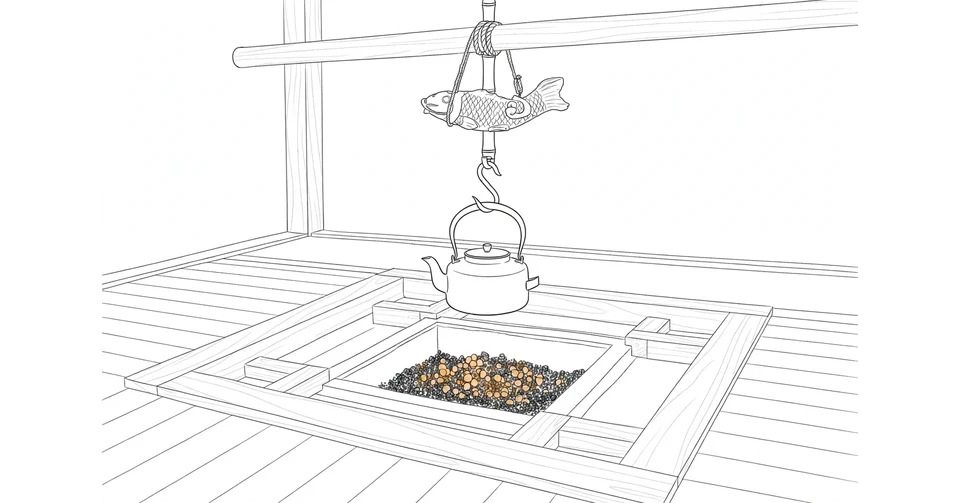
That is the first thing to understand about the irori. It was never a piece of furniture or a decoration. It was infrastructure, the way a roof or a well is infrastructure, and it shaped how a family ate, talked, slept and kept its house standing. An irori could be found at the centre of the main room of a minka, a traditional folk house, and the whole plan of the house was organised around it. To sit beside one, even a cold one, is to understand the room in a way no floor plan can teach.
What an irori actually is
Strip away the romance and an irori is a simple thing. It is a square or rectangular opening cut into the wooden floor, lined with stone or clay and filled with a deep bed of ash, in which charcoal or split firewood burns in the open. There is no chimney, no flue and no firebox. The fire sits in the floor and the smoke rises freely into the room, drifting up through gaps in the attic floorboards and out through the thatch or a raised vent in the ridge. The irori entry on Wikipedia describes it as a traditional Japanese sunken hearth fired with charcoal, used for heating the home and for cooking food, and that plain definition is the right starting point before any talk of atmosphere.
The usual size is modest. A working irori measures roughly 60 to 90 centimetres on each side, large enough for a pot to sit clear of the flames and small enough that the room can still be heated evenly and walked around safely. It generally sat in the centre of the main room, the hiroma, which was the living and dining space of the house, raised on a wooden floor above the earthen entrance area known as the doma. Larger houses sometimes had a second hearth in a guest room or in the room where silkworms were fed, but the main irori was the heart of the home.
The fire in an irori was not a roaring fire. That is a point worth stressing, because the image most visitors carry in their heads is of flames leaping up toward the kettle. In practice, the hearth was kept as a bed of glowing embers, tended through the day so it never quite went out. Longevity mattered more than strength. A fire that burned low and steady could warm the room, boil the kettle and grill a fish without filling the house with flame, and it could be banked under ash at night and woken again in the morning. Charcoal was the preferred fuel where it could be had, because it burned cleanly and steadily, while firewood was more common in the mountains simply because it was free and close at hand.
The six parts that make the hearth work
An irori looks simple, but it is a small machine with named parts, and knowing them lets you read an old house the way a mechanic reads an engine. A detailed guide to the irori at immoJapon lists six of them, and each one earns its place. The robuchi is the timber frame that edges the opening, usually a hardwood such as zelkova or chestnut, and charring on its inner face is normal after years of use. The hai is the bed of ash filling the pit, often 10 to 20 centimetres deep, which insulates the structure from the embers and holds the heat. The yuka is the raised timber floor around the pit, structurally separate from the earth floor of the entrance.
Above the fire hangs the most ingenious part of the whole arrangement. The jizaikagi is an adjustable pothook suspended from a ceiling beam, usually an iron rod inside a bamboo tube, and it is used to raise or lower a suspended pot or kettle by means of an attached lever. That lever is often decoratively carved in the shape of a fish, and the reason is not decoration at all. A fish lives in water and never closes its eyes, so it stands guard against fire in a house built almost entirely of wood, paper and straw. It is a small piece of folk wisdom, carved into a working tool, and it tells you exactly what the household feared.
The remaining two parts complete the cooking system. The gotoku is the iron trivet that stands in the ash, on which a pot or kettle rests directly when it is not hanging from the hook. The hidana is a slatted wooden rack suspended above the fire, used to dry food, spread the heat and stop sparks from reaching the ceiling. Wet clothes could be hung near it, fish and meat could be suspended from it so the rising smoke cured them, and raw wood could be dried on it before it was burned. The irori was not only a heater. It was a dryer, a smoker, a lamp and a larder, all arranged around one small bed of coals.
Keeping a small fire alive all day
Keeping an irori going was a skill, and it belonged to the daily rhythm of the house rather than to any special occasion. In the morning the ash was stirred and the buried embers were uncovered, and the fire was fed until it was strong enough to boil water for tea. Through the day it was tended in small gestures, a piece of charcoal added here, the ash smoothed there, the kettle lifted a little higher on its hook when the water boiled too hard. The fire was never allowed to go out if it could be helped, because it was also the source from which other fires were lit. Before matches were common, the irori supplied the flame for the cooking stove and for the lamps, and a house that let its hearth die had to borrow fire from a neighbour.
The work of tending it usually fell to whoever sat nearest the earth floor, the lowest seat around the hearth, and there is something honest in that arrangement. The fire did not tend itself, and the person who kept it alive was the person with the least status in the room. I find that detail quietly moving. The warmth everyone enjoyed depended on the attention of the person nobody was looking at, which is true of most comfort in most houses, in most countries, in most centuries. The irori made that truth visible. You could see who was feeding the fire.
There were real dangers in the arrangement, and they should not be romanticised away. Burning charcoal produces fine particulates and carbon monoxide, and a poorly ventilated room could become dangerous. Long exposure to smoke in old farmhouses has been linked to eye disease, and the fire itself demanded constant supervision. Leaving a lit hearth unattended was asking for the house to burn. The old houses were also extraordinarily draughty, and that draught was part of what made an open indoor fire survivable. Every gap in the timber let fresh air in and smoke out, which is a trade no modern sealed house can make. It is worth remembering that the people who lived with an irori accepted risks we would not accept, because the alternative was cold and darkness.
Cooking over an irori
Cooking at an irori was slow cooking in the most literal sense. A pot hung from the jizaikagi could be raised or lowered to control the heat, so a stew could simmer for hours without attention, and a kettle could be kept just below the boil all day. Fish and other food were often skewered and stuck into the ashes around the fire, or buried in the ashes to be grilled. A small bottle of sake, a tokkuri, could be warmed by burying it in the ash until it was ready to pour. Nothing was rushed, because the fire itself was never in a hurry, and the meal took shape around the pace of the coals.
In the Hokuriku region, on the Sea of Japan coast, cooking was done with the irori until the kamado, the enclosed cooking stove, became widespread in the 1950s. In warm western Japan, people had long since learned to use the kamado and the irori separately according to the season, keeping the open fire for winter warmth and moving the cooking outside the main room in summer. That regional split is a useful reminder that the hearth was a practical tool before it was a tradition. People used it where it worked and set it aside where it did not, and the attachment we now feel for it grew out of usefulness, not the other way around.
I think the cooking is the part that modern visitors understand fastest, because it is the most human. A kitchen you can sit in, with the food hanging over the fire in front of you and the smoke curling up toward the beams, is a very different place from a kitchen you stand in alone. The irori made cooking a social act by putting the stove in the middle of the conversation. The person cooking never turned their back on the room. That single design choice, a fire in the floor instead of a fire against the wall, changed the shape of family life, and it is worth pausing over before we move on to the architecture.
Where everyone sat around the fire
An irori was also a seating plan, and the seating plan was the family hierarchy made visible. The names of the seats vary from region to region, so any list of them is a pattern rather than a national rule, but the logic holds almost everywhere. The further you sat from the earth floor and the work, the higher your standing. The seat furthest from the doma, backed by the alcove or the family altar, was called the yokoza, and it belonged to the head of the household and to guests of high status such as a priest. It was the best position and the warmest. The wife who ran the house sat at the kakaza, the side nearest the kitchen, so that she could cook, serve and refill without crossing the room. Guests and the men of the family sat at the kyakuza, facing her, and the children and servants sat at the kijiri, the lower seat on the earth floor side, where the firewood was stacked and within reach.
There is a temptation to read this as a quaint piece of folklore, but it was a working system. In a house with no walls between the living room and the work space, the hearth told everyone where they belonged without anyone having to say it. A guest who knew the custom could sit down without being told where to go, and a child knew when they had been promoted to a better seat because their place around the fire had moved. The irori did not only warm the room. It organised it.
The floor around the hearth was part of the same logic. The main room was floored with wood or tatami, and the tatami mats that set the measure of a Japanese room gave the space its proportions, while the hearth cut a square hole in the middle of them. Light came in through shoji, and a shoji lets the daylight in while keeping the world out, so the room stayed bright without feeling exposed. Put those three things together, the mats, the paper screens and the fire in the floor, and you have the whole grammar of a traditional Japanese interior. The irori was the verb in the sentence.
The smoke that kept the house alive
The strangest fact about the irori is that it had no chimney on purpose. The smoke rose freely into the space above, drifted through deliberate gaps in the attic floorboards, filled the roof structure, and left slowly through the thatch or through a raised vent in the ridge called a kemuridashi. That sounds like a design failure to a modern eye, but it was a system, and the smoke did three jobs at once. It dried the timber, because warm air rising day after day pulled moisture out of the beams and rafters, which is the best defence against rot in a humid climate. It poisoned the insects, because tar and creosote deposits from wood smoke made the roof structure and the thatch hostile to wood boring insects and nesting birds. And it waterproofed the thatch, because the same tar coated the stems of the roof from the inside, slowing the rot that starts at the underside.
A traditional roof and a working hearth were, in other words, one system. The black, glossy beams you admire in a preserved farmhouse are not stained wood. That is a century of smoke, and the house is still standing because of it. The American scholar Edward S. Morse, who lived in Japan in the 1870s and 1880s and wrote the pioneering study Japanese Homes and Their Surroundings, published in 1885, described the scene in detail, with kettles huddled around the fire and a rack overhead from which fish and meat were suspended so the rising smoke could cure them. His drawings of the irori remain one of the best records we have of how an ordinary farmhouse actually lived.
When a family stopped lighting the hearth, the roof lost its treatment. Thatch that was expected to be partially re-laid every 10 to 15 years and fully renewed every 30 to 50 years began to fail faster, and the insects came back. Many of the old farmhouses that now sit empty went through exactly that sequence, hearth covered, roof unsmoked, moisture and insects left to work quietly for forty years. The irori, in that sense, was not only the heart of the house. It was the medicine the house took every day, and the house got sick when the medicine stopped.
Why the irori faded from daily life
The irori remained an important part of rural life through the 1960s, but it vanished quickly from daily use once electric, gas and kerosene heating offered more effective alternatives. Most families stopped lighting the hearth between the 1950s and the 1970s, when bottled gas and kerosene arrived in the villages. The change was not a rejection of tradition. It was a choice for warmth without smoke, for heat that did not need tending, for a room where children could run without falling into a fire. Anyone who has spent a winter in a draughty old farmhouse can understand why a family would make that trade, and it would be unfair to judge them for it.
The usual move during the post war remodelling wave was to board over the pit, lay tatami or a plywood floor on top, and put a kerosene heater in the middle of the room. The hearth is often still there, under the floor, waiting. In that way the irori did not disappear so much as go underground, and many owners of old houses only discover theirs when a floorboard sags or a renovation lifts the boards in the main room. Blackened beams overhead, a raised ridge vent that serves no modern purpose, a square of newer boards in the middle of the floor, these are the clues, and they are worth knowing even if you never light a fire in one.
There is a second reason the hearth faded that has nothing to do with convenience. The low heated table called the kotatsu, which many Japanese homes still use in winter, grew out of the irori tradition, taking the idea of heat at floor level and putting it under a table with a blanket instead of an open fire. It kept the posture, sitting on the floor with your legs warm, and removed the smoke, the ash and the danger. The kotatsu is the irori domesticated for the modern apartment, and its popularity is a quiet tribute to the older fire. People did not stop wanting to sit low around a warm centre. They only wanted it without the chimney problem, and the kotatsu gave it to them.
Where an irori still burns today
The irori survives where the old way of living is the point of the place. The best known survivors are the ryokan, the traditional inns, and the farmhouses preserved as museums and guesthouses. At Nyuto Onsen in Akita, rooms at Tsurunoyu still centre on low wooden rooms and an irori fireplace rather than on anything resembling a hotel lobby, and the hearth there is not a display. It is the room, doing what it has done for more than 300 years. The Kitamaebune Ship Museum in Kaga keeps its exhibits in a prosperous shipowner's home built in 1878, with tatami rooms arranged around an irori hearth, and the solid beams and lacquered wood that kelp money bought. In both places the hearth is part of the architecture, not an addition to it.
Restaurants keep the tradition alive in a different way. A restaurant with a working irori burns charcoal rather than wood, because charcoal reduces the smoke a great deal, and it grills fish and vegetables over the coals in front of its guests. The meal becomes a small piece of theatre, but it is honest theatre, because the cooking method is real and the fire is doing the work. Farmhouse guesthouses in places like Shirakawa-go, where the steep thatched roofs of the gassho-zukuri houses are kept alive by the smoke of their hearths, offer the fullest version of the experience, a night in a house where the fire is still the centre of the room and the beams above you are dark with a century of evenings.
Anyone thinking of relighting an old hearth should know that the law now treats it seriously. Under the Building Standards Act, a room containing an open flame is a fire using room, which brings restrictions on the finishes around the fire, and a tiled roof that no longer breathes will not let the smoke out the way thatch did. A sealed modern room with an open charcoal fire is a carbon monoxide risk, not a feature, and it needs permanent fresh air, a carbon monoxide alarm and an insurer who has been told about the fire in advance. The irori belongs to draughty timber houses with thatch and ridge vents. That is a constraint, not a judgment, and it is better to respect it than to fight it.
What a small fire teaches
I keep coming back to the fish on the jizaikagi. A household that carved a fish into the lever of its pothook was a household that knew exactly what it was afraid of, and it answered that fear with a small act of care rather than with a rule. The irori is full of that kind of thinking. The ash bed that holds the heat, the rack that dries the washing, the seats that tell a guest where to sit, the smoke that keeps the roof alive, none of it was designed in a single plan. It grew, piece by piece, out of people paying attention to a fire for a very long time.
That is, I think, the real reason the irori still moves us, even those of us who have never lived with one. Modern life gives us heat that arrives without effort and leaves without ceremony, and we are warmer for it and poorer in another way. The irori asks for attention and gives back a room full of people, and the trade is written into its shape. A fire in the middle of the floor cannot be ignored, and it cannot be used alone. It makes a house into a circle, and a circle into a family, and that is a piece of design no heater has yet improved on.
More in Life & Style
- A Hibachi Carries the Hearth Anywhere in the House
- A Kotatsu Turns a Cold Winter Evening Into the Warmest Room in the House
- The Jizaikagi Hangs Above the Fire and Sets the Pace of Dinner
- A Sudare Turns Harsh Sunlight Into a Cool Breeze
- A Genkan Is Where Japan Leaves the Outside World at the Door
- A Ranma Lets a Japanese Room Breathe Over the Top of Its Walls
Latest posts
- Kumiko Builds Beauty From Wood Without a Single Nail
- Japanese Paper Lanterns and the Light That Folds Flat
- A Zabuton Is the Cushion That Tells You Where You Sit in Sumo
- Tatami Still Sets the Measure of a Japanese Room
- Chawanmushi Hides a Whole Meal Inside a Teacup
- Japanese Video Games and How a Small Island Rewired Play
- A Kakejiku Turns a Blank Wall Into a Conversation
- Himeji Castle, Japan's White Heron That Survived War and Fire
- A Shoji Lets the Daylight In While Keeping the World Out
- A Tokonoma Turns One Corner of a Japanese Room Into a Shrine
- Japanese Breakfast and the Morning Meal That Starts with Rice and Soup
- Fusuma Turn a Room Into Whatever Japan Needs Next
- Wearing a Happi Means You Belong to the Matsuri
- A Yuzamashi Cools the Water Before the Tea Begins
- Tencha Is the Shade-Grown Leaf Matcha Is Made From