A Zabuton Is the Cushion That Tells You Where You Sit in Sumo
· 11 min read
A zabuton is Japan's flat sitting cushion, and its colour, fabric and place in the room quietly mark rank, honour and hospitality, from the sumo ring to the tea room.
Walk into a traditional Japanese room and the first thing you are offered is often not a chair but a square of cloth on the floor. That square is a zabuton, a flat cushion for sitting, and it does far more than soften the tatami beneath your knees. Where it is placed, what it is made of and who is allowed to sit on it all carry meaning, and in the world of sumo that meaning is written in silk.
The word itself is plain enough. Za means to sit, and futon means a padded mat, so a zabuton is literally a sitting futon. Yet it is not a pillow and not a small mattress. It is a thin, firm cushion, usually square, built to be knelt on for a long time without losing its shape, and it has been part of Japanese life for close to a thousand years.
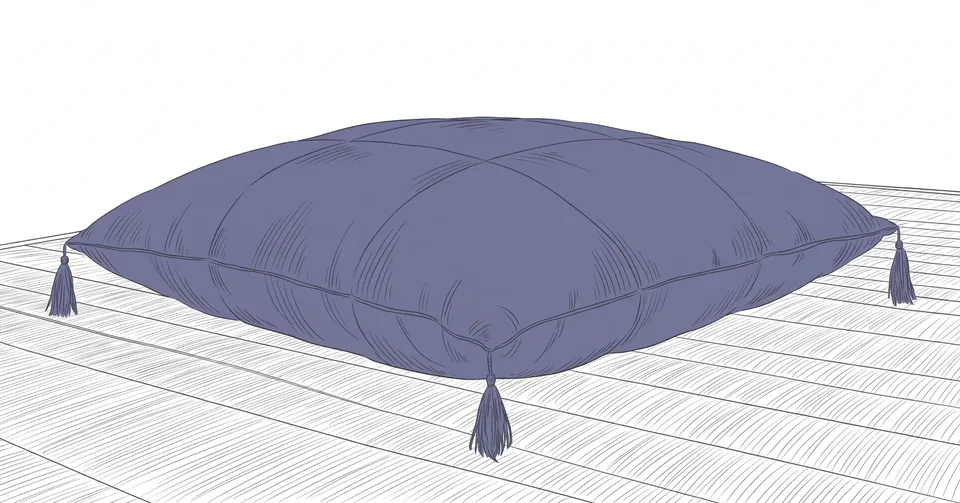
Spend an evening in a ryokan, a temple or a sumo arena and you will see the same object doing different jobs. In a home it welcomes a guest. In a temple it steadies a monk through hours of meditation. In sumo it can become a missile thrown in protest when a grand champion falls. One cushion, many roles, and each one tells you something about the room you are in.
What a zabuton is made of
A traditional zabuton is made the slow way. Layers of cotton are folded and stacked until they form a pad a few centimetres thick, then the stack is wrapped in a square of cloth, folded in half and stitched closed, rolled and turned inside out so the filling sits inside the cover. The result is a cushion with a gently rounded top and a flat bottom, usually between 55 and 59 centimetres across in a modern home, and a little larger, about 59 by 63 centimetres, in temples and formal rooms. Older sources give a wider range, up to about 90 centimetres a side, which may reflect the grander cushions of temples and theatres rather than the ones in ordinary homes.
The cover is where the money shows. Everyday covers are cotton or linen, tough fabrics that can be removed and washed. Finer ones are silk, and the finest are embroidered. The filling is almost always cotton, layered by hand so it stays even, although some modern makers blend in a little polyester to help the cushion keep its shape after years of use. Kapok, the light fibre from the seed pods of the ceiba tree, turns up in some round meditation cushions, but the flat square cushion of a Japanese home is a cotton cushion through and through.
Two details mark a good cushion. At each corner hangs a tassel, and in Kyoto cushions a three-pronged stitch called sampo-toji sits in the centre, shaped like the letter Y. The tassels were once thought to keep harmful energy away from a person at prayer or meditation, and they are still read as a sign of good luck. The central stitch is practical as well as decorative: the foot of the Y points forward, so it tells you which way the cushion should face.
From straw mats to cotton cushions
The zabuton did not arrive all at once. Its ancestor was the shitone, a cushion of layered straw matting covered with cloth, used by the aristocracy in early Japan. Before that, people sat on enza, round cushions of plaited grass, on wooden floors. When cotton reached Japan, tailors in the Edo period, from 1603 to 1868, began filling cushions with cotton padding instead of straw, and the zabuton as we know it took shape.
For a long time the cushion belonged to the few. Emperors, shoguns and senior Buddhist priests sat on zabuton while everyone else sat on bare tatami or straw. The cushion was a visible sign of rank, much as the tatami mat itself once marked wealth and authority. Over the Edo period the cushion spread beyond the court and the temple, and by the time Western chairs arrived in the twentieth century it was the standard seat in Japanese cinemas, theatres and homes alike.
I find something quietly honest about that history. A zabuton began as a privilege and became a courtesy, something offered to a guest before anything else is said. Japan has a talent for turning a practical object into a small ceremony, and this cushion is one of the clearest examples.
The zabuton in sumo
Nowhere is the zabuton more dramatic than in sumo. In the arena, the audience sits on zabuton in the box seats, and the wrestlers themselves sit on them while they wait. As the published account of a wrestler's life on this site explains, while waiting for his match, a makuuchi wrestler is entitled to his own personalized waiting cushion, a zabuton made of silk with about twenty centimeters of padding and bearing his name. The cushion is not decoration. It is a mark of having climbed into the top division, and the silk and the name stitched into it say so without a word.
Rank shows in the fabric. The higher a wrestler climbs, the finer the cushion beneath him, and the white silk zabuton of a sekitori is a visible badge of status in a sport that communicates almost everything through cloth and colour. To understand what that white silk means, and how a wrestler earns the right to sit on it, read white silk means you made it as a sekitori.
The cushion also has a wilder side. When a yokozuna, a grand champion, loses to a lower-ranked wrestler, the crowd has been known to throw their cushions toward the ring, a practice called zabuton-wo-nageru, literally throwing the cushions. It is a heckle and a compliment at once, a burst of disappointment that the champion fell and delight that the underdog won. The practice was banned in the early twentieth century, yet it has never quite gone away, and today arena cushions are often tied down to discourage the next flying cushion. A thrown cushion can injure someone and damage property, which is a good reason for the ban, even if the sight of a hundred cushions in the air is part of sumo folklore.
A cushion that marks your place
Step away from the ring and the same logic holds. In a Japanese room, where a zabuton is placed tells you where its owner stands. The seat of honour, the kamiza, is usually the spot furthest from the door, often against the alcove, and the finest cushion goes there. A guest is offered the best cushion in the room, and the host takes the humbler one. Nobody needs to announce the hierarchy. The cushions have already done it.
This is why etiquette around the cushion matters so much. It is considered rude to step on a zabuton, and a guest should approach it from the side, kneel onto it gracefully and rise without trampling it. Bowing while seated on one has its own form, and the cushion itself is treated with the respect you would show the person who offered it. I think there is a lesson in that for anyone who has ever rushed into a room and claimed the best seat without a thought. The cushion slows you down and asks you to notice where you are.
How to sit on a zabuton
The formal way to sit on a zabuton is seiza, kneeling with the legs folded beneath you and the tops of the feet resting on the floor. The cushion takes the pressure off the knees, ankles and shins, and its slight lift tilts the hips forward so the spine can stand tall. The other common posture is agura, sitting cross-legged, which is more relaxed and is fine among friends and family. Either way, the cushion is doing quiet work: it holds your body heat, it cushions the hard floor and it keeps your posture honest over a long evening.
Beginners should not worry about perfection. Seiza hurts at first, and even Japanese hosts will tell a guest to stretch their legs when they go numb. The honest rule is to sit as well as you can for as long as you can, and to change position before discomfort becomes pain. A cushion is meant to serve the body, not to punish it, and a good host would rather see a guest comfortable than correct.
The zabuton at home, in tea rooms and temples
In a modern Japanese home the zabuton is still everywhere, even in houses that have given up tatami for wooden floors. Families pull them out for dinner at a low table, for an evening around the kotatsu in winter, and for guests who drop by without warning. When the meal is over, the cushions stack neatly in a cupboard or on a shelf, which is part of their charm in small homes: a whole dining room can be stored in a closet.
In the tea room the cushion has a quieter role. Guests kneel on them through a ceremony that can last an hour or more, and the cushion keeps the body still enough for the mind to follow the slow movements of the host. In temples, large cushions support monks and priests through chanting and meditation, and in Zen practice a round zafu cushion is often placed on top of a zabuton, the flat cushion protecting the knees and ankles while the round one lifts the hips. The pairing is a small piece of engineering, worked out over centuries of sitting still.
The cushion also turns up in lighter places. In rakugo, the comic storyteller sits on a zabuton on stage and never leaves it, using only voice and fan to conjure a whole cast of characters. On the long-running television show Shoten, comedians are awarded cushions for good jokes and have them taken away for bad ones, and the first to collect ten wins. Before Japanese cinemas adopted Western chairs in the 1930s, audiences sat on zabuton to watch the film. It is a cushion that has sat through comedy, prayer, cinema and sport, and it has never asked for a better seat.
Caring for a zabuton
A good zabuton can last for years, but it needs a little care. The padding is dense, so machine washing or soaking can damage it. Stains are best dealt with at once, with a damp cloth, and the cushion should be shaken out regularly and aired in the sun for a few hours, covered with a thin cloth so the colours do not fade. A removable cover can be washed separately, which is one reason the best cushions are made with one.
When a zabuton finally goes flat, it is not quite finished. Old cushions are restuffed by craftsmen in Kyoto and elsewhere, and a well-made cover can outlive several fillings. That is a kind of sustainability that predates the word: an object built to be repaired rather than replaced, and kept because it was made well in the first place.
A small square of respect
A zabuton asks very little of you. It asks you to kneel rather than sprawl, to notice who sits where, and to treat a simple square of cloth as something worth keeping clean and offering to a guest. In a world that keeps inventing faster chairs and smarter furniture, there is something steady about a cushion that has barely changed in centuries and still does its job. Sit on one properly, and you will feel what it was designed for: not luxury, exactly, but attention. The cushion holds your weight, and for a little while, it holds your attention too.
For the full picture of how these cushions are made, what they are made of and where the best ones come from, the guide at Japan Objects walks through twenty things worth knowing, from the sampo-toji stitch to the way a cushion should be aired and cared for. The broader history, from the straw shitone to the modern square cushion, is set out in the Wikipedia entry on zabuton, which also covers the cushion's place in Zen meditation, rakugo and sumo.
More in Culture & Society
- Kumiko Builds Beauty From Wood Without a Single Nail
- Japanese Paper Lanterns and the Light That Folds Flat
- Tatami Still Sets the Measure of a Japanese Room
- A Kakejiku Turns a Blank Wall Into a Conversation
- A Shoji Lets the Daylight In While Keeping the World Out
- A Tokonoma Turns One Corner of a Japanese Room Into a Shrine
Latest posts
- A Hibachi Carries the Hearth Anywhere in the House
- A Kotatsu Turns a Cold Winter Evening Into the Warmest Room in the House
- The Jizaikagi Hangs Above the Fire and Sets the Pace of Dinner
- An Irori Hearth Warms the Room and the People Around It
- Chawanmushi Hides a Whole Meal Inside a Teacup
- Japanese Video Games and How a Small Island Rewired Play
- A Sudare Turns Harsh Sunlight Into a Cool Breeze
- Himeji Castle, Japan's White Heron That Survived War and Fire
- A Genkan Is Where Japan Leaves the Outside World at the Door
- A Ranma Lets a Japanese Room Breathe Over the Top of Its Walls
- Japanese Breakfast and the Morning Meal That Starts with Rice and Soup
- Fusuma Turn a Room Into Whatever Japan Needs Next
- Wearing a Happi Means You Belong to the Matsuri
- A Yuzamashi Cools the Water Before the Tea Begins
- Tencha Is the Shade-Grown Leaf Matcha Is Made From