Japanese Paper Lanterns and the Light That Folds Flat
· 12 min read
Japanese paper lanterns began as portable lights and became signs, shrines, and festival glow. Here is how the chochin folds, where it came from, and why it still hangs everywhere in Japan.
Walk down a narrow street in Japan after sunset and you will see them before you hear anything. Japanese paper lanterns glow outside small restaurants, shrines, and festival stalls, each one a soft ball of warm light with a name painted on its side. They look simple, almost too simple to have a history. Yet the lantern you are looking at is the result of five hundred years of clever engineering, and its best trick is that it folds flat.
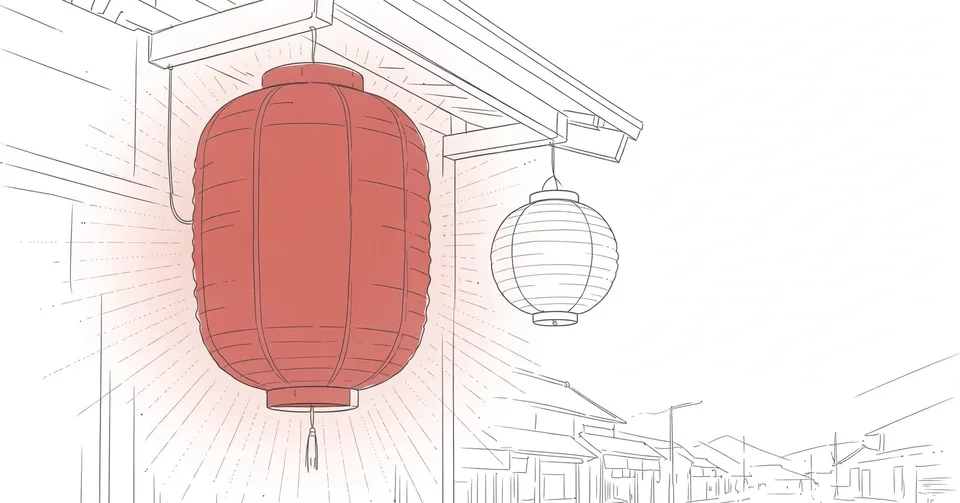
A Japanese paper lantern is not a lamp that happens to be made of paper. It is a lamp designed around paper. The frame is a spiral of split bamboo or thin wire, and the skin is washi paper pasted over it. When the lantern is lit, the whole body glows. When it is not needed, the spiral collapses and the lantern folds down to a thin disc that can be carried in a bag or stacked on a shelf. That single idea, light you can fold, is what turned a Chinese import into one of the most Japanese objects there is. Japanese paper lanterns still hang in the same places they hung two hundred years ago, and the reason is simple. They work, they are beautiful, and they tell you something before you even read them.
What Japanese paper lanterns actually are
The Japanese word for these lanterns is chochin, written with characters that mean carry and light. The name is the description. A chochin, which is to say a Japanese paper lantern, is a light you carry with you. The classic shape is round or slightly cylindrical, with a bamboo spiral inside that holds the paper skin in shape. A small opening at the top lets heat escape, and a ring or cord at the top lets the lantern hang from a hook, a pole, or a shop eave.
Japanese paper lanterns differ from their older cousin, the andon. An andon is a boxy, standing lamp with a fixed wooden frame, the kind of light that stays in one room. A chochin folds. That difference mattered enormously in a country of narrow streets and wooden houses, where fire was a constant danger and every object had to earn its space. A lantern that could collapse after use was not a novelty. It was a practical tool for people who walked at night, and in Edo period Japan, almost everyone walked at night.
The paper matters as much as the frame. Washi, the handmade paper I wrote about in my article on washi paper, is made from long plant fibres that make it far tougher than ordinary paper. It lets light through while keeping its shape, and it can be pasted, painted, and replaced when it wears out. Modern Japanese paper lanterns sometimes use vinyl instead of washi, especially for outdoor festival use, but the handmade paper version is still the standard for shrines, traditional shops, and craftspeople who paint by hand.
From China to the streets of Edo
Japanese paper lanterns began as an import. Their ancestor came from China, in a form that did not fold at all, and reached Japan during the Muromachi period, which ran from the 14th to the 16th century. The earliest confirmed evidence of hand painted chochin in Tokyo dates to the Bunki era, 1501 to 1504, when the lantern was still a rigid object held inside a bamboo basket, known as a kago chochin. It was a light for the wealthy and for temples, not yet a thing ordinary people owned.
The change came slowly. The collapsible design took its developed form around the Azuchi Momoyama period, in the late 16th century, when craftspeople learned to pleat the paper body so the whole lantern could telescope down. By the early Edo period, from 1603 onward, the folding Japanese paper lantern had become a common sight. The city of Edo was growing fast, its streets were dark, and ordinary people needed a light they could carry to the bathhouse, the market, or a friend's house and then fold away at home. Japanese paper lanterns spread because they solved a real problem, and they spread fast because they were cheap to make and easy to repair.
There is a quiet lesson in that history. The Japanese paper lantern did not become Japanese because someone declared it traditional. It became Japanese because it fit Japanese life: small houses, narrow streets, paper craft, and a culture that values objects that can be put away neatly. I find that kind of design more impressive than any grand invention. It is a tool that disappears when you do not need it and glows when you do.
The lantern at the Thunder Gate
If you have seen one Japanese paper lantern, it is probably the biggest one. It hangs at the Kaminarimon, the Thunder Gate of Senso-ji temple in Asakusa, Tokyo, and it is enormous. The Japanese paper lantern measures 3.9 metres tall and 3.3 metres across, and it weighs around 700 kilograms. It is the most photographed lantern in Japan, and it is also a good summary of what a chochin can be: a sign, a donation, and a piece of public art at the same time.
The gate itself burned down in 1865 and stood in ruins for ninety five years, and the story of its great lantern is told in detail in this history of the chochin. It was rebuilt in 1960 with a donation from Konosuke Matsushita, the founder of the company now called Panasonic, and the metal base of the lantern carries a plate bearing the old company name. The lantern is replaced roughly every ten years, and each one is hand built. Standing under it, you are looking at a craft tradition that has not changed its basic method in centuries, even as the object grew to the size of a small room.
The Kaminarimon lantern is also a reminder that Japanese paper lanterns are often paid for by someone. At shrines and temples, rows of lanterns along the approach record donations. Each one carries the name of the person or company who paid for it, and its size and position reflect the sum. The Japanese paper lantern is not only decoration. It is a public record of generosity, written in light.
A family of lanterns, each with a job
The word chochin covers a whole family of Japanese paper lanterns, and the differences are functional rather than decorative. The Odawara chochin is the travelling type: cylindrical and plain, with a flat top and bottom that let it fold down to almost nothing. It takes its name from the post town on the Tokaido road, and it was carried by anyone walking between cities at night. If the folding lantern has an ancestor, this is it.
The bonbori is rounder and squatter, with a wide shade, often mounted on a pole or a stand. These are the lanterns of the Hina Matsuri doll display and of shrine paths at dusk. The takahari chochin is the tall pole mounted type, raised high enough to be seen across a crowd or a field, used at festivals and at funerals. The bon chochin is the lantern of Obon, the festival of the dead, and it carries the most weight of all. During Obon, families hang lanterns to guide the spirits of their ancestors home, and the light is not decoration. It is an invitation.
Then there are the festival lanterns, the signboard lanterns outside shops, and the dedication lanterns called hono chochin, which bear the names of individuals or organisations that offered them as a form of prayer or gratitude. A guide to the types of Japanese paper lanterns shows how each shape matches its job, from round festival lanterns to tall pole mounted ones. A lantern outside a shop carries the name of the shop. A lantern at a shrine carries the name of the donor. A lantern at a festival carries the name of the neighbourhood that paid for it. In each case, the Japanese paper lantern is doing the same job it has done for centuries: it carries a message, and it glows.
The red lantern that means dinner
The most useful Japanese paper lantern is also the simplest. It is red, round, and hangs outside a small drinking place. In Japanese it is called an akachochin, a red lantern, and it is the ordinary word for the kind of no frills, loud, smoky drinking spot where grilled skewers arrive on the counter and nobody books a table. If you are walking through a Japanese neighbourhood in the evening and you see a red lantern glowing, you do not need a map or a review. You know what is inside.
This is the Japanese paper lantern as advertising, and it may be one of the oldest continuously used forms of outdoor advertising anywhere. Long before neon signs and printed menus, a glowing red lantern told passers by that food and drink were being served. The tradition is still alive in the izakaya, the after work pubs where Japan unwinds, and many of the best ones still announce themselves with nothing more than a red lantern and a paper sign.
The red lantern also shows how Japanese paper lanterns survive by being useful rather than by being preserved. Nobody kept the akachochin alive out of nostalgia. Shop owners kept it because it works. It is visible from the end of the street, it costs almost nothing, and it can be replaced in an afternoon. The lanterns that survive are the ones that still earn their place, and the red lantern earns its place every evening.
How a lantern is made
Making a Japanese paper lantern by hand is slow work, and the steps have barely changed. A craftsperson starts with the frame, a spiral of split bamboo or wire wound into the shape of the lantern. The spiral is what lets the lantern fold, so its spacing and tension matter more than anything else. Then sheets of washi paper are pasted over the frame, layer by layer, until the skin is smooth and even. The paper is left to dry, and then the lantern is painted.
The painting is where the craft becomes art. A signboard lantern carries the name of a shop in bold black characters. A festival lantern carries a family crest or the name of a neighbourhood. A dedication lantern carries the name of a donor. The letters are painted by hand, with a brush, and a good painter can letter a lantern in minutes. The fourth generation owner of Namidabashi Oshimaya, a chochin workshop in Tokyo, still paints lanterns by hand rather than printing them, and he is one of a shrinking number of people who do.
In Kyoto, six downtown makers of Japanese paper lanterns still work in the old way, and about 60 percent of their production goes to festival decorations, with 40 percent for temples and shrines. A well made Kyo chochin, the Kyoto style, is said to last for 50 to 60 years if it is kept dry. That is a long life for an object made of paper and bamboo, and it is a reminder that paper, when it is made well, is not fragile at all.
In Fukuoka, the Kadota Chouchinten workshop has been making Japanese paper lanterns since 1887, four generations of the same family. A visit to the Kadota workshop shows the whole process, from bamboo frame to hand painted letters. They make Japanese paper lanterns of many sizes, including the great chochin at Dazaifu Tenmangu shrine and the festival lanterns used at Hakata Gion Yamagasa and the Dontaku festival. Every lantern is handmade from start to finish, including the drawing of letters and family crests. The workshop has also designed new kinds, using vinyl instead of washi and metal wire wrapped with paper for the frame, because a craft that cannot change dies, and this one has no intention of dying.
Where the light still hangs
Japanese paper lanterns are easy to find if you know where to look. They hang outside izakaya and ramen shops, along shrine approaches, at festival stalls, and in the shopping streets of old neighbourhoods. During Japanese festivals, whole streets are strung with Japanese paper lanterns, and the warm light turns an ordinary road into something that feels older than it is. During Obon, in mid August, lanterns guide the dead home, and the same object that advertises dinner becomes a piece of ritual.
They are also easy to buy. Tourist shops sell small Japanese paper lanterns as souvenirs, and craft shops sell handmade ones in every size. A small Japanese paper lantern on a shelf at home is a pleasant object, but it is worth remembering what it is for. It is a light that folds, a sign that glows, and a piece of paper strong enough to carry a name for fifty years. The best way to understand Japanese paper lanterns is not to own one. It is to walk past one on a dark street and notice that you knew, without reading a word, exactly what it meant.
Japanese paper lanterns will keep hanging as long as they are useful, and they are useful in ways that have nothing to do with nostalgia. They mark a shop, they honour a donor, they guide a spirit, they light a street. Five hundred years after the first hand painted chochin in Tokyo, the design has not needed to change, because the problem it solves has not changed either. People still walk at night, and they still need a light they can carry home and fold away. The Japanese paper lantern does that, and it does it beautifully, which is why it is still there, glowing, when everything else on the street has changed.
More in Culture & Society
- Kumiko Builds Beauty From Wood Without a Single Nail
- A Zabuton Is the Cushion That Tells You Where You Sit in Sumo
- Tatami Still Sets the Measure of a Japanese Room
- A Kakejiku Turns a Blank Wall Into a Conversation
- A Shoji Lets the Daylight In While Keeping the World Out
- A Tokonoma Turns One Corner of a Japanese Room Into a Shrine
Latest posts
- A Hibachi Carries the Hearth Anywhere in the House
- A Kotatsu Turns a Cold Winter Evening Into the Warmest Room in the House
- The Jizaikagi Hangs Above the Fire and Sets the Pace of Dinner
- An Irori Hearth Warms the Room and the People Around It
- Chawanmushi Hides a Whole Meal Inside a Teacup
- Japanese Video Games and How a Small Island Rewired Play
- A Sudare Turns Harsh Sunlight Into a Cool Breeze
- Himeji Castle, Japan's White Heron That Survived War and Fire
- A Genkan Is Where Japan Leaves the Outside World at the Door
- A Ranma Lets a Japanese Room Breathe Over the Top of Its Walls
- Japanese Breakfast and the Morning Meal That Starts with Rice and Soup
- Fusuma Turn a Room Into Whatever Japan Needs Next
- Wearing a Happi Means You Belong to the Matsuri
- A Yuzamashi Cools the Water Before the Tea Begins
- Tencha Is the Shade-Grown Leaf Matcha Is Made From