A Hibachi Carries the Hearth Anywhere in the House
· 14 min read
A hibachi is a portable Japanese charcoal brazier that carried the warmth of the fixed hearth into any room, and it still warms hands, tea, and quiet evenings today.
On a cold evening in an old Japanese house, the warmest place was often not a room at all. It was a single round bowl sitting on the floor, filled with ash and glowing charcoal, with a pair of long metal chopsticks resting across its rim. That bowl was a hibachi, and for centuries it was how a Japanese home carried its fire from one room to another.
A hibachi is small enough to lift with both hands and modest enough to be forgotten in a corner, yet it held a central job in the Japanese home. It warmed hands on a winter morning, kept a kettle at a simmer through the afternoon, and gave a family a small bright centre to gather around after dark. It asked for little, a scoop of ash, a few pieces of charcoal, and a watchful eye, and it gave back a steady, quiet heat.
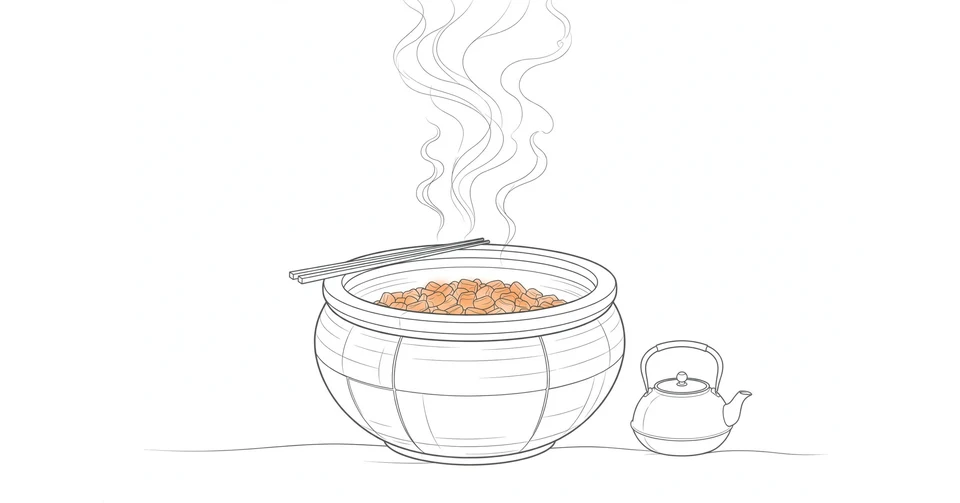
To understand it is to understand a different idea of heating. A modern heater warms a whole room whether anyone is in it or not. A hibachi warms only the people near it, and only as much as they need. It is heat you sit beside, not heat you live inside, and that small difference shaped how Japanese homes were used for hundreds of years.
What a hibachi actually is
The word hibachi means fire bowl, and the name describes the object plainly. It is a round, cylindrical, or box shaped container, open at the top, made from or lined with a heatproof material and built to hold burning charcoal. The bowl is filled with incombustible ash, and the charcoal sits in the centre of the ash, glowing gently rather than flaming. A pair of metal chopsticks called hibashi is used to move the coals, in the same way a Western household once used fire irons to tend a grate.
The first thing to know about it is that it was originally a heater, not a cooker. The Wikipedia entry on the hibachi sets this out clearly, and it is the fact most often lost when the word travels abroad. A hibachi heats by radiation, and it is too weak to warm a whole room. It warms the hands held over it, the knees tucked close to it, and the small space around it, and it does that job well. What it never tried to do was heat a house.
That modesty is the point. In a traditional Japanese house, where rooms were divided by sliding screens and people lived close to the floor, a small radiant fire made sense. You did not heat the room. You heated the person, and you put the heat exactly where the person was sitting. It could sit beside a desk while someone wrote, beside a low table while friends talked, or in the middle of a room while a family shared an evening. When the evening moved on, the fire moved with it.
From the hearth to a hibachi you can carry
The hibachi is believed to date back to the Heian period, which ran from 794 to 1185, but its story is really the story of the Japanese hearth learning to travel. For centuries the centre of a Japanese home was the irori, the sunken hearth in the middle of the main room, where charcoal burned for cooking, light, and heat all at once. The irori hearth was fixed into the floor, and the household gathered around it because the fire could not come to them.
The change came slowly, and it came in the direction of freedom. Toward the end of the Edo period, which ran from 1603 to 1868, the charcoal was moved out of the fixed hearth and into a hibachi, a portable earthenware brazier that could sit on the floor under a low table. That arrangement became the oki-gotatsu, the placed kotatsu, and it changed what a warm evening could look like. A family no longer needed a hole in the floor to stay warm. The table could move from room to room, and the kotatsu became something any household could own. The kotatsu that so many people know today began, in that sense, as a hibachi with a blanket over it.
I find that step quietly moving, the same way I find the kotatsu itself moving. A piece of furniture that began as part of the house, fixed into the floor, became something a family could carry. The warmth stopped belonging to the building and started belonging to the people sitting around it. It was the instrument of that change, a small bowl that let the hearth leave home.
By the 1900s, some cooking was also done over the hibachi, and that second life is part of its charm. A fire that began as a heater learned, late in its history, to grill a piece of food as well. But cooking was always the smaller part of the story. It was first and last a way to be warm, and everything else it did was a bonus.
Clay, wood, and metal
A hibachi can be made from several materials, and each one tells you something about where it was made and who it was made for. The classic form is earthenware or ceramic, a thick walled bowl that holds heat without cracking and cools slowly when the fire dies. Porcelain versions exist too, often decorated, and metal versions were made for households that needed something lighter or harder to break. Some hibachi sit inside a wooden frame, which protects the floor, gives the hands somewhere cool to grip, and turns a plain bowl into a piece of furniture.
The ceramic hibachi has a proud home in Shigaraki, a small town in Shiga Prefecture known as one of Japan's six ancient kilns. Shigaraki ware has been made there for centuries, and its clay is prized for high fire resistance and a warm, earthy surface. In more recent times, Shigaraki became particularly known as a production place for hibachi braziers, and the kilns there turned out braziers in large numbers from 1912 up to the beginning of the Second World War. The Hissan Pottery history of Shigaraki ware tells how the Hissan kiln, founded in the 1870s, began production and sales of ceramic household goods such as the hibachi brazier in the 1910s, and how the craft has been passed down through five generations of one family.
There is something reassuring about that continuity. The clay for a Shigaraki hibachi comes from an ancient lake bed, the firing takes a kiln master's judgement, and the finished bowl may warm a household for decades. A hibachi is not a disposable heater. It is a fired object, made slowly, and it carries the patience of its making into the room it warms. I think that is why old ones are still collected and used. They were made to last, and they look as though they were made to last, with a weight and a calm that a modern electric heater cannot copy.
When you choose a hibachi today, the material matters in a practical way too. A thick ceramic body holds heat longer and is less likely to scorch a floor, but it is heavy and it can crack if it is dropped or heated unevenly. A metal hibachi is tougher and lighter, but it cools faster and its outside can get hot to the touch. A wooden frame helps with both problems, keeping the hot bowl off the floor and giving you a safe place to hold. Whatever the material, the test is the same. Pick it up, feel its weight, and ask whether you would trust it with a small fire in your living room.
Binchotan, the charcoal a hibachi burns best
A hibachi is only as good as its charcoal, and the charcoal most often paired with it is binchotan, sometimes called white charcoal for the pale residue on its surface. Binchotan is made from a heavy, dense species of oak, such as the ubame oak of twenty to thirty years old from Minabe in Wakayama Prefecture, where some of the finest binchotan is produced. The wood is fired at high temperature until it becomes hard, dense, and almost metallic to the touch, and it burns with a long, steady heat and very little smoke.
Japan has been producing charcoal for almost five thousand years as a smoke and flame free source of heat for houses, and binchotan sits at the refined end of that long tradition. It was first adopted by the aristocracy as a smoke free fuel to heat their palaces, before being adapted for cooking and popularised by the portable brazier, which took cooking on charcoal from a luxury to an everyday custom. That pairing, fine charcoal and a portable bowl, is what made the hibachi practical for ordinary households. A smoky fire could never have sat in the middle of a living room. A binchotan fire could, and did.
In daily use, the difference is easy to feel. Ordinary charcoal flares, smokes, and dies quickly. Binchotan lights slowly, holds its heat for a long time, and gives off little smoke or smell. It is more expensive, and it asks for patience at lighting, but it repays that patience with a calm, even glow that can last an evening. For a hibachi, which is meant to sit quietly and radiate rather than blaze, that is exactly the right fuel. I have come to think of binchotan as the hibachi's other half. The bowl holds the fire, but the charcoal decides what kind of fire it is.
A small fire with many small jobs
Spend a day with one and you will see how many small jobs one bowl can do. In the morning it warms cold hands before the day begins. In the afternoon a tetsubin, a cast iron kettle, can be set over the coals to boil water for tea, and the kettle will sit there simmering gently, ready whenever someone wants a cup. A small flask of sake can be warmed in hot water beside the coals, and on a cold night that warm cup is a comfort out of all proportion to its size.
Later, when the coals are at their best, the hibachi turns cook. Small foods grill beautifully over its even heat. A piece of mochi softens and puffs on a small wire rack, a skewer of yakitori sizzles and browns, and a slice of dried fish crisps at the edges. None of this is a feast. It is a snack, a side dish, a small pleasure made while the evening passes. That is its scale. It does not cook dinner for eight people. It cooks a little something for the people sitting around it, while it keeps them warm at the same time.
The social side matters as much as the practical side. A hibachi gives people a reason to sit close and to linger. There is nothing to look at except the glow, nothing to do except tend the coals with the hibashi and pass the tea, and that simplicity slows an evening down in a good way. Conversation fills the space that a television or a phone would otherwise take. I think every home could use one object like that, something with no screen and no hurry, whose only job is to make sitting together feel worthwhile.
The hibachi that is not a hibachi
Here is where the story takes a confusing turn, and it is worth setting straight. In North America, the word hibachi usually means something else entirely. It refers to a small cooking stove heated by charcoal, which is called a shichirin in Japanese, or to an iron hot plate, called a teppan in Japanese, used in teppanyaki restaurants. If you have watched a chef in a tall hat toss shrimp across a flat steel grill while flames leap up around him, you have watched teppanyaki, not hibachi, even if the restaurant's sign says otherwise.
The confusion is understandable. Both words travelled abroad with Japanese food, and both describe a hot surface with charcoal or flame beneath it. But the real hibachi is a heater first, a round bowl of ash and glowing coals that warms a room and the people in it. The teppan is a cooker first, a flat sheet of iron built to sear meat and vegetables at high heat. One is a quiet bowl you sit beside. The other is a stage you sit around to watch a performance.
Knowing the difference does not make the restaurant meal any less enjoyable, and it should not. Teppanyaki is a fine tradition in its own right, and a good teppanyaki chef is a pleasure to watch. But the mix up does the hibachi a small injustice. It takes a modest, centuries old heater and turns it, in the mind of a whole continent, into a noisy grill. The real thing is quieter than that, and quieter is not lesser. A bowl of glowing charcoal that has warmed Japanese winters since the Heian period deserves to be known for what it actually is.
Living safely with a hibachi
A hibachi is a small open fire, and it deserves the respect that any open fire deserves. The most important rule is ventilation. A hibachi must never be used in an airtight room, and traditional Japanese houses, which were well ventilated, were forgiving in a way that a sealed modern apartment is not. Burning charcoal gives off carbon monoxide, which has no smell and no colour, so the room needs a steady flow of fresh air. Open a window a little, or a door, and never fall asleep beside a lit hibachi.
The ash bed is part of the safety system, not just a tradition. The charcoal sits in the centre of incombustible ash, which insulates the bowl, steadies the heat, and catches any falling embers. Keep the ash level topped up, keep the coals centred, and use the hibashi to move them rather than your fingers. Place it on a stable, heatproof surface, away from tatami edges, blankets, curtains, and anything that could catch. Keep children and pets at a respectful distance, and teach anyone who uses it that the rim and the coals stay hot long after the glow fades.
Care after use is simple but worth doing properly. Let the coals burn down and cool completely before you move the bowl. Ash should be left to cool fully, ideally overnight, before it is disposed of, and it should go into a metal container, never a paper bag or a plastic bin. Wipe the outside of the bowl when it is cool, store it somewhere dry, and check a ceramic hibachi for hairline cracks from time to time. A cracked bowl can still be beautiful, but it should not be trusted with a live fire until it has been checked. A little attention, given regularly, is what lets a hibachi last for decades instead of a single winter.
A hearth that learned to walk
A hibachi is only a bowl of ash and charcoal. It has no screen, no dial, and nothing to say. Yet for more than a thousand years it has held the same job, carrying a little of the hearth's warmth to wherever people happened to be sitting. It began beside the fixed fire of the old house, learned to travel under a low table, and then learned to grill a skewer and warm a cup of sake, and through every change it kept the same shape and the same promise. Sit down, stay a while, and be warm.
That is why I think the hibachi deserves its place in the Japanese home, even now, when warmer and cleverer heaters exist. A house can be heated in many ways, but only a few of them ask you to sit close to the people you live with, to tend a small fire together, and to let the evening slow down around a glow. The hibachi does that with a bowl, some ash, and a handful of charcoal, and on a cold evening, that is enough. It is enough to make a small square of a cold room the warmest place in the house, and to remind everyone sitting there that warmth was never really about the room at all.
More in Life & Style
- A Kotatsu Turns a Cold Winter Evening Into the Warmest Room in the House
- The Jizaikagi Hangs Above the Fire and Sets the Pace of Dinner
- An Irori Hearth Warms the Room and the People Around It
- A Sudare Turns Harsh Sunlight Into a Cool Breeze
- A Genkan Is Where Japan Leaves the Outside World at the Door
- A Ranma Lets a Japanese Room Breathe Over the Top of Its Walls
Latest posts
- Kumiko Builds Beauty From Wood Without a Single Nail
- Japanese Paper Lanterns and the Light That Folds Flat
- A Zabuton Is the Cushion That Tells You Where You Sit in Sumo
- Tatami Still Sets the Measure of a Japanese Room
- Chawanmushi Hides a Whole Meal Inside a Teacup
- Japanese Video Games and How a Small Island Rewired Play
- A Kakejiku Turns a Blank Wall Into a Conversation
- Himeji Castle, Japan's White Heron That Survived War and Fire
- A Shoji Lets the Daylight In While Keeping the World Out
- A Tokonoma Turns One Corner of a Japanese Room Into a Shrine
- Japanese Breakfast and the Morning Meal That Starts with Rice and Soup
- Fusuma Turn a Room Into Whatever Japan Needs Next
- Wearing a Happi Means You Belong to the Matsuri
- A Yuzamashi Cools the Water Before the Tea Begins
- Tencha Is the Shade-Grown Leaf Matcha Is Made From