Kumiko Builds Beauty From Wood Without a Single Nail
· 13 min read
Kumiko is the Japanese art of fitting tiny pieces of wood into geometric patterns without a single nail, and a finished panel is held together by nothing but precision.
There is a kind of beauty in a Japanese room that is made from almost nothing. No paint, no carving, no metal, just thin strips of wood fitted together so precisely that they hold each other in place. That beauty has a name, and the name is kumiko.
Kumiko is the Japanese art of assembling tiny wooden pieces into geometric patterns without nails, and a finished panel is held together by the accuracy of its joints alone. I first met it properly while writing about the ranma, the latticed transom above a sliding door, where a kumiko panel turns the space above a door into quiet mathematics. The pattern was the whole decoration, and it needed nothing else.
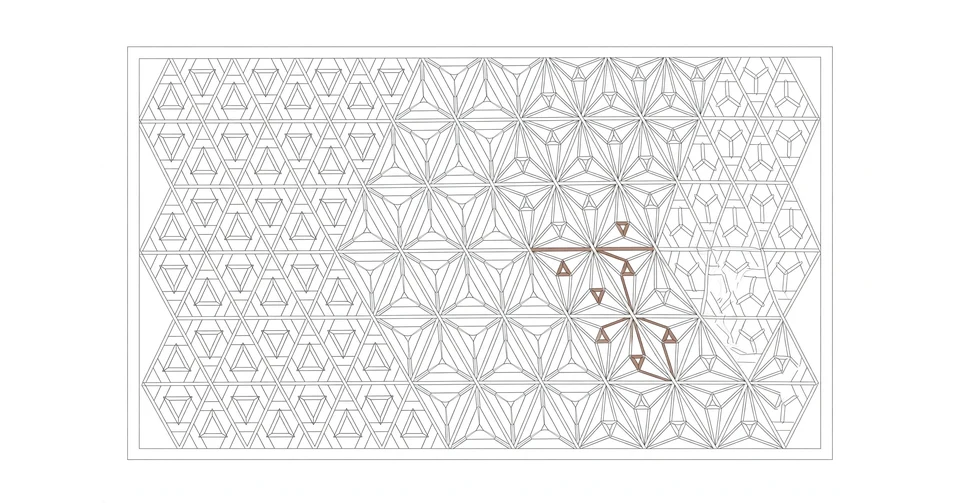
Look closely at a panel like that and the first question is always the same. Where are the nails? There are none, and in the traditional way of working there is often no glue either. The pieces are grooved and notched, then pressed together by hand until friction and geometry do the work that a screw would do in a Western frame. It is carpentry reduced to its most honest form, and it has been practised in Japan for more than a thousand years.
What kumiko actually is
The Japanese dictionary of architecture JAANUS defines kumiko plainly, as the thin wooden lattice strips set vertically and horizontally to fill the frame of a sliding door or a screen, and as the muntins within the stiles of doors and windows. The same entry notes that such latticework divides the inner sanctuary of a shrine or temple from the worshippers area, which tells you how old and how serious the craft is. It began as architecture, not decoration.
A panel is built in two stages. First the maker assembles a large framework from lattice or diamond grids. This base framework is called the jigumi. Then delicate pieces are fitted inside each cell to form the pattern. Takahiro Tanaka of the Tokyo workshop Edo Kumiko Tatematsu explains that building from the base frame toward the smaller parts makes the piece lighter and stronger, and keeps it from warping. It is a sensible order of work, big decisions first and small ones last, and it is the same order a good writer follows.
The no nails claim holds for the finished joinery, and the tolerances explain why. Edo Kumiko Tatematsu puts its tolerances at less than 0.1 mm, and notes that even a small deviation can stop the pieces from fitting. A panel that depends on friction cannot forgive a sloppy cut. Glue is a separate question, and honest makers answer it differently. Some use no glue at all and let pressure alone hold the work, while others add a dot of wood glue for durability. Tanihata, the Toyama maker, adds one qualification, that nails are never used in the assembly except for small temporary nails that hold material in place while it is worked. The spirit of the rule survives in every version. Nothing metal does the holding. I find that discipline moving, because it makes the maker responsible for every cut. There is no fastener to forgive a mistake, so the mistake has to be prevented rather than repaired.
A history with two beginnings
Ask when kumiko began and the sources disagree, which is itself worth reporting honestly. Smithsonian Magazine, in a 2025 report, states that it emerged in the Asuka period, from 538 to 710. The Tokyo Metropolitan Government gives two accounts on its own sites. One says kumiko was invented between the 8th and 12th centuries, and the other says it developed as a decorative technique for sliding doors and transoms toward the end of the Heian period. Every account agrees on the second half of the story, that the craft reached its full development in the Edo period, from 1603 to 1868. The disagreement is laid out in full in a detailed survey of kumiko and its makers, which compares the Smithsonian account with the Tokyo Metropolitan Government's two versions.
The buildings themselves give firmer dates for the lattice forms that kumiko fills. The Japanese Architecture and Art Net Users System cites the inner doors of the Phoenix Hall at Byodoin in Kyoto, built in 1053, as an example of plain lattice. It records that lattice and small sliding screen transoms were popular from the 12th to the 14th century, and that flat openwork became common in the 15th. The shoji belongs to the shoin style of the formal reception room, which first appeared in the Kamakura period, from 1192 to 1333.
In the Edo period the craft moved from temples and aristocratic houses into merchant homes, carried by the same long peace that let the ranma spread through Osaka. The transom makers of Osaka were designated a Traditional Craft of Japan on 4 September 1975, a late recognition of a skill that had already been practised for centuries. I like the fact that the history is untidy. A craft that old should have more than one birthday, and the disagreement between the sources is a reminder that kumiko grew gradually, in workshops rather than in a single invention.
The wood and the tools
Kumiko is made mainly from Japanese conifers, and the choice of timber is part of the craft. The Edo Tokyo Kirari project states that Edo Kumiko Tatematsu primarily uses what it calls Japan's three famous woods, Kiso hinoki cypress, Akita sugi cedar and Aomori hiba. In Kanuma, in Tochigi Prefecture, the makers specify top grade Kiso hinoki and locally grown Nikko sugi, and state that only the high quality masame, or straight grain, sections of the timber are used. Straight grain matters because a thin strip with wild grain will bend, split or fight the pattern.
The work is done to tolerances that sound impossible until you see the result. Edo Kumiko Tatematsu works to less than 0.1 mm, and in the United States the maker David Gootnick cuts Alaskan cedar into strips often under 2 mm thick, checking every piece with a digital calliper so that each one matches the next. The plane is the key hand tool. Tanihata describes it as one of the most important tools for kumiko and states that, besides the standard carpenter's plane, its craftsmen design and use many specially made planes. Borers make the holes and curved surfaces, and blades are sharpened and maintained before work begins. Much of the work is still done by hand even in larger workshops. Tanihata has more than sixty machines in its factory, some forty years old and others digitally controlled, yet the company states that most components are still processed by hand.
The timber itself is prepared with patience. The official standard for Osaka ranma calls for boards sawn to 45 mm or less and dried upright in the shade for at least three months, and some woods need two to three years before they are ready. Any lacquer must be natural urushi. That slowness is not inefficiency. Wood that has been dried properly will not warp after the panel is assembled, and a panel that never warps can last for generations. I think about that whenever I am tempted to hurry a piece of work. The drying cannot be rushed, and neither can the cutting, so the craft builds patience into the maker whether the maker wants it or not.
Two hundred patterns that mean something
The Tokyo Metropolitan Government's profiles of Edo Kumiko Tatematsu put the number of traditional kumiko patterns at more than 200, depicting flowers, leaves, snowflakes and other natural forms alongside auspicious and purely geometric designs. Takahiro Tanaka has said he would need to master all of them before designing a new one, which is a humbling standard for anyone who has ever been tempted to invent before learning. The patterns are not chosen at random. Each one carries a meaning, and the meaning decides where the pattern belongs.
Asanoha, the hemp leaf, is the best known. It is a star of repeating triangles that radiates from a point, named for the leaves of the hemp plant, and it has been used since the Heian period. Hemp grows straight and fast with little care, so the pattern was often used on babies and children's kimonos as a wish for strong growth, and it appears just as often in Buddhist furnishings. Kikko, the tortoise shell, is a field of interlocking hexagons, and the tortoise is a symbol of longevity, which is why the pattern appears in work meant to last. Seigaiha, fan shaped waves of the open sea, takes its name from a gagaku court dance, and it speaks of abundance and the steady return of the waves. Shippo, the seven treasures, uses overlapping circles and stands for prosperity for descendants, good relationships and harmony. Sakura, the cherry blossom, is used to encourage a good harvest, and goma, the sesame seed pod, is associated with good health and was commonly seen on the formal clothes of samurai.
Tanaka once set cherry blossoms, hemp leaves, bellflowers and snowflakes side by side in a single screen to represent the four seasons, which shows how the patterns can be combined like words in a sentence. I love that idea, that a screen can carry a calendar in its geometry, and that a guest who knows the language can read the season in the wood. A plain grid divides a room. A patterned one also says something, quietly, to anyone patient enough to look.
Where kumiko lives in the house
The shoji is the best known home for kumiko. A shoji is a sliding panel with a latticework wooden frame covered in tough, translucent white paper, and the lattice is what gives the panel its strength and its signature look. Our earlier guide to a shoji that lets the daylight in while keeping the world out describes how the paper diffuses the daylight, and the wood underneath is doing the structural work that makes the paper possible. Closed, the screen glows. Open, or removed in summer, the house opens to the garden.
The ranma is the second home. A transom filled with plain lattice is called a koshi ranma and it is the most common kind, while the diagonal lozenge lattice is the hishigoshi ranma and the version with small sliding screens is the shoji ranma. The same room may hold fusuma, shoji and a ranma together, and kumiko belongs to the light, open members of that family, the ones that let air and light pass while still marking the boundary. In a shrine or temple the lattice can also divide the inner sanctuary from the worshippers area, which is the oldest job of all, separating the sacred from the everyday with nothing more solid than a pattern.
The masters and the long apprenticeship
The craft survives because a small number of workshops refused to let it go. In Toyama, Toshio Tanihata began kumiko training in 1956 at the age of 23, returned home and founded his company in 1959, and in 1977 received the Prime Minister's Award at a national fittings exhibition. His son later returned to take over, launched the company website in 2000 and exhibited at the New York International Furniture Exhibition in 2012. The company now lists the Ritz-Carlton, Hermes and Starbucks among the companies it has supplied, which says something about how far a Toyama workshop can reach.
In Tokyo, Matsuo Tanaka taught himself kumiko while training at a fittings shop and set up Edo Kumiko Tatematsu in 1982. He has specialised in kumiko woodcrafts for over fifty-two years and can make over 250 patterns, and he says the hardest part of the craft is creating a straight line. That sentence stays with me. The hardest part of a craft built from geometry is the simplest element of all, a line that does not waver. The official standard puts the time needed to master the craft at five to ten years, and many artisans train for decades, often coming from a long line of woodwork specialists.
Kanuma, in Tochigi Prefecture, is the second great centre. Artisans gathered there more than 380 years ago, when renovations of the Nikko Toshogu temple complex drew the nation's best temple builders, and the skills took root. Kanuma kumiko is recognised as a Tochigi Prefectural Traditional Craft, and the Japan Patent Office lists it as a regional collective trademark held by the local fittings association. The registration covers lighting, fittings, furniture, folding screens and tableware, which shows how far the craft has travelled from the transom.
Kumiko in the modern room
The demand has shifted. The makers themselves say that demand from Japanese style rooms is falling while demand from hotels, studios, offices and shops is growing. Tokyo makers now produce lighting, picture frames and computer cases alongside the traditional fittings, and Kanuma's registered goods include lighting as well. At Strawfire, a Japanese restaurant in Abu Dhabi completed in 2024, a backlit kumiko screen stands between the dining room and the kitchen, and the light behind it throws the shadows of the chefs onto the lattice. It is the same trick the shoji has always played, light passing through wood, performed in a new building on the other side of the world.
Smaller pieces carry the craft into ordinary homes. Coasters, trays, lamps, photo frames and stationery boxes are now made with kumiko patterns, and at Sashikan Tategu Kogei in Mie Prefecture a new technique called Kakumaru kumiko was developed with modern designers so the lattice could fit contemporary spaces. The craft there has been passed down through three generations using techniques that can only be learned in that workshop. For anyone who wants to try, the path is open. Many master artisans are self-taught, and while it can take years to create complex patterns, it is easy to get started with basic Japanese woodcrafts. A simple coaster teaches the same lesson as a full screen, that a straight line is hard and a pattern is earned one cut at a time.
A finished panel asks for nothing. It does not move, it does not shine, and it does not explain itself. It simply sits in its frame, holding itself together by the accuracy of a thousand small decisions, and lets the light through in a pattern that someone chose on purpose. That is enough. In a world that adds fasteners to everything, a craft that holds together without a single nail is a quiet argument for doing the work properly, and for trusting that proper work will hold.
More in Culture & Society
- Japanese Paper Lanterns and the Light That Folds Flat
- A Zabuton Is the Cushion That Tells You Where You Sit in Sumo
- Tatami Still Sets the Measure of a Japanese Room
- A Kakejiku Turns a Blank Wall Into a Conversation
- A Shoji Lets the Daylight In While Keeping the World Out
- A Tokonoma Turns One Corner of a Japanese Room Into a Shrine
Latest posts
- A Hibachi Carries the Hearth Anywhere in the House
- A Kotatsu Turns a Cold Winter Evening Into the Warmest Room in the House
- The Jizaikagi Hangs Above the Fire and Sets the Pace of Dinner
- An Irori Hearth Warms the Room and the People Around It
- Chawanmushi Hides a Whole Meal Inside a Teacup
- Japanese Video Games and How a Small Island Rewired Play
- A Sudare Turns Harsh Sunlight Into a Cool Breeze
- Himeji Castle, Japan's White Heron That Survived War and Fire
- A Genkan Is Where Japan Leaves the Outside World at the Door
- A Ranma Lets a Japanese Room Breathe Over the Top of Its Walls
- Japanese Breakfast and the Morning Meal That Starts with Rice and Soup
- Fusuma Turn a Room Into Whatever Japan Needs Next
- Wearing a Happi Means You Belong to the Matsuri
- A Yuzamashi Cools the Water Before the Tea Begins
- Tencha Is the Shade-Grown Leaf Matcha Is Made From