The Jizaikagi Hangs Above the Fire and Sets the Pace of Dinner
· 18 min read
A jizaikagi is the adjustable hook that hangs a pot or kettle over an irori hearth, and the small lever that sets its height also set the pace of cooking, heating and family life in a traditional Japanese farmhouse.
Look up in a traditional Japanese farmhouse and you will see it before you notice anything else in the room. A dark iron rod drops from a ceiling beam, passes through a bamboo tube, and ends in a hook with a kettle hanging over the fire. That is a jizaikagi, the adjustable pothook of the irori hearth, and it is the quiet machine that made the whole hearth work. Raise it and the water simmers. Lower it and the stew boils. One small movement of a wooden lever decided how hot the food was, how fast the tea came, and how long the family sat around the fire.
A jizaikagi is not a decoration hung above the hearth to look old. It is a tool that solved a real problem, and the problem was that an open fire cannot be turned up or down. The fire in a sunken hearth burns at the pace of the charcoal, and the cook cannot ask the coals to behave. The jizaikagi gave the cook the one control that mattered, which was distance. A pot hanging close to the embers cooks fast. The same pot hanging higher cooks slow. By sliding the hook up and down, the cook turned distance into a dial, and that dial ran the kitchen.
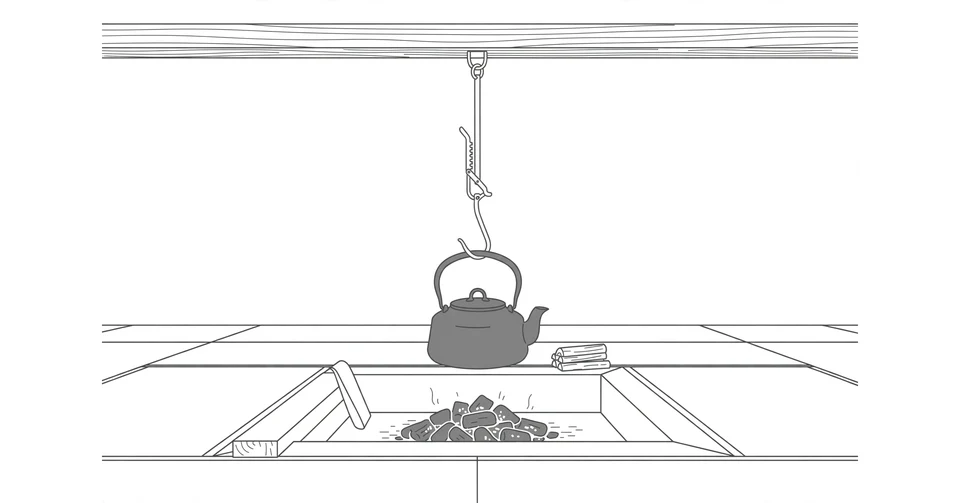
There is something touching about how little the jizaikagi asks of the person using it. No knob, no gauge, no manual. You reach up, lift a small crossbar level, slide the rod to the height you want, and let go. The weight of the pot does the locking for you. The jizaikagi rewards attention rather than strength, and it punishes nobody for getting it wrong, because the worst mistake is a pot that simmers when you wanted it to boil. In a house built of wood and paper, with a fire burning in the middle of the floor, a tool this forgiving was worth more than a clever one.
What a jizaikagi actually is
Strip the romance away and a jizaikagi is a hanging system with three jobs. It holds the pot, it sets the height, and it stays put. The usual form is an iron rod that slides inside a bamboo tube, hung from a beam above the hearth, with a small wooden crossbar that locks the rod at the chosen height. A hook at the lower end carries the pot or kettle. The irori it hangs above is the sunken hearth cut into the floor of the farmhouse, and the hook and the hearth belong together the way a tap belongs with a sink. One without the other is only half a kitchen.
The name itself tells you what the tool promises. Jizai means free, at will, or as you like, and kagi means hook. So a jizaikagi is a hook that goes where you want it, a free hook, and the name is a small boast that happens to be true. Earlier hooks were not free at all. The simplest pothooks were branches with their twigs trimmed short, hung by a rope from a beam, and the cook changed the height by moving the pot from one twig to another. That worked, but it gave the cook only a few fixed heights, one per branch, and a branch is not a precision instrument. The jizaikagi broke that limit. It slides to any height at all, not just the ones a tree happened to grow, and that freedom is what makes it the finished version of the idea.
The bamboo tube matters more than it looks. The iron rod inside it is the part that carries the weight, and the tube around it keeps the rod from swinging sideways while it slides. In more refined versions, a separate short rope ties the tail of the crossbar to the bamboo tube, so the rod can only move straight up and down. Nothing about this is accidental. A heavy kettle of boiling water hanging over an open fire, above a floor where children sit, must not swing. The tube is the part that keeps a cooking tool from becoming a hazard, and it does the job without a single moving part of its own.
The materials were whatever the household could get. Iron for the rod and the hook, because iron holds its strength in the heat. Bamboo for the sleeve, because bamboo is straight, light, and easy to replace when it chars. Wood for the crossbar, because wood can be carved, and a carved crossbar can be made into something worth looking at. Rope where rope was needed, because rope is cheap and a household could splice it in an evening. Nothing in the list is rare or imported. The jizaikagi was built from the same materials as the house around it, and a farmer could repair a jizaikagi with what was already in the shed.
How a jizaikagi holds its height
The clever part of the jizaikagi is not the hook. It is the locking. The mechanism will be familiar to anyone who has ever pitched a tent, because it works on the same principle as a guy rope tensioner, a small bar with holes that grips a rope when it tilts and frees it when it lies flat. The crossbar of the jizaikagi, sometimes called a ko-zaru, or little monkey, has a hole at each end. The hanging rope or rod passes through one hole and is fixed at the other end with a knot, while the free end runs down through the second hole to the hook that carries the pot.
At rest, the weight of the pot pulls one end of the crossbar down, so the bar sits at an angle. In that tilted position, the opposite edges of the hole bite into the rope or rod, and friction holds everything in place. The heavier the pot, the harder the grip, which is the kind of logic a good tool has. The pot locks itself. To change the height, the cook lifts the crossbar until it lies level. Level, the hole stops biting, and the rope or rod slides freely through it. Slide the pot up or down, let go of the bar, and the weight takes over again. The whole adjustment takes one hand and a few seconds, and it can be done while the kettle is already over the fire.
The guide to the irori at immoJapon describes the hook as a metal rod inside a bamboo or timber sleeve, with the height set by a wooden toggle, and that plain description is the right way to think about it. There is no ratchet, no teeth, no spring, and nothing to wear out in the way a geared mechanism wears out. Friction and gravity do all the work, and both of them are free. That is why so many of these hooks survived long after the houses around them were rebuilt. A tool with almost nothing to break is a tool that lasts for generations.
It is worth pausing on the fact that the adjustment is continuous rather than stepped. A branch hook gave the cook a handful of heights. The jizaikagi gives any height, which means the cook could set a pot just below the boil and leave it there all afternoon, or drop a kettle low for a fast rolling boil when guests arrived. The difference between a stepped hook and a free hook is the difference between a stove with three settings and a stove with a dial, and anyone who has cooked over a real fire will know which one they would rather have. The jizaikagi is a dial made of wood and iron.
The fish that watches the fire
The crossbar of a jizaikagi is very often carved in the shape of a fish, and the reason has nothing to do with decoration. A fish lives in water and never closes its eyes, so it stands guard against fire in a house built almost entirely of wood, paper and straw. The carving is a piece of folk wisdom built into a working tool, a small prayer that the household touched every time it cooked. The fish is usually a carp, or koi, and in Japanese folk belief the carp also stands for perseverance and good fortune, swimming upstream against the current, which is not a bad thing to wish for over a fire that has to be tended all day.
Not every jizaikagi crossbar is a fish. Some are plain bars of wood or iron, some are carved into other shapes, and some are left rough and practical. But the fish is common enough that it has become the signature of the object, and old fish crossbars are now collected as folk art in their own right, sold far from the farmhouses they came from. There is a quiet sadness in that. A fish that once hung above a fire, doing a job every day, now hangs on a gallery wall, doing nothing at all. The carving survives. The work does not.
I think the fish is the part of the jizaikagi that explains the household best. A family that carves a guardian into the lever of its pothook is a family that knows exactly what it fears, and it answers that fear with care rather than with panic. The house could burn. Everyone knew it. The fire was in the middle of the room, the roof was thatch, and the walls were paper. So the family put a creature of water on the tool nearest the flame and went on cooking. It was not superstition as an excuse for carelessness. It was a reminder, placed where the cook would see it a dozen times a day, to pay attention. Fear, handled well, becomes a habit of care, and the fish was the habit made visible.
Cooking at the pace of the coals
A jizaikagi turned the hearth into a kitchen with a thermostat made of distance. The pot hung from the hook could simmer for hours without attention, and a kettle could be kept just below the boil all day, ready whenever someone wanted tea. Fish and vegetables could be grilled in the ashes around the fire while the pot hung above it, so a whole meal cooked at once, at different heats, from a single bed of coals. A small bottle of sake could be warmed by burying it in the ash while the stew hung overhead. Nothing was rushed, because the fire itself was never in a hurry, and the meal took shape around the pace of the coals.
The jizaikagi also set the rhythm of the day. In the morning the embers were uncovered, the kettle was lowered close to the fire, and the water came to the boil for tea. Through the day the pot was raised a little when the stew threatened to boil over, and lowered again when the fire burned low. At night the kettle was lifted high, out of the worst of the heat, and the fire was banked under ash until morning. Each of those movements was a small decision, made by feel, and the person who made it was usually the person sitting nearest the fire, tending it while everyone else talked. The hook gave that person a quiet authority. The meal ran at the speed they chose.
There is a social point here that is easy to miss. Because the pot hung in the middle of the room, the cook never turned away from the family. The kitchen was the living room, and the person cooking was part of the conversation. The jizaikagi made that possible by keeping the food at the centre of the room instead of against a wall, and the family ate together because the fire gave them no other sensible place to sit. Modern kitchens hide the cook in a corner. The hearth put the cook in the middle, and the hook held the meal where everyone could see it.
The jizaikagi also heated the house, in its small way. A kettle hanging over the fire gives off steam all day, and a pot of stew gives off warmth as well as smell. The room around the hearth was warmed by the fire below and by the food above it, and the people sitting there were warmed twice over. That is a modest kind of heating, and nobody should pretend a kettle kept a farmhouse warm in February. But in a house where the fire was the only heat, every little helped, and the hook kept the kettle exactly where it did the most good.
One hook, many houses
No two farmhouses were alike, and the jizaikagi varied with them. Some hooks hung straight from a ceiling beam. Others hung from the slatted drying rack above the fire, the hidana, or from a larger parent hook, an oya-kagi, that carried one or two smaller hooks beneath it. Some hearths had two hooks hanging side by side, one for the kettle and one for the pot, so the water and the meal could be kept at different heights at the same time. The form followed the house, the beam, and the family, and there was never a single national standard to follow.
That variety is part of the charm, and part of the difficulty of writing about the object. A jizaikagi in a wealthy merchant house in Takayama might be finely made, with a well carved fish and a polished rod, while one in a mountain farmhouse might be a plain bar of wood and a length of rope, doing the same job with less ceremony. Both are the same jizaikagi. The difference is only in how much the household could afford to spend on beauty, and the plain one is not a worse hook. It is the same idea, built with less money.
The Kusakabe Heritage House in Takayama, a merchant home rebuilt in the late 19th century and now a museum, keeps its hearth and its jizaikagi in the family room, and visitors can still see the arrangement whole, the fire below, the hook above, the beams dark with old smoke. A travel account of the house describes the huge adjustable hook hanging above the hearth, holding the pots for water, cooking and tea, and the description is worth reading because it shows the tool in its place rather than in a museum case. The TerraFirmaTourist visit to the Kusakabe house records the hearth as the central place of the house, where the family gathered to share meals and discuss the events of the day, and that is the context the hook belongs in.
Regional habits shaped the hearth as well. In the Hokuriku region, on the Sea of Japan coast, cooking was done with the hearth until the enclosed cooking stove became widespread in the 1950s. In warm western Japan, people had long used the hearth and the stove side by side according to the season, keeping the open fire for winter warmth and moving the cooking out of the main room in summer. Where the hearth stayed in daily use longest, the hook stayed in daily use longest too, and the finest surviving examples often come from the cold snowy districts where a fire in the floor was not a luxury but a necessity. Cold country keeps old tools alive because it cannot afford to throw them away.
What survives of the jizaikagi today
The hearth faded from daily life between the 1950s and the 1970s, when gas and kerosene offered heat without smoke, and the jizaikagi faded with it. Most families stopped lighting the fire, boarded over the pit, and put a heater in the middle of the room. The jizaikagi, if it survived, was taken down and put in a storehouse, sold to an antique dealer, or left hanging from a beam in a house nobody lived in any more. The immoJapon guide notes that the pothook is often the only original piece of a hearth left, and that it is frequently removed and sold separately, which is both a tribute to its quality and a small tragedy. The best made part of the hearth is the part most likely to be taken away from it.
What remains falls into a few kinds of survival. The first is the museum house, where the jizaikagi hangs above a cold hearth as part of a preserved interior, and visitors can see how the room worked. The second is the inn and the restaurant, where a working hearth grills fish and vegetables over charcoal in front of guests, and the jizaikagi is back on duty, doing the job it was made for. The third is the farmhouse guesthouse, where travellers sleep in a room with a fire at its centre and eat a meal cooked over it, which is the fullest version of the experience still on offer. The fourth is the antique shop, where fish crossbars and iron rods are sold as folk art to people who will never hang a kettle from them.
There is also a quieter kind of survival, which is the idea itself. The principle of the hook, a bar that grips when it tilts and frees when it lies flat, is the same principle used in tent guy ropes and in adjustable straps of all kinds. The jizaikagi did not invent friction, but it used it elegantly, and the elegance is still visible in tools that have nothing to do with a Japanese farmhouse. Ideas travel further than objects. The hook itself may hang in a museum, but the thinking inside it is still at work.
I find the restaurant version the most honest of the survivals, and the museum version the most melancholy. A jizaikagi that still holds a kettle is still a jizaikagi. One behind glass is a memory of one. That is not a criticism of museums, which keep these things safe when houses fall down, and it is not a criticism of the families who stopped using them, who chose warmth without smoke for good reasons. It is only a reminder that a tool is alive while it is used, and that preservation is a second best. The best fate for a jizaikagi is the one it was made for, which is to hang above a fire, holding dinner, while the people it feeds sit around talking.
Anyone thinking of buying an old house with a hearth should look at the jizaikagi before anything else. It tells you whether the hearth was loved or merely tolerated, whether the last owners cooked over the fire or only kept it as a decoration. A well worn fish, dark with smoke, with a rod that still slides smoothly in its bamboo tube, means the hearth was used properly and often. A missing hook means someone already took the best part of the room away. The tatami mats that set the measure of a Japanese room give a house its proportions, and the hearth gives it a centre, but the jizaikagi is the part you touch. It is the handle of the whole system, and a house that still has its handle is a house that still remembers how it worked.
A hook that teaches patience
A jizaikagi teaches a small lesson that has nothing to do with Japan and everything to do with how to live with a fire. It says that control does not need to be complicated, that distance can be a dial, and that the weight of the thing you are holding can do the locking for you. It says that a tool can be beautiful without trying to be, because a carved fish on a working lever is beautiful precisely because it is working. And it says that patience is a technology, a way of cooking slowly and living slowly that a faster world keeps forgetting and then keeps rediscovering.
The farmhouse hearth is mostly gone from daily life, and it is not coming back. Gas is cleaner, electricity is easier, and nobody should have to breathe smoke to eat dinner. But the jizaikagi deserves to be remembered, not as a relic, but as a piece of thinking. Somewhere, a long time ago, someone looked at a branch with a pot hanging from it and thought that a cook should be able to set any height at all, with one hand, while the kettle was already boiling. They built a bar that grips when it tilts and frees when it lies flat, put a fish on it to watch the fire, and hung the dinner from it. That is a good piece of design. It hung dinner over fire for centuries, and it still has something to teach a kitchen full of dials and timers, which is that the best control is often the simplest one, and the simplest one is a hook that goes where you want it.
More in Life & Style
- A Hibachi Carries the Hearth Anywhere in the House
- A Kotatsu Turns a Cold Winter Evening Into the Warmest Room in the House
- An Irori Hearth Warms the Room and the People Around It
- A Sudare Turns Harsh Sunlight Into a Cool Breeze
- A Genkan Is Where Japan Leaves the Outside World at the Door
- A Ranma Lets a Japanese Room Breathe Over the Top of Its Walls
Latest posts
- Kumiko Builds Beauty From Wood Without a Single Nail
- Japanese Paper Lanterns and the Light That Folds Flat
- A Zabuton Is the Cushion That Tells You Where You Sit in Sumo
- Tatami Still Sets the Measure of a Japanese Room
- Chawanmushi Hides a Whole Meal Inside a Teacup
- Japanese Video Games and How a Small Island Rewired Play
- A Kakejiku Turns a Blank Wall Into a Conversation
- Himeji Castle, Japan's White Heron That Survived War and Fire
- A Shoji Lets the Daylight In While Keeping the World Out
- A Tokonoma Turns One Corner of a Japanese Room Into a Shrine
- Japanese Breakfast and the Morning Meal That Starts with Rice and Soup
- Fusuma Turn a Room Into Whatever Japan Needs Next
- Wearing a Happi Means You Belong to the Matsuri
- A Yuzamashi Cools the Water Before the Tea Begins
- Tencha Is the Shade-Grown Leaf Matcha Is Made From