A Kotatsu Turns a Cold Winter Evening Into the Warmest Room in the House
· 14 min read
A kotatsu is a low Japanese table with a heater underneath and a heavy blanket over it, and it has warmed family winters for centuries, from the charcoal hearth to the modern electric model.
There is a moment in a Japanese winter when the whole house seems to shrink to a single warm square. Outside, the evening is cold and the windows are dark. Inside, a family sits on the floor around a low table, legs tucked under a heavy blanket, cups of tea steaming on the tabletop above. That table is a kotatsu, and the warmth under the blanket is the kind that makes nobody want to get up.
A kotatsu is simple to describe and hard to explain to anyone who has never sat at one. It is a low wooden table with a heat source fixed underneath, covered by a thick quilt, with a tabletop laid over the quilt. You slide your legs under the blanket and the heat gathers around your knees and feet, while the rest of the room stays cool. It warms people, not rooms, and that difference is the whole idea.
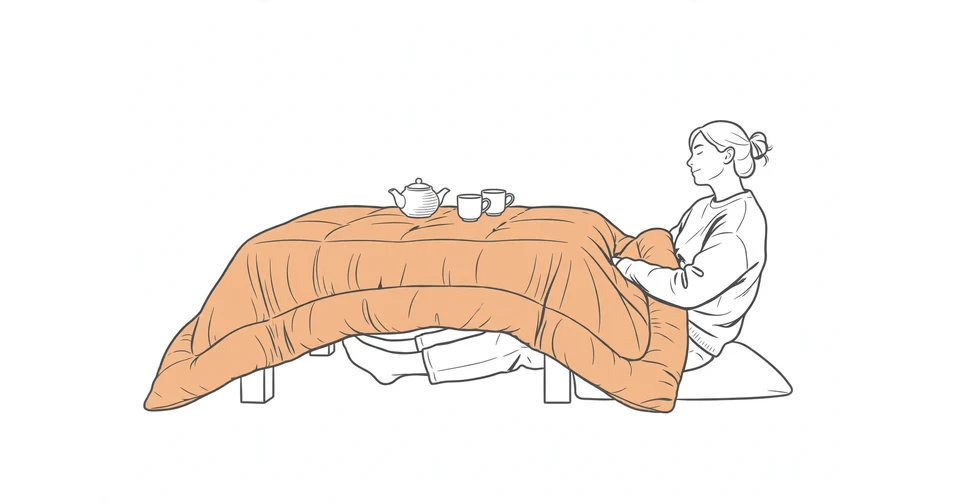
It is also, quietly, one of the oldest pieces of furniture still in everyday use in Japan. The heated table began more than six hundred years ago beside an open hearth, and it survived the move from charcoal to electricity without losing its shape or its job. To understand it is to understand how a Japanese winter evening works.
What a kotatsu actually is
Strip the table down to its parts and there is not much to it. A low frame, a heater fixed to the underside of the tabletop, a blanket draped over the frame, and a tabletop that sits on top of the blanket and holds it in place. The blanket is the key. Without it, the heat would escape into the room. With it, the warmth stays trapped in a small tent around your legs.
The modern version usually has two layers of cloth. A lighter blanket, called a shitagake, is draped over the frame first, and a second, heavier blanket, the kotatsu-gake, goes over it. The tabletop rests on top of both. In summer the blankets come off and the same low table serves as an ordinary table, which is one reason it has lasted so long in small homes. One piece of furniture does two jobs, and it does them without taking up any extra floor space.
You sit on the floor to use it, often on a zabuton, the flat cushion that has marked the seating of Japanese rooms for centuries. The low height is not an accident. It belongs to a room where people live close to the floor, on tatami rather than on chairs, and where the floor itself is part of the furniture. The table is low because the life around it is low, unhurried, and close together.
From the irori hearth to the charcoal hibachi
The history of the kotatsu begins in the Muromachi period, from 1336 to 1573, with the irori, the sunken hearth that sat in the middle of a traditional house. Charcoal burned in the irori, and it was the centre of the home, used for cooking, light, and heat all at once. At some point in the fourteenth century, people began building a wooden platform over the hearth and draping cloth over it, so that the heat stayed trapped underneath and their feet could warm inside it. That arrangement was the first kotatsu.
The next step was to dig. In the Edo period, which ran from 1603 to 1868, the floor around the irori was dug out into a square pit about 40 centimetres deep, with the wooden platform placed around it and the blanket laid over the top. This was the hori-gotatsu, the dug kotatsu, and it let people sit with their legs dangling down into the warmth instead of crouching beside a fire. Paintings from the period show families gathered around it, and the scene would be familiar to anyone who has sat at one today.
Then, toward the end of the Edo period, the kotatsu learned to walk. As tatami spread through ordinary homes, the charcoal was moved out of the fixed hearth and into a hibachi, a portable earthenware brazier that could sit on the floor under a low table. This was the oki-gotatsu, the placed kotatsu, and it changed everything. A family no longer needed a hole in the floor to stay warm. The table could move from room to room, and the kotatsu became something any household could own.
I find that step quietly moving. A piece of furniture that began as part of the house itself, fixed into the floor, became something a family could carry. It is the same move Japan made with so many things, from the fixed hearth to the portable stove, from the grand hall to the small room. The warmth stopped belonging to the building and started belonging to the people sitting around it.
How electricity set the kotatsu free
Charcoal kept the kotatsu warm for centuries, but it was never an easy housemate. It needed tending, it gave off smoke, and a brazier under a blanket was always a small fire risk. The change came in the middle of the twentieth century, when the charcoal was replaced by an electric heating element fixed directly to the frame of the table. By the 1950s, electric kotatsu were taking over from charcoal models, and they brought something charcoal could never offer, a dial to control the temperature.
The electric kotatsu spread fast. By 1997, about 81 percent of Japanese homes had a kotatsu, warmed by electricity instead of glowing coals, and the device had become a common feature of Japanese homes in winter. The numbers are old now, and the share has fallen as air conditioning and better insulation have spread, but the shape of the thing has barely changed since. A heater under a table, a blanket over the heater, a family underneath.
The electric heater also made the kotatsu safer and simpler to live with. There is no ash to clear and no charcoal to buy, and the table can be switched on and off like a lamp. Yet the feeling stayed the same, and that is the interesting part. The technology changed completely, from fire to wire, and nobody noticed, because the experience never changed at all. Warm legs, cold room, everyone close together.
Two kinds of kotatsu, one warm idea
There are two kinds of kotatsu in Japan today, and the difference is whether the table sits on the floor or over a hole in it. The oki-gotatsu is the portable kind found in homes, a low table with an electric heater under the top and a blanket over the frame. The hori-gotatsu is the sunken kind, where the table sits level with the floor and there is a pit underneath for your legs, about 40 centimetres deep. You will still find hori-gotatsu in traditional restaurants and inns, where diners climb in and sit with their legs down in the warmth, and it is often said to be better for the posture, since the legs hang naturally instead of folding under the body.
Both kinds work the same way, by heating a small space instead of a large one. Most Japanese housing is not insulated to the same degree as a Western home and does not have central heating, so families rely on heating one spot at a time. A kotatsu is a relatively inexpensive way to stay warm in winter, because the blankets trap the warm air around the people sitting there. Families may even choose to concentrate their activity in this one area of the house in order to save on energy costs, gathering around the table in the evening instead of heating every room.
That thrift is part of the charm. An air conditioner blasts hot air into a whole room and dries it out, while a kotatsu warms only the people who are actually there. The heat from a kotatsu does not dry out the room the way air conditioning does, and the warmth stays where it is wanted. I think there is a lesson in that for any home, in any country. Comfort does not have to mean heating empty space. Sometimes the kindest and cheapest answer is to bring the people closer together and warm the small circle they share.
An evening under the kotatsu
In winter, the kotatsu often becomes the centre of domestic life. In the evening, family members gather around it to enjoy food, television, games, and conversation while keeping the lower half of their bodies warm. Dinner is eaten there, homework is done there, and the evening news plays to a room full of people who are all, quietly, refusing to leave the blanket.
There is a famous truth about this that every Japanese person knows. Once you slide your legs under a kotatsu, getting up again feels almost impossible. The warmth is gentle and even, the blanket is heavy in a comforting way, and the rest of the room feels cold by comparison. It has been said that once under the kotatsu, all of your worries slip away as a familiar warmth takes over and you become completely relaxed, and anyone who has sat at one will recognise the feeling at once.
The kotatsu also does something social that a radiator never could. In a culture that often keeps a polite distance between people, the kotatsu gives everyone an excuse to sit close. Legs touch under the blanket without anyone having to comment on it. A grandmother, a child, and a teenager who barely speaks at dinner all end up sharing the same small patch of warmth, and the table becomes the place where the day is talked over. I have come to think that this is the real reason the kotatsu has survived. It is not only a heater. It is a reason to gather, and a reason to stay.
The etiquette of sharing the blanket
Sharing a kotatsu has its own small manners, and most of them are common sense. You lift the blanket, slide your legs in, and let the blanket fall back over your lap. You do not yank the blanket toward yourself, because someone else is under it too. You keep your feet to your own side, and you do not hog the warmest spot directly under the heater. Children are taught to be careful, and pets are watched, since a cat that curls up under a kotatsu may not notice it is getting too warm.
The blanket itself deserves care. The heavy kotatsu-gake was once made of bast fibres, and later of cotton, often pieced together from old garments in the patched boroboro style, so that a family's worn clothes became the blanket that warmed the next winter. In the 2010s, kotatsu blankets were often decorative, designed to match the decor of the room. Whatever it is made of, it should be aired and shaken out, kept dry, and stored away in summer, when the kotatsu goes back to being an ordinary low table.
There is also the question of who sits where, and the answer is usually nobody's business. The kotatsu is one of the few places in a Japanese home where hierarchy softens. The best seat is simply the warmest one, and the warmest one is shared by everyone. I like that about it. A house can have rules about where the guest sits and where the host sits, but under the blanket, those rules melt away, and all that is left is a family trying to stay warm together.
The danger of falling asleep under a kotatsu
Every good thing about the kotatsu has a shadow, and the shadow is sleep. It is possible to sleep under a kotatsu, and it is famously tempting, but it is not a good idea to spend the night there. Your body is not completely covered, so the heating is uneven, warm legs and a cold upper body, and the table is low, so you may touch the heating elements by accident while moving in your sleep and risk burns. One writer on the subject fell asleep under his kotatsu and woke with minor burns, a small story that is retold every winter as a warning.
Traditionally, children are told that they will catch a cold if they sleep under a kotatsu. The warning is not quite medical, but it carries a true idea inside it. A body half warmed and half chilled, left for hours in a draught, is a body asking for trouble. A short nap is generally considered acceptable, and cats, who are small enough to fit completely underneath, sleep under kotatsu all winter without a second thought. For a person, though, the honest rule is simple. Enjoy the warmth in the evening, then get up and go to bed.
I think the warning is worth keeping, not because the kotatsu is dangerous, but because it is so comfortable that it asks for a little self control. The same warmth that gathers a family in the evening can keep a person there long past the time they should have stood up. A good habit, in a cold house or anywhere else, is to enjoy comfort without letting it decide for you. The kotatsu is at its best when it is a place you visit, not a place you surrender to.
Why the kotatsu still matters in a heated age
It would be easy to assume the kotatsu is fading away. Central heating, air conditioning, and better insulation have spread through Japanese homes, and many younger people grow up in flats where the only winter heater is a remote control on the wall. The kotatsu is less common than it once was, and it is no longer the first thing a family buys for winter.
Yet it has not gone away, and I doubt it will. It survives in inns and old houses, in restaurants with sunken tables, and in the homes of families who keep one for the coldest months. It survives because no other heater does what it does. An air conditioner warms a room, but a kotatsu warms a gathering. It saves energy, it costs little to run, and it gives a family a reason to sit together in one place on a dark evening, instead of scattering to separate warm rooms with separate screens.
There is also something stubbornly human about it. The kotatsu asks you to sit on the floor, to slow down, and to share a small space with the people you live with. It does not heat the room for you while you rush through it. It invites you to stop, to put your legs under the blanket, and to stay a while. In a winter that keeps getting busier and lonelier, that invitation is worth keeping.
A small table that holds a family together
A kotatsu is only a table, a heater, and a blanket. It has no screen, no speaker, and nothing to say. Yet for more than six hundred years it has held the same job, keeping a family's legs warm while the family itself stays close. It began as a frame over an open fire, learned to travel with a charcoal brazier, and then learned to run on electricity, and through every change it kept the same shape and the same promise. Sit down, stay a while, and be warm together.
That is why I think the kotatsu deserves its place in the Japanese home, even now, when warmer and cleverer heaters exist. A house can be heated in many ways, but only a few of them gather people, and fewer still ask nothing more of them than to sit close and talk. The kotatsu does that with a blanket and a quiet hum of heat, and on a cold evening, that is enough. It is enough to make a small square of a cold room the warmest place in the house, and the place where the winter feels, for a little while, like something to enjoy rather than endure.
For the full story of the kotatsu, from the Muromachi hearth to the modern electric table, the Tokyo Weekender guide to the kotatsu sets out the history, the two types, and the honest warning about falling asleep under one. The broader account, including the 1997 survey figures and the way the kotatsu shaped winter family life, is laid out in the Wikipedia entry on kotatsu.
More in Life & Style
- A Hibachi Carries the Hearth Anywhere in the House
- The Jizaikagi Hangs Above the Fire and Sets the Pace of Dinner
- An Irori Hearth Warms the Room and the People Around It
- A Sudare Turns Harsh Sunlight Into a Cool Breeze
- A Genkan Is Where Japan Leaves the Outside World at the Door
- A Ranma Lets a Japanese Room Breathe Over the Top of Its Walls
Latest posts
- Kumiko Builds Beauty From Wood Without a Single Nail
- Japanese Paper Lanterns and the Light That Folds Flat
- A Zabuton Is the Cushion That Tells You Where You Sit in Sumo
- Tatami Still Sets the Measure of a Japanese Room
- Chawanmushi Hides a Whole Meal Inside a Teacup
- Japanese Video Games and How a Small Island Rewired Play
- A Kakejiku Turns a Blank Wall Into a Conversation
- Himeji Castle, Japan's White Heron That Survived War and Fire
- A Shoji Lets the Daylight In While Keeping the World Out
- A Tokonoma Turns One Corner of a Japanese Room Into a Shrine
- Japanese Breakfast and the Morning Meal That Starts with Rice and Soup
- Fusuma Turn a Room Into Whatever Japan Needs Next
- Wearing a Happi Means You Belong to the Matsuri
- A Yuzamashi Cools the Water Before the Tea Begins
- Tencha Is the Shade-Grown Leaf Matcha Is Made From