Edo's Hikeshi Wore Their Dragons Into the Fire
· 10 min read
The hikeshi of Edo ran into fires wearing soaked quilted coats and full back tattoos of dragons, and they fought the flames by tearing the city down around them.
When fire broke out in Edo, the men who ran toward it were the hikeshi, and their plan was not really to put the fire out. Their plan was to pull down every house standing in its path, climb onto the roofs that were left, and hold their ground there while the street below them burned.
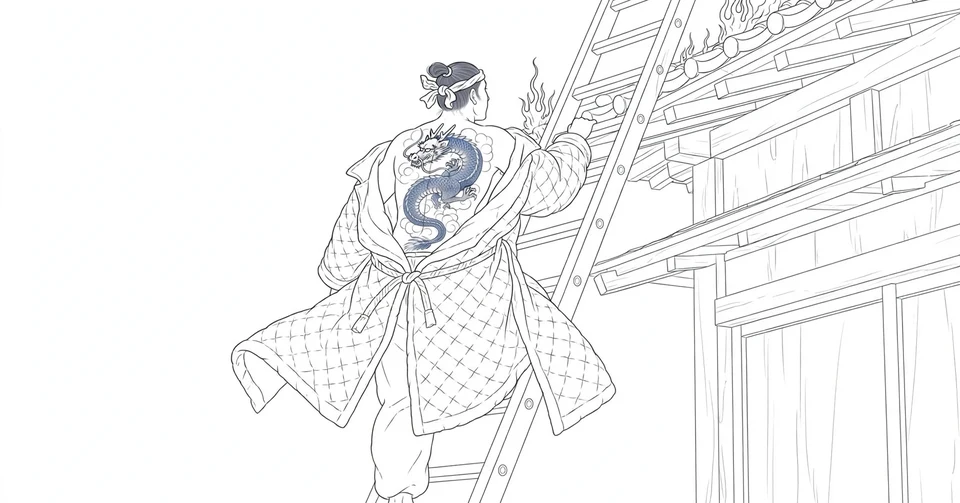
They did this wearing quilted cotton coats that had been soaked through with water, and under those coats many hikeshi wore a second kind of armour that no bucket could improve. Across their backs and arms, tattooed on a grand scale, went dragons, waves, koi and water gods, placed there in the belief that the images themselves would help keep the flames off the man inside them.
Read quickly, that can sound like superstition sewn into a uniform. Read it from inside a city that burned down in pieces every year, where the hikeshi on the roof knew the odds better than anyone, and it starts to look like something else: a considered answer to a job that offered very few good ones. Even the word is blunt. Hi means fire, and keshi comes from kesu, to erase. The hikeshi were fire erasers, and erasing, street by street, is precisely what they did.
A city built to burn
Edo, the city that is now Tokyo, was assembled out of the most flammable materials available. Houses were wood and paper, roofs were thatch or thin wooden shingles, and plaster walls and proper tiles were luxuries reserved for the daimyo and the richest merchants. Winter made it worse. Dry winds came down off the Kanto plain, households kept braziers and oil lamps burning against the cold, and by the reckoning of one history, two thirds of all the city's fires fell between November and February.
The totals are hard to read calmly. Between 1601 and 1867, Edo recorded some 1,798 fires, 49 of them classed as great fires that took whole districts at a time. Osaka, a comparable city built with more plaster and tile, had only six great fires in the same span. Edo coined a saying for its condition: fires and fights are the flowers of Edo. The worst of all came early. The Great Fire of Meireki in 1657 destroyed most of the city, and one widely repeated count puts the dead at around 107,000 people, killed in a matter of days in a city of perhaps a million.
A city like that does not get to choose whether it has hikeshi. It only gets to choose what kind. Much of the system Edo ended up with was an answer written by the Meireki fire itself.
Three kinds of hikeshi on the same street
The first brigades were the daimyo bikeshi, temporary forces raised and controlled by the great lords, whose mansions were valuable and whose interest in the common streets was limited. After the Meireki disaster frightened the shogunate into taking fire seriously, a second system appeared: the jo bikeshi, permanent city brigades staffed by samurai under ten of the shogun's direct retainers, charged above all with keeping fire away from Edo Castle. They are often described as the first permanent fire service in the world, in place before London built its own after the Great Fire of 1666. The history of the hikeshi sets out how these systems overlapped, competed and were slowly formalised.
The third kind mattered most in the end. When people picture a hikeshi now, it is usually one of these townsmen they are picturing. The machi bikeshi were organised by their own neighbourhoods, and in 1718 they received official status. In 1720 the town companies of Edo were set in order as 48 brigades, each numbered with a character from the iroha syllabary and each with its own crest. On paper, the samurai brigades guarded the samurai districts and the town brigades guarded the commoners' streets. In practice the boundary collapsed at the first smell of smoke. Every brigade raced to the same fires, and the competition between them was not a flaw in the system. It was, for better and worse, the engine of it.
Fighting fire by pulling the city down
Water, the obvious weapon, was nearly useless. Hand pumps arrived in the middle of the eighteenth century and produced a weak stream through bamboo hoses, and the hikeshi largely ignored them as weapons. The water they valued was poured over the men, not the fire.
The real technique was demolition. A fire sweeping through wooden streets cannot be drowned, but it can be starved. So the hikeshi tore down the buildings standing beside and ahead of the flames, cutting a bare strip of ground the fire could not cross. The stars of this work were the tobi, roosters of the building trade hired from the construction and roofing guilds, whose nickname means kites. Tobi climbed ladders onto burning roofs and ripped off the coverings with long pike hooks called tobiguchi, while other hikeshi worked hooks and chains from the street to pull whole frames down. Edo's hikeshi were prized for doing this surgically, destroying only the smallest part of a roof or wall that had to go, where less skilled brigades levelled everything.
There is an honesty in the method that I find hard not to admire. It admits from the start that the fire is stronger than you are, and it refuses to waste men's lives pretending otherwise. What it asks instead is judgment under pressure: which house, which roof, which wall, and exactly when.
The matoi could not be allowed to fall
Every hikeshi brigade carried its emblem into the fire on a long pole: the matoi, topped with a burst of paper or cloth streamers and the company crest. The matoi bearer, the matoi mochi, had the most exposed job in Edo. He climbed to the roof nearest the flames and planted himself at the point closest to the fire, a spot the townspeople called the hana, the flower, which is one reason the hikeshi themselves were nicknamed the flowers of Edo. From up there he signalled his crew, marked their claim on the fire, and stayed.
Staying mattered commercially as well as spiritually. A brigade whose matoi was flying over a saved street could expect gifts of sake and money from the grateful owners, so the race to raise the standard first was also a race to be paid. The American naturalist Edward Morse, watching Tokyo fires in the late 1870s, described hikeshi standard bearers standing on ridge poles while streams of water were thrown over them rather than at the flames, and noted that they often lost their lives by remaining at their posts too long.
The same pride made the hikeshi a public nuisance between fires. Brigades brawled with each other in the streets, quarrelled over precedence at fire scenes, and occasionally had to be restrained from demolishing the house of a man the company disliked. The old saying paired fires with fights for a reason. Edo admired these men and kept a wary distance from them at the same time, which is usually the correct response to people who are brave for a living.
Sashiko, cold water and a second skin of ink
Before a hikeshi went in, he was dressed for drowning rather than burning. His coat, the hikeshi banten, was built from several layers of thick cotton quilted together with dense sashiko stitching, and the quilting was the point: it turned the coat into a sponge. Crews drenched the men before they approached the flames and kept them wet as they worked, so that the garment steamed instead of catching. A surviving jacket in the Victoria and Albert Museum shows the type well, indigo cotton worked with a dragon moving among clouds, and the museum notes the practical logic of it, a fireman soaked to the skin, attacking the blaze with a long pole to pull buildings down.
The coats were reversible, plain side out in the fire. The decorated side, dyed with heroes, dragons and storm clouds, was turned outward after a victory and on festival days. Often the imagery inside the coat echoed the imagery on the man's skin. Many hikeshi were tattooed across the back and arms with the same population of beings: dragons above all, but also koi, waves and Fudo Myoo, a deity bound up with fire itself. The reasoning was plain to them. A dragon is a water being, a bringer of storms and rain, and to carry one into a fire was to carry the opposite element on your back as a shield. I have written elsewhere about how irezumi travelled from craft to pride to stigma in Japan, and the hikeshi stand near the proud beginning of that road. For the hikeshi the tattoo was conviction made visible, and the pain of getting a full back done was itself a kind of evidence: a man who had sat still for that was unlikely to run from a roof.
I think there is also something shrewder underneath the belief. A crew of hikeshi that shares symbols shares a story about itself, and men who believe they are dragons behave, measurably, a little more like dragons. The tattoo did not need to stop a single spark to do its work. It needed to keep its owner standing on the ridge pole one minute longer, and by every account, it often did.
What the dragons left behind
The world that needed the hikeshi ended with the Edo period itself, and organised municipal fire services took the place of the hikeshi. The matoi survived as ceremony, still carried at festivals, and the tobi's ladder skills live on in the acrobatic displays of Dezomeshiki, the New Year firemen's parade, where firefighters still balance at the tops of tall ladders in front of crowds. The men on those ladders today are showing off an inheritance: those tricks were once the working techniques of men who fought fires from rooftops.
The tattoos had a stranger afterlife. The full back that once announced a rescuer, a man whose arrival at your street was the best news of the worst night of your life, came in time to announce something else entirely, and even now a heavily tattooed bather in Japan can run into the rules that still govern tattoos at onsen and be turned politely away. The ink did not change. The reading of it did.
What I keep coming back to, though, is the coat soaked in cold water and the dragon under it, one defence that worked on the body and one that worked on the mind, worn by men who knew exactly how thin both were. The hikeshi were not under any illusion that a picture could stop a fire. They simply understood, earlier than most, that courage is partly a technology, and that a man who believes something stands behind him will stand a little longer himself. Edo burned and burned, and on the roofs of the doomed houses, holding their standards upright in the sparks, the flowers of Edo stood with their dragons on their backs, facing the fire in the only direction that has ever worked: toward it.
More in Culture & Society
- Sodoran Treats an Heirloom Like an Honoured Guest
- You Can Read a Pecalang From Across the Street
- When the Gara-Gara Starts, the Puppets Drop the Plot
- Forty Pounds of Cowbells, and the Mamuthones Say Nothing
- The Oarfish Still Answers to a Name From the Dragon Palace
- Irezumi Was an Art Before It Was a Warning
Latest posts
- Kagawa Puts the Sweet Part Inside the Mochi
- A Yubatake Cools a Spring With Nothing but Wood and Gravity
- Toji Meant Moving to a Hot Spring Until You Got Better
- Nyuto Onsen Hides Seven Inns at the End of a Snow Road
- A Donko Never Got the Chance to Open
- The Milpa Is a Garden That Thinks Like a Forest
- The Kitamaebune Came Home Loaded With Kelp
- Nobody Just Watches a Panigyria, Everybody Dances
- Ponzu Began With a Fruit Too Bitter to Eat
- Kombu Is the Quiet Half of Dashi
- Manza Onsen Bathes at 1,800 Metres
- The Oshi Kept Fuji's Pilgrims Fed, Housed, and Devout
- Every Prefecture Argues About What Goes in Ozoni
- Japan's Population Decline and the Villages It Leaves Behind
- KRL Commuterline and the Trains That Move Jakarta