Fudo Myoo Fights Fire With Fire
· 9 min read
Fudo Myoo, the Immovable Wisdom King, sits wreathed in flames that purify instead of destroy. This is the story of the fiercest face in Japanese Buddhism, and of the Edo firefighters who carried Fudo Myoo into burning buildings on their own tattooed backs.
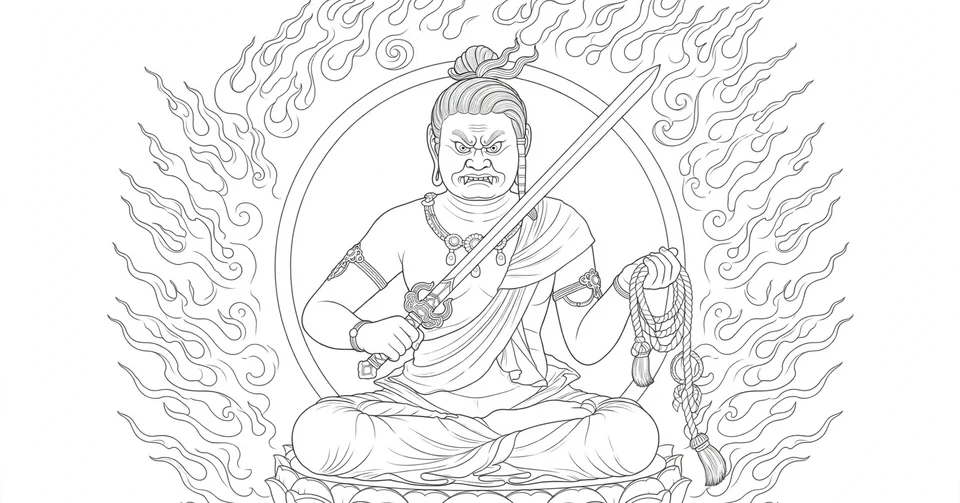
Stand in front of a statue of Fudo Myoo and the first thing you notice is the fire. Flames are carved rising behind him, taller than the figure itself, curling around his shoulders like a living halo. Yet he sits in the middle of that blaze completely unmoved, glaring out at the world. Of all the beings enshrined in a Japanese temple, Fudo Myoo looks the angriest, and he is the one surrounded by fire.
That apparent contradiction is exactly the point. In the teaching, the flames of Fudo Myoo are not the kind of fire that eats wooden houses and whole city districts. His fire burns inward. It is said to consume the delusions, attachments and fears that block a person's way to enlightenment. He does not stand outside the fire threatening you with it. He sits inside it, demonstrating that it cannot touch what has become truly still.
Nor is he a figure from a closed chapter of history. Fudo Myoo is still worshipped today, above all in the Shingon and Tendai schools, and also in Zen, Nichiren and the mountain ascetic tradition of Shugendo. Worshippers often address him with the affectionate name O-Fudo-san, the way you might speak of a stern grandfather who lives down the road. Small statues of him stand beside waterfalls deep in the mountains, where ascetics train under the falling water.
An immovable messenger
The name gives away the character. Fudo means immovable, and it translates the Sanskrit name Acala, the Immovable One. In the earliest texts that reached China, Acala was a minor figure, a servant and messenger of the Buddha Vairocana, already described as holding a sword and a noose, his body enveloped in fierce flames, resting on a rock. Over the following centuries he rose steadily in rank until he stood as the foremost of the five Wisdom Kings, the fierce deities who guard the teaching.
Japanese esoteric Buddhism went further and read Fudo Myoo as a form of Vairocana himself, the cosmic Buddha appearing in wrath. The logic is compassionate rather than frightening. A gentle teacher can guide those who are ready to listen, but people hardened by greed, anger and ignorance may need to be confronted, subdued and dragged back. So the same Buddha shows a kind face to some and a terrifying face to others. The anger of Fudo Myoo is understood as mercy wearing work clothes.
The cult of Fudo Myoo was brought to Japan by Kukai, the founder of the Shingon school, in the early ninth century, and it flourished there far more than it ever had in India or China. He became a protector of the imperial court and of the nation, invoked in state rituals, and at the same time a personal guardian for individual priests. Kukai himself, and great monks after him such as Ennin and Enchin, are remembered as his devotees. Images of Fudo Myoo were installed as the principal deity of many temples, and stories of the Immovable One rescuing believers in moments of danger circulated widely.
How to read the statue
Every part of a Fudo Myoo statue is a piece of instruction. In his right hand he raises a sword. It is not a weapon for fighting people. The sword of Fudo Myoo cuts through delusion and ignorance, severing the confusions that keep a mind tied in knots. Sometimes the blade is shown as the Kurikara sword, wrapped in the coils of Kurikara, a dragon king, so that even the sword carries a guardian within it.
In his left hand he holds a lasso, a rope for binding and pulling. Where the sword severs, the rope rescues. It is meant for hauling the straying and the stubborn back toward awakening, the way you might throw a line to someone being carried off by a river. Read together, the two hands describe a complete method: cut what harms, hold fast to who can still be saved.
Beneath him is rock. Fudo Myoo sits or stands on a rough stone seat because he cannot be shifted, and the mind he represents cannot be shifted either. In later Japanese images his eyes are mismatched on purpose, one turned upward toward heaven, the other lowered toward the earth, and his two fangs point in opposite directions, one up and one down. Commentators have long read those pairings as a lesson in themselves: heaven and earth, rising and returning, held in a single unmoving face.
He rarely stands alone, either. In many Japanese images Fudo Myoo is flanked by two boy attendants, Kongara and Seitaka, small figures who embody the deity's service to others: Kongara with his palms joined in reverence, Seitaka sterner, as if the pair were the soft and hard halves of devotion itself. Even a Wisdom King, the sculptors seem to say, is attended by children learning how to serve.
And then there is the fire. The flaming halo behind Fudo Myoo is called the Garuda flame, named after the mythical fire breathing bird of Indian legend. It is the visual signature of the deity, and it is also the whole doctrine in one image. The flames are not behind him as decoration. They are what he burns with, and what he is never burned by.
Fire that purifies
In temples dedicated to him, priests perform ritual services to Fudo Myoo that routinely include the goma, the sacred fire rite inherited from the ancient homa ceremony. Offerings and prayers are committed to a consecrated fire in front of his image, on the understanding that the flame carries them where they need to go and reduces the rest to ash. The worshipper's hope is plain enough: that something in themselves, an obsession, a grief, a habit that will not loosen, might be fed to that fire and not return.
I find something honest in this. Many religious traditions try to talk people out of their anger and fear, as if those fires were simply mistakes. The tradition around Fudo Myoo takes a different route. It accepts that fire exists, inside people as much as in wooden cities, and instead of pretending otherwise it gives the fire a supervisor: a figure who sits at its centre, unblinking, and decides what gets burned. Anger aimed at cruelty, grief burned down into resolve, fear converted into steadiness. The fiercest face in the temple turns out to be a quality controller.
The god on the firefighters' backs
Nobody understood this better than the hikeshi, the firefighter brigades of old Edo. Their city of wood and paper burned so often that fires were nicknamed the flowers of Edo, and their method of fighting them was mostly demolition, tearing down buildings ahead of the flames with hooks and bare hands. I have written elsewhere about how Edo's hikeshi wore their dragons into the fire, marching in under quilted coats soaked with water.
Under those coats, many hikeshi were tattooed across the back and shoulders, and alongside the dragons and koi, one of the beings they carried into burning buildings was Fudo Myoo. The reasoning layered the elements with beautiful economy. A dragon is a water being, a bringer of rain, so it worked as a shield of water. Fudo Myoo offered the opposite and complementary promise: a god who stands inside fire without burning, a patron for a man whose workplace was the inside of a fire. To wear him on your back was to borrow his stillness at the exact moment you would most need it. Japan's long irezumi tradition made such images into far more than decoration. They were theology written on skin, chosen by men who expected their beliefs to be tested at close range.
The hikeshi were working men, roofers and labourers, but they were not the only ones who leaned on this deity. The warlord Takeda Shingen took Fudo Myoo as his personal patron and is said to have commissioned a statue modelled on his own face. A general planning campaigns and a roofer climbing into a burning row house were, in their different ways, asking for the same thing: to remain unmoved in the middle of the blaze.
Where Japan still meets Fudo Myoo
The most famous address for this deity is Naritasan Shinsho-ji, the great temple at Narita not far from the international airport. The temple was founded in the year 940 around a statue of Fudo Myoo that tradition says was carved by Kobo Daishi, Kukai himself. A thousand years later the temple still draws crowds of worshippers, and the shop lined street leading to its gates has served pilgrims for centuries.
But you do not need to go to Narita. Fudo halls stand in temples all over Japan, and Fudo Myoo also heads the list of the Thirteen Buddhas who are honoured in turn during memorial services, which means he is the first of them entrusted with the care of the dead, watching over the opening days of grief. On Mount Koya, a celebrated painting of the Red Fudo, skin the colour of his own flames, has been treasured for centuries. He is, in the best sense, unavoidable.
There is a reason Japan kept the angry one. A faith that offered only gentle faces would have little to say to a firefighter, a soldier, or anyone standing in front of a hospital door at three in the morning. Fudo Myoo does not promise to spare you the fire. He offers something quieter and, I think, more credible: proof by example that a person can sit in the middle of it, sword in hand and rope ready, and let it burn only what needed burning.
More in Culture & Society
Latest posts
- Shimekasu Was Herring You Never Ate
- A Hana Donko Wears Its Cracks Like Flowers
- A Lembaga Perkreditan Desa Is a Bank the Village Owns
- Kaburiyu Is How You Talk Your Body Into the Bath
- Kuki Is the Spring the Sea Turned White
- Tatsuko Wished for Beauty and Became a Statue
- Warangan Is the Wash That Reveals the Pattern
- Ganbanyoku Is Bathing Without Water
- The Obuki Throws Out Nine Thousand Litres a Minute
- Every Village Writes Its Own Awig-Awig
- Sainokawara Is a Bath You Share With a Hundred Strangers
- Umaji Refused to Disappear
- Rwa Bhineda Keeps Opposites From Going to War
- Kasepekang Is Exile Without Leaving Home
- Jamasan Washes a Blade Thinner Every Year