Binchotan Is the Charcoal That Made the Hibachi Possible
· 24 min read
Binchotan is a hard white charcoal made from ubame oak in Wakayama, and its long, steady, almost smokeless burn is what turned the hibachi from a palace luxury into an everyday fire.
Pick up a piece of binchotan and the first surprise is its weight. It is heavier than it looks, hard as a piece of wood can be without turning to stone, and when you tap two pieces together they ring with a clear metallic clink. It does not look like charcoal at all, and in a way it is not. It is wood that has been taken to the edge of fire and brought back changed, pale on the surface, dense all the way through, and able to hold a steady heat for hours. Binchotan is the charcoal that made the hibachi possible, and once you have cooked over it, ordinary charcoal feels like a different fuel entirely.
A hibachi is only as good as its charcoal, and the charcoal most often paired with it is binchotan. That pairing is not an accident of taste. A hibachi is a small open bowl that sits in the middle of a room, so its fuel has to burn cleanly, steadily, and without smoke, and binchotan is one of the few charcoals in the world that can do all three at once. It lights slowly and asks for patience, but once it is going it holds its heat for a long time, and it gives off so little smoke that a fire can sit beside people in a living room without driving them out.
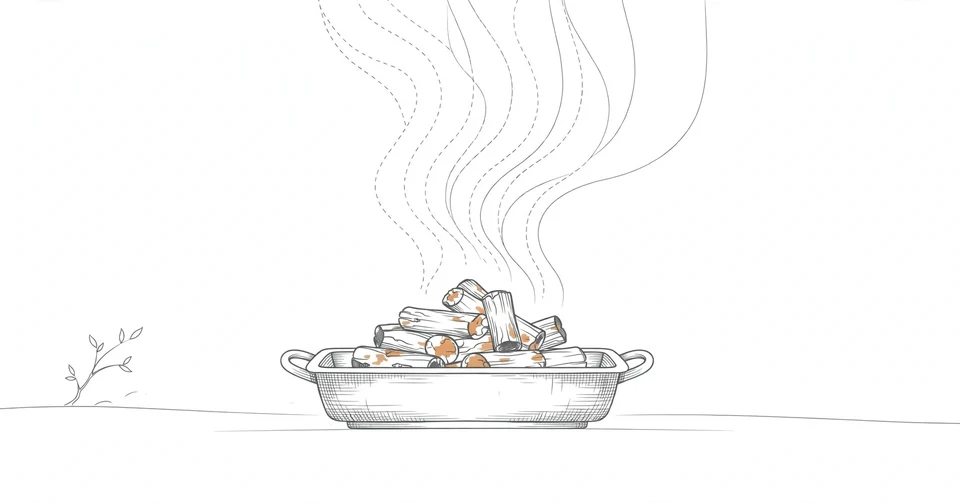
This article follows the charcoal from the forest to the grill. It begins with the ubame oak of Minabe in Wakayama Prefecture, follows the wood through a kiln fired hotter than a thousand degrees, and ends at a small grill where a skewer of yakitori turns over a steady glow. Along the way it explains why binchotan costs more than ordinary charcoal, how to light it, and how to tell the real Kishu binchotan from the imitations that borrow its name.
What white charcoal actually is
Japan divides its charcoal into two broad families, black charcoal and white charcoal, and the charcoal of this article belongs firmly to the second. Black charcoal is made at lower temperatures. It catches fire easily and it is forgiving to light, but it burns for a shorter time and it gives off more smoke. White charcoal is made at far higher temperatures, and the difference shows in every quality that matters. It is harder, denser, and it holds its heat far longer, and that is why it became the charcoal of choice for cooking and for heating a room.
The name white charcoal comes from the pale residue on the surface of the finished pieces. After firing, the hot charcoal is taken from the kiln and covered in a damp mixture of earth, sand, and ash, and that curing step leaves the surface whitish grey, sometimes with a metallic sheen. The Japanese name for it is bincho zumi, and the charcoal is also known simply as white charcoal in English. The pale surface is not a flaw or a coating. It is the signature of the process, and it is the first thing to look for when you are learning to recognise the real thing.
What makes this charcoal different from ordinary charcoal is not one quality but a combination. It is hard enough to ring like metal when struck, it is heavy for its size, and its cut surface is smooth and polished rather than rough and crumbly. It burns with a long, steady heat and very little smoke or smell, and it gives off few flying sparks. For a cook, those qualities add up to control. The fire does what it is told, it stays where it is put, and it does not fill the food with smoke. For a household that once kept a small fire in the middle of the living room, the same qualities added up to something else, safety and comfort in a room full of people.
I think there is a lesson in the way this charcoal refuses to be hurried. It is a fuel that rewards patience at every stage, from the forest to the kiln to the lighting, and it punishes haste with a cold grill. That is not a defect. It is the character of the thing, and once you accept it, the charcoal stops being a chore and starts being a small ritual of its own.
Binchotan begins with the ubame oak
Binchotan is made from a heavy, dense species of oak, such as the ubame oak of twenty to thirty years old from Minabe in Wakayama Prefecture, where some of the finest binchotan is produced. The ubame oak, known in Latin as Quercus phillyreoides, is a dense evergreen oak native to Japan, and it is the official tree of Wakayama Prefecture and the town tree of Minabe. It grows slowly, and its wood is close grained and heavy, which is exactly what a charcoal maker wants. A fast growing soft wood would burn away too quickly. A dense oak holds together through the firing and comes out as a hard stick of carbon.
The forests that supply the wood are not wild timber stands cut at random. They are coppice forests, managed over generations so that the oak is cut and allowed to regrow, and the same hillsides have supplied charcoal makers for centuries. The Minabe and Tanabe area is also famous for its ume plums, and the charcoal forests form part of the Minabe Tanabe Ume System, a farming landscape recognised by the Food and Agriculture Organization of the United Nations as a Globally Important Agricultural Heritage System. The charcoal and the plums share the same hills, and the same families have often worked both.
Choosing the wood is the first skilled decision in making this charcoal. The charcoal maker walks the forest and selects trees of the right size and age, and the logs are cut to length and arranged carefully inside the kiln. A crooked log or a log of the wrong thickness will fire unevenly, and the finished charcoal will be weaker for it. The work starts long before any fire is lit, and the quality of the finished charcoal is decided as much in the forest as in the kiln.
That link between a particular tree and a particular place is why the name Kishu binchotan matters. Kishu is the old name for the Wakayama region, and charcoal from Wakayama is called Kishu binchotan to distinguish it from charcoal made elsewhere. The town of Minabe produces more binchotan than any other town in Japan, and the region has been the centre of the craft for centuries. When you buy binchotan, you are not just buying a fuel. You are buying a piece of that forest and that history, and the price reflects it.
A week inside the kiln
Making it is a slow process, and the kiln is where the wood is transformed. The logs are stacked inside a specially built kiln, and the firing begins at a low temperature. The Wikipedia entry on binchotan sets out the firing in stages. The wood is heated at around 240 degrees Celsius for about 120 hours, which is five full days, and only then is the temperature raised to around 1,000 degrees Celsius. The whole process takes several days from start to finish, and it demands constant attention throughout.
The charcoal maker does not watch a thermometer and walk away. The work is judged by the senses, by the sound of the kiln, the colour of the smoke, and the colour of the flames. If the temperature or the airflow is wrong, the quality of the finished charcoal suffers, and a batch that has taken a week to make can be ruined in an afternoon. The kiln itself is a piece of craft in its own right. Building and maintaining it takes knowledge that is passed down through generations, and the best makers are said to read their kilns the way a cook reads an oven, by feel and by habit rather than by numbers alone.
The final stage is the most dramatic. When the firing is complete, the glowing charcoal is pulled from the kiln while it is still red hot, in a step called kamadashi, and it is rapidly cooled by covering it with ash. Sparks fly, and the sight is said to resemble fireworks. The ash covering is what gives white charcoal its pale surface, and it also stops the charcoal from burning away in the open air. What comes out of the ash is hard, dense, and almost metallic to the touch, with a smooth cut surface and a sheen that ordinary charcoal never has.
I find the kiln stage the most humbling part of the story. A week of careful work, most of it spent watching smoke and listening to a kiln, produces a stick of charcoal that looks unremarkable until you pick it up. The weight and the ring when it is struck are the only signs of what went into it. There is no label on a piece of this charcoal that says how many days it spent in the kiln, and yet the difference is there in your hand.
Why binchotan burns the way it does
The reason this charcoal burns long, steady, and almost smokeless is the same reason it is hard. The long firing at high temperature drives almost everything out of the wood except carbon, and the carbon that remains is packed into a dense, tight structure. There is little left in it to flare up, smoke, or smell, so when it burns, it burns as a slow glow rather than a flame. Ordinary charcoal still contains more of the wood's volatile matter, so it catches quickly, flares, smokes, and dies. This charcoal has already been through its fire once, in the kiln, and what is left is the calm part of the wood.
That density also explains the heat. A piece of binchotan can reach a very high temperature and hold it, and it releases that heat evenly over a long time rather than in a short burst. For grilling, that even heat is the whole point. Food cooked over binchotan is seared quickly on the outside while staying moist inside, and the high heat is associated with far infrared radiation, which helps create an appealing grilled surface without drying the interior. That is one reason dishes such as grilled eel and yakitori are often cooked over high quality charcoal, and it is why a yakitori master will pay far more for binchotan than for ordinary charcoal.
The low smoke matters just as much. Because it gives off little smoke and little smell, the natural aroma and flavour of the ingredients stay at the centre of the dish. A smoky fire can be pleasant over a campfire, but it overwhelms delicate food, and it would have been unbearable in a small room. The same low smoke that makes binchotan a good cooking fuel is what once made it a safe heating fuel, and it is the quality that ties its two histories together.
There is a trade off, and it is worth stating plainly. Binchotan is slow to light, and it needs a strong heat source and patience to get going. It is also more expensive than ordinary charcoal, sometimes far more. Neither of those facts is a secret, and neither should put a home cook off. The cost is the price of a week in a kiln and a forest managed for decades, and the slow lighting is the price of a fire that will not flare, smoke, or die on you halfway through dinner.
From palace heating to everyday cooking
The story of this charcoal, as it is usually told, begins with the aristocracy. It was first adopted as a smoke free fuel to heat palaces, where a smoky fire would have been unthinkable, and only later adapted for cooking. Charcoal making in the Kishu region is believed to be very old, with traditions said to date back to the Heian period, which ran from 794 to 1185. One local account holds that the Buddhist monk Kukai, also known as Kobo Daishi, brought charcoal making techniques back from China, and Minabe Town dates the origin of Kishu binchotan to his time in the 800s. These are traditions handed down rather than documented events, and the honest sources say so, but they show how deeply the craft is woven into the region's sense of itself.
The name itself comes later, from the Edo period. During the Genroku era in the late 17th century, a charcoal wholesaler from Tanabe named Bichuya Chozaemon played an important role in marketing the charcoal widely, and the name binchotan is traditionally associated with him. By the Edo period, the Kishu domain recognised the high quality of the charcoal produced in the Kumano area and actively protected and promoted charcoal production as an important local industry. From there, The charcoal spread throughout Japan, particularly to Edo, present day Tokyo, where its intense heat and stable burning made it highly valued by professional cooks.
The portable brazier is what carried binchotan from the palace into the ordinary home. Before the brazier, charcoal cooking was a luxury, something that belonged to grand houses and professional kitchens. The hibachi changed that, because a small bowl of glowing binchotan could sit in any room and cook a little food while it warmed the people around it. The hibachi took cooking on charcoal from a luxury to an everyday custom, and binchotan was the fuel that made that possible. A smoky fire could never have sat in the middle of a living room. A binchotan fire could, and did.
That journey from palace to household is still visible in the way the craft is protected today. In 1974, Wakayama Prefecture designated the traditional technique for producing Kishu binchotan as an intangible folk cultural property. In 2006, Kishu binchotan became the first regional brand certified under Japan's Regional Collective Trademark system. The protection is not nostalgia. It is a recognition that a craft this slow and this tied to a place can be lost quickly if the name is allowed to drift, and that the people who keep it alive deserve to have their work recognised as theirs.
Binchotan and the hibachi
No pairing in Japanese cooking is quite as natural as this charcoal and the hibachi. The hibachi is a small portable brazier, a bowl of ash with charcoal glowing in the centre, and it was originally a heater rather than a cooker. It warms the hands held over it and the small space around it, and it does that job well precisely because it does not try to heat a whole room. For that job, ordinary charcoal would have been a poor choice. It would have smoked, flared, and died too quickly, and the room would have filled with the smell of the fire instead of the warmth of it.
The charcoal fits the hibachi because the two share the same idea of heat. Both are modest, steady, and close to the people using them. The charcoal lights slowly, holds its heat for a long time, and gives off little smoke or smell, and the bowl holds that heat in a small space where it can be used. Together they make a fire that can sit on the floor of a living room, warm a kettle for tea, and grill a skewer of food, all without fuss. The hibachi holds the fire, but the charcoal decides what kind of fire it is, and binchotan decides that it will be a calm one.
The irori hearth that came before the hibachi was fixed into the floor of the house, and the household gathered around it because the fire could not come to them. The hibachi set the fire free, and binchotan made that freedom liveable. A family could carry the bowl from room to room, and the fire would travel with them, steady and smokeless, in a way that no other charcoal of the time could manage. That is why the pairing lasted. It was not a fashion. It was the only combination that worked.
I think of the hibachi and binchotan as a small argument for doing one thing well. The bowl does not try to be a stove, and the charcoal does not try to be a bonfire. Each of them is narrow and excellent at its job, and together they are enough. Modern heating is warmer and cleverer, and modern grills are faster, but neither of them asks you to sit close to the people you live with and tend a small glow together. That is a different kind of warmth, and it is the kind that binchotan was made for.
Yakitori and the grill
If there is one dish that shows what this charcoal can do, it is yakitori. A skewer of chicken, brushed with sauce or salted, turned slowly over a narrow grill, needs a fire that is hot, even, and free of smoke, and this charcoal provides exactly that. The high heat sears the surface quickly, the steady glow cooks the inside without drying it, and the lack of smoke lets the flavour of the chicken and the sauce speak for itself. A yakitori master will often use a long narrow grill, a konro, filled with binchotan, and will adjust the heat by fanning the coals or raising and lowering the skewers, working the fire the way a potter works a kiln.
Grilled eel is the other classic. Like yakitori, it needs a fierce, even heat that crisps the skin while keeping the flesh moist, and the far infrared heat of binchotan is well suited to it. The same qualities serve any small piece of food cooked over charcoal, a piece of mochi softening on a rack, a slice of dried fish crisping at the edges, a vegetable taking on a light char. None of these are grand dishes. They are small pleasures, cooked quickly over a fire that is exactly hot enough and no hotter.
The point is not that only binchotan can grill. Any charcoal can cook a skewer. The point is that binchotan makes the cooking easier to control and the result cleaner to taste. The heat does not surge and fade, the food does not pick up a harsh smoky edge, and the cook does not have to fight the fire. For a professional, that control is worth paying for. For a home cook with a small grill and a few skewers, it turns a fiddly job into a relaxed one, and that is a fair trade for the higher price.
There is also a quieter pleasure in cooking over binchotan, which is the sound and the sight of it. The coals glow a deep orange under a pale grey surface, they make almost no noise, and they give off no more smoke than a candle. It is a fire you can watch without watering eyes, and a grill you can stand beside without smelling of smoke afterwards. I have come to think that is the real luxury of binchotan. Not the heat, which other fuels can match, but the calm that comes with it.
How to light binchotan without losing your patience
The honest first step is to accept that this charcoal is slow to light. It is dense and it has very little left in it to catch, so a match and a sheet of newspaper will not do the job. The usual tools are a chimney starter with some lighter charcoal or firelighters underneath, or a gas burner held against the pieces until they glow. Either way, the waiting is part of the process, and the charcoal will not be hurried.
Start with a few pieces, not a full load. Set them in the chimney starter or over the burner, and give them time until the core of each piece glows orange and the surface turns pale with ash. That can take a while, and the temptation is to declare the charcoal ready too early. Resist it. A piece of binchotan that is only lit on the outside will go out on the grill, and you will be back at the burner with cold food waiting. Wait until the glow is deep and the pieces hold their heat on their own, then move them to the grill with tongs and arrange them in a single layer.
Once it is going, binchotan asks for very little. A gentle fan will raise the heat, and closing the airflow will let it settle. Do not stir it constantly or poke at it the way you might with ordinary charcoal. It holds its shape as it burns, shrinking slowly rather than crumbling, and the best way to manage it is to leave it alone and let it do its work. When the cooking is done, the coals can be left to burn down safely, or they can be snuffed out in a lidded metal container and used again another day, which softens the cost a little.
Safety deserves a plain word here. Burning charcoal gives off carbon monoxide, which has no smell and no colour, so binchotan must never be used in an airtight room. Use it outdoors or in a well ventilated space, keep it on a stable heatproof surface, and keep children and pets at a respectful distance. The same low smoke that makes binchotan pleasant to cook over does not make it safe to breathe in a sealed room. The calm of the fire is real, but so is the gas it gives off, and the two facts belong together.
How to tell real Kishu binchotan from imitations
As the charcoal became famous, the name began to travel further than the charcoal itself, and lower quality or counterfeit products became more common. The definition of the name broadened, and charcoal made elsewhere, or from other woods, began to be sold under it. That is why charcoal produced in Wakayama began to be specifically called Kishu binchotan, to distinguish it and maintain its quality and tradition. Knowing how to check what you are buying is part of buying binchotan at all.
There are a few practical checks, and they are worth running through before you pay a premium price:
- Look for the yellow Kishu Binchotan label issued by the Wakayama Prefectural Charcoal Cooperative. Genuine certified pieces carry the label and are marked non dangerous goods, which is why they are exceptionally allowed on domestic flights in Japan. A label is not a guarantee on its own, but its absence on charcoal sold at a premium price is a warning.
- Check for the regional collective trademark. Kishu binchotan was the first regional brand certified under Japan's Regional Collective Trademark system in 2006, and reputable sellers will say so plainly.
- Pick it up. Real binchotan is heavy for its size, hard, and smooth, with a pale or metallic sheen on the surface. It should feel more like a piece of ceramic than a piece of wood.
- Tap two pieces together. High quality binchotan produces a clear, high pitched clink, almost like metal. Ordinary charcoal thuds. The sound test is an old one, and it is surprisingly reliable.
- Buy from a seller you trust, and be suspicious of a price that is far below the usual range. Real Kishu binchotan takes a week in a kiln and decades of managed forest, and no honest seller can offer it cheaply.
None of these checks is perfect by itself, and a careful buyer uses several of them together. The label can be faked, the sound test takes practice, and the price varies with the seller. But taken together, they will keep you away from most imitations, and they will teach you what the real thing feels like in the hand. After a few purchases, the weight and the ring become familiar, and you will not need the checklist anymore.
The wider point is about the name itself. Binchotan is not a brand. It is a craft tied to a place, a tree, and a method, and the protections around the Kishu name exist because the craft is slow and the imitation is fast. Paying for the real thing is not snobbery. It is a way of keeping the kilns in Wakayama lit, and of making sure that the next generation of charcoal makers has a reason to keep doing work that takes a week to produce a stick of fuel.
Beyond the grill
This charcoal has a life beyond cooking, and it is worth a short look because it shows how unusual the material is. The charcoal is full of microscopic pores, which give it a remarkably large surface area, and those pores can interact with substances in water and in the air. That is why binchotan is used for water purification, for humidity control, and for absorbing odours, and why it appears in products that have nothing to do with fire at all.
The same hardness and clear sound that mark good binchotan have also inspired crafts. Binchotan wind chimes are admired for their pure, delicate sound, and the charcoal has been used to make musical instruments, including a charcoal xylophone. The Kishu Binchotan Promotion Center in Minabe Town introduces visitors to the craft with exhibits, workshops, and a virtual reality experience of the inside of a kiln, and the Kishu Binchotan Discovery Museum in the nearby memorial park explains the science and the history. Visitors can even watch kamadashi, the pulling of glowing charcoal from the kiln, when the timing is right.
The food world has found its own playful uses. In the Minabe area, visitors may come across binchotan ramen with dark noodles, ume sumi soba made with the region's famous plums, and binchotan coffee prepared with water filtered through charcoal. There is even binchotan ice cream, whose dark colour makes it memorable. None of these are the reason binchotan matters, but they show how deeply the charcoal has entered the life of its home region, from the kiln to the kitchen to the souvenir shop.
What I take from all of this is that binchotan is not simply a fuel. It is a material that a region has spent centuries learning to make, use, and celebrate, and its uses keep growing because its qualities are real. A fuel that can purify water, quiet a room with a wind chime, and grill a skewer of chicken is a strange and versatile thing, and it earns its place in the house many times over.
A quiet fire worth keeping
This charcoal asks a lot of the people who make it and the people who use it. It asks a forest to grow slowly, a charcoal maker to watch a kiln for a week, and a cook to wait patiently while it lights. In return it gives a fire that is steady, clean, and long lived, a fire that can warm a room, grill a meal, and sit quietly beside people without demanding attention. That is a fair exchange, and it is the reason the charcoal has survived for centuries while faster and cheaper fuels have come and gone.
The next time you see a small grill glowing in front of a yakitori shop, or a hibachi warming a quiet room, look past the food and the bowl to the charcoal itself. It is a pale, hard stick of oak that spent a week in a kiln in Wakayama, and it carries that week with it in every hour it burns. A fire that patient deserves a little patience in return, and it repays the wait with the calmest heat in Japanese cooking. That calm is the whole point of binchotan, and it is why a simple piece of charcoal earned a name, a trademark, and a place in the heart of a region.
More in Food & Travel
- Chawanmushi Hides a Whole Meal Inside a Teacup
- Himeji Castle, Japan's White Heron That Survived War and Fire
- Japanese Breakfast and the Morning Meal That Starts with Rice and Soup
- A Yuzamashi Cools the Water Before the Tea Begins
- Tencha Is the Shade-Grown Leaf Matcha Is Made From
- A Kyusu Is the Small Teapot Behind Every Good Cup of Sencha
Latest posts
- Japanese Candles Are Still Rolled by Hand in Japan
- Ubame Oak Is the Tree That Turns Into White Charcoal
- Igusa Is the Humble Grass Under Every Tatami Mat
- Japanese Incense and the Art of Listening to Smoke
- Kumiko Builds Beauty From Wood Without a Single Nail
- A Hibachi Carries the Hearth Anywhere in the House
- A Kotatsu Turns a Cold Winter Evening Into the Warmest Room in the House
- The Jizaikagi Hangs Above the Fire and Sets the Pace of Dinner
- Japanese Paper Lanterns and the Light That Folds Flat
- A Zabuton Is the Cushion That Tells You Where You Sit in Sumo
- An Irori Hearth Warms the Room and the People Around It
- Tatami Still Sets the Measure of a Japanese Room
- Japanese Video Games and How a Small Island Rewired Play
- A Kakejiku Turns a Blank Wall Into a Conversation
- A Sudare Turns Harsh Sunlight Into a Cool Breeze