Japanese Incense and the Art of Listening to Smoke
· 15 min read
Japanese incense arrived with Buddhism in the sixth century and became one of Japan's three classical arts. Here is how a stick of smoke became a discipline of listening, and where to try it today.
Walk into an old temple in Kyoto and the first thing you notice is not what you see. It is what you breathe. A thin thread of smoke rises from a bronze burner, curls once in the still air, and disappears. Nobody hurries past it. People pause, bow, and breathe in slowly, as if the smoke were saying something worth hearing. That pause is the whole point. Japanese incense is not a room freshener. It is a practice, and its practitioners insist on a strange word for what they do. They do not smell the incense. They listen to it.
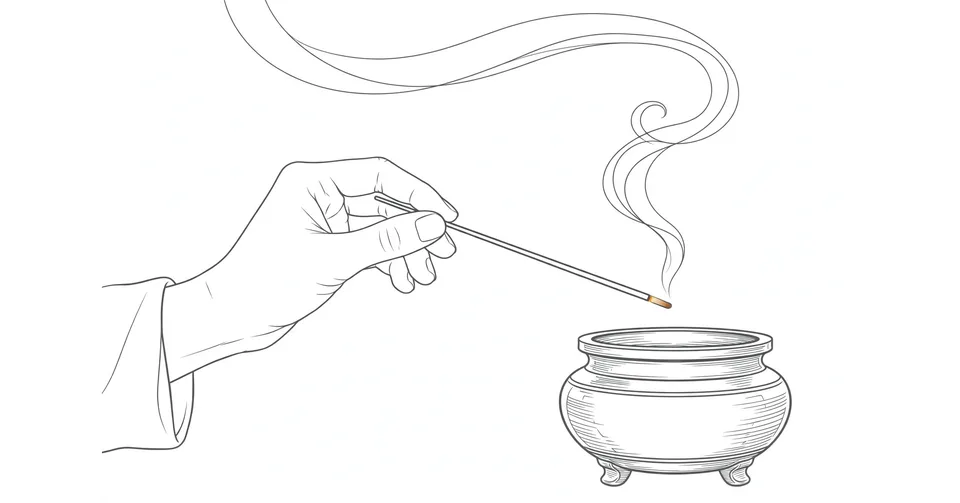
That single word, listen, is the key to everything that follows. Japanese incense began as temple ritual, became a court pastime, then a codified art, and finally an everyday habit that still burns in millions of Japanese homes. Along the way it produced games, schools, grading systems, and companies older than most countries. A stick of Japanese incense costs a few yen. A gram of the finest wood it is made from can cost more than gold. The distance between those two facts is the story of this article.
What Japanese incense actually is
The Japanese word for incense is ko, written with a single character that means fragrance. Japanese incense usually takes one of a few familiar forms. The most common is the stick, a thin rod of pressed powder that burns slowly for twenty to forty minutes. There are also cones, coils, powders, and small chips of fragrant wood. The wood is the heart of the tradition. Agarwood, called jinko in Japanese, is the resinous heartwood of a tree that has been infected by a particular mould. The tree defends itself by producing a dark, fragrant resin, and that resin is what burns with a deep, complex scent no laboratory has fully copied.
Japanese incense differs from the incense most of the world knows. In many countries incense is burned to cover a smell or to set a mood. In Japan it is burned to be attended to. The smoke is thin on purpose. The scent is subtle on purpose. A practitioner warms a sliver of wood over charcoal buried in ash, so the fragrance rises with almost no smoke at all. The technique is called indirect heating, and it came to Japan from Song dynasty China along with Buddhism and tea. It turns burning into something closer to steeping. Nothing is consumed in a hurry, and nothing is wasted on a cloud. That is the first thing to understand about Japanese incense: it is made to be listened to, not merely smelled.
The raw materials are graded with a seriousness that surprises newcomers. The classic system is called rikkoku gomi, which means six countries and five tastes. Six traditional sources of agarwood are each described with five qualities of scent: sweet, sour, salty, bitter, and pungent. The labels are traditional rather than strictly geographical, and honest sellers will say so, but the system has guided buyers for centuries. At the top sits kyara, the finest grade of agarwood, which can sell for more than one million yen per kilogram. To put that in perspective, that is roughly ten times the price of gold by weight. A single session of the classical art may use a chip of kyara smaller than a fingernail.
How Japanese incense reached Japan
Japanese incense arrived with Buddhism in the sixth century, carried from China through Korea. The oldest formal record comes from the Nihon Shoki, one of Japan's earliest histories. It tells of a log of agarwood that drifted ashore on Awaji Island in 595, during the reign of Empress Suiko. The log was presented to Prince Shotoku, who already knew incense burning from Buddhist ritual, which had reached Japan around 538. The court began to burn fragrant wood as an offering, a practice called sonaeko, and the scent moved from the temple into the palace.
By the Heian period, which ran from 794 to 1185, Japanese incense had become a court obsession. Aristocrats blended their own recipes, perfumed their robes and their letters, and played games to test one another's noses. The Tale of Genji, written around the year 1000, describes incense blending contests in detail, and the scent of a person's robes was considered part of their character. A courtier who smelled wrong had failed at something important. The games of that era were the ancestors of the formal art that came later.
The turning point came in the Muromachi period, from 1336 to 1573. Under the patronage of the eighth Ashikaga shogun, Yoshimasa, and his advisor Sanjonishi Sanetaka, the appreciation of incense was organised into a codified discipline. The result was kodo, the Way of Fragrance. Two schools emerged and still exist today: the Oie school, associated with the court aristocracy, and the Shino school, associated with the warrior class. The present form of kodo has kept the structure and manner of the Muromachi period largely unchanged for more than five hundred years.
Samurai, too, took up Japanese incense. Warriors purified their minds and bodies with fragrant wood before battle, and a commander's scent was part of his presence. The same men who carried swords kept incense burners in their field kits. It is one of those details that makes the old Japan feel stranger and richer than the postcard version: the warrior class that prized the sword also prized the smoke.
One of the three classical arts
Kodo, the formal art of Japanese incense, is counted as one of the three classical Japanese arts of refinement, alongside the tea ceremony and flower arranging. That grouping matters, because it tells you how Japan ranks the art. The Japanese tea ceremony is about attention paid to a bowl of tea. Flower arranging is about attention paid to a stem. Kodo is about attention paid to a scent. All three are disciplines of noticing, and all three reward slowness.
The comparison with the tea ceremony is especially close. Both arts came from China with Buddhism, both were formalised under the Ashikaga shoguns, both use a small set of treasured tools, and both treat preparation as part of the experience. In kodo the tools are called kodogu, and like tea utensils they are valued as high art. A burner, a pair of tongs, a feather for brushing ash, a small plate for the wood: each object has its own history, its own makers, and its own collectors. A beautiful burner can cost more than the incense it will ever hold.
There is also a quiet philosophical link to ikigai, the Japanese idea of a reason to live. Kodo does not promise happiness or success. It promises a half hour in which your only task is to pay attention to one thing. In a culture that has always valued that kind of focus, from the tea room to the dojo, the art of incense found a natural home. It asks nothing of you except presence, and it is honest about the fact that presence is hard.
Listening, not smelling
The most famous fact about kodo is also the most misunderstood. Participants do not say they smell the incense. They say they listen to it. The verb is kiku, the Japanese word for listening, and the practice itself is called monko, which means listening to fragrance. The choice of word is deliberate. Smelling is passive. You walk into a room and a smell hits you. Listening is active. You lean in, you concentrate, and you follow something as it changes.
A session works like this. A small piece of charcoal is buried in ash inside a burner. A sliver of fragrant wood rests on a thin metal plate above the heat, so it warms without burning. The burner is passed from person to person. Each person cups it, brings it close, and breathes in slowly three times. Then the burner moves on. Nobody speaks during the listening. Afterwards, participants may describe what they noticed, often with the vocabulary of the rikkoku gomi system, and in game formats they try to identify which wood was used.
The discipline is in the restraint. There is no smoke to hide behind. The fragrance is faint, it changes as the wood warms, and it is gone in a minute. To catch it you have to be still, and to describe it you have to have paid attention. That restraint is the signature of Japanese incense, and it is what separates the art from a scented candle. People who practise kodo say it trains the same faculty that kintsugi trains in the eye: the ability to find meaning in something small, plain, and easily missed. A cracked bowl and a sliver of wood are both easy to walk past. Both arts exist to stop you walking past.
If this sounds precious, it is worth remembering that the same attitude governs everyday Japanese incense. A stick burned at a family altar is not lit and forgotten. It is lit, watched, and allowed to finish. The smoke marks a short, bounded time for remembrance. That is the whole art in miniature: a beginning, a middle, and an end, measured in scent rather than in minutes.
The games of incense
Kodo is social as well as solitary, and the games of Japanese incense are where the art shows its playful side. The games are called kumiko, which means incense comparing. A host prepares several woods, participants listen to each in turn, and then they guess which was which, or arrange them in order, or match them to a poem. The most famous game is genjiko, named after The Tale of Genji. It uses fifty-two combinations of five woods, one for each chapter of the novel except the first, and players mark their answers on a diagram that mirrors the book's chapter pattern.
Genjiko is a good example of how seriously Japan takes play. The game is genuinely difficult, it requires memory and concentration, and it has been played the same way for centuries. It is also, underneath the formality, a parlour game: friends sitting in a circle, trying to outdo one another, laughing when someone confidently names the wrong wood. The form is strict and the mood is light, which is a combination Japan has always liked.
There is a lesson in the games that goes beyond incense. A culture that builds a competitive game around telling five kinds of wood apart by smell is a culture that believes small differences matter. That belief runs through Japanese craft in general, from the grading of tea to the polishing of a sword. Kodo is the most extreme case, because the differences it asks you to notice are invisible. You cannot see a scent. You can only listen for it.
Japanese incense in everyday life
Outside the ceremony room, Japanese incense is an ordinary part of daily life, and the everyday forms are worth knowing. The table below lists the main forms and where you will meet them. The prices are approximate, and they vary widely by maker and material.
| Form | What it is | Where you meet it |
|---|---|---|
| Stick incense | Thin rods of pressed powder, the everyday form | Homes, temples, graves |
| Cone incense | Small cones that burn for about fifteen minutes | Small rooms, short sessions |
| Wood chips | Slivers of agarwood or sandalwood for kodo | Ceremony rooms, specialist shops |
| Powder incense | Loose powder pressed into shapes or burned on charcoal | Temples, formal offerings |
| Coil incense | Spirals that burn for hours | Summer evenings, mosquito coils |
The stick is the form most visitors will meet first. A bundle of a hundred sticks from a good maker costs a few hundred yen, and a single stick burns for about half an hour. Temples sell them at the entrance. Families keep a box beside the household altar. At graves, visitors light a stick, place it in the burner, and bow. The act is called osenko, and it is one of the most common rituals in Japan. Nobody explains it to children. They watch, they copy, and by adulthood the gesture is automatic.
Coil incense deserves a mention because it is the one form most travellers already know without realising it. The mosquito coil, a spiral of incense that burns slowly through a summer evening, was developed in Japan in the late nineteenth century and is still sold everywhere in summer. It is Japanese incense at its most practical: the same slow burning, the same thin smoke, put to work against insects rather than in pursuit of beauty.
One honest warning for buyers: not all Japanese incense is equal, and the cheap sticks sold to tourists can be harsh and smoky. The difference is in the materials. Good Japanese incense uses natural wood and binder, and it burns clean. If you want to try the real thing, buy from a Kyoto maker or a specialist shop, and start with sandalwood rather than the cheapest agarwood blend. Sandalwood is warmer, sweeter, and more forgiving, and it is the scent most Japanese people associate with a temple.
The old incense houses of Kyoto
Japanese incense has been a business for centuries, and the old companies are still running. Kyoto is the centre, because Kyoto is where the temples are, and the temples were the first customers. Four names have survived longer than most nations. Kungyokudo has made incense since 1575. Baieido was founded in 1657, with roots going back further. Kyukyodo dates to 1663. Shoyeido, one of the best known, was founded in 1705. All four still operate from Kyoto, and all four still supply temples across Japan and the world.
Nippon Kodo is the giant of the Japanese incense trade. It was established in New York in 1965 and is now the largest seller of Japanese incense worldwide. Its sticks are the ones most travellers will find in shops abroad, and they are a fair introduction, though the Kyoto houses keep the deeper catalogues. The difference between the two is a little like the difference between a chain bookstore and an old bookshop: one gives you the standard range, the other gives you the range plus four hundred years of opinions about it.
Visiting these shops is one of the simplest pleasures in Kyoto. The Shoyeido flagship near Nijo Castle sells the full range and, through its Lisn shops in Kyoto and Tokyo, offers short appreciation sessions for beginners. Kyukyodo's shop in central Kyoto has sold incense, paper, and brushes since the seventeenth century. You can walk in, say nothing, and simply breathe. The staff are used to it. Smelling before buying is the entire point.
Where to try Japanese incense yourself
You do not need a ceremony to meet Japanese incense. The easiest way is to buy a small box in Kyoto or Tokyo and burn one stick at home, somewhere quiet, with nothing else demanding your attention. Light it, watch the smoke for a minute, and notice how quickly the scent changes as the stick burns down. That is the whole lesson, and it costs less than a coffee.
For a deeper introduction to Japanese incense, look for a short kodo experience. Lisn, the fragrance shop run by Shoyeido, offers appreciation sessions in Kyoto and Tokyo that walk beginners through the tools, the woods, and the listening. Some temples and cultural centres run seasonal sessions too, often in English. A guide to kodo sessions lists where to try them and what to expect. Book ahead, arrive on time, and expect to sit on the floor. The etiquette is simple: listen first, speak later, and do not rush the burner when it reaches you.
If you visit a temple, the encounter is even simpler. Buy a small bundle at the entrance, light one stick from the communal flame, place it upright in the sand, and bow. Nobody will test you on the rikkoku gomi system. The gesture is the same one millions of people make every day, and it needs no translation.
My own view, after years of passing these burners without really noticing them, is that Japanese incense is Japan's most honest art. It makes nothing you can keep, it leaves nothing behind except ash, and it cannot be photographed well. A temple, a bowl, or a garden will still be there when you come back. A stick of Japanese incense will not. It asks you to be there while it lasts, and then it is gone. That is a small demand, and it is the reason the art has lasted fourteen hundred years. Everything else in Japan that old has a building or a book to prove it existed. Incense has only the memory of people who were paying attention.
So the next time you catch a thread of smoke in a temple courtyard, do what the practitioners do. Stop, breathe in slowly, and listen. You may not be able to name the wood. You may not know the school or the game. None of that matters. For one minute, you will have done the thing the art asks of you, which is simply to notice something that is already there, and to notice it properly before it disappears.
More in Culture & Society
- Japanese Candles Are Still Rolled by Hand in Japan
- Ubame Oak Is the Tree That Turns Into White Charcoal
- Igusa Is the Humble Grass Under Every Tatami Mat
- Kumiko Builds Beauty From Wood Without a Single Nail
- Japanese Paper Lanterns and the Light That Folds Flat
- A Zabuton Is the Cushion That Tells You Where You Sit in Sumo
Latest posts
- Binchotan Is the Charcoal That Made the Hibachi Possible
- A Hibachi Carries the Hearth Anywhere in the House
- A Kotatsu Turns a Cold Winter Evening Into the Warmest Room in the House
- The Jizaikagi Hangs Above the Fire and Sets the Pace of Dinner
- An Irori Hearth Warms the Room and the People Around It
- Tatami Still Sets the Measure of a Japanese Room
- Chawanmushi Hides a Whole Meal Inside a Teacup
- Japanese Video Games and How a Small Island Rewired Play
- A Kakejiku Turns a Blank Wall Into a Conversation
- A Sudare Turns Harsh Sunlight Into a Cool Breeze
- Himeji Castle, Japan's White Heron That Survived War and Fire
- A Genkan Is Where Japan Leaves the Outside World at the Door
- A Shoji Lets the Daylight In While Keeping the World Out
- A Ranma Lets a Japanese Room Breathe Over the Top of Its Walls
- A Tokonoma Turns One Corner of a Japanese Room Into a Shrine