Ubame Oak Is the Tree That Turns Into White Charcoal
· 15 min read
The ubame oak is a slow growing evergreen oak of the warm Pacific coast of Japan, and its dense wood is the raw material of Kishu binchotan, the white charcoal prized by grill cooks.
Japan has many trees that people admire for their flowers or their autumn color, and the ubame oak is admired for almost the opposite reason. It is a plain looking evergreen oak that grows slowly on dry coastal hills, and its fame comes from what happens after it is cut. The ubame oak is the tree behind Kishu binchotan, the white charcoal that burns hot, clean, and long, and that grill cooks in Japan and far beyond treat as the finest charcoal in the world.
That is a strange kind of fame for a tree. Most trees are valued while they are standing, for shade or fruit or beauty, and the ubame oak offers little of that. Its leaves are small and leathery, its acorns are modest, and it never puts on a show. Yet entire hillsides in Wakayama Prefecture are managed with this tree in mind, and the town of Minabe chose it as its town tree. To understand why, it helps to look at the tree itself first, before the charcoal, the kilns, and the famous white sticks that come out of them.
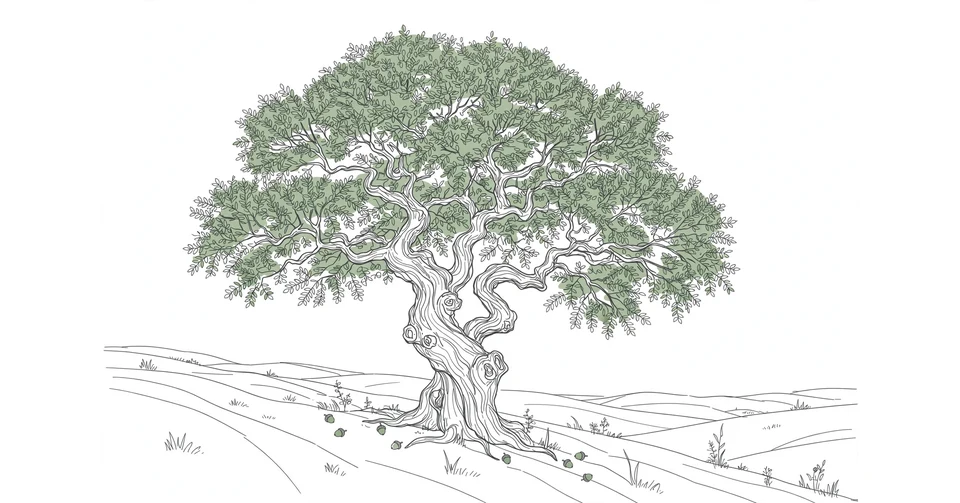
The ubame oak is not a tree that hurries, and that slowness is the whole point of it. It grows a little each year on thin soil and steep ground, and the wood it lays down is tight grained and heavy. A fast growing tree gives soft wood, and soft wood gives charcoal that crumbles and burns out quickly. The ubame oak gives the opposite, and that is why a tree that looks unremarkable from the road can be worth more than a whole plantation of faster timber.
What the ubame oak is
The ubame oak, known in Latin as Quercus phillyraeoides, is an evergreen oak in the beech family, and it is native to Japan and parts of mainland China. In Japan it grows along the Pacific coast, from the Boso Peninsula in the east through the Kii Peninsula and Shikoku to Kyushu and the Ryukyu Islands in the south. It is a short, shrubby oak by the standards of its family, and whether you call it a shrub or a tree depends on the specimen in front of you. Some grow as low bushes, some reach about ten metres, and botanical references describe the species as ranging from about one metre to about fifteen metres tall.
Its leaves tell you what kind of life it leads. They are oval, sometimes a little elongated, leathery and glossy dark green, with small teeth around the upper half, and they are often bronze when young. The leaves stay on through winter, which is what makes it an evergreen, and they are tough enough to hold up against salt wind and strong sun. Around May, the tree puts out a multitude of small yellow flowers, with the male flowers hanging from the lower side of new branches and the female flowers blooming on the upper part. The fruit is an oval or spindle shaped acorn held in a cone shaped cup, and it turns brown and falls from the branch when ripe.
In Japanese the tree is called ubamegashi, and the name is worth pausing over, because the same word shows up in the names of the charcoal and the region it comes from. The ubame oak is not a rare tree in the sense of being hard to find, but it is a particular tree, tied to a particular kind of place. You will not find it in the deep snowy mountains or the cold north. It belongs to the warm coast, and that is where its story starts.
Where the ubame oak grows
The ubame oak grows where most trees would struggle. It favors warm, near coastal mountainous areas, and it does well in barren soil on cliffs and steep slopes, in places buffeted by strong winds. The Nanki Kumano Geopark, which covers the southern Kii Peninsula, describes it as growing abundantly in warm, near coastal mountainous areas, and that description fits the tree wherever it appears. It is a tree of ridges and sea facing slopes, not of rich valley bottoms, and it shares those slopes with other evergreen broadleaf trees such as sudajii and camellia.
That habitat explains a lot about the wood. A tree that grows slowly on poor soil, fighting wind and salt and drought, lays down dense wood, because there is no spare energy for soft, fast growth. The same hardship that keeps the ubame oak short and shrubby is what makes its timber so hard. The Japan Tourism Agency, in its description of the tree on the Tokushima coast, notes that it grows slowly in warmer regions, including in the barren soil of coastal areas and mountainous cliffs, and stands strong even in locations buffeted by strong winds. That is not a complaint about the tree. It is the reason the tree is useful.
The heartland of the ubame oak is Wakayama Prefecture, on the Kii Peninsula, and the town of Minabe in particular. Minabe sits on the western coast of the peninsula, and its hills are covered in a mix of ume orchards and coppice forest. The ridges above the orchards are kept as broadleaf forest, and the ubame oak is one of the trees that lives there. Minabe produces more binchotan than any other town in Japan, and that is no accident. The tree and the town grew up together, and the town still keeps the forest that feeds its kilns.
The tree also grows beyond Wakayama. It is common along the Tokushima coast, where it can be seen in Naruto Park, and it appears across Shikoku and Kyushu. But Wakayama is where the ubame oak became a cultural and economic fact rather than just a botanical one, and the prefecture has recognized that by making it the official tree of Wakayama. Minabe, for its part, made it the town tree. A tree does not usually get that kind of honor unless it has shaped the place that honors it.
Slow growth, dense wood
The most important fact about the ubame oak is also the simplest. It grows slowly, and slow growth makes dense wood. The wood is exceptionally hard and heavy for an oak, and it is that density, rather than any beauty in the grain, that people value. The tree is so dense that it is a poor choice for ordinary building timber, which is a point worth remembering, because the tree found its purpose precisely in the quality that made it useless for something else.
Makers of binchotan usually wait decades before cutting a tree. The wood of a tree of twenty or thirty years old is already dense enough to be prized, and older trees are used too, though very old wood can become brittle and less suited to charcoal. The wait is long, and it is one reason true binchotan is scarce and expensive. A charcoal maker cannot plant a fast crop and harvest it next season. The maker has to think in decades, and the forest has to be managed with that same patience.
That management takes a particular form. Rather than clear felling whole hillsides, makers selectively cut branches and stems by hand, in the coppice tradition, and the forest regenerates from the stumps and roots. The ridge forests above Minabe and Tanabe are managed this way, with selective cutting that lets old branches be pruned so new ones can grow. The same system is part of the Minabe Tanabe Ume System, which was recognized as a Globally Important Agricultural Heritage System by the Food and Agriculture Organization in 2015. In that system, ume orchards sit on the lower slopes, and broadleaf forest, including ubame oak, is kept on the ridges above them, so the same hillside produces both plums and charcoal wood.
I find something reassuring in that arrangement. A landscape that produces two things at once, and asks for patience in return, is a landscape that has been thought about for a long time. The ubame oak does not fit a world that wants everything now, and the people who work with it have not tried to make it fit. They have built a whole economy around waiting, and the waiting is part of the quality.
From ubame oak to white charcoal
The ubame oak becomes famous only when it leaves the forest. Its wood is the classic raw material of binchotan, the Japanese white charcoal, and of Kishu binchotan in particular, the charcoal of the old Kishu region, which is the former name of Wakayama Prefecture. The connection is so close that it is hard to talk about one without the other, and the binchotan article on this site tells the charcoal side of the story in full, including how a small clay grill called a hibachi made that charcoal useful inside the home.
The making of binchotan is a slow process, and it suits the slow wood. The ubame oak is cut and stacked in a clay kiln, where it is carbonized over roughly two weeks, with the temperature rising above 1,000 degrees Celsius near the end. At the finish, the glowing charcoal is pulled out and smothered in a mixture of ash and soil, which cools it quickly and leaves a white ash coating on the surface. That white coating is why it is called white charcoal, and the hard, metallic ring it makes when two pieces are struck together is the sign of good quality.
The result is a charcoal that is slow to light but steady and long burning once it catches, with a clean heat and almost no smoke or smell. A single piece can burn for four to six hours, and the fixed carbon content of good Kishu binchotan is above ninety percent, which is why it burns so hot and so clean. That performance comes directly from the wood. A soft wood would give a soft charcoal that crumbles and burns out, and no kiln technique can fix that. The kiln only reveals what the tree already put into the wood.
The craft has a long history in Wakayama. The technique is said to have been brought back from Tang China by the monk Kobo Daishi, and it was perfected in the Edo period by a craftsman named Bichu ya Chozaemon, who began producing it in Tanabe during the Genroku era. Wakayama designated the Kishu binchotan production technique as an Intangible Folk Cultural Property in 1974, and in 2006 Kishu binchotan became the first product certified under Japan's Regional Collective Trademark system. None of that history would exist without the ubame oak growing on the hills above the kilns.
The same wood is used for Tosa binchotan in Kochi Prefecture, where the ubame oak also grows, while Hyuga binchotan in Miyazaki uses a different oak, arakashi, because the ubame oak does not grow natively there. That detail matters, because it shows how local the craft is. The charcoal is not a recipe that can be moved anywhere. It belongs to the places where its tree grows.
The official tree of Wakayama
The ubame oak is the official tree of Wakayama Prefecture, and the town tree of Minabe, and those titles are not decorative. They say something about how a place sees itself. Wakayama is a prefecture of steep forested mountains and a long Pacific coast, and its old name, Kishu, comes from Kii no kuni, which means the land of trees. The ubame oak is the tree that fits that name best, because it is the tree that turned the forests of Kishu into something the whole country knows.
Minabe's choice is even more direct. The town is famous for two things, ume plums and binchotan, and both come from the same hills. The Nanko ume, the prized plum variety that made Minabe famous, grows on the slopes, and the ubame oak grows on the ridges above. When the town chose the ubame oak as its tree, it was choosing the tree that stands guard over the orchards and feeds the kilns at the same time. It was also choosing a tree that asks for patience, in a town whose main products both take years to mature.
There is a quiet lesson in a prefecture choosing a slow, plain, working tree as its symbol rather than a showy flowering one. Wakayama could have picked a cherry or a plum blossom, and nobody would have blamed it. It picked the ubame oak instead, a tree that does its best work out of sight and after it is cut down. I think that says something honest about the place, and about the people who live there. They chose the tree that earns its keep.
More than charcoal
Charcoal is the famous use of the ubame oak, but it is not the only one. The tree is also commonly planted in Japanese gardens and used for hedges, where its small glossy leaves and its tolerance for pruning make it a neat, durable evergreen. A tree that can survive wind and salt and poor soil on a coastal cliff can certainly survive a garden, and gardeners have made use of that toughness for a long time.
The tree also supports wildlife in its coastal forests. The Nanki Kumano Geopark notes that a butterfly found only on the southern Kii Peninsula, the Nanki uranami akashijimi, feeds on ubame oak leaves as a caterpillar, which is a small reminder that a working forest is still a living forest. The coppice woods that feed the kilns are also home to birds, insects, and fungi, and the selective cutting that keeps the charcoal supply going also keeps the forest open and varied, rather than letting it close into a single dark canopy.
And the charcoal itself has uses beyond the grill. Binchotan is used for water purification and as a natural deodorizer, because its fine pores absorb impurities and odors, and those uses depend on the same dense, pure carbon that makes it burn well. A piece of ubame oak that ends up in a water filter is doing the same quiet work it does in a hibachi, which is to say it is doing the work of a very dense piece of wood, made slowly, over decades, on a windy hill.
The hibachi is worth mentioning here, because it is the other half of the story. A hibachi is a small portable clay or metal grill that carries the hearth anywhere in the house, and it was the binchotan inside it that made the hibachi practical. The charcoal burned hot and clean enough to use indoors, and the grill could be carried from room to room. The tree, the charcoal, and the grill form a chain, and the ubame oak is the first link in it.
Why a slow tree matters
It is tempting to see the ubame oak as a curiosity, a tree famous for becoming charcoal, and to move on. But the tree raises a question that is worth sitting with. What is the value of something that takes decades to become useful, and that is at its best only after it is gone? The modern answer is usually to find a faster substitute, and the charcoal world has tried, with eucalyptus and acacia and other fast growing woods. Those charcoals work, and they are cheaper, and they are fine for many purposes. But they are not the same, and the people who pay a premium for Kishu binchotan are paying, in the end, for the decades the ubame oak took.
That is not nostalgia. It is a practical fact about material. Density cannot be faked in a hurry, and a tree that grows fast lays down soft wood, whatever you do to it afterwards. The ubame oak is valuable because it refuses to hurry, and the whole craft around it, the coppice forests, the two week firing, the hand sorting, is built to protect that refusal. The tree sets the pace, and everyone else adjusts to it.
There is also a limit built into the story, and it is worth naming. The ubame oak grows slowly, its supply is limited, and true binchotan made from it will always be scarce and expensive. That scarcity is not a marketing trick. It is the arithmetic of a slow tree on a steep hill, and it means the craft can only survive if the forest is managed with care and the charcoal is priced to pay for the waiting. The replanting and selective cutting in Wakayama are not a side project. They are the condition that makes the whole thing possible, and they are the reason the kilns still have wood to burn.
The ubame oak will never be a famous tree in the way a cherry blossom is famous. It does not bloom in a cloud of pink, and it does not draw crowds. It stands on dry coastal hills, grows a little each year, and waits. Then, after decades, it becomes a white stick of charcoal that burns for hours without smoke, and a grill cook on the other side of the world strikes two pieces together and hears the clear ring that says the wood was dense and the firing was right. That is the tree's whole reputation, and it is enough. A tree that takes its time, and is worth the wait, is a rarer thing than it should be.
More in Culture & Society
- Japanese Candles Are Still Rolled by Hand in Japan
- Igusa Is the Humble Grass Under Every Tatami Mat
- Japanese Incense and the Art of Listening to Smoke
- Kumiko Builds Beauty From Wood Without a Single Nail
- Japanese Paper Lanterns and the Light That Folds Flat
- A Zabuton Is the Cushion That Tells You Where You Sit in Sumo
Latest posts
- Binchotan Is the Charcoal That Made the Hibachi Possible
- A Hibachi Carries the Hearth Anywhere in the House
- A Kotatsu Turns a Cold Winter Evening Into the Warmest Room in the House
- The Jizaikagi Hangs Above the Fire and Sets the Pace of Dinner
- An Irori Hearth Warms the Room and the People Around It
- Tatami Still Sets the Measure of a Japanese Room
- Chawanmushi Hides a Whole Meal Inside a Teacup
- Japanese Video Games and How a Small Island Rewired Play
- A Kakejiku Turns a Blank Wall Into a Conversation
- A Sudare Turns Harsh Sunlight Into a Cool Breeze
- Himeji Castle, Japan's White Heron That Survived War and Fire
- A Genkan Is Where Japan Leaves the Outside World at the Door
- A Shoji Lets the Daylight In While Keeping the World Out
- A Ranma Lets a Japanese Room Breathe Over the Top of Its Walls
- A Tokonoma Turns One Corner of a Japanese Room Into a Shrine