Igusa Is the Humble Grass Under Every Tatami Mat
· 23 min read
Igusa is the soft rush grass woven into the surface of every traditional tatami mat, and this article follows it from the flooded fields of Yatsushiro to the quiet floor of a Japanese room.
Step into a traditional Japanese room in bare feet and the first thing you notice is not the size of the room or the low table in the middle of it. It is the floor. It gives a little under your weight, it smells faintly of cut grass, and it feels cool in summer and never quite cold in winter. That floor is tatami, and the part of it you actually touch, the woven green surface, is made of a single plant. That plant is igusa, and this article is about it.
Igusa is a soft rush, a wetland grass with long, straight, round stems and a spongy white core. It has no flowers worth looking at and no fruit worth eating, and yet igusa has floored Japanese rooms for thousands of years. It is easy to walk across a tatami mat a hundred times without once wondering what the igusa under it is, and that is exactly the point of this article. The grass under your feet has a history, a home region, a harvest season, and a craft of its own, and once you know a little of it, the floor starts to feel less like a surface and more like a field that came indoors.
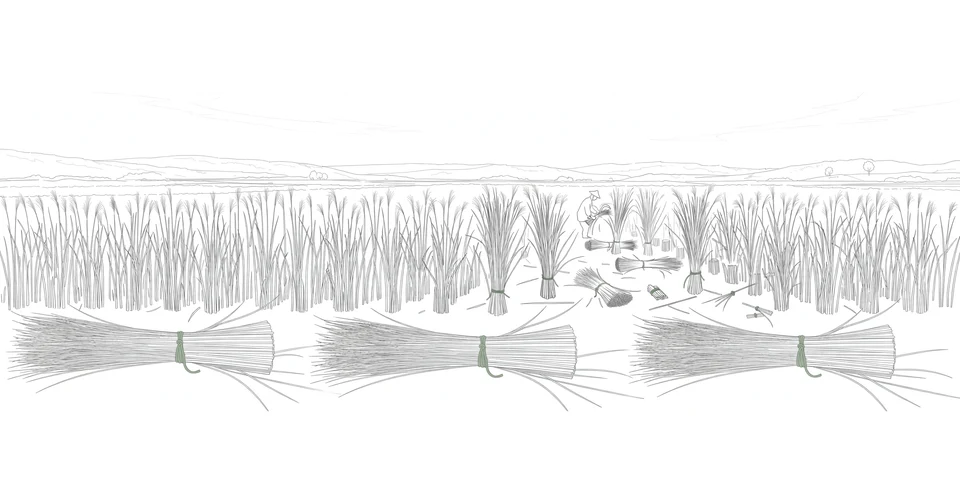
I first paid attention to igusa not in a museum or a craft shop but in an inn, on my second morning there, when the sun had warmed the mats and the whole room smelled faintly of hay. I had slept on tatami before and thought of it as simply the floor, the way you think of wood as simply the floor. Then the innkeeper mentioned, almost in passing, that the mats in my room had been woven from rush grown in Kumamoto, and that the grass had been cut that summer. Suddenly the floor had a season attached to it, and a place, and I have never quite been able to step onto tatami without thinking of a flooded field somewhere in Kyushu since.
What igusa actually is
Igusa is the common name for Juncus decipiens, a soft rush that grows in wet ground. Written with the characters for rush grass, it is also called toushin-sou, a name that comes from an older use: its stems were once used as wicks, called toushin, in oil lamps, and they were still used in Japanese candles. Long before it became a floor, igusa was a small light in a dark room, which feels fitting for a plant that still brings a kind of calm into a room today.
The igusa stem is the whole story. Outside, it is smooth, round, and straight, which is what makes it possible to weave into a tight, even surface. Inside, it is white and cotton like, built into a dense honeycomb structure full of tiny air pockets. That structure is the reason igusa behaves the way it does in a room, and why no other grass was ever chosen for the job. It takes in moisture when the air is damp and gives it back when the air is dry, and it can hold a surprising amount of water without feeling wet. The same honeycomb is credited with adsorbing harmful substances from the air, and the grass is also known for mild antibacterial properties. None of this is magic. It is the ordinary physics of a hollow plant stem, put to work as flooring.
A single tatami mat uses a remarkable amount of igusa. After the ends and roots are removed, somewhere between 4,000 and 7,000 stems of igusa go into one mat. Hold that number in mind the next time you look at a tatami floor, because it changes the scale of the thing. A six mat room is not six pieces of flooring. It is tens of thousands of individual stems, each one grown, cut, dried, sorted, and woven by hand or by machine, and each one doing a small share of the work of keeping the room dry and quiet. I find that number oddly moving. It is a lot of effort for something most people never look at twice, and that is the nature of good craft. It hides its labour under your feet.
A grass with a very old history
Igusa has been part of Japanese life for far longer than tatami has been a floor, and the grass was woven before the floor existed. Mats woven from igusa were found in pit dwellings around 4,000 years old, from the Jomon era, and woven igusa products were found with Jomon pottery in ruins in Aomori Prefecture around 2,000 years old. The history of igusa weaving traces this long record from those early mats to the fields of Yatsushiro today. The plant was already being woven into mats before Japan had written history, before it had emperors in the modern sense, before most of its famous temples existed. It is one of the oldest materials still in daily use in a Japanese home.
By the eighth century, tatami appears in the written record. Statements about it are found in the Kojiki, compiled in 712, in the Nihon Shoki, and in the Manyoshu, the great collection of ten thousand leaves, and a tatami bed used by Emperor Shomu in the same era is kept at the Shoso-in, the treasure house of Todai-ji Temple. Picture scrolls from the Heian era show people using tatami as seating cushions and bedding in the homes of nobles. The use of the mats changed in the Muromachi era, along with the spread of the tea ceremony, when whole rooms came to be covered with them, and it is said that the Japanese custom of sitting on the legs was born in that time.
That long history matters because it explains why igusa is treated with a respect that a modern flooring material never receives. A floor made from a plant that people have woven for four thousand years is not a trend. It is a habit that survived every change in Japanese architecture, from pit dwellings to aristocratic mansions to concrete apartments, and it survived because the material itself kept earning its place. It breathes, it smells pleasant, it softens sound, and it forgives bare feet. I think there is a lesson in that durability. Things that last are rarely the things that shout. They are the things that quietly do their job, year after year, until nobody can imagine the room without them.
The fields of Yatsushiro
Almost all of the igusa grown in Japan comes from one prefecture, and the grass grows best where the water runs shallow and warm. Kumamoto is the major producer, and within Kumamoto the best known growing region is Yatsushiro, along with the nearby towns of Hikawa and the city of Uki. Rush grown in Yatsushiro City, Hikawa Town, and Uki City accounts for about 90 percent of the nation's tatami production, which makes this one small corner of Kyushu the floor of Japan in a very literal sense.
The geography explains why. Igusa is a wetland grass, and it is grown in flooded paddy fields on the Yatsushiro plain, fed by abundant water from the Kuma River and from underground sources. The climate does the rest. In the paddy fields the temperature drops to nearly freezing in winter, from January to March, and rises again in summer. Long hours of sunshine in May followed by shorter sunshine hours in June help the stems grow longer, and long stems are what a weaver needs, because a tatami facing woven from long rush comes out with a uniform colour and a clean, even look. A field of igusa in early summer is a striking sight, a flat green sea of thin blades standing in shallow water, a flat green sea of thin blades standing in shallow water, and it looks nothing like a floor. That is the trick of it. The floor starts as a crop.
The history of the trade in Yatsushiro goes back to the 1500s, when a local lord had the rush cultivated in his territory and encouraged it under special protection. The story attached to it is a good one. Cultivation in the area was promoted by Iwasaki Shume Tadahisa, the lord of the local Agetsuchi Castle, in 1505. In 1516, eleven years after cultivation started, the village suffered a great famine when the plants did not grow, but the production of tatami mats saved the lives of the villagers, and the cultivation of the plant was promoted even more after that. The people of Sencho Town in Yatsushiro City still enshrine Lord Iwasaki at Iwasaki Shrine as the god of igusa, and hold festivals in April and October every year, when the producers visit the shrine to give thanks and pray for a good harvest.
For a long time cultivation was limited to a handful of villages, and it stayed that way until the Meiji Restoration, when it gradually spread as a local industry into the Uki and Kuma areas around Yatsushiro. By 1970 it had become the biggest production area in Japan, and it has held that position ever since. That is a long run for one region and one crop, and it rests on something simple. The soil, the water, and the seasons of Yatsushiro suit igusa better than anywhere else in the country, and five hundred years of farmers have learned exactly how to use that advantage.
From a flooded field to a woven floor
The journey from field to floor follows the seasons, and each step exists for a reason. The igusa is planted in the flooded paddies, supported with nets as it lengthens, and it grows through spring into early summer, when the stems are at their longest and greenest. The harvest comes in summer, and it is hot, muddy work, done in the heat of the day with machines and by hand. The cut stems are gathered into bundles, and the bundles are carried to the workshop while they are still fresh, because what happens next has to happen quickly.
The next step is the one that gives igusa its character. Freshly cut igusa is immersed in a solution of natural soil dissolved in water, a traditional process called dorozome, or mud dyeing. The mud clings to every stem, and it does three things at once. It lets the rush dry evenly, it protects the chlorophyll and the inner structure from damage, and it sets the gloss and colour tone that make a good mat. The Hasegawa article on igusa describes the same step with the older name sendo, the natural clay the rush is soaked in before drying, and notes that the process adds the fresh smell and enhances the colour and gloss. Without the mud, the grass would dry unevenly and lose its green. With it, the grass keeps its colour for years.
After the mud bath the igusa is dried, and then it is sorted by length and checked for thickness and damage. Only the straight, even stems become a tatami facing. The rest goes to other products, because igusa is used for more than floors. It is woven into goza mats, rugs, bags, and all kinds of household goods, and a lower grade stem is still a useful stem. The sorting is where quality is decided, and it is done with an eye that comes from years of practice. A weaver can tell at a glance whether a bundle will make a fine mat or an ordinary one.
The weaving itself produces the omote, the tatami surface. As the tatami article explains, the omote is a weft faced weave of soft rush called igusa, worked on a warp of hemp or weaker cotton, and laid over a core of sewn rice straw called the doko. The weave is tight and flat, with the stems lying side by side in one direction, and the result is a surface that is smooth to the touch but not slippery, firm but not hard. The long sides are edged with cloth called heri, usually brocade or plain cloth. It is a simple construction, three parts and a weave, and it has not fundamentally changed in centuries, which tells you how right the design was in the first place.
Modern workshops weave igusa with machines, and some of the work is still done by hand, but the material sets the pace either way. Igusa is a crop, not a manufactured sheet, so every mat is slightly different, and every mat carries the marks of the summer it was cut. I like that. A floor that remembers its harvest is a floor with a story, and a room floored with it feels less like a product and more like a place.
Why the grass breathes
The most useful thing igusa does in a room is also the least visible, and it is the reason the grass survived the arrival of concrete and carpet. It regulates humidity. The hollow, honeycomb stems absorb moisture from damp air and release it again when the air dries out, which is exactly what a Japanese house needs through a humid summer and a dry winter. A tatami room feels less clammy in the rainy season and less parched when the heater is on, and the floor is doing a quiet share of that work. It also softens sound, which is why a tatami room feels quieter than a room with a hard floor, and it insulates against the cold from below.
Then there is the scent, which is the part of igusa that people remember longest. A fresh omote has a grassy scent, sweet and green, like cut hay on a summer day, and the smell is part of the pleasure of a new mat. It fades slowly as the weave turns from green toward gold, and that slow change of colour is treated not as damage but as part of living with the floor. A mat that has gone gold has simply aged in front of you, the way a wooden floor darkens or a paper screen yellows, and Japanese homes have a habit of accepting that kind of change instead of fighting it. I think that acceptance is one of the best things about the material. It asks you to notice time passing instead of pretending it is not.
The scent is also connected to the calming effect people associate with igusa. The plant is said to cleanse the air as it adjusts humidity, and to release a gentle, healing aroma with its sweet smell, and its antibacterial properties have been noted for a long time. Whether you believe in the healing claims or not, the experience is real enough. A room floored with fresh igusa smells like a field, and a room that smells like a field is a room that feels less like a box. That is a small thing, and it is also the whole point. A home is made of small things, and the floor is the largest small thing in it.
The trade is that igusa asks for care in return. Straw and rush breathe, which means they also hold moisture, and a damp, closed room can grow mould or attract dust mites. That is the honest price of a living material, and it is a fair one, as long as the owner knows what they are doing. A hard floor asks nothing of you and gives nothing back. Igusa asks for dry air and a little attention, and in return it gives you a room that smells of grass and stays comfortable through the seasons.
Paper and plastic rivals
Not every tatami mat today is made of igusa, and it is worth knowing what the alternatives are, because they change the character of the room. The classic combination is still straw core and rush surface, and it is still the standard against which the others are judged. But modern mats sometimes have a core of compressed wood chips or extruded polystyrene foam instead of rice straw, and the surface is sometimes paper or synthetic fibre rather than igusa. These versions are lighter, cheaper, and easier to keep dry, and they make sense in a damp apartment, a rented room, or a home where nobody wants to think about humidity.
Paper tatami, usually made from washi paper fibres, is the most common alternative surface to igusa. It is tougher against stains and moisture, it comes in colours that natural rush never will, and it does not fade from green to gold in the same way. Synthetic fibre surfaces go further in the same direction, built for durability and easy cleaning. Both have their place, and I would not call them fake tatami. They are tatami made for a different kind of life, one where the floor is expected to look the same in ten years as it did on the day it was laid.
The difference is what you lose. Paper and plastic do not breathe the way igusa breathes, they do not smell of grass, and they do not change colour with the seasons. They are floors, and good ones, but they are not fields. A room floored with igusa has a smell and a texture that no factory can copy, because the smell and the texture come from a plant that grew in a particular place in a particular summer. That is the choice, put simply. If you want a floor that never changes and never asks anything of you, the modern surfaces are the sensible answer. If you want a floor that smells of summer and ages in front of you, there is only igusa, and the extra care is the price of that pleasure. I know which one I would choose for my own room, and it is the one that needs me to open a window now and then.
How to care for igusa
Caring for igusa is mostly a matter of keeping it dry and working with the grain of the woven rush, and the rules are simple enough to learn in an afternoon. The most important rule is to clean along the grain, never against it. Vacuum regularly on a low power setting, without the brush attachment, because the brush is too abrasive for the woven rush, and always move in the direction the stems lie. A soft broom works too, and a dry cloth wiped along the grain after vacuuming picks up the fine dust that the vacuum leaves behind. Going against the grain drags at the weave and can weaken it, so the direction matters more than the effort.
Water is the enemy, and that is the second rule. Igusa is absorbent, so a wet cloth can trap moisture inside the igusa fibres and lead to mould, and a soaked mat can change colour permanently. For a liquid spill, blot at once with a dry towel and press down to soak up as much as possible, and do not rub, because rubbing pushes the liquid deeper into the weave. A hair dryer can help dry the spot afterwards. For dark stains such as coffee or soy sauce, a common household method is to sprinkle talcum powder or flour over the stain, leave it to absorb the liquid, and vacuum it up along the grain once it has dried. For a general freshening, a cloth lightly dampened with diluted vinegar, wiped along the grain and then dried thoroughly with a fan or a hair dryer, is the usual advice. The Mailmate guide to cleaning tatami sets out these steps in detail, from the daily vacuum to the vinegar wipe, and it is worth reading before you try anything stronger than a dry cloth.
Humidity is the third rule, and it is the one that matters most through the year. Aim to keep indoor humidity below 60 percent, with a dehumidifier or moisture absorber packs in the tatami room, and ventilate the room daily, ideally by opening windows on opposite sides to make a cross breeze. The risky season is the rainy season, tsuyu, from June through mid-July, and the humid summer months after it, when indoor humidity often rises above 70 percent. If you sleep on a futon laid on the mats, fold it and put it away every morning, because moisture trapped between the bedding and the mat is one of the fastest ways to grow mould. A tatami room that is aired daily and kept dry will stay clean with very little work. A room that is left shut and damp will not, and no amount of scrubbing will fix that.
If mould does appear on the igusa, the standard remedy is gentle. Vacuum the area slowly along the grain to remove the surface spores, then spray a small amount of ethanol on the mould and scrub it gently with a toothbrush, again along the grain, and dry the area thoroughly. Bleach based cleaners should be avoided, because the bleach can discolour and damage the natural rush. Mites are dealt with in a similar spirit: vacuum thoroughly, improve the airflow, and on a sunny day take the mat outside and stand it upright in direct sunlight for several hours, since heat and light help kill mites, then vacuum again. If you rent, tell your landlord first, because replacing a mat may be covered by the lease.
Dents from furniture can be lifted, too, and the method is a small piece of household magic. Place a towel soaked in hot water and wrung out hard over the dent, press a household iron set to low heat over the towel for 20 to 30 seconds, and the steam will make the compressed igusa fibres swell back into shape. Dry the spot at once with a hair dryer or a fan, because the one thing you must not do after adding moisture is leave the mat damp. For lighter dents, a damp cloth left over the spot for a few minutes may be enough. Prevention is simpler still. Use furniture with wide, flat feet rather than skinny legs, put foam pads under the feet, and do not leave heavy items sitting on the mats for long stretches.
| Problem | What to do | What to use |
|---|---|---|
| Daily dust | Vacuum or sweep along the grain, then wipe with a dry cloth | Vacuum on low power without a brush, or a soft broom |
| Liquid spill | Blot at once with a dry towel, do not rub, then dry | Dry cloth or towel, hair dryer |
| Dark stain | Sprinkle talcum powder or flour, let it dry, vacuum along the grain | Talcum powder or flour, vacuum |
| Musty smell | Ventilate the room, wipe along the grain with diluted vinegar, dry well | Dehumidifier, vinegar, dry cloth, fan |
| Mould | Vacuum along the grain, spray ethanol, scrub gently with a toothbrush, dry | Ethanol, spray bottle, toothbrush, dry cloth |
| Furniture dent | Damp towel over the dent, low iron for 20 to 30 seconds, dry at once | Wet towel, iron, hair dryer |
None of this is difficult, and that is the point. The care of igusa is not a specialist skill. It is a short list of habits, and most of them are habits that make a home healthier anyway: open the windows, keep the room dry, put the futon away, and clean in the direction the material wants. A mat that is treated this way will usually keep its woven surface for around five or six years before it needs replacing, while the straw core underneath can last longer if it stays dry. That is a modest lifespan for a floor, and it is honest about it. The surface is not meant to last forever. It is meant to be renewed, and the renewal is part of the rhythm of the house.
The light in a tatami room completes the picture, and it is shaped by the shoji, the paper screen on a wooden lattice that turns harsh daylight into a soft glow. A room of igusa, paper, wood, and cloth is a room built entirely from soft materials, and the softness is the point. Nothing in it is hard enough to hurt you, and nothing is loud enough to shout. It is a room that asks you to lower your voice, and most people do, without being told.
The grass under the quiet
It is strange, when you think about it, that a plant with no flowers and no fruit should have shaped the rooms of a whole country. Igusa does not feed anyone, it does not shade a street, and it would not win a prize at a flower show. It grows in shallow water, it is cut in the heat, it is dipped in mud, and it is woven into a flat green mat that most people step on without a second thought. And yet that mat became the measure of a room, the seat of a guest, the bed of an emperor, and the floor of a tea ceremony. A humble grass did all of that simply by being good at being a floor.
I think the reason it lasted is that it never tried to be more than it is. Igusa does not pretend to be marble or hardwood. It is grass, and it behaves like grass, taking in moisture, giving off a scent, changing colour with time, and asking to be kept dry. A home that accepts that kind of honesty ends up with rooms that feel calm without trying to be calm, and that calm is worth the small trouble of opening a window and vacuuming along the grain. The best materials are like that. They do not demand attention. They reward it.
If you ever find yourself in a tatami room, take a moment before you sit down. Look at the weave, close up, and follow one stem with your eye from one edge of the mat to the other. That stem grew in a flooded field in Kumamoto, it was cut in summer, dipped in mud, dried in the sun, and woven by someone who knew the work. It travelled a long way to lie flat under your knees, and it will be there, quietly breathing, for years. The floor is not just a floor. It is a field that learned how to be a room, and the grass that made it possible is igusa.
More in Culture & Society
- Japanese Candles Are Still Rolled by Hand in Japan
- Ubame Oak Is the Tree That Turns Into White Charcoal
- Japanese Incense and the Art of Listening to Smoke
- Kumiko Builds Beauty From Wood Without a Single Nail
- Japanese Paper Lanterns and the Light That Folds Flat
- A Zabuton Is the Cushion That Tells You Where You Sit in Sumo
Latest posts
- Binchotan Is the Charcoal That Made the Hibachi Possible
- A Hibachi Carries the Hearth Anywhere in the House
- A Kotatsu Turns a Cold Winter Evening Into the Warmest Room in the House
- The Jizaikagi Hangs Above the Fire and Sets the Pace of Dinner
- An Irori Hearth Warms the Room and the People Around It
- Tatami Still Sets the Measure of a Japanese Room
- Chawanmushi Hides a Whole Meal Inside a Teacup
- Japanese Video Games and How a Small Island Rewired Play
- A Kakejiku Turns a Blank Wall Into a Conversation
- A Sudare Turns Harsh Sunlight Into a Cool Breeze
- Himeji Castle, Japan's White Heron That Survived War and Fire
- A Genkan Is Where Japan Leaves the Outside World at the Door
- A Shoji Lets the Daylight In While Keeping the World Out
- A Ranma Lets a Japanese Room Breathe Over the Top of Its Walls
- A Tokonoma Turns One Corner of a Japanese Room Into a Shrine