Japanese Candles Are Still Rolled by Hand in Japan
· 16 min read
Japanese candles, known as warosoku, are still made by hand from plant wax and a hollow wick of washi paper and rush pith, giving them a large, flickering flame unlike any Western candle.
Japanese candles are still rolled by hand in Japan, one at a time, by a small number of workshops that have kept the craft alive for centuries. They are called warosoku, and they are not a simpler version of the candles most of us know. They are a different object entirely, made from different materials, built around a different kind of wick, and burned for different reasons.
Light one and the difference is obvious within seconds. The flame is larger and brighter than a Western candle flame, it moves constantly even when there is no draft in the room, and it leaves almost no soot and very little melted wax behind. Japanese candles do not drip the way paraffin candles do, and they are hard to blow out by accident.
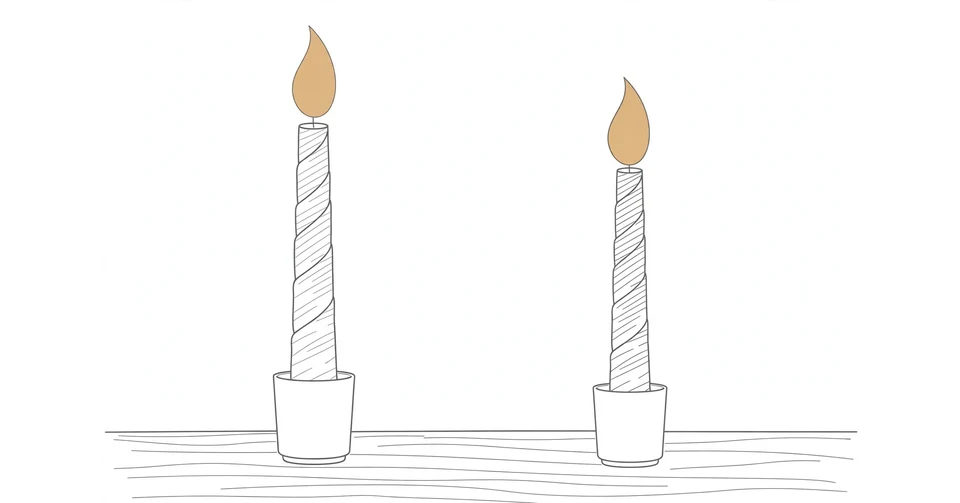
That living flame is the whole point. Japanese candles were made for temples and home altars first, and for quiet rooms second, and everything about their construction serves the quality of the light. I think that is why they have survived the arrival of electric light, cheap factory candles, and a century of reasons to disappear. A warosoku does something no light bulb can do, and once you have sat beside one in a dark room, the appeal is easy to understand.
What makes Japanese candles different
The easiest way to understand Japanese candles is to compare them with the Western candles that fill most shops today. A Western candle is usually poured paraffin, a petroleum product, into a mould around a braided cotton wick. A Japanese candle is built by hand around a thick, rigid wick, layer by layer, from wax that comes from plants. The two objects share a name and almost nothing else.
| Feature | Japanese candles | Western candles |
|---|---|---|
| Wax | Plant wax, usually haze or rice bran | Paraffin from petroleum |
| Wick | Washi paper and rush pith, hollow | Braided cotton thread |
| Method | Rolled and layered by hand | Poured into moulds by machine |
| Flame | Large, bright, always moving | Small and steady |
| Light | Soft, dim orange glow | Brighter orange light |
| Price | Expensive | Inexpensive |
The table above comes from a guide to Japanese candles published by GOOD LUCK TRIP, and it matches what every other source says. The differences are not cosmetic. They start with the wax and end with the flame.
The wax comes from a tree
The most prized wax for Japanese candles is mokuro, written with the characters for tree and wax. It is pressed from the nutlike fruit of the haze tree, Toxicodendron succedaneum, a relative of sumac that grows in the warm parts of western Japan, in Kyushu, Shikoku, and Wakayama Prefecture. The berries are harvested in winter, steamed, and pressed, and the pale wax that comes out of them burns cleanly with very little smoke and a faint, earthy scent.
Haze wax is the classic material, but it was never the only one. Rice bran wax, palm wax, rapeseed wax, and lacquer wax have all been used over the centuries, and they matter more today than ever because haze trees have become scarce. The GOOD LUCK TRIP guide on Japanese candles explains that aging farmers and a shortage of successors have left the haze supply in a critical state, and that makers now blend in other plant waxes to keep working. There are efforts across Japan to restore overgrown haze forests and plant new ones, which tells you how seriously the craft takes its raw material.
One rule has never changed. Japanese candles are made entirely from vegetable matter, with no animal products at all. That matters because the candles are used in Buddhist temples and on home altars, and Buddhism prohibits the intentional killing of animals. A candle that contained tallow or beeswax would be wrong for the altar in a way that has nothing to do with how it burns. The plant wax is not a marketing choice. It is a religious one, and it has shaped the craft from the beginning.
The wick is the real invention
If the wax is the body of a Japanese candle, the wick is its soul, and it is where the craft gets strange and wonderful. A Western wick is a cotton string. A Japanese candle wick is a small piece of engineering made from paper and grass.
It starts with a sheet of washi, Japanese paper made from mulberry bark, rolled into a tight cylinder. Around that core the maker wraps toushin, the pale pith pulled from inside a rush plant called tohshinsou, a relative of igusa. The finished wick is thick, rigid, and slightly conical, and it is hollow down the middle. Air passes up through that hollow centre while the candle burns, feeding the flame from below and making it sway and dance even in still air.
That hollow wick is the reason Japanese candles behave the way they do. The thick wick draws up a lot of melted wax, so the flame burns large and bright, and the wax is consumed as fast as it melts, so it almost never drips down the side. The flame flickers in an irregular rhythm that researchers have compared to the pattern of waves and of a resting heartbeat, which may be why sitting beside one feels calming rather than merely decorative. The wick also leaves behind a stub of carbon as it burns, and makers supply a small wick trimmer with their candles so the owner can snip it back and keep the flame clean.
The igusa connection runs deeper than most people realise. The same rush grass that is woven into tatami mats also supplies the pith for candle wicks, and the parts of the plant that are no good for mats are the parts that end up in candles. The story of igusa, the humble grass under every tatami mat notes that its stems were once used as wicks, called toushin, in oil lamps, and that they were still used in Japanese candles. One plant, two household objects, nothing wasted. That kind of thrift is not an accident. It is the old Japanese habit of using a material completely, and it is built into the candle itself.
Two shapes, and a flame that will not sit still
Most Japanese candles come in one of two shapes. The ikari-gata, or anchor shape, flares out at the top and narrows toward the middle, like a small anchor, and the shape lets melted wax run away from the flame instead of pooling around it and drowning it. The kigake is straight up and down, the same silhouette as a Western candle, which is a useful reminder that shape alone does not make a candle Japanese. What makes it Japanese is what goes into it.
Size and burning time vary widely. Small Japanese candles, about 7 cm long, burn for roughly 25 to 30 minutes, a little faster than a Western candle of the same length because the thick wick burns hotter. Larger candles burn far longer, and the range runs from about 30 minutes to more than nine hours, so a household can choose a candle to match the occasion, a short prayer or a long ceremony. As the candle burns, the flame can grow to roughly half the length of the body, which is startling the first time you see it, and it sways in a wide arc that no Western candle can match.
A short history of light in Japan
Candles are believed to have arrived in Japan during the Nara period, from 710 to 794, along with Buddhism from China. The first candles were mitsu-rousoku, made from beeswax, and beeswax was so rare and valuable that only the nobility could afford them. They were luxury objects and ritual objects at once, which is a combination that has followed Japanese candles through their whole history.
In the Heian period, from 794 to 1185, makers began using pine resin instead of beeswax. The use of haze seeds for candle wax is said to have begun in the Muromachi period, from 1336 to 1573, and that was the turning point. Once Japan could grow its own candle wax, the craft could spread beyond the court and the great temples, and local traditions began to take root in different regions.
The peak of Japanese candles came late in the Edo period and into the Meiji period, from the mid 1700s to 1912. Even then, Japanese candles were luxury goods. Wealthy merchants and samurai families burned them, while ordinary people lit their homes with rapeseed oil lamps. Candles marked wealth and ceremony, not everyday lighting, and that association with special occasions has never quite left them.
Electricity changed everything, as it did for candle makers everywhere. Demand fell, workshops closed, and the apprenticeship system that had carried the craft from one generation to the next began to thin out. It takes years to learn to make Japanese candles properly, and by the time a young person had mastered the work, the market for it had shrunk to temples, altars, and a small number of devoted buyers. That is the quiet crisis behind the craft, and it is still going on today.
How a candle is rolled by hand
Making Japanese candles is a division of labour, and the work is spread across specialists who each master one part of the process. There are the chigiriko-san, who pick the haze seeds, the seirousho, where the wax is produced, the makite-shokunin, who wrap the rush pith around washi paper to make the wick, the kigataya-san, who make the wooden moulds, and the takegushiya-san, who produce the bamboo skewers the wicks are threaded onto. A single candle is the work of many hands before it is ever lit.
The best-known workshop to visit for Japanese candles is Nakamura Candle in the Fushimi ward of Kyoto, founded in 1887 and now run by fourth-generation artisan Koichi Tagawa, who has spent around 35 years at the craft. The process he demonstrates begins with the wick. Washi paper is rolled into a cylinder, toushin is wrapped around it, and the finished wick is slipped onto a bamboo skewer and warmed in water so the wax will not set too fast when it meets the cold wick.
Then the wick goes into a wooden mould and melted wax is poured in. The rough candle that comes out of the mould is only the beginning, and the finishing of Japanese candles is done entirely by hand. In the seijou-kigake stage, the candle is whitened in sunlight and well-kneaded white wax is rubbed onto it by hand, layer after layer, until it reaches the right thickness and size. The top and bottom are trimmed, the surface is planed smooth, and the ends are shaped with a knife. Red candles get their colour at this stage, with red wax applied to the outer layer by ladle instead of white.
Other makers build Japanese candles without a mould at all, in a technique called tegake, or hand application. The maker holds a bowl of melted haze wax, kept at a carefully controlled temperature, and scoops the wax up with a bare hand or a spatula, spreading it in thin layers over a wick on a skewer and turning the skewer as the wax sets. The layers repeat until the candle has its shape, and then the maker planes and trims it by hand. Watching it is closer to watching a potter at a wheel than watching a factory line, and the rhythm of the work is part of the craft. The guide to Japanese candles on Japan Objects describes the same layering process and notes that the finished candle has a ringed, almost tree-trunk appearance where the layers meet, which is a small honest signature of how it was made.
The makers who still do this work are few, and their names are worth knowing. Tanji Renshodo in Kyoto is a family business that has made traditional candles for about 500 years, and its current head, Kiyoshi Tanji, has said there were once more than 80 traditional candle makers in Kyoto and now there are only four. Takazawa Candle was established in 1892 in Nanao, in Ishikawa Prefecture, and is the last traditional warosoku maker in that prefecture. Daiyo, founded in 1914 in Shiga Prefecture on the shores of Lake Biwa, has passed its knowledge across four generations. These are not large companies. They are family workshops, and the craft survives because the families have refused to let it go.
Japanese candles in temples and at home
Japanese candles are still, first and foremost, ritual objects. They burn in Buddhist temples and on the butsudan, the cabinet-like home altar where families remember their dead, and they are lit for Obon, for Higan, for memorial services, and for the monthly anniversaries of a death. During a ceremony it is important that the candles keep burning without going out, which is one reason the thick wick and the wind-resistant flame were developed the way they were. A candle that dies in the middle of a rite is not a small inconvenience. It interrupts the offering.
The connection to temple life is easy to see in the morning routine of a temple, where candles are lit before sunrise as part of the day's first prayers. The article about a gongyo that starts the temple day before sunrise describes that quiet hour when the temple wakes, and the candle flame is part of it, steady company for chanting in the dark. Japanese candles belong to that hour in a way that electric light never will, because the flame itself is part of the offering, not just a way to see.
Beyond temples, Japanese candles have found their way into tea ceremony, where they are used as a timekeeping tool as well as a light, and into Noh, Kyogen, and Kabuki theatre, where their warm, low light suits the stage. They are also lit for yobanashi, the old custom of talking through the night by candlelight, which is a good name for what a warosoku invites. You do not light one and hurry. You light one and stay.
Red candles, white candles, and painted candles
Japanese candles come in two colours, and the colour is a language of its own. White candles are the everyday offering, used on household altars and at funerals and memorial services up to the third anniversary of a death. Red candles, called shu-rousoku, are for celebration: New Year, Obon, weddings, and the placing of a new altar in a home. The same flame, a different message, and anyone who grew up with a butsudan in the house reads the colour without thinking.
There are also e-rousoku, painted Japanese candles decorated with flowers and seasonal designs. Its ancestor is the hana-rousoku, the flower candle, which was invented in the cold regions of Tohoku and Hokuriku, where fresh flowers were impossible to find for the altar in winter. A painted flower does not wither, so it could stand in for a real one as an offering, and over time the painting became an art of its own, done by specialists called etsukeshi. Today e-rousoku are popular souvenirs, painted with flowers, animals, and seasonal scenes, and some shops will paint a custom design to order. They are usually offered rather than burned, which seems right. Some candles are too pretty to light, and that is a compliment, not a waste.
Why the craft survives
Given everything against it, the survival of Japanese candles is worth asking about directly. The raw material is scarce. The apprenticeship is long. The price is high compared with a factory candle, and the market is small. A craft with that profile is supposed to die, and yet warosoku workshops are still rolling candles by hand in Kyoto, Shiga, and Ishikawa, and visitors still come to watch them work.
Part of the answer is practical. Temples still need Japanese candles, and they need them made properly, because the plant wax and the steady flame are part of the rite. As long as there are temples and home altars, there will be someone who has to make the candles for them, and the workshops that supply them have a reason to exist that no trend can replace.
Part of the answer is that the craft has found new buyers without giving up its old ones. The plant-based wax has made Japanese candles appealing to people who want a candle with no animal products and no petroleum, and the flame itself has become a selling point for people who use candles for meditation, for a bath, or for a quiet evening at home. Workshops now run hands-on sessions where visitors can try rolling a candle themselves, and those experiences turn a curious tourist into a customer who understands why the price is what it is. A candle you have watched being made is not an expensive candle. It is a fairly priced one.
I think the deepest reason is simpler than either of those. Japanese candles survive because they are still used, not only admired. A craft that is only displayed in a museum is already finished, however beautiful it is. A craft that is lit every morning in a temple, placed on a home altar, and carried into a tea room is still alive, because it still has a job to do. The workshops survive for the same reason the candles do: somebody still needs the light, and somebody still knows how to make it.
That is what stays with me about warosoku. They are old, slow, expensive, and hard to make, and none of that is a flaw. The slowness is the craft, the expense is the labour, and the difficulty is what keeps the flame worth watching. In a world that has made light cheap and instant, Japanese candles are a reminder that light can also be deliberate, and that a flame made by hand, from a tree and a grass and a sheet of paper, is still one of the finest things a room can hold.
More in Culture & Society
- Ubame Oak Is the Tree That Turns Into White Charcoal
- Igusa Is the Humble Grass Under Every Tatami Mat
- Japanese Incense and the Art of Listening to Smoke
- Kumiko Builds Beauty From Wood Without a Single Nail
- Japanese Paper Lanterns and the Light That Folds Flat
- A Zabuton Is the Cushion That Tells You Where You Sit in Sumo
Latest posts
- Binchotan Is the Charcoal That Made the Hibachi Possible
- A Hibachi Carries the Hearth Anywhere in the House
- A Kotatsu Turns a Cold Winter Evening Into the Warmest Room in the House
- The Jizaikagi Hangs Above the Fire and Sets the Pace of Dinner
- An Irori Hearth Warms the Room and the People Around It
- Tatami Still Sets the Measure of a Japanese Room
- Chawanmushi Hides a Whole Meal Inside a Teacup
- Japanese Video Games and How a Small Island Rewired Play
- A Kakejiku Turns a Blank Wall Into a Conversation
- A Sudare Turns Harsh Sunlight Into a Cool Breeze
- Himeji Castle, Japan's White Heron That Survived War and Fire
- A Genkan Is Where Japan Leaves the Outside World at the Door
- A Shoji Lets the Daylight In While Keeping the World Out
- A Ranma Lets a Japanese Room Breathe Over the Top of Its Walls
- A Tokonoma Turns One Corner of a Japanese Room Into a Shrine