There Is Miso in Far More Than the Soup
· 11 min read
Miso is famous as soup, but in Japan this fermented soybean paste also glazes eggplant, pickles vegetables, marinates fish and sweetens caramel. A tour of its types, its regions and its many jobs beyond the bowl.
Ask a visitor to Japan to name a dish with miso in it and almost everyone gives the same answer: the soup. The cloudy little bowl beside the rice is a fine introduction, but it hides most of the story. In a Japanese kitchen, miso is not one dish. It is a whole shelf of seasonings wearing a single name.
The same family of pastes glazes grilled eggplant, marinates cod overnight, pickles daikon, gives ramen broth its backbone and, lately, turns up in salted caramel and chocolate. Once you start reading labels and menus with that in mind, you find it everywhere, quietly doing work that soy sauce and salt alone cannot do.
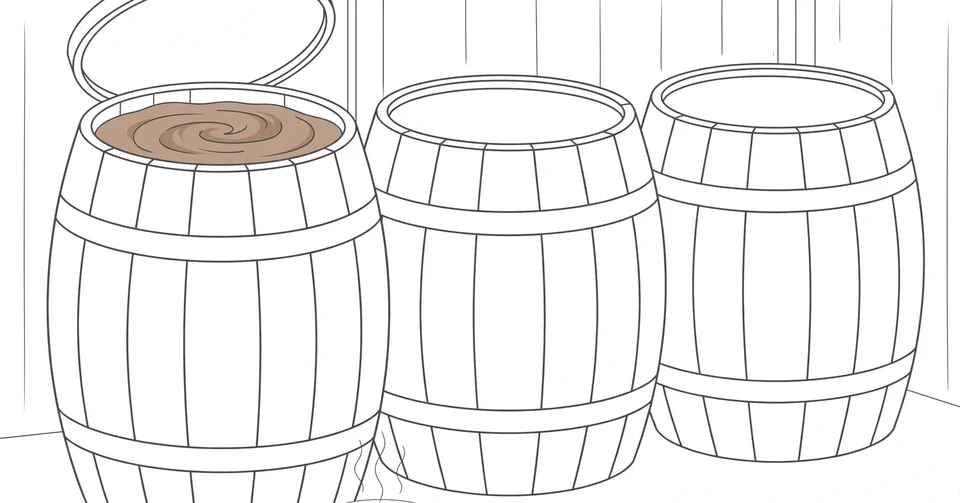
This article follows the paste beyond the soup bowl. It looks at what miso is made of, why its colour is really a clock, how regions from Nagano to Okazaki made it their own, and why a seasoning older than most castles is now being rediscovered by dessert chefs and small brewers working in wooden barrels again.
What miso actually is
At its simplest, miso is a thick paste of soybeans fermented with salt and koji. The koji is the engine: a mould called Aspergillus oryzae grown on a bed of steamed rice, barley or soybeans, which fills the grain with enzymes. If you want the full story of that remarkable mould, I wrote about it in koji mold, the quiet engine behind Japanese food.
Making it is a two stage process. First the koji is grown. Then it is mixed with mashed cooked soybeans and salt, and the mixture is packed into a vessel and left alone. Over the following weeks, months or years, the enzymes get to work. Amylase breaks grain starch down into sugars, which is where the sweetness comes from. Protease breaks soybean protein down into amino acids, including glutamate, which is where the deep savoury taste comes from. Salt keeps the wrong microbes out while salt tolerant yeasts and bacteria add aroma. Depending on the style, fermentation can take as little as five days or as long as several years.
The soup is simply the most famous delivery system. A bowl of miso soup is the paste loosened in dashi, the quiet stock under almost everything Japan cooks, with tofu, wakame or clams dropped in. Cooks add the paste at the end, off the boil, because fierce heat flattens its aroma and kills the living cultures that make it more than a salty paste.
That living quality also explains its old importance. The paste is rich in protein and minerals, and historians of food note the important nutritional role it played in feudal Japan, long before anyone could analyse it. The honest modern reading is more modest: it is a flavourful food with real nutrients and a lot of salt, and it is best enjoyed as a seasoning rather than treated as a medicine.
Colour is a clock
Newcomers often assume the tubs on the shelf, pale gold through to dark brown, are different products. Mostly they are the same idea at different ages. Colour tracks time, temperature and recipe, and it predicts flavour well enough that Japanese cooks shop by it.
White miso, or shiro miso, sits at the young end. It is made with a generous proportion of rice koji and relatively little salt, and it may ferment for only a week or two. The result is pale, smooth and noticeably sweet, with a gentle savouriness. Kyoto is its spiritual home, where the extra sweet local style called Saikyo miso perfumes some of the city's most refined cooking.
Red miso, or aka miso, is the same paste grown old. Aged for a year or more, often made with steamed rather than boiled soybeans and a higher share of bean to grain, it darkens through the slow browning reactions between amino acids and sugars. It tastes saltier, denser and more assertive, the kind of seasoning that stands up to winter stews and strong fish. The darker styles are favoured in Tokyo and the colder north.
Between the two sits the yellowish, light brown style that most Japanese households actually use, balanced enough for daily soup. And when a cook wants the sweetness of one and the depth of another, the answer is awase miso, a blend. Blending is not a shortcut but a craft of its own: a very salty soybean batch, for instance, becomes rounder when folded into a mild rice one.
Underneath the colours sits a second classification, by the grain the koji grew on. Kome miso uses rice koji and is the most common. Mugi miso uses barley koji and has a rustic, fragrant character associated with Kyushu and Shikoku. Mame miso uses soybean koji only, no grain at all, and it is the darkest and most intensely savoury of the three.
A map of Japan written in miso
Because the paste keeps well and every district made its own, regional styles became local signatures, and some became industries.
The biggest name is Shinshu miso from Nagano, the old province of Shinshu. Nagano's makers produce roughly 40 percent of all the miso made in Japan, more than any other prefecture, and their light coloured rice paste, moderately salted and aged for months rather than years, became the national default that fills supermarket shelves from Hokkaido to Okinawa. When a Japanese recipe just says miso without specifying, it usually means something in this family.
Sendai, in the north, took the opposite path. Sendai miso is a red rice paste, coarsely mashed and built for a cold climate and long keeping. Its fame is tied to the warlord Date Masamune, who ruled Sendai and promoted miso making in his domain in the early Edo period. He had good reason: in the warring years just before, the paste had been prized military food across Japan, portable protein that did not spoil, and more than one daimyo treated its production as serious economic business.
Living in Shizuoka, I sit between these two poles. The supermarkets here stock Shinshu tubs as the everyday choice, and one shelf down there is usually a dark Aichi paste for people who want the old, heavy flavour. It is a small daily reminder that it was never one national taste, but hundreds of local ones that industry partly flattened and never quite erased.
Hatcho, the paste that fed a shogun
The most extreme of the regional styles is Hatcho miso, and it deserves its own chapter. It is a mame miso, made from soybeans, salt and water with soybean koji and no grain at all, and it comes from one small district of Okazaki in Aichi Prefecture. Even the name is geography: the district of Hatcho sits about eight cho, roughly 870 metres, west of Okazaki Castle, the birthplace of Tokugawa Ieyasu.
Only two breweries there still make it the old way. At Kakukyu, founded in 1645, workers fill cedar barrels of about six tons each with the soybean mixture, then stack river stones on top in a neat pyramid weighing around three tons. The pressure squeezes moisture evenly through the paste while it ages for over two years, through two summers and two winters, in a storehouse without temperature control. Maruya, its neighbour, works in much the same way.
The paste that comes out is dense, low in moisture, barely sweet and almost chocolate dark, with a deep savoury core and a slight astringent edge. It was valued as provisions for Tokugawa forces, and its hometown still eats accordingly. Around Nagoya, Hatcho style paste is the base of the sauce poured over miso katsu and of the broth in misonikomi udon, noodles simmered directly in a clay pot of it. One spoonful explains why a shogunate kept it close: very little of it flavours a great deal of food.
Far beyond the soup bowl
Return to the kitchen and the jobs multiply. One of the oldest is dengaku, in which a sweetened miso sauce is spread over grilled eggplant, tofu or konnyaku and briefly caramelised. Nasu dengaku, eggplant under a glossy layer of it, is the version most people meet first, and it shows the paste behaving like a glaze rather than a soup base.
It also works as a preserving bed. Vegetables buried in miso for days or weeks come out as misozuke, pickles that are sweeter and gentler than plain salt pickles, having traded moisture for flavour with the paste around them. Cucumber, daikon, carrot and eggplant all take this treatment well, and farmhouse makers once judged a good batch by how the vegetables seasoned the bed for the next round.
Fish gets a more luxurious version of the same trick. In saikyo yaki, fish such as Spanish mackerel or cod is rested overnight in sweet white Saikyo miso, then wiped clean and grilled. The marinade seasons, firms and faintly cures the flesh, and the sugars in the paste brown beautifully under heat. It is probably the single most imitated dish of its kind in restaurants outside Japan, where black cod in this style became a modern classic.
The paste anchors heartier cooking too. Ramen shops build a miso tare, the concentrated seasoning at the bottom of the bowl, and the famous bowls of Sapporo turned that into a regional style rich enough for a Hokkaido winter. At home, mackerel simmers in it as saba no misoni, rice balls are brushed with it and grilled as miso yaki onigiri, and a dab of it on cucumber sticks is a drinking snack all by itself.
The newest chapter is dessert. Because the paste combines salt, sweetness and fermented depth in one ingredient, pastry chefs have started using it the way they use salted butter. Miso caramel is now a standard trick in Tokyo cafes and far beyond, and the paste turns up in chocolate, ice cream and baked goods, where a small amount reads not as bean but as roundness. I was sceptical until I tried it in caramel; the logic is the same as salt on chocolate, just with more going on. As Just One Cookbook's miso guide notes, home cooks in Japan now reach for it in dressings, stir fries and desserts as readily as in soup.
Temae miso and the return of the wooden barrel
For most of its history, none of this was bought. Miso was made at home, farm by farm and house by house, each batch slightly different. The word temae miso, literally one's own miso, appeared in medieval times for the homemade kind, and the phrase later became an idiom for praising your own work, which tells you how proudly people judged their batch. Industrial production changed that: as the overview of miso on Wikipedia puts it, the paste is now produced industrially in large quantities and traditional homemade production has become rare.
What is being revived, interestingly, is not only home making, though kits and workshops have brought that back too. It is the barrel. Traditionally it was fermented in kioke, large barrels of cedar or cypress, whose wood shelters the microbes that give a brewery its house flavour. Through the twentieth century most makers switched to steel, enamel or plastic, which are easier to clean and far easier to replace. Coopering nearly died with the change: at the low point only a handful of craftsmen in Japan still knew how to build and repair the big barrels.
In the last decade or so, smaller brewers of the paste, soy sauce and sake have begun ordering wooden barrels again, and new coopers have been trained to make them, partly for flavour and partly from a feeling that a fermented food should live in something alive. The barrels are expensive and demanding, and nobody sensible claims they will replace industrial tanks. But they have already done one useful thing, which is to remind the industry that the vessel is part of the recipe.
A paste that rewards patience
Stand back and miso looks less like an ingredient than like a technology: a way to turn soybeans, grain and salt into protein that keeps, travels and improves almost anything it touches. The soup was only ever the easiest way to serve it. The glaze, the pickle bed, the marinade and the caramel are the same idea wearing different clothes.
That, in the end, is why the tub in the fridge deserves a second look. Whether it is a two week white one from Kyoto, a two year Hatcho aged under three tons of stone, or an everyday Shinshu blend, each one is time made edible. Japan built a cuisine on that patience, and the rest of the world is still finding new places to put it.
More in Food & Travel
Latest posts
- Manza Onsen Bathes at 1,800 Metres
- Irezumi Was an Art Before It Was a Warning
- The Oshi Kept Fuji's Pilgrims Fed, Housed, and Devout
- Japan's Population Decline and the Villages It Leaves Behind
- KRL Commuterline and the Trains That Move Jakarta
- Loma Linda's Long Lives Run on Saturdays
- Maruten Numazu and the Towering Kakiage Bowl of the Port
- The Three Sisters Grow Better Together
- Half the Old Springs in Japan Thank Kobo Daishi
- Tatamiishi Terraces Filter a River Through Stone
- Wasabi-Zuke Puts the Whole Plant in Sake Lees
- Konyoku Is Still Out There, Past the Last Train Station
- Karo Is the Tengger's Other Great Gathering
- Dry January Lasts a Month on Purpose
- Urashima's Dragon Palace Had a Name, Ryugu