Dashi, the Quiet Stock Under Almost Everything Japan Cooks
· 9 min read
Almost every soup, simmered dish and noodle bowl in Japan starts the same way, with dashi, a clear stock drawn from dried kelp and bonito flakes that tastes deep while staying light.
Eat a bowl of miso soup anywhere in Japan and the first flavour you meet is not the miso. Underneath the paste, the tofu and the wakame sits something warm, round and strangely hard to describe, a savouriness with no weight to it. That something is dashi. Once you learn to notice it, you start tasting it in places you never suspected.
Dashi is the stock Japanese cooking is built on, and it is barely a recipe at all. Two dried ingredients, kelp and bonito flakes, give up their flavour to hot water in a matter of minutes. There are no bones, no fat, no long simmering and no skimming for hours. Yet this pale, almost clear liquid carries noodle broths, simmered vegetables and whole categories of dishes that would taste strangely hollow without dashi.
For something so simple, it took a long time to arrive. Kelp was already being sent to the Japanese court as tribute in the eighth century, and dried bonito is nearly as old, but the two were not put into the same pot in writing until 1668, in a recipe for a clear cod soup. By 1730, a cookbook could state it as settled fact: dashi is the foundation of cooking.
What dashi actually is
Dashi is not a single stock but a family of them, each one made by drawing flavour out of a dried ingredient into water. It forms the base for miso soup, clear broth soup and noodle broth, and it serves as the simmering liquid for countless pots of vegetables, fish and tofu. It even hides inside solid food. The batter of okonomiyaki and takoyaki carries stock inside it, which is part of why those griddled snacks taste complete under so few seasonings.
This is where dashi parts company with the stocks of Europe. A French fond builds depth slowly, breaking down bones and vegetables over hours. The Japanese method moves all the slow work upstream, into the drying yard and the smokehouse, months before anything reaches the kitchen. What is left for the cook is only the extraction, and extraction is quick. The liquid that results has no fat, no collagen and no body, and that thinness is deliberate. Whatever will be set on top of it, a piece of white fish, a square of tofu, a single egg, needs to be heard clearly, and richness would only talk over it.
It is also the broth underneath chankonabe, the hot pot that feeds a sumo stable, where the flavour base of the wrestlers' enormous shared pot is built on stock and then seasoned with miso, soy sauce or salt. And in a clear soup called suimono, the stock stops hiding and becomes the dish itself, served in a lacquered bowl with almost nothing floating in it. That bowl is where a serious chef is judged, because there is nowhere for a weak batch to hide.
Two pillars, and a flavour that multiplies
When cooks in Japan say the word without qualification, they usually mean awase dashi, the combination stock. Awase means combined, and the two things combined are kombu, dried kelp, and katsuobushi, shavings of skipjack tuna that has been boiled, smoked and fermented until it is hard enough to be planed like a block of wood. The pairing can look arbitrary, until you look at the chemistry underneath it. The standard reference entry on dashi notes that kombu is especially high in glutamic acid while katsuobushi is especially high in sodium inosinate, and that the two together create a synergy of umami.
Tasted separately, each compound is a modest savouriness. Tasted together, they do not add up. They multiply. Researchers have measured the combined effect at seven or eight times the savoury intensity of either one on its own, which is how two pale, faint ingredients produce a stock that is not faint at all. Japanese cooks found this by palate in the seventeenth century. The laboratory only caught up much later, which is a pattern worth remembering whenever tradition and science argue in a kitchen.
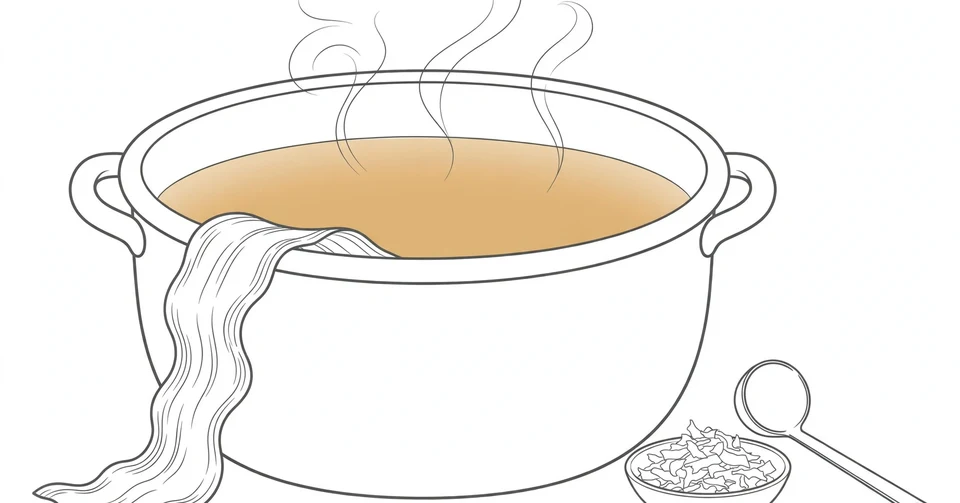
Making dashi is mostly an exercise in restraint. The kelp warms gently in the water and comes out just before the boiling point, because boiled kombu turns the liquid slimy and bitter, and the white powder dusting its surface holds much of the flavour, so it is never washed off. The bonito flakes go in next, steep briefly, sink to the bottom, and are strained away without being squeezed. Twenty minutes, start to finish, and most of that is waiting.
The chemist who found a fifth taste in his soup
In 1908, a Tokyo chemistry professor named Kikunae Ikeda kept puzzling over the kelp broth served at his own table. It tasted deeply satisfying, yet it was not sweet, sour, salty or bitter, and the bowl held no meat and almost no salt. Ikeda worked through roughly twelve kilograms of kombu and isolated about thirty grams of crystals. The crystals were glutamic acid, and he named the taste they carried umami.
I have told the longer version of that discovery in my piece on umami, the fifth taste Japan gave the world. What matters here is how much of that story happens inside a stock pot. Ikeda's student Shintaro Kodama identified inosinate, the savoury compound in katsuobushi, in 1913. In 1957, Akira Kuninaka found the third member of the family, guanylate, in dried shiitake mushrooms, and with it the multiplication effect that explains why the kelp and bonito pairing works so well. Three compounds, three dried ingredients, one quiet broth. The science of the fifth taste was, from the beginning, a science of dashi.
First dashi for clear soup, second dashi for the weeknight pot
A professional kitchen draws its dashi in two passes. Ichiban dashi, the first dashi, is drawn from fresh kelp and fresh flakes, and it is the purest and most aromatic pot of the day. It is reserved for dishes where the stock itself will be tasted: clear soups, and chawanmushi, the savoury steamed egg custard, where nothing covers the broth and any flaw shows.
The spent kelp and flakes are not thrown away. Simmered again in fresh water, they yield niban dashi, the second dashi, lighter and less perfumed but still genuinely useful. This is the everyday stock, the one for simmered dishes and miso soup, where vegetables, miso and other ingredients bring plenty of flavour of their own and a delicate first pressing would be wasted. Restaurants, which draw large batches daily, plan their menus around the split.
Home kitchens mostly skip the formality. The sensible method taught by the step by step guide at Just One Cookbook is to draw one very good first batch, then give the spent kelp and flakes a second life as furikake rice seasoning or as tsukudani, kelp simmered down in soy sauce. Nothing wasted, and the weeknight pot loses very little.
Kelp alone, mushrooms, and little dried fish
The combination stock is the standard, not the whole family. Kombu drawn on its own gives the clearest and most transparent version of all, faintly mineral, almost colourless, and it is the foundation of Kyoto's refined cooking and of any dish where the broth should be felt rather than noticed. It is also, being purely kelp, the natural dashi for anyone avoiding fish.
Dried shiitake mushrooms take the family somewhere earthier. Soaked until soft, they release a deep, woodsy savouriness, and dried mushrooms carry far more of it than fresh ones do. Because shiitake works through guanylate, pairing mushroom with kelp triggers the same multiplication as the classic pairing. Kelp and shiitake together are also the historic backbone of shojin ryori, the vegetarian cooking of Buddhist temples, which had to find depth without fish or meat and found it here.
At the other end of the scale sits niboshi dashi, drawn from small dried sardines whose heads and innards are pinched off first, to keep bitterness out of the pot. It is toasty, frankly fishy and completely unpretentious, the home stock of western Japan, and it stands up happily to a strong, dark miso. Where the combination stock whispers, this one speaks in a normal voice, and there are mornings when that is exactly what a soup needs.
The granules in every cupboard
Convenience, though, has been winning for decades. Granulated and liquid instant dashi largely replaced the homemade pot in the second half of the twentieth century, and Ajinomoto launched its Hon-Dashi granules in 1970, just as Japanese households found themselves with less time to cook. The powder is honest about what it is: stronger and less subtle than a drawn stock, built from the same glutamates and nucleotides, but short on aroma. Tea bag style packets of real dried flakes sit in the middle, steeped like tea and thrown away.
In my own kitchen in Shizuoka, the granules win on weeknights, and I feel no guilt about it. A Tuesday miso soup made with powder is still a good soup, and pretending otherwise would be snobbery, not standards. But on a slow weekend the real thing takes twenty minutes and asks almost nothing of you, and the smell of warm kelp and bonito drifting through the kitchen is an argument no jar can make. What a powder cannot store is that aroma, and aroma is most of what a first pressing is for.
That, in the end, is the character of this stock. Its flavour is drawn out rather than added, two plain dried things and water, handled briefly and then allowed to vanish into other dishes. A cook who understands it stops trying to make the pot impressive and starts trying to make everything else taste more like itself. The stock stays quiet. The food does not.
More in Food & Travel
Latest posts
- Loma Linda's Long Lives Run on Saturdays
- Half the Old Springs in Japan Thank Kobo Daishi
- Tatamiishi Terraces Filter a River Through Stone
- Wasabi-Zuke Puts the Whole Plant in Sake Lees
- Konyoku Is Still Out There, Past the Last Train Station
- Karo Is the Tengger's Other Great Gathering
- Dry January Lasts a Month on Purpose
- Urashima's Dragon Palace Had a Name, Ryugu
- Petruk's Nose Arrives Before He Does
- Ikaria Runs on Island Time
- Why Nicoya Cooks Its Corn in Lime
- A Ngaben Can Take a Village Years to Prepare
- Juryo Is Where Sumo Starts Paying
- Nobody Eats the Daidai, and That Is the Point
- There Are Only 105 Toshiyori Shares in All of Sumo