Netsuke Held a Samurai's World on a Cord
· 17 min read
A netsuke is a small carved toggle that once held a man's belongings on his sash, and it grew into one of Japan's most loved miniature arts.
A netsuke is smaller than a matchbox, and it once carried a man's whole day. Tobacco, medicine, a seal, a few coins, all of it hung from a cord at his waist, and the only thing stopping the lot from sliding to the floor was a small carved toggle tucked above his sash. That toggle is the netsuke, and it is one of the most charming objects Japan ever made.
The idea came from a simple problem. The kimono has no pockets, so a man who needed to carry things had to hang them outside his clothes. The solution was a cord, a container, and a button, and the button turned out to be the part worth keeping. Over two centuries of the Edo period, carvers turned that button into a monkey, a rat, a god, a pumpkin, a whole scene from a folk tale, each one small enough to hide in a closed fist.
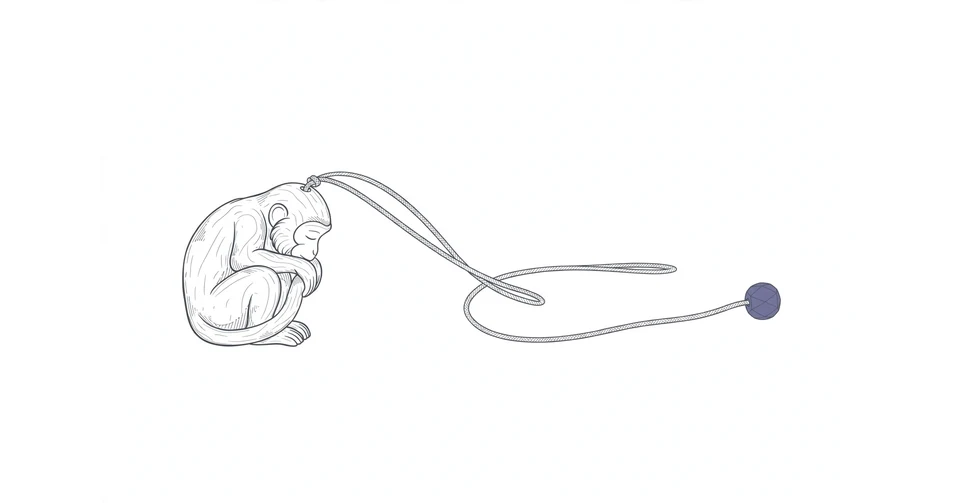
Hold one in your hand and the appeal is immediate. A good netsuke feels smooth and warm, balanced in the palm, carved on every side including the bottom, and it stands on its own when you set it down. That is no accident. It was designed to be touched a dozen times a day, and the carvers knew that a thing handled that often had to please the hand as much as the eye.
A netsuke is a button with a second life
The word netsuke joins two Japanese words, ne, meaning root or base, and tsuke, meaning attached. It is a root that holds things fast. The earliest examples were plain, little more than a stick with two holes or a smooth pebble with a channel cut through it. They did a job and asked for no attention. By the 18th century, the job had become an art, and the art had become a quiet contest of taste among townsmen who could not show off in any other way.
The system the netsuke belonged to is called sagemono, a collective word for hanging things. A man threaded a cord through his container, then through two small holes in the netsuke, called himotoshi, and knotted the cord under the container. He slipped the netsuke under his obi sash from below and let it sit on top of the sash while the container hung a few inches beneath it. To open the container, he slid the netsuke out from behind the sash and the whole ensemble came free in his hand. A sliding bead on the cord, the ojime, worked as a tightener that kept the container shut. The kinchaku drawstring bag I wrote about earlier used the same logic, and as I noted there, that button was the netsuke, the small carved toggle that has since become a collectors object in its own right. You can read that story in Kinchaku Carries a Whole Festival in One Small Bag.
What strikes me about this system is how much trust it placed in a single small object. A man walked through a crowded street with his money and his seal hanging off one carved toggle, and the toggle never failed him. Modern life solves the same problem with zips and Velcro and phone wallets, and none of it has half the grace. There is a lesson in that, I think, about how a constraint can make a thing beautiful. The kimono had no pockets, and because it had no pockets, Japan invented a pocket that was also a sculpture.
The cord, the bead and the box
A netsuke never worked alone. It was one part of a set, and each part had its own craft. The cord was usually braided silk, strong and smooth, and the knot at the end had to sit flat so it would not snag on the silk of the kimono. The ojime bead, often carved from ivory, coral, wood or glass, slid along the cord to open and close the container, and it was often carved to match the netsuke, so the whole set told one story. The most famous container was the inro, a stack of small nested compartments held together by the cord, first used for seals and later for medicine. A fine inro, lacquered in black and gold, could cost more than the netsuke that held it up, and a matching set was a point of pride.
The cord itself had a cousin in the samurai world. The sageo is the cord that ties a katana to its scabbard, and like the netsuke cord it is both practical and decorative, a braid that says something about its owner before a word is spoken. You can read about it in Sageo Is the Cord That Ties a Katana to Its Samurai. The two cords belong to the same world, a world in which the things a man carried on his body were chosen with the same care as the clothes he wore.
Small forms with strict rules
A netsuke had to obey the job before it could please the eye. It had to be small enough to slip under the obi but bulky enough that it could not slip through, smooth enough not to damage silk, and tough enough to survive being knocked against door frames all day. Those rules shaped the forms carvers worked in, and the forms are still how collectors sort them today.
The most common form is katabori, a compact figure carved in the round, usually one to three inches high. Most of the netsuke you will ever see are katabori, and they are the form that lets a carver show off, because the figure has to work from every angle. A second form is manju, named after the round bean cake it resembles, a thick flat disc with carving in relief, sometimes made in two halves that swivel open. A third is kagamibuta, the mirror lid type, a shallow bowl of ivory or wood with a decorated metal disc for a lid, made with brass, bronze, copper, gold, iron, pewter or silver. Ryusa netsuke are carved like lace, so light passes through them, and men netsuke are small copies of the masks worn in Noh theatre. Sashi netsuke are long and narrow, about six inches, made to be thrust behind the obi like a stick, and karakuri netsuke hide moving parts or small surprises inside.
The discipline of the form is part of the pleasure. A carver could not add a tall hat or a long sword that would catch on clothing, so ingenuity went into the curve of a back, the tuck of a tail, the way a cord hole became the mouth of a fish. When you look at a fine netsuke, you are looking at a puzzle solved in miniature, and the solution had to survive daily use.
Ivory, boxwood and stag antler
A netsuke could be carved from almost any material found in Japan, but two dominated: ivory and wood. Ivory was the luxury material, smooth, creamy, and able to hold fine detail, and it came to Japan mostly from India through China. The Metropolitan Museum of Art notes that about 80 percent of surviving antique netsuke were carved in native Japanese woods, including cypress, cherry, black persimmon, yew, camphor, zelkova and camellia, with boxwood favored for its fine grain and durability. That figure surprises people who think of netsuke as ivory first, but wood was the everyday material, and it is wood that shows the carver's hand most honestly, because wood hides nothing.
The full list of materials reads like a catalog of the natural world. Stag antler was used by two major schools, and boar tusk was the signature material of the Iwami carvers. Walrus tusk, hippopotamus tooth, hornbill ivory, whale bone, baleen, coral, shell, lacquer, porcelain, metal, bamboo, walnut shell, and even the tagua nut, sometimes called vegetable ivory, all appear in old netsuke. Umimatsu, a black coral also called sea pine, was prized for its dark surface and amber inclusions. Modern carvers, working after international trade restrictions on elephant ivory in 1989, turned to fossilized mammoth ivory and walrus tusk, and to the many woods that were always there.
The material also tells you how the piece was meant to age. Wood gains a soft shine from handling, ivory mellows to a warm tint, and both develop a quality the Japanese call aji, the agreeable feel of a thing that has been touched often and well. A netsuke that has never been handled feels dead in the hand, however pretty it looks in a case. The good ones ask to be picked up, and that is a rare quality in art.
The carvers who signed their names
The men who made netsuke were called netsuke-shi, and for a long time nobody outside Japan knew their names. Most of what we know about Edo period carvers comes from a single book, the Soken Kisho, published in Osaka in 1781 by Inaba Tsuryu, which lists more than 50 famous masters, most from Kyoto and Osaka. It was a book about sword fittings that happened to include carvers, which tells you how netsuke were seen at the time, as a craft of the sword world as much as an art of its own.
The names in that book are still the names collectors chase. Tametaka founded the Nagoya school and was followed there by Ikkan, whose pieces command high prices at auction. Seiyodo Tomiharu, who lived from 1733 to 1810, founded the Iwami school. Masanao of Kyoto carved a sleeping rat so convincing that it is still reproduced as the image of the perfect netsuke. Masatoshi of Osaka carved the hare with amber eyes that later gave its name to a famous memoir. Signatures only became common late in the 18th century, when individual carvers had reputations worth protecting, and some pieces were signed by a master although the work was done by a pupil, which was the highest honor a student could receive.
What I admire about these carvers is that they worked without the safety net of size. A painter can hide a mistake in a corner of a canvas, and a sculptor can turn a statue so the weak side faces the wall. A netsuke carver had nowhere to hide. Every surface was visible, every surface was touched, and the bottom had to be as finished as the top. It is a humbling standard, and it explains why the best netsuke still feel modern. They were made to a standard that has nothing to do with fashion.
What the carvings chose to show
A netsuke could show almost anything, and the range of subjects is a portrait of Edo Japan in miniature. Carvers made people, famous and anonymous, warriors, priests, children, fishermen, woodcutters, and merchants. They made animals, including the twelve animals of the zodiac, and plants so small that a chestnut or a bean was carved at actual size. They made gods and demons, the Seven Lucky Gods, figures from Chinese legend, masks, coins, roof tiles, tools, and abstract family crests. Some were erotic, some were jokes, and some were quiet parodies of the elite that could be hidden in a closed fist if an official walked by.
The subjects changed over time, and the change tells a story. Early netsuke leaned on motifs from China, while later pieces turned toward subjects that were strictly Japanese, a shift that mirrors the wider culture of the Edo period as it grew more confident in its own tastes. Animals are the most loved subjects of all, and they reward close looking. The Metropolitan Museum points out that traditional netsuke octopuses are often carved with nine tentacles instead of eight, usually wrapped around a beautiful woman, a small joke that only reveals itself when you count. That kind of humor, small and private, is the soul of the art. It was made for one person at a time, not for a crowd.
How a useful toggle became a collectors prize
The netsuke began as a tool of the samurai, worn with the formal kimono, but it did not stay theirs. Under the strict social order of the Edo period, warriors stood at the top, followed by farmers, artisans, and merchants at the bottom. Sumptuary laws told merchants what houses they could build and what fabrics they could wear, but those laws said nothing about the small toggle on a cord. A rich merchant could not wear silk brocade, but he could carry an ivory netsuke carved by a famous master, and everyone on the street would understand what it meant. The netsuke became a quiet way to display wealth, and a public way to display taste.
That is why the art flourished in the towns, not the castles. The merchants of Osaka and Edo were the great patrons, and they wanted wit, novelty, and craftsmanship they could show to friends over sake. A netsuke was shown the way a watch is shown today, slipped out of a pocket, turned in the palm, handed over for a friend to admire, and then tucked away again. It was social, portable, and personal, all at once, and no other Japanese art was quite like it.
The Meiji export boom and the collections that left Japan
Everything changed when Japan opened its ports to foreign trade in 1854. Western suits and uniforms arrived, the kimono retreated into private life, and the netsuke stopped being a daily necessity. Demand for the toggle collapsed, but demand for the carving exploded. Foreigners living in Japan bought netsuke as souvenirs, small enough to fit in a palm, exotic enough to show at home, and cheap enough at first to collect by the dozen. Compact and portable by design, they were exported in large numbers, and some of the greatest collections ended up outside Japan.
The Metropolitan Museum of Art tells the story plainly in its essay on the art. The Russian jeweler Peter Carl Faberge, famous for his eggs, became an avid collector. In 1910, Mrs. Russell Sage, one of the museum's great benefactors, gave the museum a group of 2,500 pieces she had bought from a dealer in Pasadena, California, a collection considered the largest and finest in the United States at the time. Other great New York collections followed, from the Tiffany designer Edward C. Moore, the store founder Benjamin Altman, and Louisine Havemeyer. The full story, including the museum's catalog of masterpieces, is worth reading in the Metropolitan Museum of Art catalog of netsuke masterpieces.
The export worried people in Japan, and with reason. Go Seinosuke, a collector who lived from 1865 to 1942, donated 274 fine pieces to the Tokyo National Museum because he feared too many netsuke were leaving the country and too few were left to see at home. The museum later showed all 274 pieces together to mark its 150th anniversary, alongside 500 contemporary works from the collection of Prince Takamado. The imbalance is still real today, and it is one reason a visitor to Japan can walk through a museum in New York and see more fine netsuke than in most museums in Tokyo.
Old, reproduction or outright forgery
Sooner or later, anyone who loves netsuke has to ask whether the piece in front of them is old, and the honest answer is that it is hard to tell. Forgeries were rare until the late Edo period, when the rising value of originals made copying them profitable, and they have grown more skillful ever since. The Metropolitan Museum's catalog devotes a whole chapter to the problem, and its advice is still the best available, learned as much as possible, and stay skeptical.
The tests are practical. A genuine old netsuke shows wear where it was handled, especially around the cord holes, whose edges grow soft and sloped with use. A forgery often has cord holes with sharp edges, and little wear anywhere, which is hard to believe in a piece supposedly two centuries old. Ivory tells its own story in its cracks. A natural crack starts at a deep point and grows outward, always along the grain, with dirt gathered inside so it looks black. A forger can force cracks with boiling water and cold water, with an oven, with chemicals, or with an awl, and can even paint cracks on with stain. Under magnification, a painted crack betrays itself, because the stain sits on the surface instead of inside the wood or ivory, and a carved detail that cuts across a crack shows the carving came after the damage.
Patina is the other clue, and the harder one. Real patina comes from time and from human oils, a skin that forms slowly as a piece is rubbed and handled, and it is uneven, with highs and lows. Machine polishing with chemicals can imitate the shine, and resins can give a hard glossy finish that resists simple testing. The catalog is blunt about this: wood does not show signs of age for fifty years, ivory can easily be made to look old, and in the end only a trained eye and a sense of touch can tell natural skin from machine polish. The honest summary is the Latin phrase the catalog ends on, caveat emptor, let the buyer beware.
None of this should put a beginner off. The point is not to buy an antique but to learn to look. Inexpensive and faithful reproductions are sold in museum shops, and they are a fine way to start, because the pleasure of a netsuke is in the looking and the holding, not in the certificate. Buy the carving, not the story, and if the price seems too good for the story being told, walk away.
Where to see netsuke today
The best place to see netsuke is still a museum, where you can compare dozens side by side and train your eye. The Metropolitan Museum of Art, the Los Angeles County Museum of Art, the Asian Art Museum of San Francisco, the Toledo Museum of Art, the British Museum, and the Victoria and Albert Museum all hold large collections, which is a reminder of how thoroughly the art traveled. In Japan, the Kyoto Seishu Netsuke Art Museum is the only museum in the country devoted entirely to netsuke, housed in a late Edo period samurai residence, with more than 5,000 pieces in its collection and about 400 on display at a time, changed every three months. The Tokyo National Museum keeps a small room for 50 of the 500 contemporary works collected by Prince and Princess Takamado, and it holds the 274 pieces of the Go collection.
If you go, do not rush. A netsuke rewards the slow look, the second look, the turn in the hand that a glass case will not allow. Stand in front of one and ask what it was for, who carried it, what it held up, and what joke the carver was telling. The Wikipedia article on netsuke is a good place to start before a visit, with clear descriptions of the forms, the materials, and the carvers. Then go and see the real thing, and notice how much smaller it is than you expected, and how much larger it feels once you understand what it did.
A netsuke held a samurai's world on a cord, and then it held a merchant's pride, and then a collector's fortune, and now it holds a museum visitor's attention for a long minute. That is a lot of work for an object the size of a walnut, and it is why the little toggle outlived the sash it hung from. The kimono changed, the cords were cut, and the carving remained, still smooth, still balanced, still waiting to be picked up.
More in Culture & Society
- Hachimaki Is the Headband Japan Ties On Before the Hard Part Begins
- Kinchaku Carries a Whole Festival in One Small Bag
- Baikasai Serves Tea Under the Plum Blossom at Kitano Tenmangu
- Plum Blossom Opens Japan's Year Before the Cherry Trees Wake
- Tenjin Engi Emaki Paints a Storm God Into a Saint of Learning
- The Flying Plum Tree That Followed a Scholar Into Exile
Latest posts
- Tenugui Is the Thin Cotton Cloth Japan Uses for Everything
- Takuan Turns a Humble Daikon Into Japan's Yellow Crunch
- Nukazuke Is the Living Pickle Bed Japan Feeds Every Day
- Tsukemono Is the Crunch Japan Puts Beside Every Meal
- Ochazuke Is Rice Tea and Comfort in One Bowl
- Aojiso Is the Green Leaf Japan Eats Fresh and Raw
- Akajiso Gives Umeboshi Its Deep Red Blush
- Umeshu Is the Liqueur Japan Makes From Unripe Plums
- Shiso Is the Leaf That Paints Umeboshi Red
- Hello Kitty and the Cat Who Conquered the World
- Umeboshi Is the Sour Plum Japan Puts in Every Bento
- Kitano Tenmangu Turns Plum Blossom Into a Prayer for Exams
- Japanese Geisha and the World Behind the Painted Face
- Tenjin Is the Storm God Who Became Japan's Patron of Learning
- Queen Is the Crown Japan Gives Its Best Woman Karuta Player