Shibayama Turns Shell Ivory and Coral Into Small Paintings in Lacquer
· 27 min read
Shibayama is the Japanese art of carving shell, ivory, coral and tortoiseshell into tiny high relief pictures set into lacquer, a craft invented in Edo in the 1770s that became one of Japan's most admired exports.
Imagine a small lacquered box, no bigger than a paperback book, and on its lid a whole garden in miniature. A crane stands on one leg in mother of pearl. A spray of cherry blossom glows pink in coral. A butterfly, carved from ivory no thicker than a coin, seems ready to lift off the surface. Nothing is painted. Every petal, feather and leaf is a separate piece of shell, bone or stone, cut by hand and set into the lacquer so that it stands proud of the surface, catching the light like a tiny relief sculpture. That is the quiet magic of shibayama.
Shibayama is one of the most jewel-like crafts Japan ever produced. It takes the old Japanese love of lacquer and pushes it in a new direction. Instead of laying shell flat into the surface, as raden does, the shibayama artisan carves each fragment into a three dimensional shape and fixes it above the ground, so the design rises from the box like a small painting made of real materials. Visitors to the Paris World Exposition in 1867 called it exactly that, the oriental mosaic art.
Shibayama is a young craft by Japanese standards, invented in Edo in the 1770s, and yet within a century it had travelled from the workshops of a single family to the drawing rooms of Europe and America. It is a story of one clever artisan, a handful of precious materials, and a port city that turned a court luxury into an export industry. It is also a story with a quiet ending, because today the craft survives in the hands of a very small number of makers.
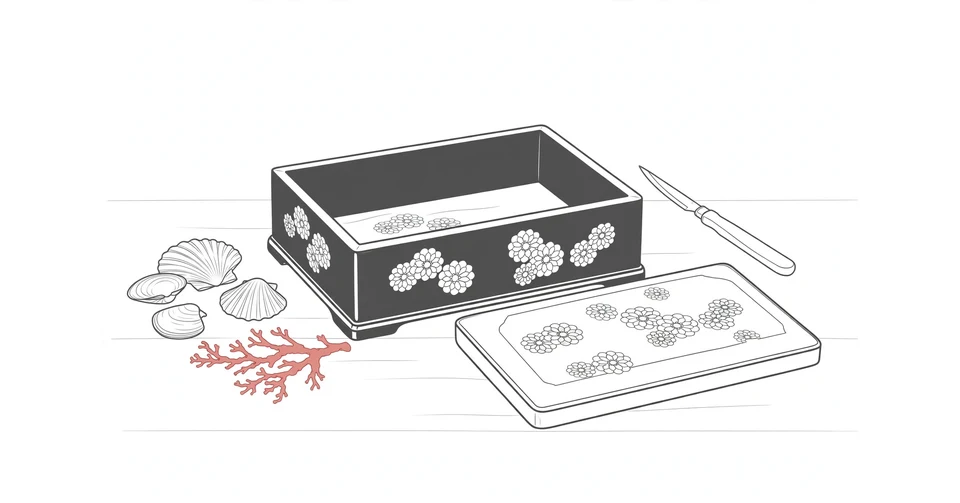
What draws me to shibayama is not its luxury, though it is certainly luxurious. It is the patience the work demands. A single panel can contain hundreds of separate inlays, each one cut, carved, polished and fitted by hand, and each one useless on its own. Only when they are all in place does the picture appear. That feels like a good description of craftsmanship itself, many small acts of care adding up to something no single act could achieve.
What shibayama actually is
Shibayama, written in Japanese as shibayama zogan, is a form of inlay work in which small pieces of carved material are set into a ground of wood, ivory or lacquer. The materials are the heart of the matter. Mother of pearl from pearl oyster, turban shell and abalone gives white, silver, pink and blue green. Coral gives red and pink. Ivory gives a warm, creamy white that takes dye well. Tortoiseshell gives amber and brown. Gold and silver leaf, stained ivory, coconut shell, bone, horn, amber, hardstones and ceramics can all join the picture as well, each fragment chosen the way a painter chooses a pigment.
The defining feature of shibayama is relief. In most inlay work the pieces sit flush with the surface, polished flat until fingertip and eye find no edge. In shibayama the carved pieces protrude above the ground, standing in high relief like tiny applique. A flower petal is not a flat shape but a small curved shell, carved to suggest the fold of a real petal. A bird is not a silhouette but a small sculpture, its wing layered from separate pieces of shell and ivory. The word shibayama can even be used to refer to the relief inlay pieces themselves, which tells you how central that raised carving is to the whole idea.
The subjects are usually drawn from nature and from Japanese literature and daily life. Flowers and birds are the most common, cranes among lakeside rushes, cherry blossom with a butterfly, a parrot on a wisteria branch. Figures appear too, a boy at cherry blossom viewing with two servants, a court lady in layered robes, the poet Fujiwara no Yasumasa in a landscape. The scenes are small, often no larger than a hand, but they are composed like paintings, with foreground, middle distance and background, and with the same attention to balance and empty space.
The objects themselves are usually things made to be handled and admired at close range. Inro, the small compartmented cases that hung from a belt, were among the earliest and most characteristic shibayama objects, and our earlier article on the inro tells the story of the little case itself. Small boxes, writing boxes, dishes, incense burners, table screens, panels and large cabinets all carry the work, and in the export era the range grew to include vases, chocolate boxes, dressing boxes and folding screens made specifically for Western buyers. Whatever the object, the logic is the same. Shibayama rewards the close look, and it was made for objects that invite you to pick them up.
The haberdasher who named a craft after his hometown
Shibayama began with one man. He was Onoki Senzo, an Edo haberdasher who lived during the An'ei era, from 1772 to 1781. The spelling of his family name varies between sources, Onoki, Onogi and Onogi with a long o, but the story itself is consistent. Senzo came from a farming family in the town of Shibayama, in Shimosa Province, in what is now Chiba prefecture. He moved to the capital, Edo, to further his artistic career, and there he developed a style of ivory inlaying that became so popular that he named works done with the technique after his hometown. Later he adopted the name Shibayama as his own surname, becoming Shibayama Senzo.
It is worth pausing on that detail, because it says something about how crafts were named in Edo Japan. Senzo did not name the technique after himself. He named it after the place he came from, a small town that most Edo people would never have visited. The name stuck so firmly that within a generation it described not only the work of Senzo and his descendants but any inlay work of this type, whoever made it.
Senzo lived from 1775 to 1836, according to the dealer and historian Laura Bordignon, which would make him a young man when the An'ei era ended in 1781. The dates do not quite line up neatly, and that is worth admitting rather than smoothing over. What is certain is that the style emerged in the last quarter of the eighteenth century, that Senzo founded the Shibayama school, and that he had many followers. His son and grandson carried the name forward, and the third generation, Shibayama Senzo III, succeeded him in the school.
The timing matters, because shibayama arrived at a moment when taste in Japan was changing. The late Edo period favoured softer, more delicate design highlighted with inlay work, and the shibayama style suited that mood perfectly. It became popular with feudal daimyo lords and wealthy merchants, and it flourished under the rule of the eleventh shogun, Tokugawa Ienari, who reigned from 1786 to 1837.
How shibayama is made, step by step
Making shibayama is slow, fiddly work, and the sequence of steps has changed very little since Senzo's day. The account that follows comes from the Art Research Center at Ritsumeikan University, which documented the technique with the master Miyazaki Teruo, and its story on shibayama inlay is the clearest description I have found.
First, the artisan cuts the shell or other material to roughly the size of the inlay piece. A design sketch on paper is pasted over the surface, and the shell is cut out around its outline. Then the contouring details of the design are carved, and the edges are smoothed and polished. This carving of the inlay pieces is what most distinguishes shibayama from other lacquer arts, because the carving gives each piece its three dimensional form before it is ever set into the ground.
Next comes the carving of the depressions. The prepared inlay pieces are temporarily attached to the surface of the material into which they are to be inserted, and a needle is used to punch out the outline before the pieces are removed again. The outlined shapes are carved out to create custom sized depressions, and only then are the pieces inlaid into them. The fit has to be exact. The tools are simple and demanding, various chisels and knives for carving appliques and depressions, and the artisan must be experienced in sharpening them. Shell is hard and brittle, ivory is dense and oily, coral is soft and easily scratched, and each one needs a different touch learned over years of handling the materials.
One technique deserves special attention, because it produces the most magical effect in shibayama work. Thin pieces of mother of pearl can be painted from beneath, on their reverse side, so that the colour shows through the translucent shell and the flower seems to glow from inside. It is a small trick, but it separates a good piece from a great one. Finally, the inlaid pieces are lacquered, and the whole surface is finished. The lacquer protects the inlay and gives the ground its deep, dark lustre, against which the pale shell and ivory and the red coral stand out. On many pieces the ground is gold lacquer, known as kinji, which makes the pale inlays glow even more brightly.
A palette of shell, ivory and coral
The materials of shibayama are worth listing properly, because the palette is the point. A painter has tubes of colour. A shibayama artisan has a drawer of fragments, each one a colour that nature made.
| Material | Colour and character | Typical use |
|---|---|---|
| Mother of pearl, pearl oyster | White, silver, pale gold | Robes, petals, water |
| Abalone shell | Electric blue, pink, green | Wings, waves, flowers |
| Turban shell | Warm white, soft pink | Petals, shells, small figures |
| Ivory, often stained | Creamy white, takes dye well | Faces, figures, baskets |
| Coral | Red, pink | Blossom, berries, lips |
| Tortoiseshell | Amber, brown, mottled | Swords, hair, baskets |
| Gold and silver | Warm and cool metallic shine | Grounds, leaves, accents |
| Coconut shell, bone, horn | Dark browns and blacks | Branches, hair, outlines |
The table is only a guide, because artisans used whatever could be crisply carved or worked, and the lists in the sources run long. Amber, hardstones, exotic woods and ceramics all appear in fine pieces. The skill lies not in owning many materials but in knowing which one gives the right colour and the right texture for a single petal or a single feather.
Stained ivory deserves a mention of its own. Ivory takes dye readily, so an artisan could colour a piece red for a robe or green for a leaf, and the colour would sit inside the material rather than on top of it. On a famous inkstone case by the modern master Miyazaki Teruo, the court dancer Shizuka Gozen wears a white robe of pearl oyster shell, a red hakama carved from red dyed ivory, and carries a sword executed in tortoiseshell. Three materials, three colours, one figure, and each material chosen because it does a job the others cannot do. That is the real lesson of the shibayama palette. The artisan is not decorating a surface. He or she is building a picture out of the properties of things, the shine of shell, the warmth of ivory, the depth of tortoiseshell.
Shibayama and raden, cousins not twins
Anyone who has read our earlier article on raden will recognise the family resemblance. Both techniques set shell into lacquer. Both use mother of pearl from abalone and pearl oysters. Both produce that shifting, iridescent light that makes lacquerware so addictive. But they are different techniques with different ambitions, and confusing them misses what makes each one special.
Raden is the older art by a thousand years. It arrived in Japan from Tang dynasty China in the eighth century, and its defining gesture is to set thin pieces of shell into the lacquer and polish them flat, so the surface feels perfectly smooth and the shell seems to lie just beneath a skin of dark water. The light comes from the structure of the nacre itself, and the colour shifts as you tilt the piece. Raden is quiet, subtle, and it rewards patience.
Shibayama is younger, bolder and louder. It does not lay the shell flat. It carves it into relief and sets it proud of the surface, so you can feel the design with your fingertip and see the shadows the raised pieces cast. It also uses many more materials than raden, ivory, coral, tortoiseshell, gold, silver and ceramics alongside the shell, so the picture has a range of colour and texture that raden, which uses shell alone, does not attempt. Where raden whispers, shibayama speaks in a clear, confident voice.
The difference is also a difference in history. Raden was a court art for centuries before it found an export market. Shibayama was born in the late Edo period and found its greatest audience abroad, in the export boom of the Meiji period. Raden looks inward, to the quiet of a scholar's desk. Shibayama looks outward, to a world market that wanted Japan in miniature. Neither is better than the other. But if you stand in front of a lacquered box and the design rises from the surface in tiny carved relief, you are looking at shibayama, not raden, and knowing the difference will change how you look at the piece.
Somada, the quieter cousin
Shibayama was not the only new inlay style of the Edo period. About a century earlier, in the 1670s, Somada Kiyosuke invented Somada ware, a style characterised by a regular pattern made from a combination of lacquer, finely cut shellfish, gold leaf and silver leaf. The two styles are often mentioned together, because both were invented by named Edo craftsmen, both combine shell with lacquer and metal, and both were exported in large quantities from Yokohama to Europe and the United States.
The difference is one of surface and feeling. Somada inlay sits flush with the surface, like raden, and its effect comes from the regular, almost textile like pattern of finely cut shell and metal leaf. It is orderly and shimmering, a fabric of light. Shibayama breaks that flatness. Its pieces stand up in relief, and its pictures are pictorial rather than patterned, a garden or a figure rather than a repeating design. Somada is a pattern you admire. Shibayama is a picture you enter.
The two styles were contemporaries in the export trade, and they were often sold side by side in Yokohama and in the shops of London and Paris. A buyer in the nineteenth century might own a Somada inro and a shibayama cabinet, and enjoy them for different reasons. The Somada piece would reward a love of order and shimmer. The shibayama piece would reward a love of miniature painting. That pairing shows how inventive Edo period lacquer workers were. Within a single century they produced two entirely new styles, each with its own logic, each named after its inventor, and each successful enough to cross the world.
A writing box from Nagasaki
The most instructive single object I found while researching this article is a writing box in the Victoria and Albert Museum in London, and it is worth describing carefully, because it shows what the shibayama style could do at its best.
The box was made in Japan for the Western market between 1800 and 1850. It is a European style writing box, a desk in the form of a box, which opens up to form a slanting writing surface covered in baize, with a drawer on the lower side and a metal lockplate. It measures 42.2 centimetres wide, 25.4 deep and 14.8 high. Writing boxes of this kind were not used in Japan at all. They were made especially for export to the West, where Japanese lacquer had been admired since the end of the sixteenth century.
The box is made of wood covered with black lacquer and inlaid with mother of pearl shell, which is underpainted in colours. The decoration shows a bird on the branch of a maple tree, together with other plants, such as bamboo, and sprigs of flowering plants and blossoms scattered round the sides. The coloured mother of pearl design of birds and foliage is typical of early nineteenth century lacquer objects made for foreign customers.
The Victoria and Albert Museum explains the context plainly. Japanese export wares were shipped abroad from Deshima, a small island in Nagasaki harbour. By the late eighteenth century a new type of export work, called Nagasaki lacquer, had developed there, characterised by extremely thin and strikingly coloured pieces of pearl shell inlaid into black lacquer, with the main parts of the design often underpainted, and the shell backed with metal foil to create a multifaceted shine.
The box has a history that is almost as interesting as its making. It was one of the first Japanese objects bought by the museum, purchased from Hewitt and Co. of Fenchurch Street in London and accessioned in 1852, in the museum's opening years. It was probably imported into Britain from the Netherlands, because before the 1850s the Dutch were the only Europeans granted trading rights by Japan. It is still on display in South Kensington today, in the museum's East Asia collection.
What strikes me about this box is the double translation it represents. A Japanese technique, painting from beneath a sliver of shell, decorates a European object, a writing desk, that no Japanese person would ever have used, for a customer in London who had never seen Japan. The bird on the maple branch is Japanese. The box it sits on is European. The trade that carried it between the two worlds ran through a tiny Dutch island in Nagasaki harbour.
Paris 1867 and the export boom
If the Nagasaki writing box shows shibayama in its early export phase, the Paris World Exposition of 1867 shows the moment the craft became famous. Japan exhibited at a world exposition for the first time, and among the many Japanese arts and crafts on display, shibayama attracted particular attention. Visitors dubbed it the oriental mosaic art, a name that captured exactly what made it strange and delightful to European eyes, a mosaic made not of stone but of shell and ivory, pictorial rather than geometric, and small enough to hold in the hand.
The timing was fortunate. The Meiji Restoration of 1868 opened Japan to foreign trade, and the new Meiji government actively exported the country's crafts, along with silk and tea, in a bid to gain foreign trade money. Shibayama crafts became popular souvenirs among Westerners who visited Japan after the restoration, and the export trade grew rapidly. Works by masters such as Shibayama Muneichi and Shibayama Muneaki attracted great attention at international expositions and exhibitions, and through them the name shibayama became widely known internationally.
The export market changed what was made. In the Edo period, shibayama objects were mainly delicate small things, inro, netsuke, small boxes and vases, made for Japanese patrons. For export, the workshops made larger pieces, table screens, panels, cabinets and folding screens with large decorative designs, built to fill a Victorian drawing room rather than a kimono pocket. Export pieces often featured figures that were clearly Japanese, cherry blossom viewing parties, court ladies, famous poets, because that was what Western buyers wanted to see.
The demand was enormous, and it kept growing. From about 1870 onwards, rapid growth in demand meant that numerous other studios quickly began production of a far wider and more diverse range of works. Workshops across Edo, and then Yokohama, took up the technique, and the name shibayama came to describe a whole industry rather than a single school.
Yokohama, the port that remade shibayama
Yokohama is the second half of the shibayama story, and it is the half that explains how a court craft became a mass export. The Tokugawa shogunate opened Yokohama port in 1859 after being pressured by the United States, and the port quickly became the gateway for Japanese exports. Brokers began allotting jobs and contracting designs, and as export demand increased, they established export commission houses at the port, leading to the gathering of artisans in the area. Thus began Yokohama shibayama lacquer ware, with its own unique style of inlaying that catered to Western tastes.
The move changed the craft in three ways. First, the scale grew. Yokohama shibayama usually featured furnishings with large inlays, folding screens, cabinets and panels, where Edo period work had been small and delicate. A screen might carry a long tailed rooster carved from bone, life size and startlingly present, where an Edo inro would have carried a flower the size of a fingernail.
Second, the organisation of labour changed. Artisans worked within a system of division of labour, with specialists for each stage, including artisans who carved only faces. The system could produce a large volume of work quickly, but it also meant that the knowledge of the whole process was spread across many hands, and that is a fragile way to keep a craft alive.
Third, the materials changed. Export pieces used carved bone more freely, along with the traditional shell, ivory and coral, because bone was cheaper and could be carved large. The Yokohama style is sometimes described as bolder and more pictorial than the Edo style, with larger designs and stronger contrasts, made to be seen from across a room rather than held in the hand.
At its peak before the Second World War, there were about 500 active shibayama artisans, according to the Ritsumeikan University account. Five hundred people, in and around one port city, making a single luxury craft for export. It was a real industry, not a handful of hobbyists, and it supported families, workshops, brokers and shippers.
Production took a devastating turn as a result of the Great Kanto Earthquake and the air raids during the Pacific War. Workshops were destroyed, artisans were scattered, and the export market that had sustained the craft collapsed. When production resumed after the war, the market for luxury export lacquer never returned to its Meiji scale, and the craft that had once employed hundreds now depended on a handful of determined individuals.
How to tell real shibayama from imitation
Shibayama is expensive, slow work, and wherever expensive slow work exists, imitations follow. If you are standing in front of a lacquered object and wondering whether the inlay is real shibayama or a copy, there are a few honest tests you can apply, and none of them requires special equipment.
First, feel the surface, if you are allowed to touch it, or look at it from the side. Real shibayama stands proud of the ground. The pieces rise above the lacquer in low relief, and you can see the tiny shadows they cast. A printed imitation is flat, however glossy. A resin copy may imitate relief, but it will look moulded rather than carved, with soft edges where a carved piece has crisp ones.
Second, look for the hand. Real shibayama is made piece by piece, and the pieces are never perfectly identical. A flower may have petals that differ slightly in tone, because they were cut from different parts of the shell. Those small irregularities are not flaws. They are the signature of a human hand. Machine made copies repeat with mechanical regularity, and that regularity is the giveaway.
Third, examine the materials. Real mother of pearl changes colour as the light moves across it, shifting from green to pink to silver blue. Real coral has a soft, waxy depth. Real ivory has a fine grain and a warm tone that plastic imitations struggle to match. If every colour looks flat and uniform, or if the whole surface has the same hard, plastic shine, be suspicious. Fourth, check the signature. The majority of shibayama items are signed by the artist, and this is an important feature for a collector. A signature does not guarantee authenticity on its own, because signatures can be faked, but an unsigned piece that claims to be a fine nineteenth century example deserves a second look.
Finally, buy from a source you trust, and ask questions. A reputable dealer or artisan will be happy to tell you where a piece was made, what materials were used, and whether the work is Edo period, Meiji period or Yokohama style. If a seller cannot answer those questions, or if a price seems far too low for the amount of hand work on display, walk away. Shibayama is slow work, and slow work has a price.
Where to see shibayama today
The best place to meet shibayama is in a museum, where you can look closely and at leisure. The Victoria and Albert Museum in London holds the Nagasaki writing box described above, one of the first Japanese objects the museum ever bought. The Metropolitan Museum of Art in New York holds Edo period lacquer with gold maki-e and inlays of ivory and mother of pearl, and the Tokyo National Museum holds the great lacquer collections that show the wider world of raden and maki-e in which shibayama grew up.
In Japan itself, the Kyoto Seishu Netsuke Art Museum, which opened in autumn 2007 in a restored historical mansion, the only remaining samurai estate in Kyoto, holds works by the modern master Miyazaki Teruo alongside historical shibayama pieces, in a collection of over 4,000 works. The Kiyomizu Sannenzaka Museum in Kyoto, which supplied much of the material for the Ritsumeikan University account of shibayama, covers the crafts of the Meiji period, the era when shibayama reached its widest audience. If you cannot get to a museum, an auction house viewing or a dealer who specialises in Japanese art is the next best thing. Shibayama is a small scale art, and it needs to be seen close up, in good light, with time to look. A photograph gives you the design. Only the object itself gives you the relief, the shadows and the shifting colour of the shell.
Ivory, tortoiseshell and the law today
There is one part of the shibayama story that cannot be told honestly without mentioning the law, and it concerns two of the craft's classic materials. Ivory and tortoiseshell, which gave shibayama its warm whites and its amber browns, now come from animals whose survival is threatened, and international trade in them is heavily restricted.
African elephants were listed under Appendix I of CITES, the Convention on International Trade in Endangered Species of Wild Fauna and Flora, in 1989, which effectively banned international commercial trade in ivory. All seven species of sea turtle, including the hawksbill, whose shell gives tortoiseshell, have been protected under CITES Appendix I since 1981, making international commercial trade in their shell largely illegal. Many countries, including Japan, have additional domestic rules, and the details vary by country and by the age and provenance of the piece. Antique pieces made before the bans are generally treated differently from new material, but the paperwork is real, and a buyer who ignores it can lose the object at a border.
This matters for shibayama in two ways. First, it changes what modern artisans can use. New ivory and new tortoiseshell are effectively unavailable for ordinary craft work, so contemporary makers work with shell, bone, stained wood, resin and other substitutes, or with pre ban stocks where those are legal and documented. Second, it changes how collectors should buy. An antique shibayama piece containing ivory or tortoiseshell can be legally owned and traded in many countries, but only with the right documentation, and the rules differ between the country you buy in and the country you carry it home to. Anyone buying a piece with these materials should check the rules before paying, not after.
None of this diminishes the old pieces. They were made in a time when the consequences of the ivory and tortoiseshell trades were not understood, and they remain works of great skill and beauty. But it does mean that the craft's future will be built from different materials, and that seems right to me. The skill is in the carving, not in the species.
Shibayama today, the last master and his students
The modern history of shibayama is dominated by one man, Miyazaki Teruo, born in 1936 into a shibayama inlaid lacquer producing family. When production resumed after the Second World War, Miyazaki sensed the danger of the sophisticated art form devolving into a means to make cheap tourist souvenirs. He took it upon himself to acquire the skills necessary to execute every step in the production of shibayama, in an attempt to bring back the delicate art of the Meiji period.
That decision matters more than it might sound. In the Yokohama division of labour, almost nobody knew the whole process. Miyazaki set out to learn it all, carving, inlaying, lacquering, polishing, so that the craft would not survive only as a set of disconnected specialisms. Today he is described as the only shibayama master in Japan who inherited the techniques of the Edo and Meiji periods, and his works are highly valued by collectors inside and outside the country.
His work shows what the revived craft can do. A tiny box type netsuke shaped like a hydrangea uses expertly inlaid mother of pearl to create the flower heads. Another, shaped like a flower basket, carries autumn grasses and flowers in materials of various colours, with the plaited bamboo basket executed in dyed ivory. An inkstone case on the theme of the twelfth century court dancer Shizuka Gozen shows a robe of white pearl oyster shell, a red hakama of dyed ivory and a sword of tortoiseshell.
Miyazaki is not alone. Independent artists who studied under him, such as Gushima Naoko and Matsumoto Kaori, continue to create and study the art, and Miyazaki gives lectures at the Yokohama Shibayama Society, contributing to the teaching of Yokohama's traditional craft techniques. The craft that once employed about 500 artisans now depends on a small circle of makers and students, but that circle is active, and it is producing work of real quality.
There is a temptation to frame this as a sad ending, the last master and his few pupils, a craft fading away. I think that framing is wrong. Shibayama has always been a small craft. It began with one man in Edo. It grew large for a few decades because a port and a world exposition made it fashionable, and then it shrank again. The smallness is not a failure. What matters is not how many people practise it, but whether the knowledge passes from one pair of hands to the next, and right now, it is passing.
Small paintings that outlasted an empire of trade
Shibayama began as a haberdasher's experiment in Edo in the 1770s, became a luxury for shoguns and merchants, charmed Paris in 1867, filled the workshops of Yokohama with five hundred artisans, and then shrank to a handful of makers keeping a difficult skill alive. That arc, from one man to an industry and back to a few hands, is the whole history of the craft in a single sentence.
What survives the arc is the work itself. The pieces are still there, in museums and collections, the Nagasaki writing box in London, the screens and cabinets from Yokohama, the tiny netsuke that Miyazaki Teruo still makes by hand. Pick one up, if you ever get the chance, and tilt it in the light. The shell will change colour. The coral will glow. The carved crane will cast its small shadow on the lacquer. And for a moment, a garden the size of a hand will feel larger than the room you are standing in.
That is what shibayama does, and it is why it is worth knowing about. It takes the smallest fragments of the natural world, shell, ivory, coral, tortoiseshell, and turns them into pictures that outlast the trade that carried them around the world. The materials are modest. The patience is not. And the result, a small painting made of real things, is the kind of beauty that does not need to shout, because it is still here, still catching the light, more than two centuries after a haberdasher from a small town in Chiba decided to name his new art after home.
More in Culture & Society
- Togidashi Buries Gold in Lacquer and Polishes It Back Into the Light
- Nashiji Scatters Gold Dust Like Pear Skin Across Black Lacquer
- Raden Turns Mother of Pearl Into Lacquer That Catches the Light
- Maki-e Sprinkles Gold Dust Onto Wet Lacquer
- Urushi Is the Tree Sap Japan Turns Into Lacquer That Outlives Centuries
- Ojime Is the Tiny Bead That Keeps a Netsuke From Slipping Away
Latest posts
- Inro Is the Little Lacquered Box That Carried a Samurai's Day
- Hachimaki Is the Headband Japan Ties On Before the Hard Part Begins
- Netsuke Held a Samurai's World on a Cord
- Tenugui Is the Thin Cotton Cloth Japan Uses for Everything
- Kinchaku Carries a Whole Festival in One Small Bag
- Takuan Turns a Humble Daikon Into Japan's Yellow Crunch
- Nukazuke Is the Living Pickle Bed Japan Feeds Every Day
- Tsukemono Is the Crunch Japan Puts Beside Every Meal
- Ochazuke Is Rice Tea and Comfort in One Bowl
- Aojiso Is the Green Leaf Japan Eats Fresh and Raw
- Akajiso Gives Umeboshi Its Deep Red Blush
- Umeshu Is the Liqueur Japan Makes From Unripe Plums
- Shiso Is the Leaf That Paints Umeboshi Red
- Hello Kitty and the Cat Who Conquered the World
- Umeboshi Is the Sour Plum Japan Puts in Every Bento