Togidashi Buries Gold in Lacquer and Polishes It Back Into the Light
· 26 min read
Togidashi is the oldest maki-e technique, and it works by hiding gold under lacquer and polishing the surface until the design shines through again.
Imagine spending weeks painting a picture in gold, then covering it completely in black lacquer until nothing is left to see. That is the first promise of togidashi, the oldest of the maki-e techniques, and it is also the strangest. The gold is not lost. It is waiting under a dark skin of lacquer, and only patient polishing will bring it back into the light.
The name says what happens. Togi means to polish or sharpen, and dashi means to bring out, so togidashi is the act of polishing something out of hiding. A design is drawn in wet lacquer, sprinkled with gold or silver powder, and then buried under more lacquer. Once the lacquer has cured, the artisan sands and burnishes the surface until the metal shows through again, level with the ground around it, smooth to the touch, and shining softly as if seen through still water.
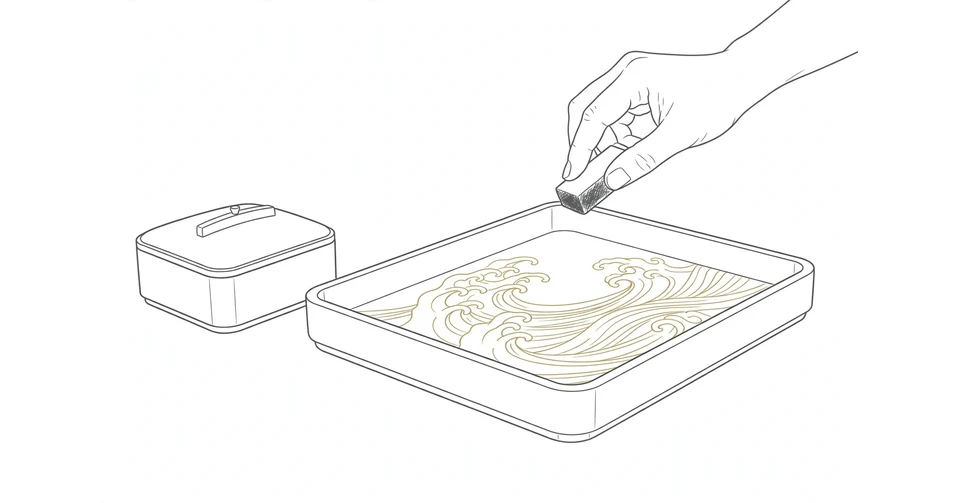
This article follows togidashi from the first brush stroke to the final polish, compares it with its two sister techniques, traces its history from the Nara and Heian courts to living masters today, and explains how to look at a finished piece so the quiet trick at its heart becomes visible. The gold in a togidashi piece does not shout. It waits for the light to find it, and that patience is the whole point of the craft.
What togidashi is, in one breath
Togidashi maki-e, or burnished maki-e, takes the opposite approach to most decoration. After the powder is sprinkled, more layers of urushi are applied over the whole design to bury it, and once the lacquer has cured, the surface is sanded and polished until the metal shows through again. That single sentence, which the companion article on maki-e already sketches in passing, contains the whole method. Everything else in this article is the detail of how that burying and uncovering is done, and why a craft would choose to hide its most precious material before showing it.
The result is a surface with no step between the design and the ground. Run a fingertip across a finished togidashi piece and you feel nothing but smooth lacquer, yet your eyes see gold flowers, distant mountains, or a goldfish swimming below the surface. The metal and the black ground sit at exactly the same height, which is the signature of togidashi and the first thing to check when you are learning to tell the techniques apart. Other maki-e styles let the gold sit proud of the surface or rise up in relief. Togidashi makes the gold disappear into the surface and then coaxes it back out.
That flatness is not a limitation. It is a language. Because the design lies level with its ground, an artisan can use togidashi to suggest depth without building it up. A mountain range can sit far away in the haze of a landscape. A goldfish can look as if it is truly under water, seen through the dark surface of a pond. A moon can hang behind a thin veil of cloud. The technique is at its best when the picture needs distance, water, mist, or quiet, and that is why it has survived for more than a thousand years as a working method rather than a museum curiosity.
It is worth saying plainly that togidashi is slow, demanding, and unforgiving. The artisan cannot see the design for much of the process, because it is buried under black lacquer. The polishing that reveals it is done by feel and by faint glimpses through the thinning lacquer, and one stroke too many can cut through the gold and ruin weeks of work. A craft that asks its maker to work blind for so long, trusting that the gold is still there, tells you something about the people who developed it. They valued patience over display, and they were willing to let the material set the pace.
Togidashi beside hira maki-e and taka maki-e
Maki-e has three basic techniques, and togidashi is the oldest of the three. The other two are hira maki-e, or flat maki-e, and taka maki-e, or raised maki-e. All three start the same way. A design is drawn with lacquer on a finished lacquered surface, and while the lacquer is still wet, metal powder is sprinkled over it from a small bamboo tube called a funzutsu. The difference is what happens after the powder lands.
In hira maki-e, the artisan applies one thin protective coat of lacquer over the powder, lets it harden, and then sands and polishes the gold itself until it shines. The design stays slightly raised above the ground, and the gold is visible from the start. It is the simplest of the three techniques, and also the youngest in its finished form. According to the history of the craft, hira maki-e was developed in the latter half of the Heian period, after togidashi, and only completed in the Kamakura period, because it needed finer metal powder than the early workshops could produce. When the powder is fine, a thin coat is enough to protect it. When the powder is coarse, it is not, and that practical fact shaped the whole history of the craft.
In taka maki-e, the artisan builds the design up in relief before any gold is sprinkled. A foundation of lacquer mixed with charcoal powder or polishing powder is shaped into low mounds, and the design is then drawn over those mounds and sprinkled with gold. The result is a design that stands up from the surface, catching light and shadow like a small sculpture. Taka maki-e is the most challenging of the three basic techniques, because the raised foundation must be polished with great care so the surrounding lacquer is not damaged. It came later than the other two, and it speaks a different visual language, one of nearness and touch rather than distance and depth.
Togidashi sits between these two in feeling, though it is older than both in origin. Like hira maki-e, it begins with a flat drawing. Like taka maki-e, it demands long, careful polishing. But its result is unlike either of them. The design is level with the ground, the gold is locked inside the lacquer rather than sitting on it, and the picture has a soft, hazy quality that the other techniques cannot copy. If hira maki-e is a drawing in gold on black, and taka maki-e is a small relief in gold, then togidashi is a picture seen through dark glass, clear but always slightly removed, as if the gold were remembering itself rather than announcing itself.
A simple comparison makes the differences easy to keep in mind.
| Technique | How the gold sits | Surface feel | Best for |
|---|---|---|---|
| Togidashi maki-e | Level with the ground, buried then polished out | Perfectly smooth | Distant mountains, water, mist, goldfish |
| Hira maki-e | Slightly raised, coated once and polished | Nearly smooth, gold just proud of the ground | Bold flat designs, crests, flowers |
| Taka maki-e | Raised on a shaped foundation | Relief you can feel with a fingertip | Rocks, tree trunks, animals, near foreground |
The table is a guide, not a rule. Real pieces often mix techniques, and the most ambitious works use all three at once, with togidashi handling the background and the distance while raised work carries the foreground. That mixed approach has its own name, and it deserves a section of its own later in this article.
The slow road from brush to polish
A togidashi piece begins long before any gold appears. The wooden base, often a box, a writing case, a tray, or a tea utensil, is first strengthened with linen cloth pasted over the wood, then coated with layer after layer of lacquer. Each coat is left to dry and then polished flat before the next one goes on. The foundation alone can take months, and for a large piece the base coats and the decoration together can stretch into years. Murose Kazumi, a living national treasure for maki-e, has said that a single piece the size of a sheet of paper can take three to four years from planning to completion, with about a year spent on the base coats and another year on the decoration. That pace is not unusual in this craft. It is the normal speed of lacquer.
Only when the ground is perfectly smooth and clean does the drawing begin. The artisan transfers the design onto the surface, a step called okime, and then draws it in lacquer with a fine brush. The lines and filled areas are called ji-nuri, the ground painting, and they must be done in one confident pass, because wet lacquer does not forgive hesitation. The piece then rests in a furo, a cabinet kept warm and humid, until the lacquer is half dry. Urushi does not dry like paint. It hardens through a chemical change that needs moisture in the air, which is why the furo matters, and why a lacquer workshop smells faintly of damp wood even on a dry day.
At the half dry moment in a togidashi piece, the gold arrives. The artisan takes up the funzutsu, a bamboo tube with a fine mesh at one end, fills it with metal powder, and taps or flicks it so the powder falls like a fine rain over the wet lacquer. This step is called kona-maki, the sprinkling of powder. The powder may be gold, silver, or an alloy, and it may be coarse or fine, round or flattened, depending on the effect the artisan wants. Coarse powder gives a bold, granular shine. Fine powder gives a smooth, misty glow. Some pieces use several sizes of powder in one design, so the gold changes character from one part of the picture to another. One special form of the powder is nashiji, made by flattening gold grains until they shine like pear skin, and it is often used for backgrounds that need a soft, even glow. A little of the powder always falls where it is not wanted, and the artisan brushes the loose grains away and saves them, because gold dust is too precious to waste.
Then comes the step that separates togidashi from the other techniques. A thin coat of lacquer is applied over the powder to lock it down, a step called kona-katame, and after that the whole surface, design and ground together, is coated with black lacquer in a step called nurikomi. The gold disappears. The design that the artisan has just drawn with such care is gone from sight, hidden under a dark, even skin. The piece goes back into the furo to cure, and for a day or two, sometimes longer, there is nothing to look at but black lacquer.
When the lacquer has hardened, the polishing begins, and this is where togidashi earns its name. The artisan works through a sequence of charcoals, each one chosen for its hardness and its grain. A rough charcoal made from magnolia wood, called hooh-sumi, takes down the high spots and levels the surface. A softer charcoal from paulownia wood, called suruga-sumi, refines the surface in the middle and final stages. A fine charcoal from crape myrtle or lettuce wood, called roiro-sumi, brings the polish finer still. And a charcoal from camellia wood, called tsubaki-sumi, is used on the areas where gold powder has been sprinkled, because it is gentle enough to polish the metal without tearing it. Water is used throughout, and the artisan watches the surface change as the black lacquer thins. At first the gold is only a faint shadow under the lacquer. Then it begins to show through in patches. The work is to stop at exactly the right moment, when the design is fully visible and level with the ground, but before the polishing cuts into the gold itself.
The finishing steps are quieter but just as important. Thin lacquer is rubbed into the surface and wiped away, a step called suri-urushi, and the surface is burnished again with fine charcoal and polishing powder. Some workshops finish with deer antler powder and a little oil, rubbed in until the surface reaches a mirror gloss. The gold that togidashi buried weeks earlier now shines through a thin skin of lacquer, and the whole piece has the depth of a picture under glass, even though there is no glass at all. Only lacquer, gold, charcoal, water, and time.
Why Heian craftsmen buried their own gold
The history of togidashi begins with a practical problem. In the Nara period (710 to 794) and the early Heian period (794 to 1185), Japanese workshops could not yet refine gold and silver powder into the fine, even grains that later centuries took for granted. The powder was coarse and granular, made by filing metal down, and when it was sprinkled onto wet lacquer, the grains stood up from the surface like tiny pebbles. A thin coat of lacquer could not hold them. They would catch on cloth, on fingers, on anything that touched the piece, and they would come loose.
The solution was to bury them, and that practical answer became togidashi. By coating the whole surface with lacquer and then polishing it flat, the artisan locked the coarse grains inside a hard, smooth skin, and the gold could no longer be knocked off. That is why togidashi became the mainstream of maki-e until the late Heian period, when refining techniques improved and finer powder began to appear. The technique was not a style choice at first. It was an answer to the material as it existed, and its soft, hazy look was a side effect of a practical fix that later generations came to love for its own sake.
The early evidence supports this story of togidashi. A Nara period sword scabbard kept at the Shosoin Repository in Nara, the Kara-tachi sword with gilded silver fittings once belonging to Emperor Shomu, who reigned in the eighth century, uses a technique called makkinru, or powdered gold inlay, that works on the same principle as togidashi. The gold is set into the surface and polished level, and the result has the same quiet, embedded quality. From the Heian period onwards, the technique came to be known as maki-e, and by the Kamakura period (1185 to 1333), the three basic techniques of hira maki-e, togidashi maki-e, and taka maki-e had been perfected. Togidashi was the first of them, and the other two grew out of the knowledge it had built up.
There is a national treasure that makes this history visible. The Maki-e Lacquered Box with Hosoge Flowers and Karyobinga Designs, a small box decorated with stylised flowers and a mythical bird-like creature, is the oldest datable national treasure to use togidashi, and it shows the technique already fully formed, with the gold sitting level in the lacquer and the design reading clearly through the polished surface. Looking at it today, more than a thousand years after it was made, is a strange experience. The box has outlived the court that ordered it, the workshop that made it, and the language of its time, and the gold is still there, still level, still shining softly under its skin of lacquer. That durability is part of the point. Togidashi does not just look quiet. It is built to last quietly.
A note of honesty is needed here. The dating of the earliest togidashi pieces rests on a small number of surviving objects, and different guides place the refinement of the technique at slightly different points in the timeline. The account given here follows the most widely repeated version, which traces the technique from the Nara period through the Heian period, and it is the version supported by the datable treasures named above. The broad shape of the story is secure: togidashi came first, it dominated while powder was coarse, and finer powder later allowed hira maki-e to develop. The exact decade in which one step gave way to the next is harder to fix, and it is better to admit that than to pretend the record is neater than it is.
Shishiai togidashi, where flat meets raised
The most demanding form of maki-e combines togidashi with its opposite. Shishiai togidashi maki-e, also called raised and burnished maki-e, begins with taka maki-e, building the foreground up in relief, and then finishes with togidashi, burying the whole surface in lacquer and polishing it back to a smooth finish. The raised areas stay raised, but their edges are softened and the whole surface is brought to one level of gloss, so the picture reads as a single continuous scene rather than a collage of techniques.
It is the most complicated technique in maki-e, and it was developed in the Muromachi period (1336 to 1573) and became popular in the Edo period (1603 to 1868). The difficulty of shishiai togidashi is easy to understand. The artisan must polish a surface that is not flat, taking down the lacquer over the background until the togidashi design appears, while leaving the raised foreground intact and not cutting through the gold on its high points. Every pass of the charcoal is a judgment call, and the margin for error is thin. That is why shishiai togidashi is reserved for the most ambitious pieces, and why it is often used for landscapes, where the contrast between a flat, misty distance and a solid, near foreground is exactly what the picture needs.
The classic example is the Hatsune no Chodo, the Hatsune furniture set, a national treasure in which mist and rock motifs are combined. The distant mountains are done in togidashi, flat and hazy, while the foreground rocks are done in taka maki-e, raised and solid, and the boundary between the two is polished so smoothly that the eye moves from distance to foreground without noticing the join. It is a picture of depth made by two opposite methods, and it works because togidashi is so good at suggesting distance. The far away is flat and quiet. The near at hand is raised and present. The eye knows the difference at once, even though the surface is nearly smooth to the touch.
For a collector, shishiai togidashi is a useful test of a workshop's skill. If the boundary between the raised and flat areas is rough, or if the gold in the raised area looks thin and worn, the polishing was rushed. If the boundary disappears and the whole surface glows evenly, the maker knew the technique deeply. The price of such pieces reflects that. They take the most steps, the most time, and the most judgment, and they fail most often in the final polishing, when a single careless pass can undo months of work.
How to look at a togidashi piece
The best way to understand togidashi is to look at a piece slowly, in good light, and to let your eyes adjust to what the technique is doing. The first thing to notice is the flatness. Hold the piece at an angle and look across the surface rather than straight down at it. In a hira maki-e piece, the gold catches the light as a slightly raised pattern. In a togidashi piece, the light slides across the surface without interruption, and the gold appears and disappears as the angle changes, like a fish moving under water.
The second thing to notice is the haze. Togidashi gold never has the hard, mirror sharpness of gold leaf. It has a soft, slightly veiled quality, because you are looking at it through a thin layer of lacquer. That veil is the point. It makes the design feel distant, as if it belonged to a memory rather than to the present moment. The guide published by the lacquer studio Urushi Art Hariya puts it well, noting that togidashi is used in landscapes to depict distant mountains, and in painted scenes to create motifs like goldfish swimming underwater. Both examples depend on the same effect. The subject is there, but it is held at a small remove, and the remove is what makes it beautiful.
The third thing to notice is how the gold in a togidashi piece changes with the light. Move a togidashi box slowly under a lamp and watch the design brighten and dim. The gold powder is not a flat sheet. It is thousands of tiny grains, each one catching the light at a slightly different angle, and the thin skin of lacquer over them softens and blends their shine into a single glow. That grain is why older pieces, made with coarse powder, can look richer than newer ones made with fine powder. The coarse grains give the surface a texture that fine powder cannot copy, and the polishing that reveals them also shapes them, cutting each grain level with the surface so it catches the light as a small flat mirror.
If you ever have the chance to handle a togidashi piece, and a museum or a dealer allows it, pay attention to the touch as well as the sight. A togidashi surface feels cool, smooth, and faintly moist, even when it is dry. That moist feeling is characteristic of lacquer, and it is one of the reasons people who love lacquer talk about touching it as much as looking at it. The gold gives nothing away to the fingertip. It is there for the eyes only, and that separation between what the hand feels and what the eye sees is a small, private pleasure that the technique offers to whoever holds the piece.
Works and makers worth knowing
The story of togidashi is carried by a small number of famous objects and a long line of makers, and both are worth meeting. The Maki-e Lacquered Box with Hosoge Flowers and Karyobinga Designs, already mentioned above, is the oldest datable treasure of the technique, and it shows togidashi used for flowers and a mythical creature on a small box, a scale that still suits the technique today. The Kara-tachi sword scabbard at the Shosoin shows the same idea at work a century or more earlier, in the related form called makkinru, and it reminds us that the technique began in the service of objects that were both useful and ceremonial, not in the service of art for its own sake.
The Hatsune furniture set, with its mist and rocks in shishiai togidashi, shows the technique at its most ambitious, and it is the piece most often cited when writers want to explain why a flat background and a raised foreground belong together. These three objects, a box, a scabbard, and a furniture set, span the whole early history of the technique, and together they show how little its core idea has changed. Bury the gold, polish it out, and let the surface do the talking.
Among living makers, the name most closely tied to togidashi today is Murose Kazumi, who was designated a living national treasure for maki-e in 2008. His pieces use togidashi as their foundation, and his best known recent work, Gift from Heaven, a box for holding letters exhibited at the seventieth Japan Traditional Kogei Exhibition in 2023, shows what the technique can do when it is pushed to its limit. Gold grains in different colours, shapes, and textures are layered three dimensionally under a glossy, mirror like lacquer surface, and the grapes and squirrels on the lid are made with raden, mother of pearl inlay, set into the same polished ground. The design was drawn in lacquer, sprinkled with gold from a funzutsu, coated with more lacquer, left to harden, and then burnished with charcoal until the leaves and sunlight showed through again. The grapes and squirrels themselves were cut from mother of pearl shell, pasted onto the surface, and polished with charcoal to finish.
Murose has spoken about the time this kind of work takes, and his numbers are worth remembering. For a piece the size of a sheet of paper, about a year goes into the base coats and the repeated polishing and recoating, and about another year into the decoration, so that a single piece can take three to four years from planning to completion. He has also said that lacquer hardens and grows more transparent over time, so that if a piece is well preserved, its beauty can last for a good five hundred years. That is a different timeline from most crafts, and it changes how a maker thinks about a piece. It is not made for this year. It is made for a future its maker will not see, and the technique of burying gold under lacquer and polishing it out again is a good match for that patience, because it builds the design into the body of the object rather than laying it on the surface.
Murose learned the craft from his father, the lacquer artist Murose Shunji, and later from the masters Matsuda Gonroku, who was designated a living national treasure for maki-e in 1955, and Taguchi Yoshikuni, who received the same designation in 1989. He also led a team of eighteen researchers and technicians in the restoration and reproduction of the Ume makie tebako, a plum blossom cosmetic box from the Kamakura period, a project that took three years and was completed in 1998. That restoration changed his own work, because it taught him that the gold in Kamakura period maki-e was not laid down in an even sheet but was used with attention to the texture of each grain, and he has experimented with that idea ever since. The line from the Heian workshops to a living master is unbroken, and it runs through people who learned by watching, by making mistakes, and by repairing the work of their predecessors.
Keeping togidashi alive at home
A togidashi piece is tougher than it looks, because the gold is locked inside the lacquer rather than sitting on it, but it still needs care. The first rule is to keep it out of direct sunlight and away from heat. Lacquer is an organic material, and long exposure to strong sun can dull its surface and, over years, cause fine cracks. A shaded shelf, a closed cabinet, or a box when the piece is not in use will do more for its life than any polish. The second rule is to handle it with clean, dry hands, and to avoid perfumes, solvents, and harsh cleaners, all of which can damage the lacquer. A soft, dry cloth is enough for dust. If a piece needs more than that, it needs a professional, not a household cleaner.
Water is a smaller worry than most people expect, because cured lacquer is water resistant, and lacquerware has been used for soup bowls and sake cups for centuries. But a togidashi piece is not a soup bowl, and standing water, dishwashers, and long soaking will still harm it over time. Wipe it dry if it gets wet, and never put it in a dishwasher. The third rule is to avoid knocks and drops, because lacquer can chip, and a chip that exposes the wood beneath is an entry point for moisture. A chipped piece can be repaired, and Japan has a long tradition of lacquer repair, but a repair is always more expensive than the care that would have prevented it.
For collectors, togidashi has a practical advantage that is worth knowing. Because the gold is level with the surface and sealed under lacquer, it does not wear away with handling in the way that raised gold can. A hira maki-e design can lose its shine where fingers touch it often, and a taka maki-e design can catch on cloth and chip at its high points. A togidashi design, if the piece is well made, will look much the same after decades of gentle use as it did when it left the workshop, because the gold is protected by the very lacquer that hides it. That durability is part of why the technique was developed in the first place, and it is still a good reason to choose it today.
When buying, look for the signs of genuine togidashi described earlier in this article. The surface should be perfectly smooth, with no step between the design and the ground. The gold should appear softly through the lacquer, not sit on top of it. The boundary between a togidashi background and any raised work should be clean and even. And the piece should feel cool and silky to the touch, not sticky or rough. If a seller calls a piece togidashi but the gold is clearly raised and catches your fingernail, it is probably hira maki-e or taka maki-e instead, and the price should reflect that. The names matter, because they describe different amounts of labour, and a buyer who knows them is harder to mislead.
There is also a quieter reason to choose togidashi, and it has nothing to do with money. A piece made by togidashi rewards the person who lives with it. The design changes with the light, with the season, and with the angle from which you look at it, so a box that has sat on a shelf for a year can still surprise you on a bright morning. That slow reveal, repeated every day, is the same pleasure the artisan had when the gold first showed through the lacquer, and it is a pleasure that does not wear out. A craft that hides its beauty and then gives it back a little at a time is a good companion for a long life, and that may be the most honest reason to keep it alive.
The gold in a togidashi piece was buried on purpose, and it was polished back into the light on purpose, and both decisions say the same thing. Beauty does not have to announce itself to be real. It can wait under a dark surface, patient and hidden, until the work is done and the light is right. That is the lesson of togidashi, and it is a generous one, because it applies far beyond lacquer. A thousand years of craftsmen have trusted that what is hidden carefully will still be there when it is uncovered, and a thousand years of looking has proved them right.
More in Culture & Society
- Shibayama Turns Shell Ivory and Coral Into Small Paintings in Lacquer
- Nashiji Scatters Gold Dust Like Pear Skin Across Black Lacquer
- Raden Turns Mother of Pearl Into Lacquer That Catches the Light
- Maki-e Sprinkles Gold Dust Onto Wet Lacquer
- Urushi Is the Tree Sap Japan Turns Into Lacquer That Outlives Centuries
- Ojime Is the Tiny Bead That Keeps a Netsuke From Slipping Away
Latest posts
- Inro Is the Little Lacquered Box That Carried a Samurai's Day
- Hachimaki Is the Headband Japan Ties On Before the Hard Part Begins
- Netsuke Held a Samurai's World on a Cord
- Tenugui Is the Thin Cotton Cloth Japan Uses for Everything
- Kinchaku Carries a Whole Festival in One Small Bag
- Takuan Turns a Humble Daikon Into Japan's Yellow Crunch
- Nukazuke Is the Living Pickle Bed Japan Feeds Every Day
- Tsukemono Is the Crunch Japan Puts Beside Every Meal
- Ochazuke Is Rice Tea and Comfort in One Bowl
- Aojiso Is the Green Leaf Japan Eats Fresh and Raw
- Akajiso Gives Umeboshi Its Deep Red Blush
- Umeshu Is the Liqueur Japan Makes From Unripe Plums
- Shiso Is the Leaf That Paints Umeboshi Red
- Hello Kitty and the Cat Who Conquered the World
- Umeboshi Is the Sour Plum Japan Puts in Every Bento