Kinchaku Carries a Whole Festival in One Small Bag
· 17 min read
A kinchaku is Japan's small drawstring bag for carrying coins, a phone and an amulet when a yukata has no pockets. It began as a money pouch, became festival wear, and still works today.
On a summer festival evening in Japan, the crowd moves slowly between food stalls and game booths, and almost everyone is carrying less than you would expect. There is no handbag, no backpack, no bulging pocket. There is a small drawstring bag, a kinchaku, hanging from a hand or tucked into a sash, and it holds everything the evening needs.
The kinchaku exists because the yukata has no pockets. The light cotton yukata is a robe that wraps and ties, with no place to stash a coin or a key, so the bag became its companion. It hangs from the wrist, slips into the fold of the sash, or dangles from the obi, and it carries the small things a festival evening asks for. A few coins, a phone, a paper charm, and nothing more.
That is the whole charm of the thing. A kinchaku does not try to carry your life. It carries the evening, and it does so with a simplicity that has survived for centuries.
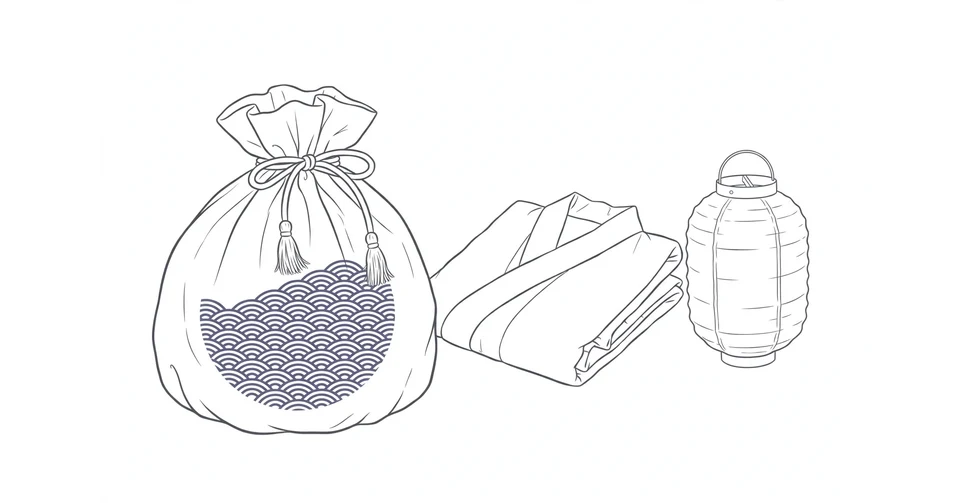
The bag looks too simple to have a history, and that is exactly why its history is worth telling. A pouch made of a circle of cloth and a cord should not need explaining, yet this one has been a money bag, a childs amulet case, a piece of festival dress, and now a small fashion object. Each of those lives left a mark on the way it is made and the way it is used.
A bag born from a robe with no pockets
The kimono, and the yukata that came from it, is a long straight garment with no pockets and no buttons. It is worn by crossing the flaps one over the other and closing them with a fabric belt called an obi. That cut is elegant and it is also impractical, because a person still needs to carry small things. The answer was a family of small containers hung from the obi, known together as sagemono, or hanging objects. The kinchaku was one of them, and the most flexible of the group.
The Museums of Genoa, in their account of Edo period mens accessories, list the sagemono plainly. In the absence of pockets, small objects and consumables were kept in small containers hung on the obi belt, and among them were pill boxes, pipe holders, tobacco containers, portable inkpots, purse bags called kinchaku, and perfume bottles. The kinchaku sat in that company as the soft one, the bag rather than the box, and that softness is what let it outlive the rest.
An older English account, Captain Frank Brinkley's history of Japanese art, describes the kinchaku as the most ancient of the objects attached to the girdle. In the days when the ordinary means of exchange were strings of copper cash, too bulky to carry on the person, a money pouch was of little use to common people. But for aristocratic and wealthy people, who paid with gold dust or coins of precious metal, the kinchaku was more or less necessary. It began, in other words, as a purse for people who had something worth carrying.
By the middle of the seventeenth century, choosing the material for a kinchaku and the other suspended objects had become a matter of serious taste. Brinkley notes that records from that century list no fewer than ninety three kinds of leather and fur described as orthodox materials for sagemono, and only ten of them were of Japanese manufacture. The rest came from China, India, Persia, Ceylon, Luzon, Russia, Holland, and elsewhere. A small bag had become a small statement, and the choice of cloth or skin said as much about its owner as any other part of the outfit.
The bag changed its job as money changed. When coins became common and paper money arrived, the kinchaku stopped being much used as a monetary receptacle, and its place was taken by a kind of pocket book carried in the bosom. But the bag did not go out of fashion. Brinkley records that it became part of a childs costume, made of richly embroidered silk or costly brocade, and used to hold an amulet and a wooden ticket inscribed with the name and address of the childs parents. The little one was thus placed under the protection of heaven on one hand, and of kind people who might find it straying on the other. That is a lovely second life for a money bag, and it says something about how Japan treats useful things. When the original job disappears, the object is given a new one rather than thrown away.
A Japanese museum source, the Costume Museum in Kyoto, places the wider flowering of these small bags in the middle of the Edo period, from 1603 to 1868, when the style of the short sleeved kimono was completed and the small bags attached to the body came into extensive use. Making them became an independent occupation, and from the middle of the Edo period onward, outstanding handicrafts of dyed fabrics, leather, ivory and metal were produced for women in particular. The kinchaku appears in that museum list among the items carried at the waist, beside the inro container, the pillbox, the talisman bag, the wallet, and the cigarette case. It was one tool among many, but it was the one that ordinary people could make at home.
There is a lesson in that long history that goes beyond fashion. The kinchaku survived because it never tried to be more than it was. It is a bag, a cord, and a knot, and that is enough. Fashions that depend on complexity die when the fashion changes. A simple answer to a simple problem, how to carry a few small things when your clothes have no pockets, keeps working long after the world that invented it has gone.
How a kinchaku is made and tied
A traditional kinchaku is made from a single piece of cloth, cut in a circle or a square, with a channel sewn around the edge. A cord is threaded through the channel, and pulling the two ends gathers the cloth into a pouch. That is the whole construction, and it is part of the appeal. There is no zip, no clasp, no lining to fail, and nothing to break. If the cord wears out, it can be replaced in a minute.
The cloth matters more than the shape. Cotton is the common choice for festival use, often dyed indigo, which has been the working colour of Japanese cloth since the Edo period. Indigo dye was valued because it reduced odour, protected the skin, and repelled insects, and the deep blue became so associated with everyday Japan that foreign visitors once called it a blue country. Silk and brocade appear in finer versions, the kind made for a childs amulet or a formal occasion, and modern makers use linen, hemp, and printed cotton in patterns that range from quiet geometric designs to bold festival motifs.
The cord is usually a braided silk or cotton himo, and it is threaded so that both ends emerge from the same side of the channel. Pulling the ends closes the mouth of the bag, and the knot is what keeps it shut. The simplest way is a plain bow, tied the way you would tie a shoelace, and for a festival evening that is enough. A firmer method is to pull the cords tight, cross them, and tie a double knot that will not loosen while you walk. Some people wrap the cord once around the wrist after tying it, so the bag hangs from the hand and cannot be forgotten on a stall counter.
The old way of securing the bag was more ingenious. Brinkley describes how men fastened the strings of the pouch to a kind of button, passed it under the girdle, and brought it out above, so that the button offered an effective obstacle to the withdrawal of the pouch without the owners knowledge. That button was the netsuke, the small carved toggle that has since become a collectors object in its own right. The modern festival kinchaku rarely needs a netsuke, because it is carried in the hand rather than hung from the sash, but the idea is the same. The bag should stay with its owner, and the cord is the whole security system.
Size is part of the design, and it is a discipline. A typical festival kinchaku is small enough to hold in one hand, roughly the size of a large fist when full, and it holds a phone, a few coins, and a paper charm. It cannot hold a water bottle, a guidebook, or a jacket, and that is the point. The bag forces a choice, and the choice is the pleasure of it. You decide what the evening actually needs, and you leave the rest behind. I have come to think of that as a small piece of wisdom disguised as a bag. Most of what we carry through a day is carried out of habit rather than need, and a pouch that refuses to hold it is a gentle correction.
Making one at home is a reasonable first sewing project, and that is part of why the form has lasted. A circle of cloth, a folded channel, a cord, and a knot are all it takes, and the result is genuinely useful. People who sew their first kinchaku often make a second one immediately, because the first taught them what size they actually wanted. The bag is forgiving of imperfect stitching, which is more than can be said for most traditional crafts.
What goes inside a festival kinchaku
The contents of a kinchaku tell you what the evening is for, and the list is short. Coins come first, because festival stalls still run largely on cash, and a handful of coins is easier to fish out of a soft pouch than out of a wallet. A phone comes second, because the evening will want photographs, and because a phone is also the map, the meeting point, and the train timetable home. An omamori, the small paper or cloth amulet bought at a shrine, comes third for many people, tucked in as a quiet piece of luck.
That is the core, and everything else is optional. A handkerchief is common on hot evenings, when the air is thick and the crowd is close. A paper fan fits if the bag is large enough, and a lip balm or a small packet of tissues rounds out the list. A ticket for the fireworks, if the show is seated, folds neatly into the bottom. What does not go in is anything sharp, anything heavy, or anything you would miss badly if the cord came undone. The bag is soft and its mouth is held by a knot, so it rewards light, flat, unbreakable things.
There is also a small etiquette to the contents. A kinchaku is not a place for a wallet full of cards, and it is not a place for a passport or a house key on a festival night. Those belong in a proper bag or a safe pocket, if the outfit has one, and the festival bag should hold only what the festival needs. That separation is part of the ritual. The evening gets its own small set of belongings, and the rest of life waits at home.
The omamori deserves a word of its own, because it connects the festival bag to its older life as a childs amulet case. The amulet is a small pouch inside a pouch, a charm that is meant to be carried and not opened, and putting it in a kinchaku continues a very old habit. The bag that once held a childs amulet and a wooden name ticket now holds an adults amulet and a phone, and the shape of the evening has not changed as much as the contents have.
Kinchaku, inro and the modern pouch
People meeting the kinchaku for the first time often confuse it with the inro, and the confusion is understandable, because both hung from the same sash and both solved the same problem. The difference is in the material and the job. The inro is a small case of lacquered wood, built from a stack of compartments that fit together and are held by a silk cord, with a sliding bead called an ojime to tighten the cord and a netsuke toggle to secure it to the obi. It was made for things that needed a hard case, medicine, seals, tobacco, and small valuables. The kinchaku is a soft bag of cloth, closed by a drawstring, and made for things that could be squeezed, coins, charms, and small soft objects.
The Genoa museum page describes the inro as the most important of the sagemono, and that is fair. It was the object that attracted the finest lacquer work and the most celebrated carvers, and whole schools of artists specialised in making it. The kinchaku was the quieter cousin, the one that any household could sew, and that difference in status is part of why the kinchaku survived and the inro became a museum piece. A lacquered case needs a master to make it and a collector to keep it. A cloth bag needs a needle and a cord, and anyone can replace it.
The modern pouch is the third member of the comparison, and it is worth being honest about. A zippered pouch from a stationery shop holds more, closes more firmly, and costs less than a handmade kinchaku. It is the better tool if the only measure is carrying capacity. But it is not the same object, because it carries no history and no ceremony. Opening a drawstring with a pull of the cord is a small physical pleasure, the cloth gathering in the hand, and that pleasure is part of why people still choose the older form. I would not argue that the kinchaku is more practical than a zippered pouch. I would argue that practicality is not the only thing a bag is for, and that a small daily ritual, pulling a cord, hearing the cloth rustle, is worth a little less capacity.
There is also a practical point that favours the cloth bag on a summer evening. A zippered pouch is rigid and it sweats in the heat, while a cotton kinchaku breathes, folds flat when empty, and can be washed after a night of festival food and spilled drink. It is a bag that forgives the evening, and that is a real virtue at a matsuri.
Where the kinchaku fits today
The kinchaku never really went away, but its home has widened. The most familiar setting is still the summer festival, worn with a yukata and completed by wooden geta sandals, which still clatter through the streets on festival nights. Our piece on those sandals, geta still clatter through Japanese summer, describes the sound they make on stone paths, and the kinchaku belongs in that same picture, the small bag swinging gently as its owner walks between the stalls.
Beyond the festival, the bag has found new work. Craft shops sell it as a small gift bag, a jewellery pouch, a tea ceremony accessory, and a carrying case for small electronics. People use it to hold charging cables, earphones, and coins, and the old festival size turns out to be about right for the small objects of modern life. A phone fits, a cable fits, and the bag slips into a larger bag or a coat pocket without adding weight. It has become, without anyone planning it, the ideal size for the things we carry but do not want to look at.
Buying one is straightforward, and the choice is between a festival stall and a craft shop. Festival stalls sell simple cotton versions in bright patterns, cheap and cheerful, and they are the right choice for a first kinchaku. Craft shops and department stores sell finer ones in silk, brocade, and hand dyed indigo, made by workshops that have been sewing them for generations, and those are the ones to buy when the bag is meant to last. Online, artisan sellers offer handmade versions in small batches, and the best of them show the cloth, the cord, and the stitching clearly in their photographs, which is what to look for. A kinchaku should be judged the way any piece of cloth is judged, by the weight of the fabric, the evenness of the stitching, and the smoothness of the cord.
There are a few things to check before buying. The channel that holds the cord should be sewn firmly, with no loose threads at the opening where the cord emerges. The cord itself should slide freely when pulled, without catching on the seam. The cloth should feel substantial rather than thin, because a thin bag will wear through at the corners where the cord pulls. And the size should be tried with a phone, because a bag that cannot hold a phone will spend the evening empty. None of this requires expertise. It requires a hand, a phone, and a minute of attention, and that is how most good purchases are made.
The bag also makes a thoughtful gift, and this is where its history helps. A kinchaku given to someone is a small, useful, and unmistakably Japanese object, and it carries the story of the robe with no pockets and the festival that needed a bag. It is the kind of gift that does not demand display. It sits in a drawer, gets used, and is remembered each time the cord is pulled. That is a better fate than most souvenirs, which are admired once and then forgotten.
A small bag with a long memory
A kinchaku is easy to overlook, and that is the risk of writing about it. It is a circle of cloth and a cord, and a reader could reasonably ask why such a small thing deserves an article. The answer is that small things are where a culture shows its habits. The way a people carries its coins, its charms, and its phone says something about what it values, and the kinchaku says that Japan values lightness, simplicity, and the willingness to carry less.
The bag has survived because it answers a question that has not gone away. Clothes still have too few pockets, evenings still need a few small things, and people still enjoy carrying them in something made by hand. The Edo period gave the bag its form, the festival gave it its colour, and the modern world gave it a phone to carry. None of those changes required the bag to change, and that is a rare thing.
So the next time you see a small drawstring bag swinging from a wrist at a summer festival, look at it for a moment longer than you otherwise would. It is not an accessory chosen at random. It is the descendant of a money pouch, a childs amulet case, and a piece of festival dress, and it is carrying a whole evening in a space no bigger than a fist. The festival fits in it, and so, for a few hours, does everything that matters.
More in Culture & Society
- Hachimaki Is the Headband Japan Ties On Before the Hard Part Begins
- Netsuke Held a Samurai's World on a Cord
- Baikasai Serves Tea Under the Plum Blossom at Kitano Tenmangu
- Plum Blossom Opens Japan's Year Before the Cherry Trees Wake
- Tenjin Engi Emaki Paints a Storm God Into a Saint of Learning
- The Flying Plum Tree That Followed a Scholar Into Exile
Latest posts
- Tenugui Is the Thin Cotton Cloth Japan Uses for Everything
- Takuan Turns a Humble Daikon Into Japan's Yellow Crunch
- Nukazuke Is the Living Pickle Bed Japan Feeds Every Day
- Tsukemono Is the Crunch Japan Puts Beside Every Meal
- Ochazuke Is Rice Tea and Comfort in One Bowl
- Aojiso Is the Green Leaf Japan Eats Fresh and Raw
- Akajiso Gives Umeboshi Its Deep Red Blush
- Umeshu Is the Liqueur Japan Makes From Unripe Plums
- Shiso Is the Leaf That Paints Umeboshi Red
- Hello Kitty and the Cat Who Conquered the World
- Umeboshi Is the Sour Plum Japan Puts in Every Bento
- Kitano Tenmangu Turns Plum Blossom Into a Prayer for Exams
- Japanese Geisha and the World Behind the Painted Face
- Tenjin Is the Storm God Who Became Japan's Patron of Learning
- Queen Is the Crown Japan Gives Its Best Woman Karuta Player