Urushi Is the Tree Sap Japan Turns Into Lacquer That Outlives Centuries
· 17 min read
Urushi is the sap of the Japanese lacquer tree, and once it cures it becomes one of the toughest and most beautiful coatings ever made. This is the story of the tree, the harvest, the layers, and the objects it protects.
Hold a black lacquered bowl in your hands and it feels like holding something that should not exist. It is warm to the touch, light for its size, and so smooth that light slides across it without catching. It looks like plastic, but it is not. It is wood, sealed in the sap of a tree, and the coating on it may be older than the person holding it by several generations. That coating is urushi, and it is one of the oldest and strangest materials in Japan.
Urushi is the sap of the lacquer tree, known to botanists as Toxicodendron vernicifluum, a deciduous tree that typically grows 8 to 10 metres tall. The sap is milky white when it first leaves the tree and turns brown on contact with air. In its raw state it is poisonous to touch. Once it cures, it becomes a hard, waterproof, heat resistant skin that can survive for thousands of years. The journey from poison to heirloom is the whole story of urushi.
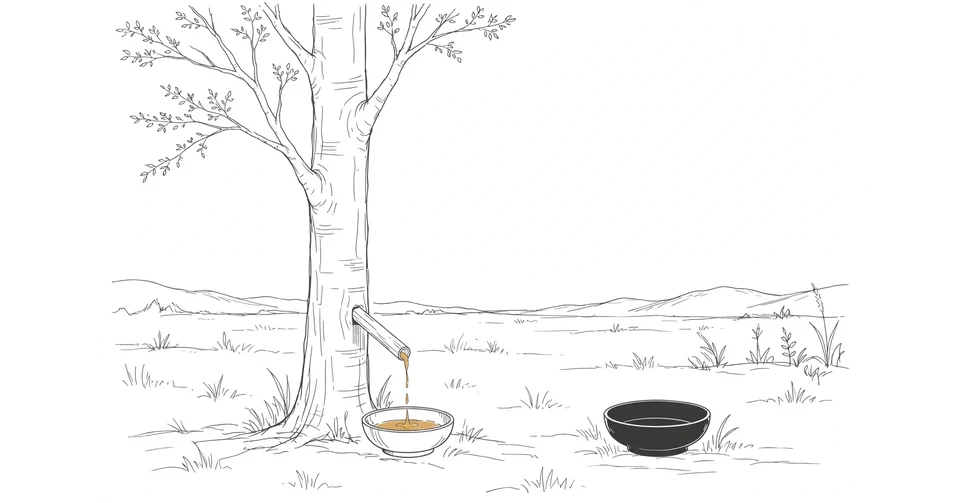
I find that contradiction hard to get over. The same substance that raises blisters on bare skin is the substance Japan has trusted for centuries to hold its food, guard its swords, and decorate its temples. It asks for patience, skill, and respect, and in return it gives back a finish that no synthetic coating has ever quite matched. To understand urushi is to understand why Japan still bothers with a craft that takes months to do what a factory can do in minutes.
What urushi actually is
Urushi begins as sap stored in the cells beneath the bark of the lacquer tree. The tree is a relative of poison ivy, which explains the first thing anyone needs to know about it. Its main active component is urushiol, the same family of compounds that makes poison ivy so miserable, and raw urushi can cause an itchy, blistering rash on contact with skin. Craftsmen who work with it wear protection and learn to handle it with care, and many develop some tolerance over years of exposure, though for some people the sensitivity never fades.
The chemistry is what makes urushi remarkable. Urushiol hardens through enzymatic oxidation, driven by an enzyme called laccase, and the process needs warm and humid conditions, roughly 20 to 30 degrees Celsius and 60 to 80 percent humidity. This is the opposite of ordinary paint, which dries best in dry air. Urushi needs damp air to cure, which is why lacquerers work in special humid cabinets and why the craft developed in a country where summer is hot and wet. Once cured, the coating is remarkably resistant to water, heat, and chemical damage, and it also protects the wood beneath it against rot and insects. A good guide to the material and its properties is this guide to Japanese lacquerware, which explains how the sap hardens and why the finished surface lasts so long.
That durability was the original point. Long before lacquerware became an art form, urushi was used simply because it worked. It sealed wood against water, glued things together, and kept tools and containers from rotting. The beauty came later, as craftsmen discovered that layer upon layer of the same humble sap could be polished to a mirror shine. I think that order matters. A material that earns its place through usefulness first and beauty second tends to stay useful for a very long time.
How urushi is harvested
Collecting urushi is slow, skilled, and a little dangerous, and it has barely changed in centuries. In Japan the harvest is called urushi-kaki, and it runs from June to October, when warm and humid weather keeps the sap flowing. The harvester, known as an urushi-kaki, cuts shallow horizontal grooves into the bark with a special blade, then scrapes off the milky sap that seeps out with a flat tool. The angle and depth of each cut matter. Cut too deep and the tree is damaged. Cut too shallow and little sap comes out. Fresh cuts are made through the season, and the sap is collected again and again from the same trees.
The trees chosen for tapping are usually around 10 to 15 years old, old enough to give a worthwhile amount of sap. Even then, the yield is small. A single tree gives only a few hundred grams of usable sap across an entire season, which is why lacquer has always been precious. The sap is sorted by when it was collected. The early harvest, from June to mid-July, is watery and best suited to base coats. The peak harvest, from mid-July to late August, gives the most lustrous sap. The late harvest runs into mid-October and closes the season.
The numbers behind the harvest are sobering. The Joboji district in Iwate Prefecture, the heart of Japanese lacquer production, is said to have had around 300 harvesters at its prime. That number fell to 19 in 2014 as demand shrank, before climbing back to 35 as restoration work created new demand, including eight harvesters in their twenties and thirties. A survey by the Forestry Agency found that Iwate Prefecture accounted for 80 percent of national output in 2023. Domestic production is a small fraction of what Japan uses, and more than 90 percent of the urushi used in Japan today is imported, mostly from China. The craft survives on a thin thread of trees, tappers, and stubborn demand.
Raw sap cannot be used straight from the tree. It carries bits of bark, dust, and other debris, so it is gently heated and filtered through cloth to produce raw lacquer, called ki-urushi. Then it is stirred in stages known as nayashi and kurome, which smooth the texture, improve the gloss, and adjust the drying time. The result is a clear, light amber lacquer called suki-urushi, ready to be coloured or applied. Every step is done by hand and by feel, and the quality of the finished lacquer depends on the judgement of the person stirring it.
Nine thousand years of urushi in Japan
The history of urushi in Japan reaches back nearly 9,000 years to the Jomon period, the long prehistoric era that ran from around 10,000 to 300 BCE. Lacquered pottery fragments found in Hakodate, in Hokkaido, are among the earliest known examples, and similar finds of lacquered wooden bowls, ornaments, and tools have turned up at sites across the country. The dates attached to the oldest finds vary a little between sources, so the honest figure is "nearly 9,000 years" rather than a single precise year, but the broad fact is secure. People in Japan were already using urushi thousands of years before the first written records.
In the Jomon period, urushi was used mainly as glue and as a sealant, to strengthen tools and waterproof containers. The Shimoyakebe ruins in Higashimurayama, Tokyo, show the whole sequence, from sap collecting to finished lacquerware, and the site was probably a major production centre in the late Jomon period, about 4,300 to 3,400 years ago. Around 300 pieces of earthenware found there carried a red lacquer coating, and the people of the time seem to have loved red, perhaps because the colour suggested life and vitality. Wooden bows, combs, and hairpins coated with urushi were found at the same site, and pieces of wood still carry vivid traces of the old sap collecting cuts.
The craft grew up with the country. In the Asuka period, from the late sixth to the seventh century, urushi moved from tools into religious architecture, Buddhist statues, and ritual objects, and production spread as demand grew. For a long time lacquerware belonged to the elite, to nobles, monks, and educated families. That changed in the Kamakura period, from 1185 to 1333, when simpler production methods made lacquerware cheaper and it entered ordinary homes. By the Edo period, from 1603 to 1868, regional domains supported lacquer production as a local industry, and the distinct regional styles we still know today took shape. When I look at that timeline, what strikes me is not any single golden age but the sheer continuity. A material used by hunter gatherers was still being applied to temple gates a few years ago, and the technique in between barely changed.
The layers that make lacquer last
A lacquered object is not coated once. It is coated many times, and the patience of that layering is the whole secret of its strength. Most lacquerware starts with a wooden base, called kiji, and before any decorative coat goes on, a foundation must be built. This base preparation is called shitaji-zukuri, and it is what separates lacquerware that lasts for generations from lacquerware that chips in a year.
The base is built from raw urushi mixed with fine powders, such as jinoko, a powder made from fired and ground clay or volcanic ash. The mixture is spread on, left to dry, and polished, and the process is repeated until the surface is smooth and strong. In Wajima, the famous lacquer town in Ishikawa Prefecture, the weak points of a bowl, such as the lip and the foot, are first reinforced with cloth soaked in lacquer, a technique called nunokise, and the base powder is a local diatomaceous earth found only around Wajima. That local earth is one reason Wajima lacquer is so famously tough.
Once the base is ready, the lacquer itself goes on in three phases: the base coat, the middle coat, and the final top coat. After each coat, the piece rests in a furo, a special drying cabinet held at around 20 to 30 degrees Celsius and 60 to 80 percent humidity, until the urushi hardens. Then the surface is polished, often with charcoal, and the next coat goes on. The final coat can be left as it is, a soft natural lustre called nuritate, or polished with charcoal to a deep mirror gloss called roiro-nuri. The black finish most people picture comes from kuro-urushi, lacquer coloured with iron hydroxide, while the bright vermilion of festive ware comes from shu-urushi, made by mixing clear lacquer with cinnabar or red iron oxide.
Our own site has seen how long this takes up close. The lacquered sheath of a katana, the saya, is sealed with urushi applied in many thin layers, each one dried and polished before the next, and a specialist may spend two or three months on a single sheath. Read the story of the saya, the lacquered sheath that guards the katana and the timescale stops sounding like an exaggeration. It is simply what the material demands, and the craftsmen who work with it have never pretended otherwise.
The objects urushi made famous
Urushi touches almost every corner of Japanese craft, because almost anything made of wood can be sealed, strengthened, and decorated with it. The most familiar objects are bowls, trays, chopsticks, and boxes, but the material has always travelled further than the table. It coats temple gates and Buddhist statues, furniture and stationery, sword sheaths and small personal cases. In the age of the samurai, maki-e decoration on a sword sheath or a portable case was a quiet way of showing status, and the more elegant the work, the higher the standing of its owner.
The small lacquered box called an inro is a good example of how practical the craft could be. An inro hung from a sash and carried the small items of daily life, and its lacquered surface had to survive being knocked, opened, and closed a hundred times a day. Our guide to the inro, the little lacquered box that carried a samurai's day follows one of those boxes through its working life, and the lesson is the same as with the saya. Urushi was not chosen for show. It was chosen because it could take a beating and still look beautiful.
The decoration is where urushi becomes art. Maki-e, literally "sprinkled picture", is the most famous technique. A design is painted in wet lacquer, then gold or silver powder is sprinkled over it before it dries, and the powder is sealed under more lacquer and polished to reveal the image. Chinkin carves fine lines into hardened lacquer and fills them with gold dust. Raden sets thin pieces of mother-of-pearl into the surface so they shimmer, and rankaku uses broken eggshell to make white patterns that lacquer alone cannot achieve. European traders in the age of exploration were fascinated above all by maki-e, and they commissioned Kyoto artisans to decorate Western style cabinets and boxes, which were then sold at high prices in Spain and Portugal.
Scale is another way to grasp what urushi does. The Yomei-mon gate of Nikko Toshogu, a designated national treasure, needed 600 kilograms of urushi for its restoration from 2013 to 2017, and that amount would have required around 3,000 lacquer trees to produce. The lacquer was used as a base coat across the gate, as glue for gold leaf, and over parts hidden under metal fittings. Old layers of lacquer were deliberately left hidden beneath the new ones, so that conservators of the future can still study how the work was done. That detail, reported in this Yomiuri feature on urushi and the restoration of cultural properties, is the one I keep coming back to. The restorers were not only repairing a gate. They were leaving a message for people they will never meet.
The places behind the names
Lacquer in Japan is inseparable from place, because each region developed its own way of working with urushi. The Edo period gave rise to a map of styles that is still used today. Tsugaru-nuri comes from Aomori Prefecture, Hidehira-nuri from Iwate, Wajima-nuri from Ishikawa, Wakasa-nuri from Fukui, Shunkei-nuri from Gifu, and Kagawa Shikki from Kagawa. Each name is a promise about how the object was made, and buying from a known lacquer town is a little like buying a knife from a known smithing town. The name carries the method.
Wajima is the most celebrated of them, and its reputation rests on durability as much as beauty. The cloth reinforcement and the local diatomaceous earth in its base coats make Wajima ware unusually resistant to chipping, which is why it has survived as both tableware and art. Kyoto, meanwhile, became the centre of maki-e, where the finest gold powder work was done for the court, the temples, and later for foreign merchants. The regional differences are not marketing. They are the visible result of different woods, different earths, different climates, and different generations of craftsmen solving the same problem in their own way.
The geography of supply has shifted, though. Japan now imports the overwhelming majority of its lacquer, and domestic production is a small share of the total. In 2015, the Agency for Cultural Affairs announced that domestically produced urushi should in principle be used for the restoration of National Treasures and Important Cultural Properties, and conservators restoring the shrines and temples of Nikko have used only domestic lacquer since 2007. That policy is not nostalgia. Japanese urushi behaves differently from imported lacquer in Japanese weather, and the people who restore thousand year old buildings want a material that agrees with the climate it will live in. The future of the craft depends on keeping enough trees and enough tappers alive to meet that standard.
Living with lacquer and looking after it
A lacquered object is tougher than it looks, but it is not indestructible, and it asks for a little care. The finished surface is safe to eat from, because fully cured urushi is non-toxic and food safe, even though the raw sap is poisonous. The enemy of cured lacquer is not water or heat in ordinary use. It is ultraviolet light, which slowly degrades the surface, along with harsh detergents, long soaking, and dishwashers and microwaves. Hand washing with a mild detergent and a soft cloth, followed by prompt drying, is the safe routine, and lacquer likes the same moderate humidity that people do, neither bone dry nor damp.
That care is repaid over decades. A well made lacquer bowl does not wear out in the way a plastic bowl does. It gains a soft patina, it can be repaired and refinished rather than thrown away, and a scratched surface can be recoated by a craftsman who knows the material. The jubako, the stacked lacquered box of the New Year table, is a good example. Families keep one for decades, repair it when it chips, and hand it down, and the scratches it gathers are the record of the meals it has carried. I think that is the right way to think about lacquer in general. It is not a disposable finish. It is a surface that ages with its owner.
Modern lacquer is also finding new work. Researchers and artisans have developed types of urushi that adhere to glass and ceramics, sprayable lacquers, and more weather resistant formulations that stand up better to ultraviolet light and outdoor use. Swiss watchmaker Chopard has decorated watch dials with maki-e since 2009, working with the Tokyo lacquer maker Yamada Heiando, and a 2024 diplomatic gift from the Japanese prime minister included a coffee cup and a fountain pen finished with maki-e by the Wajima maker Taya Shikkiten. The material that sealed Jomon pottery is now sealing watch dials a little over three centimetres across. The scale changed. The patience did not.
Why urushi still matters
Urushi matters because it is proof that a slow material can outlast every fast one. A plastic bowl is cheaper, lighter, and easier to make, and it will be in a landfill within a decade. A lacquered bowl takes months to make, costs far more, and may still be in use a century from now. The choice between them is not really about bowls. It is about what kind of time we want our objects to live in, and whether we believe that the things we touch every day deserve the same care as the things we put behind glass.
There is also a quieter lesson in the harvest. A tree grows for a decade or more, gives a few hundred grams of sap in a season, and is then felled, and from that small gift comes a coating that can protect a temple gate for generations. That ratio, a whole tree for a cupful of sap, and a cupful of sap for a century of use, is the opposite of how most modern manufacturing works. It asks the maker to waste nothing and the user to keep what they have.
The next time you pick up a black lacquered bowl, look at the surface before you look at the food in it. That depth of black, that soft warmth under your fingers, is the sap of a tree that grew for years, was cut by hand in summer humidity, was filtered and stirred and layered and polished by people you will never meet, and was cured in damp air because the material refused to harden any other way. Urushi is not just a coating. It is a record of patience, and patience, it turns out, is the most durable thing Japan ever made.
More in Culture & Society
- Maki-e Sprinkles Gold Dust Onto Wet Lacquer
- Ojime Is the Tiny Bead That Keeps a Netsuke From Slipping Away
- Inro Is the Little Lacquered Box That Carried a Samurai's Day
- Hachimaki Is the Headband Japan Ties On Before the Hard Part Begins
- Netsuke Held a Samurai's World on a Cord
- Kinchaku Carries a Whole Festival in One Small Bag
Latest posts
- Tenugui Is the Thin Cotton Cloth Japan Uses for Everything
- Takuan Turns a Humble Daikon Into Japan's Yellow Crunch
- Nukazuke Is the Living Pickle Bed Japan Feeds Every Day
- Tsukemono Is the Crunch Japan Puts Beside Every Meal
- Ochazuke Is Rice Tea and Comfort in One Bowl
- Aojiso Is the Green Leaf Japan Eats Fresh and Raw
- Akajiso Gives Umeboshi Its Deep Red Blush
- Umeshu Is the Liqueur Japan Makes From Unripe Plums
- Shiso Is the Leaf That Paints Umeboshi Red
- Hello Kitty and the Cat Who Conquered the World
- Umeboshi Is the Sour Plum Japan Puts in Every Bento
- Baikasai Serves Tea Under the Plum Blossom at Kitano Tenmangu
- Plum Blossom Opens Japan's Year Before the Cherry Trees Wake
- Tenjin Engi Emaki Paints a Storm God Into a Saint of Learning
- The Flying Plum Tree That Followed a Scholar Into Exile