Hachimaki Is the Headband Japan Ties On Before the Hard Part Begins
· 17 min read
A hachimaki is a narrow band of cloth tied around the forehead, and in Japan it marks the moment when ordinary effort turns into real determination.
A hachimaki is a narrow strip of cloth tied around the forehead, and it does something no ordinary headband can do. It tells everyone in the room, including the person wearing it, that the hard part has begun. A student ties one on before a long night of study. A drummer ties one on before the first strike of the taiko. A festival carrier ties one on before lifting a portable shrine onto tired shoulders. The cloth itself is simple, but the gesture is not.
The band is usually cotton, often white or red, and often printed with a word or two in kanji across the front. It keeps sweat out of the eyes and hair out of the face, and those practical jobs matter, especially in the heat of a Japanese summer. Yet nobody ties on a hachimaki only to stay dry. The act of tying it is a small ceremony of its own, a way of saying that from this moment on, full attention is required.
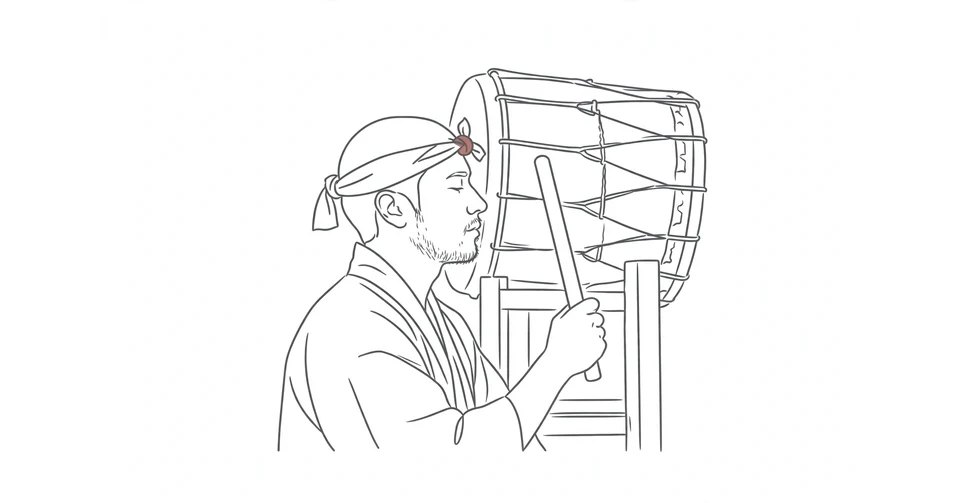
That is why the hachimaki turns up in so many different corners of Japanese life, from shrine festivals and school sports days to examination halls and martial arts halls. It belongs to no single group, and that is part of its strength. The same strip of cloth can serve a samurai, a cook, a student, and a drummer, and each of them ties it on for the same reason. Something difficult is about to happen, and they want to meet it properly.
What a hachimaki is
A hachimaki is a long, narrow band of cloth, usually cotton, tied around the head so that it sits across the forehead. A typical band is about three to six centimetres wide and about 90 to 120 centimetres long, though longer versions of two to three metres exist for wrapping several times around the head. The name itself explains the object. Hachi refers to the head, enclosed like a bowl, and maki comes from the verb maku, to wrap. A hachimaki is therefore not a hat. It is a cloth wrapped around the head.
Most hachimaki are white or red, and many carry a word in kanji on the front, placed where everyone can read it. The best known words are hissho, meaning certain victory, doryoku, meaning effort, and ganbare, meaning keep going. Some bands carry a red circle that recalls the flag of Japan. Others carry the name of a neighbourhood, a school, a team, or a festival. The writing is part of the point. A plain band keeps sweat back. A band with a word on it also states an intention, and the wearer carries that intention where it can be seen.
The cloth is deliberately simple. Cotton absorbs sweat, washes easily, and can be folded, twisted, or rolled to suit the wearer. Ready made versions exist, including elastic bands and rings sewn into a loop, but the classic hachimaki is just a strip of cloth, and that simplicity is why it has lasted. There is nothing to break, nothing to charge, and nothing to learn beyond the knot.
Where the hachimaki came from
The origin of the hachimaki is not fully settled, and honest sources say so plainly. The most common explanation links the headband to the samurai, who wore a cloth under the helmet, the kabuto, to protect the forehead from cuts and to absorb sweat. That is the account given by the hachimaki entry on Wikipedia, and it is also the leading theory in longer guides to the headband. It makes practical sense. A heavy helmet rubs, slips, and traps heat, and a layer of cloth between metal and skin solves all three problems at once.
Other explanations point to religious ascetics or early craftsmen, and the truth may be that several uses grew up side by side. Headbands of various kinds appear in many corners of old Japan. In the Izu Islands, women tied one at weddings and funerals. The Ainu wore headbands of their own, the matanpushi for men and longer forms for women. At the court of Ryukyu, crown like headbands were part of formal dress. The hachimaki as we know it today may have gathered meaning from more than one of these traditions, which would explain why it feels both martial and ceremonial, both practical and symbolic.
For most of Japanese history, the hachimaki was not an everyday accessory. It showed that a person was in a special state, at war, during a religious ritual, at a wedding or a funeral, during illness, or while giving birth. That sense of a special state has never really left it. Even today, nobody ties on a hachimaki to do nothing. The band marks a change of mode, from ordinary time to a time when effort matters, and the wearer steps into that time deliberately.
The samurai under the helmet
The samurai connection is the one most people meet first, and it is worth understanding properly. A samurai wore the cloth under the helmet to cushion the forehead, absorb sweat, and keep long hair back so that it did not block the view in combat. For extra protection there was the hachi-gane, also called the hitai-ate, an armoured forehead plate made of metal or hardened leather. The cloth band and the armoured plate were related but different things, one soft and one hard, and together they show how seriously the forehead was taken as a place worth protecting.
The image of the warrior with a white headband comes from this period, and it is still used in films and comics today. The band signals determination. Whoever ties it is preparing for an effort, and the audience understands that without a word of explanation. That is a powerful piece of visual shorthand, and it has travelled far beyond Japan, into anime, manga, and martial arts films around the world. A character who ties on a hachimaki is about to train harder, fight longer, or refuse to give up, and the viewer knows it at once.
Yet the samurai story should not be allowed to swallow the whole history. Warriors were not the only people who tied cloth around their heads, and the headband was never only a military object. Craftsmen tied one on for concentration at the workbench. Labourers tied one on to keep sweat out of their eyes on a hot day. The samurai gave the hachimaki its most dramatic image, but ordinary workers gave it its daily life, and both halves of that story deserve to be remembered.
The wartime chapter Japan does not hide
There is one chapter of the hachimaki story that must be handled honestly, and briefly. In the Second World War, Japanese pilots took up the samurai motif, and kamikaze pilots tied a hachimaki before their final flight, often with the characters for hissho, certain victory, written across the front. The cloth was part of the preparation, and it was meant to strengthen fighting spirit. That association made the headband known around the world, but it also burdened it with a military image that does not match its use in sport and daily life today.
It would be wrong to pretend this chapter did not happen, and equally wrong to let it define the whole object. The hachimaki existed for centuries before the war, and it has been worn for decades since by students, athletes, cooks, and festival crowds who have nothing to do with war. The war borrowed the symbol. It did not create it, and it did not own it afterwards. A full history of the hachimaki has to mention the kamikaze pilots, and then it has to move on, because the cloth itself moved on, back to the festivals, the sports days, and the examination halls where it had always belonged.
Hachimaki at the festival
If there is one place where the hachimaki is most alive today, it is the matsuri, the Japanese festival. At Shinto festivals, men who carry a mikoshi, a portable shrine, through the streets often wear a hachimaki, and the band marks the transition from ordinary life to ritual. It shows that the wearers are physically and mentally present, ready for the weight, the heat, and the shouting that carrying a shrine demands. A mikoshi is heavy, the route is long, and the crowd is loud, and the headband is the smallest part of the uniform and somehow the most telling.
At traditional festivals in rural areas, the hachimaki is often part of a group uniform, and the colour and the writing on the band can indicate membership in a neighbourhood or a team. That matters more than it might sound. A festival is a team effort, and the team needs to recognise itself in a crowd. Matching happi coats do part of that work, and matching headbands finish it, because the band sits at eye level, where other carriers can see it at a glance. When dozens of people are shouting, lifting, and turning together, that glance is enough.
Taiko, sport, and the school sports day
The festival drummer deserves a closer look, because the taiko drum and the hachimaki belong together. Taiko playing is physical work. The drummer stands, lifts heavy sticks, and strikes a large drum again and again, often outdoors in summer heat, often as part of a group that must stay in perfect time. Sweat runs, hair falls forward, and concentration slips, and a hachimaki answers all three problems with a single strip of cloth. It is no accident that so many taiko players wear one, or that the image of the drummer with a knotted band has become one of the classic pictures of a Japanese festival.
Sport uses the hachimaki in the same spirit. In modern Japan, hachimaki are often printed with slogans and red circles, and they serve the practical function of absorbing sweat during physical activity, so they are often worn by sportspeople. Competitive eaters such as Takeru Kobayashi wear one at contests, and in martial arts such as karate it is part of the equipment, keeping sweat back and signalling tension. The band does not make anyone stronger or faster. It marks the moment when the athlete stops warming up and starts competing, and that marking has value of its own.
At school sports days, the undokai, pupils wear coloured hachimaki to identify their team. The colours divide the school into sides, red against white, and the children wear their side on their foreheads for the whole day. It is a small thing, but it teaches a large lesson. Belonging can be worn lightly, and a team can be recognised at a glance, and the child who ties on the band is not just watching the sports day. They are part of it, with a side to support and a race to run.
The exam desk and the quiet hachimaki
Not every hachimaki is tied for a public performance. Some of the most familiar ones are tied in private, at a desk, late at night, by a student facing an examination. Today the hachimaki appears mostly on people preparing for an exam. Students tie one during study periods to show concentration and willpower, and office workers and craftsmen also use it on long working days. The band has moved indoors, into the study room and the workshop, and it still does the same job.
There is something touching about that use. An examination is a lonely kind of hard work, with no crowd, no drum, and no team to carry the weight. The student ties the band on alone, and the only person who sees the word across the forehead may be the student in the mirror. Yet the gesture still works, because the audience was never the point. The point is the decision, made visible to oneself, to take the next few hours seriously. A hachimaki at a desk is a promise a person makes to themselves, and the cloth holds them to it.
How a tenugui becomes a hachimaki
The hachimaki has a close relative, and the relationship explains a great deal about Japanese cloth culture. A tenugui is a thin cotton cloth, about 35 by 90 centimetres, and Japan has used it for centuries as a towel, a head wrap, a gift wrap, and a small work of art. Rolled and tied, a tenugui becomes a hachimaki headband, worn for work, for sport, and above all at festivals, where it keeps sweat out of the eyes and marks the wearer as part of the group. That sentence, from the article on this site about the tenugui, is the seed this article grew from, and it deserves to be read in full.
The connection is practical as well as poetic. A tenugui is long enough to fold into a headband, and short enough to fold flat into a pocket or a bag. It is cheap, light, and quick to dry, and it can be washed in the morning and dry by the afternoon. A festival goer who owns a tenugui already owns a hachimaki, and only the fold stands between the two. That is why so many people at festivals reach for a tenugui or a bandana when they need a headband. They are easier to find than a ready made hachimaki, and they do the job just as well.
How to tie a hachimaki
Tying a hachimaki is simple, and the simplicity is part of the pleasure. There are two basic ways, and both are described clearly in the detailed guide to the hachimaki that I read while researching this article. In the nejiri hachimaki, the cloth is twisted tightly into a rope, placed around the forehead, and knotted at the back. In the muko hachimaki, the knot sits at the front, where it can be seen, often with the ends standing up like small wings. There are also ready made rings sewn into a loop, for those who want the look without the knot.
Start with a tenugui or a dedicated band. Fold the cloth lengthwise two or three times until it is a band a few centimetres wide, and smooth it flat so that it will sit evenly. Place the middle of the band across the forehead, just above the eyebrows, and bring the ends around the head, keeping the band level. Tie a firm knot at the back, or at the front if you prefer the muko style, and tuck the ends so that they do not hang into the face. The band should sit firmly without pressing, and it should stay in place when you move, bend, or look up.
A few practical notes will save a first timer some trouble. Do not tie the band too tightly, since it can otherwise cause a headache, and a headache is the opposite of concentration. If the band slips, it is usually because the fold is uneven or the knot is too loose, and refolding it flat solves the problem. If the knot sits at the front, keep the ends short, so that they do not flap into the eyes when you run or drum. And if you are using a tenugui, remember that the cloth is forgiving. The fold can be adjusted until it sits comfortably, and there is no single correct width.
Colours, writing, and looking after one
Traditionally cotton is used, usually in white or red, and the choice of colour is rarely an accident. White is the colour of purity and of the ritual cloth, and it suits the samurai image and the shrine festival. Red is bold, visible, and energetic, and it suits the sports day and the team that wants to be seen. Bands with two colours or with printed characters are also popular, and the writing is where the personality of the band lives.
The common inscriptions are worth learning, because they are the closest thing the hachimaki has to a vocabulary. Hissho, written with the characters for certain and victory, is the boldest choice, and it suits a competition or a final effort. Doryoku, meaning effort, is quieter, and it suits a long period of study or training, where the work matters more than the result. Ganbare, meaning keep going, is the most encouraging of the three, and it suits a friend, a child, or a team that needs support rather than pressure. Choosing among them is a small act of self knowledge. The word you put on your forehead says something about how you see the task ahead.
In Japan, a hachimaki is sold in festival supply shops, sports stores, and online, and a simple band costs very little. Temple shops and festival stalls sell them too, often printed with the name of the shrine or the festival, and those are the most meaningful ones to buy, because they carry the place as well as the object. Looking after one is easy. Cotton washes in cold or lukewarm water with mild soap, and it dries best in the shade, so that the colours hold longer. A white band will soften with use, and a printed band will fade a little with each wash, and neither change is a flaw. Like the tenugui it is related to, a hachimaki is an object that is meant to be used until it is thin, and the fading is a record of the days it has served.
Why a strip of cloth still matters
A hachimaki is a simple piece of cloth that has expressed concentration and determination in Japan for centuries. It accompanied samurai under the helmet, pilots in wartime, students before exams, and athletes in competition, and understanding it also means understanding a part of the Japanese mindset. That is the conclusion of the guide I read, and I agree with it, because the headband is a window into something larger than itself, a culture that values preparation, effort, and the visible sign of a decision.
I think that is why the hachimaki will survive. It does not depend on fashion, and it does not depend on technology, and it does not ask its owner to believe anything complicated. It asks only for a knot, tied firmly, and a few hours of honest effort. In a world that keeps inventing new ways to measure motivation, a strip of cloth that simply declares it may be the most honest tool of all.
There is one more connection worth carrying home, and it is the one this article began with. A tenugui in the pocket and a hachimaki on the forehead are the same cloth in two forms, and the step between them is only a fold and a knot. The yukata, the light robe Japan reaches for after the bath, belongs to the same quiet world, the world of simple cotton things that serve daily life without demanding attention. Japan is full of such objects, and each one repays a closer look. The hachimaki is a good place to start, because it is the simplest of them, a strip of cloth, tied on, before the hard part begins.
More in Culture & Society
- Netsuke Held a Samurai's World on a Cord
- Kinchaku Carries a Whole Festival in One Small Bag
- Baikasai Serves Tea Under the Plum Blossom at Kitano Tenmangu
- Plum Blossom Opens Japan's Year Before the Cherry Trees Wake
- Tenjin Engi Emaki Paints a Storm God Into a Saint of Learning
- The Flying Plum Tree That Followed a Scholar Into Exile
Latest posts
- Tenugui Is the Thin Cotton Cloth Japan Uses for Everything
- Takuan Turns a Humble Daikon Into Japan's Yellow Crunch
- Nukazuke Is the Living Pickle Bed Japan Feeds Every Day
- Tsukemono Is the Crunch Japan Puts Beside Every Meal
- Ochazuke Is Rice Tea and Comfort in One Bowl
- Aojiso Is the Green Leaf Japan Eats Fresh and Raw
- Akajiso Gives Umeboshi Its Deep Red Blush
- Umeshu Is the Liqueur Japan Makes From Unripe Plums
- Shiso Is the Leaf That Paints Umeboshi Red
- Hello Kitty and the Cat Who Conquered the World
- Umeboshi Is the Sour Plum Japan Puts in Every Bento
- Kitano Tenmangu Turns Plum Blossom Into a Prayer for Exams
- Japanese Geisha and the World Behind the Painted Face
- Tenjin Is the Storm God Who Became Japan's Patron of Learning
- Queen Is the Crown Japan Gives Its Best Woman Karuta Player