Raden Turns Mother of Pearl Into Lacquer That Catches the Light
· 21 min read
Raden is the Japanese art of setting thin pieces of mother of pearl into black lacquer, a technique that has glittered on boxes, inro and instruments for more than a thousand years.
Hold a black lacquered box up to the light and tilt it slowly. For a moment nothing happens, and then a wave, a flower or a flock of cranes flashes green, pink and blue across the dark surface. That flash is raden, the Japanese technique of setting pieces of mother of pearl into lacquer, cut thin enough to catch the light and polished until shell and lacquer sit perfectly flat together.
Raden is not paint and it is not glitter. It is real shell, the iridescent inner layer of abalone and pearl oysters, sliced into wafers, cut into shapes and sealed under coats of lacquer. The lacquer itself comes from the sap of the lacquer tree, and once it hardens it protects the shell for centuries. A piece made in the Heian period can still shimmer today, which is why so many of the finest examples survive in museums and temple treasuries.
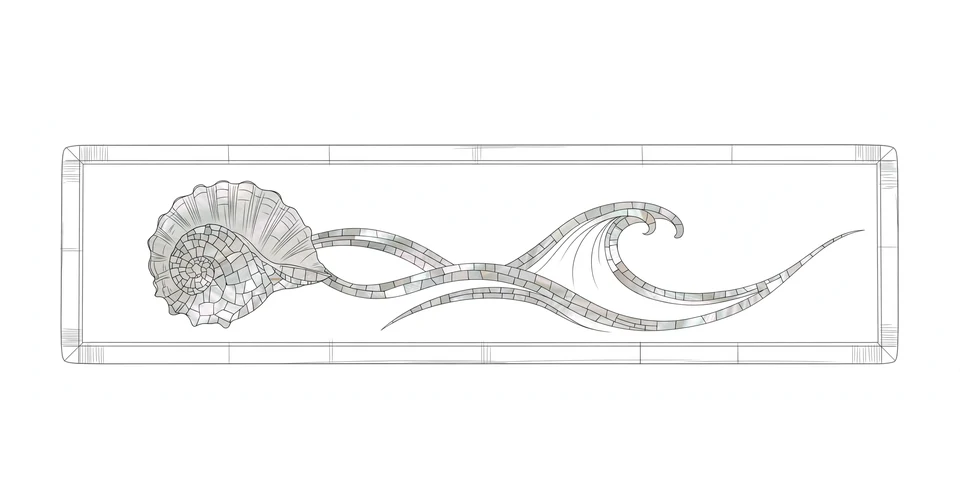
What makes raden so quietly addictive is that it never shows the same face twice. The colour of the shell shifts with the angle of the light and the angle of your eye, so a box you have owned for years can surprise you on an ordinary afternoon. I think that is the heart of its charm. Gold leaf is magnificent and permanent, but it always says the same thing. Raden whispers, and it changes its mind.
What raden actually is
The word raden is written with two kanji. The first, ra, means shell. The second, den, means inlaid. Put together, the word describes exactly what the artisan does, which is to inlay shell. Wikipedia's article on raden notes that in Japan the term is used only for shell inlay. If an artisan sets metal or ivory into a surface instead, that is a different technique called zogan, and it has its own name and its own history.
The material is the nacre, or mother of pearl, that lines the inside of certain mollusk shells. Abalones and pearl oysters are the usual sources, and each species gives a slightly different colour and quality of nacre. Some shells lean green, some lean pink, and some flash a cool silver blue. The artisan chooses the shell the way a painter chooses a pigment, matching the tone to the design before a single piece is cut.
Raden belongs to the wider world of Japanese lacquerware, and it is usually found on objects that were made to be handled and admired at close range. Writing boxes, cosmetic boxes, small chests, mirrors, trays and musical instruments all carry it. The shell sits in the lacquer rather than on top of it, which is why a good piece feels smooth to the touch. Your fingertip finds no edge, no ridge and no bump, only a cool, glassy surface with light trapped just beneath it.
The technique arrived in Japan from Tang dynasty China during the Nara period, in the eighth century, and Japanese artisans made it their own over the following centuries. The Japan Tourism Agency describes raden plainly as a lacquerware decorative technique in which mother of pearl is embedded in the surface lacquer, and notes that Japanese artists used it to ornament everything from small household items to military equipment and great works of architecture. That range is worth remembering. Raden was never only a luxury for the court. It decorated sword fittings and armour as well as writing boxes, which tells you how deeply the Japanese valued the effect.
How raden is made, step by step
Making raden starts with a shell that looks entirely unpromising from the outside. The artisan grinds down both sides of the shell until only a thin wafer of nacre remains. This is slow and dusty work, and it demands patience, because nacre is hard and brittle and it cracks if it is forced. The wafer is then cut into the shapes the design needs, using a scroll saw, a precision knife, punch templates or acid etching, depending on the thickness and the shape.
Thickness matters more than most people realise, and it decides how the shell is fixed to the piece. The Japan Tourism Agency's page on raden gives the numbers. Pieces between 0.1 and 2 millimetres thick are called atsugai, which means thick shell. Pieces thinner than 0.1 millimetres are called usugai, which means thin shell. Small flakes of nacre can even be pulverised into an iridescent powder called mijingai, or shell particles, which is sprinkled like gold dust. A third category, kenma, uses shell thinner still, ground and polished down to an almost transparent film.
Thick pieces are usually set into shallow beds carved into the lacquered surface, much like stones set into a ring. Thinner pieces are pressed into a thick coat of wet lacquer, or brushed with lacquer and stuck to the surface. Once the pieces are in place, the artisan coats the whole surface with more lacquer and lets it harden. Then comes the long polishing, rubbing the surface down until the lacquer over the shell is thin enough for light to reach the nacre and bounce back out, but thick enough to protect it. If the polishing goes too far, the shell is exposed and damaged. If it stops too soon, the design looks cloudy. The margin between the two is small, and only experience knows where it lies.
I find something deeply reassuring in this process. There is no shortcut in it. Each layer of lacquer must dry and harden in humid air before the next can be applied, and a fine piece may carry dozens of layers. The artisan cannot hurry the weather, the tree sap or the shell. In a world that celebrates speed, raden insists on slowness, and the result carries that patience in its surface.
Three thicknesses of shell
The three categories of raden are not just technical jargon. They produce visibly different effects, and learning to tell them apart changes how you look at a piece.
Atsugai, the thick shell, gives the boldest effect. The pieces are solid enough to be cut with a scroll saw and finished with a file or a rubbing stone before they are applied, and they sit in the lacquer with real presence. A flower petal or a wave crest made in atsugai has a milky depth, and its colour changes dramatically as you move the piece. Many of the most dramatic designs, the ones you notice from across a room, are built from atsugai.
Usugai, the thin shell, is more delicate. The pieces are usually made with a template and a special punch, which lets the artisan cut tiny, precise shapes again and again. Thin shell can be laid in fine lines and small details, like the veins of a leaf or the feathers of a bird, and it can be layered to build up subtle gradations of colour. Because the shell is so thin, it follows the curve of the surface easily, which makes it ideal for rounded lids and small objects.
Kenma, the thinnest application, is the most subtle of the three. The shell is ground down until it is almost a film, and it is used where the artisan wants a faint shimmer rather than a bold flash, a hint of light in a dark ground. Kenma is the technique that rewards the closest looking. Stand back and you may miss it entirely. Lean in, and the surface suddenly wakes up.
If you ever get the chance to examine a good piece in a museum, try looking at it from three distances. From across the room, the atsugai shapes will call to you. From a normal viewing distance, the usugai detail will emerge. And from a few centimetres away, the kenma will appear, like a secret the artisan left for the careful viewer. That layering of rewards is one of the reasons raden has held its audience for so many centuries.
A journey from Tang China to Nara
Raden did not begin in Japan. The technique, known in Chinese as luodian, was already highly developed in Tang dynasty China, where lacquer backed luodian on bronze mirrors was a treasure of craftsmanship. Bronze mirrors with luodian lacquer backs have been excavated from Tang tombs in Shanxian County and Luoyang, in Henan Province. Some scholars trace the idea further back, to Sasanian Persia or even to the Shang dynasty, though the Persian route is the more widely accepted theory.
From Tang China the technique crossed to Japan during the Nara period, in the eighth century, carried along the same sea routes that brought Buddhism, writing and court culture. The Japanese took the Chinese characters for the technique and read them in their own way, and the word raden was born. The early Japanese pieces were close to their Chinese models, but the Japanese soon began to combine raden with their own lacquer techniques, and that combination produced something new.
The Shosoin, the great treasure repository at Todaiji temple in Nara, holds some of the earliest evidence of how far the technique had travelled. Among the belongings of Emperor Shomu, who reigned in the first half of the eighth century, are about one hundred and fifty lacquer articles, including furniture, musical instruments, boxes and vessels, ornamented with inlays of thin sheets of silver and gold, mother of pearl and crystal. These objects reflect Tang dynasty techniques and styles, and they show that raden was already a court art within a century of its arrival.
In the Heian period, from the ninth to the twelfth centuries, raden was combined with maki-e, the technique of sprinkling gold or silver powder onto wet lacquer, and the two techniques have been partners ever since. The combination is powerful. Gold gives a design its structure and its warmth, while shell gives it light that moves. A famous example is the maki-e raden paper box with a wheels in flow design, known as katawaguruma, from the eleventh to twelfth centuries, which is now a National Treasure in the Tokyo National Museum. Another is the cosmetic box with a design of wheels half submerged in a stream, in maki-e lacquer and mother-of-pearl inlay, from the thirteenth century, also a National Treasure.
Raden declined in the Muromachi period, when taste shifted towards plainer, more restrained wares, and the flamboyant shell inlay fell out of fashion at court. It might have faded away entirely. Instead, it found a new audience overseas, and that second life is one of the great turning points in its history.
The export centuries and the Nanban trade
From the late sixteenth century, as Portuguese and Spanish traders arrived in Japan, Japanese lacquerware decorated with maki-e and raden began to travel to Europe through the Nanban trade. The Jesuits ordered pieces, and European merchants ordered more. Raden was often used on European style items, such as chests of drawers and coffee cups, and it was very popular in Europe, because the mother of pearl covering the items gave them a status as a unique luxury. The Japanese called these goods Nanban lacquerware, using the word Nanban, meaning southern barbarians, for foreigners arriving from the south.
In the Edo period, exports continued through the Dutch East India Company and private traders. Until the 1690s the Dutch company held a monopoly on Japanese lacquerware exports to Europe, but the work was so expensive, especially the pieces lavishly decorated with gold powder, that customers were limited to royalty and nobility. After 1690, private trade opened the market wider. The emphasis in Edo period exports was on artistic expression through maki-e, but raden remained part of the vocabulary, and it came back into its own after Japan opened to foreign trade in the 1850s.
Two Edo period styles are particularly associated with the export revival. Somada ware was invented by Somada Kiyosuke in the 1670s, and it is characterised by a regular pattern made from a combination of lacquer, finely cut shellfish, gold leaf and silver leaf. Shibayama ware was invented by Shibayama Senzo in the 1770s, and it is characterised by the inlay of many materials, including shellfish, gold, silver, ivory, coral, tortoiseshell and ceramics. Both styles were exported in large quantities from Yokohama to Europe and the United States, and both are still celebrated today. The celebrated Edo period craftsmen of raden include Toshichi Ikushima, Chobei Aogai and the Somada brothers, whose names are still attached to the finest surviving pieces.
A Shibayama style writing box from Nagasaki, made between 1800 and 1850, shows what the style could do. Wood covered with black lacquer carries flowers inlaid in mother of pearl that has been painted from beneath, so the shell itself seems to glow with colour. It is a small object, made to sit on a desk, and yet it carries the ambition of a painting.
Raden, maki-e and nashiji: three ways to decorate lacquer
Visitors to a lacquer exhibition often ask how raden differs from its two famous companions, maki-e and nashiji. The three techniques all decorate the same black lacquer ground, and they are often combined on a single object, but each one works differently and each one catches the light in its own way.
Maki-e, which means sprinkled picture, is made by painting a design in wet lacquer and then sprinkling gold or silver powder onto the sticky surface before it hardens. The powder is then sealed under more lacquer and polished. The result is a design that glows with a steady, warm light. Our earlier article on maki-e explains the sprinkling process in detail, and it is worth reading alongside this one, because the two techniques are so often found together on the same box.
Nashiji, which means pear skin, is made by sprinkling fine flakes of gold or silver onto the lacquer ground to create a speckled surface that resembles the skin of a Japanese pear. It is often used as a background, a field of tiny golden points against which a bolder design can stand out. Where maki-e draws the picture and raden supplies the flash of colour, nashiji supplies the atmosphere, a quiet shimmer that fills the empty space.
Raden is the only one of the three that uses no metal at all. Its light comes from the structure of the shell itself, from layers of nacre that split incoming light into shifting colours. That is why raden can look green from one angle and pink from another, while gold always looks gold. It is also why raden feels cooler and more elusive than its companions. Gold announces itself. Shell waits to be noticed.
On many of the greatest pieces the three techniques appear together. A writing box may have a maki-e landscape in gold, a nashiji ground like a starry sky, and raden flowers that catch the light as the lid turns. The artisan is not showing off three techniques for the sake of it. Each one is doing a job the others cannot do, and the piece is richer because all three are present.
Where you meet raden: inro, writing boxes and more
If you want to meet raden in person, the most likely place is a museum case full of small, dark, gleaming objects. The technique suits things that are held in the hand and turned in the light, and the Japanese applied it to exactly those things.
The inro is a perfect example. An inro is a small, compartmented case that hung from the belt, and it carried seals, medicines or writing tools through the day. Because it was worn in public and handled constantly, it became a showcase for lacquer artistry. A fine inro may carry a minute pattern in mother-of-pearl inlay, with shell pieces so small that the design only resolves when you hold the case close. The Somada school was famous for this work, and a nineteenth century inro in the Tokyo National Museum shows how fine the technique could become. Our earlier article on the inro tells the story of the little case itself, and it quotes the phrase that started this article, that raden sets pieces of mother of pearl into the lacquer, cut thin enough to catch the light. That image has stayed with me since I first read it, because it captures the whole technique in a single line.
Writing boxes are the other classic home for raden. A writing box, or suzuribako, held an inkstone, a water dropper and brushes, and it sat on the desk of a scholar, a poet or an official. The lid was the canvas, and the greatest artists treated it as one. Ogata Korin, one of the most celebrated painters of the Edo period, made a writing box with an Eight Bridges design, known as Yatsuhashi, in the eighteenth century, with flowers inlaid in abalone shell. It is now a National Treasure in the Tokyo National Museum, and it is one of the most reproduced images in all of Japanese lacquer art. The irises on its lid are not painted. They are shell, cut and set and polished, and they still catch the light three hundred years after Korin laid them down.
Raden also appears on larger pieces. Mirrors with lacquered backs, chests of drawers made for export, trays, cosmetic boxes, and musical instruments like the biwa lute all carry it. The Shosoin treasures include lutes decorated with raden, and the technique was used on military equipment too, on sword fittings and armour, where a flash of shell on a dark ground must have been a startling sight on the battlefield. Today you will also find raden on jewellery, on fountain pens, on watch dials and on contemporary sculpture, because the material adapts easily to new forms. The shell does not care what shape it decorates. It only needs lacquer to hold it and light to wake it.
Raden today: living craft and new experiments
Raden is not a museum technique. It is still practised across Japan, and it was designated an Important Intangible Cultural Heritage in 1999, which recognised its place in the living culture of the country rather than only in its past. Workshops in Wajima, Takaoka, Kyoto and elsewhere still train apprentices in the cutting and setting of shell, and the work they produce ranges from faithful reproductions of Edo period designs to objects that would have startled an Edo period artisan.
The most interesting developments are happening where tradition meets new tools. Some contemporary artists cut shell with lasers, producing pieces so small and so precise that no hand saw could match them, and then set those pieces by hand using the old methods. Others use raden on new surfaces, embedding thousands of tiny shell fragments into sculptural forms, so that a rock-like object shimmers with digits or patterns that look almost digital. One artist working in this vein covers polished faces with tiny multicoloured shell rectangles that resemble pixels, shifting between blue, green and purple as the viewer moves. The effect is startling, and it shows that a technique more than a thousand years old can still feel like the future.
I think this is the right way to think about tradition. A craft does not survive by being frozen. It survives by being used, and by being allowed to change just enough to stay alive. The artisans who invented Somada ware in the 1670s and Shibayama ware in the 1770s were not preserving a museum style. They were inventing new styles for new customers, using old techniques in new combinations. The laser cut shell of today is the same spirit in a different century.
At the same time, the old skills are still taught the old way, because there is no substitute for them. Cutting shell by hand, judging the thickness of a wafer by touch, knowing when the lacquer has hardened enough to polish, these are things that can only be learned by doing them, badly at first and then better, over years. The designation as an Important Intangible Cultural Heritage helps to keep that teaching alive, by recognising that the knowledge lives in the hands of the artisans and not only in the objects they make.
How to recognise real raden
If you are standing in front of a lacquered object and wondering whether the shimmer is real raden or an imitation, there are a few honest tests you can apply, and none of them requires special equipment.
First, change the angle. Real shell changes colour as the light moves across it, shifting from green to pink to silver blue. A printed imitation or a plastic inlay will usually hold one colour, or it will glitter in a flat, uniform way. Move the piece slowly under a single light and watch the design. If the colours travel across the surface, you are probably looking at real nacre.
Second, look closely at the edges. In genuine raden, the shell pieces are set into the lacquer and polished flat, so the surface feels perfectly smooth. You should not be able to feel the edge of a shell piece with your fingertip, though museums will rightly stop you from touching. With your eyes, look for tiny, crisp boundaries between shell and lacquer, and for the fine lines where the artisan cut the shapes. Machine printed imitations often have soft, blurred edges, and the design may repeat with mechanical regularity.
Third, look for the hand. Real raden is made piece by piece, and the pieces are never perfectly identical. A flower may have petals that differ slightly in tone, because they were cut from different parts of the shell. A wave may have segments that vary in colour along its length. Those small irregularities are not flaws. They are the signature of a human hand, and they are part of what you are paying for.
Fourth, consider the ground. Fine lacquer has a depth that is hard to fake. It looks like dark water, with a soft reflection rather than a hard shine. If the black surface looks like plastic, flat and glaring, the object is probably not fine lacquer, whatever the decoration on top of it may be.
Finally, buy from a source you trust, and ask questions. A reputable dealer or artisan will be happy to tell you where a piece was made, what shell was used, and whether the work is atsugai, usugai or kenma. If a seller cannot answer those questions, or if a price seems far too low for the amount of hand work on display, walk away. Raden is slow work, and slow work has a price. That price is part of the story of the object, and a piece that pretends otherwise is usually pretending about more than the price.
A quiet kind of luxury
Raden has survived for more than a thousand years, from Tang China to Nara, from the Heian court to the export trade, from the hands of Edo period masters to the laser cutters of contemporary studios. It survived a decline in the Muromachi period, a shift in fashion, and the arrival of mass production. That survival tells you something about what people value.
I believe the reason is simple. Raden does not shout. In a culture of decoration that can be very loud, all gold and red and black, raden offers something quieter. It asks you to pick the object up, to turn it, to look again. It rewards attention with a small, private surprise, a flash of colour that only you can see from where you are standing. That is a generous kind of beauty, because it makes the viewer a participant rather than a spectator.
If you ever have the chance to hold a piece of raden, take it slowly. Tilt it. Watch the shell wake up. And remember that what you are holding is not only a technique but a chain of hands, from the diver who gathered the abalone, to the artisan who ground the shell thin, to the polisher who knew exactly when to stop. The light you see is old, but it is still catching the eye, which is all any craft can ask for.
More in Culture & Society
- Shibayama Turns Shell Ivory and Coral Into Small Paintings in Lacquer
- Togidashi Buries Gold in Lacquer and Polishes It Back Into the Light
- Nashiji Scatters Gold Dust Like Pear Skin Across Black Lacquer
- Maki-e Sprinkles Gold Dust Onto Wet Lacquer
- Urushi Is the Tree Sap Japan Turns Into Lacquer That Outlives Centuries
- Ojime Is the Tiny Bead That Keeps a Netsuke From Slipping Away
Latest posts
- Inro Is the Little Lacquered Box That Carried a Samurai's Day
- Hachimaki Is the Headband Japan Ties On Before the Hard Part Begins
- Netsuke Held a Samurai's World on a Cord
- Tenugui Is the Thin Cotton Cloth Japan Uses for Everything
- Kinchaku Carries a Whole Festival in One Small Bag
- Takuan Turns a Humble Daikon Into Japan's Yellow Crunch
- Nukazuke Is the Living Pickle Bed Japan Feeds Every Day
- Tsukemono Is the Crunch Japan Puts Beside Every Meal
- Ochazuke Is Rice Tea and Comfort in One Bowl
- Aojiso Is the Green Leaf Japan Eats Fresh and Raw
- Akajiso Gives Umeboshi Its Deep Red Blush
- Umeshu Is the Liqueur Japan Makes From Unripe Plums
- Shiso Is the Leaf That Paints Umeboshi Red
- Hello Kitty and the Cat Who Conquered the World
- Umeboshi Is the Sour Plum Japan Puts in Every Bento