Maki-e Sprinkles Gold Dust Onto Wet Lacquer
· 19 min read
The Japanese art called maki-e paints a design in wet lacquer and sprinkles it with gold dust, a Heian court technique that still turns boxes, sheaths, and writing cases into small paintings.
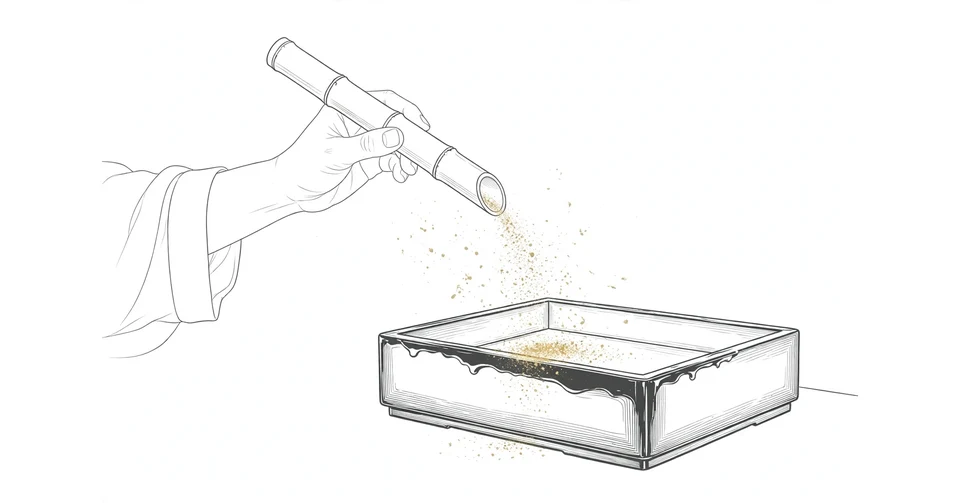
There is a moment in a lacquer workshop in Kyoto when the room seems to hold its breath. The artisan has just painted a shape in wet lacquer on the lid of a black box, and now, with a small bamboo tube, the work called maki-e begins. A tap, a breath of gold dust, and the dark surface catches the light. That is the whole trick of the craft, and it is also the whole wonder of it. Gold dust, wet lacquer, and a steady hand are enough to turn a useful box into a small painting that will outlive its maker.
The word itself tells you what happens. Maki means sprinkling, and e means picture, so maki-e is a sprinkled picture. The lacquer is the paint and the glue at the same time. The gold is not laid on top of a finished surface. It is dropped into wet lacquer and held there as the lacquer hardens, which is why the design seems to sit inside the black surface rather than on it. Once you have seen a piece of it in good light, the black stops looking empty. It looks like night with gold stars in it.
This is a craft with more than a thousand years behind it, and it still rewards slow looking. The sections below follow the technique from the first brush stroke to the final polish, meet the four main ways of building a design, and trace the road from the Heian court to European drawing rooms and modern fountain pens. Along the way, the gold stays the same. What changes is what people ask it to say.
What maki-e means, and why the name fits
The name is unusually honest. Many crafts hide their method behind a poetic name, but this one describes the act itself. You paint with lacquer, you sprinkle metal powder, and the picture appears as the lacquer dries. There is no step where the gold is glued on afterwards or pressed into place. The wet lacquer does the holding, and the timing does the rest. Sprinkle too early and the powder sinks. Sprinkle too late and it will not stick. The name is a set of instructions in two syllables.
The term maki-e first appeared in the Heian period, which ran from 794 to 1185, a time when court culture in Kyoto was at its height. Yet the idea behind it is older. A precursor was recorded in the Nara period under the term makkinru, which meant gold powder mixed with urushi to make lacquer paintings. A sword scabbard from the Nara period kept at Shosoin, the treasure house in Nara, uses a technique called makkinrusaku that is close enough to maki-e that it is sometimes said the craft began in the Nara period. The honest version is that nobody knows the exact origin. What the sources agree on is that maki-e as a named craft belongs to the Heian court, and that it grew up among people who had the wealth and the patience to treat a box lid as a canvas.
That setting matters, because it was never a cheap craft. Lacquer, gold, and silver were all extremely valuable, and a piece of maki-e cost a great deal of money. The wealthy aristocrats of the Heian court used it not only for furnishing goods but in the building of their own homes and temples, and the technique became an important way of expressing the aristocratic sense of beauty. I think that is the first thing to understand about it. This was not decoration added to make a plain object prettier. It was a display of taste, wealth, and patience, all in a single gesture of the hand.
How maki-e is made, step by slow step
Making it is a sequence of small, exact steps, and each one has to be finished before the next can begin. The work can take several months for a simple piece and years for a complex one, because every part of the design has to be painted, sprinkled, cured, and polished in turn. Nothing can be rushed, and nothing can be done out of order. The full process is laid out in the Kyuseido introduction to maki-e, which walks through each stage with photographs of the tools.
It starts with the base. A wooden object is covered with several layers of urushi, the natural lacquer made from the sap of the lacquer tree, to build a strong foundation. Urushi is a difficult material. It gives a rash if it touches the skin, and it only hardens properly in warm, humid air, so the workshop itself has to be kept damp and warm while the lacquer cures. The base coats are dried and polished, one after another, until the surface is smooth and deep. This foundation work is the part nobody sees, and it is the part that decides whether the finished piece will last for generations.
Then comes the design. The artisan traces the design with a fine maki-e brush and urushi on transfer paper, then rubs the design onto the surface of the object. Gold or silver foil powder is applied so the design can be seen clearly on the dark base. For a simple design, this transfer step may be skipped, and the artisan may paint straight onto the surface.
The heart of the process is the third step. The design is painted with urushi onto the surface using a maki-e brush, and while the urushi is still wet, metal powder is sprinkled onto it through a hollow bamboo tube called a funzutsu, or spread with a soft brush called a kebo. The urushi acts as the adhesive, and the metal powder sinks into it and stays. The sprinkled design is then left to cure in a warm, humid place, and the painting and sprinkling may be repeated several times until the whole design is complete.
After curing, the metal powder has to be fixed in place. Several thin layers of urushi are applied over the design to fill the gaps between the grains and increase the adhesion. Then comes the polishing. The surface is sanded carefully with charcoal or other polishing materials, and finished by hand polishing to bring out the shine of the metal and leave a smooth, glossy surface. Depending on the technique, more layers of raw urushi may be added over the design, followed by more polishing, until the finish is exactly right.
I find the curing step the most telling part of the whole process. The artisan does the painting and the sprinkling, and then has to step back and wait while warm, damp air does the hardening. There is no way to hurry lacquer with heat or force. It hardens on its own schedule, and the craft is built around accepting that. In a world that prizes speed, the craft is a reminder that some things only work when you let them take their time.
Four ways to sprinkle gold
Not every piece is made the same way. Over the centuries, artisans developed four main techniques, and each one gives a different look and a different feeling under the hand. They can be used alone or in combination, and the finest pieces often mix them within a single design.
Hira maki-e, or flat maki-e, is the foundation of them all. The design is painted, the powder is sprinkled before the urushi cures, and the surface is polished to bring out the shine. The finished design sits slightly raised above the surface of the lacquered body. It was developed in the latter half of the Heian period and completed in the Kamakura period, once artisans had learned to refine metal powder into finer grains. It became popular in the Azuchi-Momoyama period, when demand for maki-e grew and a simpler technique was needed.
Togidashi maki-e, or burnished maki-e, takes the opposite approach. After the powder is sprinkled, more layers of urushi are applied over the whole design to bury it, and once the lacquer has cured, the surface is sanded and polished until the metal shows through again. The result is a smooth finish, with the design lying flat inside the lacquer rather than sitting on top of it. Because the powder is sealed inside the lacquer, it is harder to dislodge than in hira maki-e. This was the earliest of the techniques to be completed, and it was the mainstream form of the craft until the late Heian period, when gold and silver powder was still coarse and rough.
Taka maki-e, or raised maki-e, builds the design upward before any gold is sprinkled. Lacquer is mixed with charcoal powder, mineral particles, or clay to make a thick paste, and the pattern is drawn with it to raise it above the surface. The raised shape is dried, and then the ordinary maki-e process is carried out on top of it. The result is a design you can feel with your fingertip, a landscape with real hills and a flower with real petals. The technique was developed in the middle of the Kamakura period, and in the Muromachi period, artisans learned to raise the pattern higher still by mixing lacquer with powdered whetstone or clay.
Shishiai togidashi maki-e is the most advanced of the four, and the most demanding. It combines taka maki-e with togidashi maki-e, raising the pattern first and then burying it in lacquer and polishing it flat. The surface does not become fully smooth, because the raised work remains, and the contrast between the raised and polished areas gives the design a dramatic depth. It was developed in the Muromachi period and became popular in the Edo period. When you see a maki-e tray with waves that seem to move as the light changes, there is a good chance this is the technique behind it.
The powders, from whisper fine to bold
The metal powder is where the craft gets its range. Gold is the most popular choice, because it looks luxurious and resists tarnishing, but silver, platinum, and copper are all used, along with brass, tin, and aluminium as cheaper substitutes. Silver is often used beside gold, though it needs more care because it can tarnish over time. Copper gives a reddish metallic glow but tarnishes too. Platinum is rare and highly valued because it does not tarnish at all.
The powders also come in different sizes and shapes, from extra fine, size 1, to coarse, size 15 or larger. Fine powders suit small, intricate details. Coarse powders suit large, expressive areas. The shape of each grain changes how the finished surface catches the light, and an experienced artisan chooses the powder the way a painter chooses a brush.
| Powder | Japanese name | Character |
|---|---|---|
| Foil powder | Keshi-fun | Extremely fine, matte and soft, best for display work |
| Round powder | Maru-fun | Smooth spherical grains, polished to a soft shine |
| Flat powder | Hirame-fun | Flat grains that shimmer and add depth |
| Pear skin powder | Nashiji-fun | Speckled texture like pear skin, used for backgrounds |
Foil powder, or keshi-fun, is made by crushing gold or silver foil into an extremely fine dust. It cannot be polished, so it keeps a soft, matte finish, and it is better suited to work that will be displayed rather than handled often. Round powder, or maru-fun, is made of finely ground metal with a uniform, spherical shape, and it is burnished to a smooth metallic finish with soft gradients. Flat powder, or hirame-fun, reflects light differently from each angle, which gives large areas a shimmering depth. Pear skin powder, or nashiji-fun, is named for its resemblance to the speckled skin of a pear, and it is used to create a subtle, textured background that makes the main design stand out.
The choice of powder is a quiet decision, and it is one of the reasons no two pieces are ever identical, even when they follow the same design. The same pine tree painted with fine foil powder looks soft and distant, while the same tree in coarse round powder looks bold and near. The artisan is not only drawing a picture. The artisan is choosing how the light will behave on it.
A thousand years at court, then the world
Maki-e stayed close to the court for a long time. In the Heian period, it was a luxury for aristocrats, and its cost kept it out of ordinary homes. From the 10th century onward, it was exported to other Asian countries as a Japanese specialty, and it became quite popular there, because lacquerware was being produced in other parts of East Asia at the same time, but maki-e was not used at all. Japan had something nobody else had, and it knew it.
Exports to Europe began at the end of the 16th century, first to Portugal and Spain, then to England, the Netherlands, and other countries. Most of the lacquerware made for export was specially ordered by Dutch merchants and made to fit European tastes and European rooms, and the work was mainly done by artisans in Kyoto. The Dutch merchants would call on the artisans at Dejima, the man-made island in Nagasaki that was the centre of trade with the Netherlands, and stop in Kyoto on the way to Edo to check the work in progress. The pieces they ordered were chests with many drawers, large coffers, tables, plates, and coffee cups, all decorated with intricate patterns in maki-e and raden, the mother of pearl inlay that makes a surface shimmer.
Japanese lacquerware was admired in Europe to a degree that is hard to overstate. The word japan began to appear in the lists of assets of 17th century European aristocrats, because japan had come to be used in Europe as a word for lacquerware in general. Marie Antoinette, the queen of France, kept a small collection of Japanese lacquerware on a shelf in her room at the Palace of Versailles, and those pieces are now held in the Palace of Versailles Museum, the Louvre, and the Guimet Museum. The history of lacquer in Japan is told in full in the Highlighting Japan interview with Professor Hidaka Kaori, who explains how the craft spread from the court to the wider world.
Back in Japan, the craft was also building its own history of masters. Kōami Dōchō, who lived from 1410 to 1478, was the first lacquer master whose name is linked to specific works, and his maki-e designs drew on the work of contemporary painters of his time. Kōami and another master, Igarashi Shinsai, founded the two major schools of lacquer making in Japanese history. Their names matter because they mark the moment when the craft stopped being anonymous court work and became an art with authors, lineages, and reputations to defend.
Where maki-e lives
The objects that carry it tell you how the Japanese used it. It was not made for gallery walls. It was made for things people touched every day, and the decoration had to survive that touching. Writing boxes are among the finest examples. The Cosmetic Box with Carriage Wheels in Water, a National Treasure from the 12th century held at the Tokyo National Museum, combines maki-e with raden in a design of wheels drifting in a stream. Ogata Kōrin, the great Edo period painter, made a writing box with an Eight Bridges design that is also a National Treasure, its irises and plank bridges picked out in gold maki-e and abalone shell.
The inro, the small tiered case that hung from a sash and held seals or medicine, was another favourite surface for maki-e. In the Edo period, inro became small portable paintings, and fine examples with landscapes, cranes, and scenes from legend are now held in museums around the world. Tea ceremony items, combs, sake bottles, and trays all carried it too. The technique went wherever lacquer went, and lacquer went everywhere.
The sword carried it as well. Our guide to the saya, the lacquered sheath that guards the katana describes how the scabbard became a canvas in the Edo period, with gold powder landscapes, mother of pearl cranes, and carved waves laid over the black lacquer. The blade itself could not easily be decorated, since its beauty came from the steel, but the sheath could carry anything, and the gold turned it into a partner to the sword rather than a mere cover.
The stacked boxes of the family table carried it too. Our story of the jubako, the stacked boxes that layer a family's luck explains that maki-e is the technique of painting a shape in wet lacquer and sprinkling it with gold or silver powder, so the design appears as the lacquer dries. On a jubako, the decoration was often an auspicious pattern, pine, bamboo, plum blossom, a crane, or a tortoise, the old symbols of long life and good fortune. The box was used at New Year and at festivals, so the gold on its lid was not only beautiful. It was a wish, repeated every time the lid came off.
Maki-e kept growing in the modern era as well. Shibata Zeshin, a lacquer artist of the Meiji period, made a famous maki-e work called Fuji Tagonoura in 1872, showing that the craft could still surprise people a thousand years after it began. And in the early 1920s, the maki-e master Matsuda Gonroku, who was later named a Living National Treasure, was asked to bring maki-e to more contemporary objects so it could reach buyers overseas. He led the formation of the Kokkokai group within the Namiki company, a group of highly skilled maki-e artists, and their work paved the way for the market in urushi and maki-e fountain pens that still exists today.
The neighbours of maki-e
The technique rarely works alone. Two other techniques often share the same surface, and knowing them helps you read a piece properly. Chinkin is a related technique in which the artisan carves shallow lines into the lacquer and fills them with gold leaf or gold powder. Where sprinkling builds the design up with powder, chinkin cuts into the surface and fills the cut, so the line has a sharp, engraved quality. Raden sets thin pieces of mother of pearl into the lacquer so they shimmer with rainbow colours as the light moves. The Cosmetic Box with Carriage Wheels in Water pairs maki-e with raden, and the combination is the point. Gold gives the design its shape, and shell gives it a light that gold alone cannot make.
Wajima, in Ishikawa Prefecture, is one of the regions famous for this work. Its lacquerware is known for base coats strengthened with diatomaceous earth, which makes the foundation unusually hard and durable. That matters for the gold work, because a design sprinkled in gold is only as good as the lacquer beneath it. A strong base means the gold stays where it was put, and the piece can be used, washed, and handled for decades without the decoration lifting away.
The modern life of maki-e
Today the craft lives in two worlds at once. In one, it decorates luxury goods, fountain pens, watches, and pieces of modern art, and collectors pay high prices for the work of named masters. In the other, it is a craft in slow decline, because it takes so long to learn and so long to make. Artisans often train for at least ten years before they are considered well versed in the craft, and the number of young people willing to take up that training has been falling. Screen printing has been adopted to simplify the process and bring prices down, but a printed imitation is not the same as a handmade piece, and nobody who has seen both would confuse them.
I think the decline is real, and I also think it is not the whole story. A craft that has survived for more than a thousand years, through the fall of the court that invented it, through the wars of the samurai era, through the opening of Japan to the world, and through the invention of plastic, is not a fragile thing. It has already adapted once, when Matsuda Gonroku carried it onto fountain pens in the 1920s, and it can adapt again. The question is not whether the craft will survive. The question is whether enough people will still be willing to wait for lacquer to dry.
Looking at maki-e with fresh eyes
If you ever stand in front of a piece of it, there is a simple way to look at it. Move slowly, and let the light move across the surface. Tilt the piece a little. The gold will brighten and dim as the angle changes, and that shifting is part of the design. In togidashi maki-e, the design will seem to lie flat and deep inside the lacquer, like a view through still water. In taka maki-e, the raised parts will catch the light first and throw small shadows, so the design gains a third dimension. In hira maki-e, the gold will sit lightly on the surface, bright and direct. Each technique asks for a different kind of looking, and the piece rewards you for noticing.
Care matters too. Good urushi lacquer is extremely durable, and a well cared for piece of maki-e can last for generations and be passed down as an heirloom. Keep it out of harsh sunlight and away from extreme dryness, which can crack lacquer, and handle it with clean, dry hands. The lacquer likes the same moderate conditions that people do, not too hot, not too dry, not too damp. A piece that is used gently and stored well will outlast the person who bought it, and that is the whole idea. The gold was never meant to be locked away. It was meant to be seen, touched, and used.
A piece of maki-e asks for nothing more than a moment of attention. It was made by a hand that painted in wet lacquer, sprinkled gold dust from a bamboo tube, and then waited, patiently, for the lacquer to harden around each grain. The gold will still be there long after the hand is gone, catching the light for whoever tilts the box next. That is a quiet kind of permanence, and it is enough.
More in Culture & Society
- Urushi Is the Tree Sap Japan Turns Into Lacquer That Outlives Centuries
- Ojime Is the Tiny Bead That Keeps a Netsuke From Slipping Away
- Inro Is the Little Lacquered Box That Carried a Samurai's Day
- Hachimaki Is the Headband Japan Ties On Before the Hard Part Begins
- Netsuke Held a Samurai's World on a Cord
- Kinchaku Carries a Whole Festival in One Small Bag
Latest posts
- Tenugui Is the Thin Cotton Cloth Japan Uses for Everything
- Takuan Turns a Humble Daikon Into Japan's Yellow Crunch
- Nukazuke Is the Living Pickle Bed Japan Feeds Every Day
- Tsukemono Is the Crunch Japan Puts Beside Every Meal
- Ochazuke Is Rice Tea and Comfort in One Bowl
- Aojiso Is the Green Leaf Japan Eats Fresh and Raw
- Akajiso Gives Umeboshi Its Deep Red Blush
- Umeshu Is the Liqueur Japan Makes From Unripe Plums
- Shiso Is the Leaf That Paints Umeboshi Red
- Hello Kitty and the Cat Who Conquered the World
- Umeboshi Is the Sour Plum Japan Puts in Every Bento
- Baikasai Serves Tea Under the Plum Blossom at Kitano Tenmangu
- Plum Blossom Opens Japan's Year Before the Cherry Trees Wake
- Tenjin Engi Emaki Paints a Storm God Into a Saint of Learning
- The Flying Plum Tree That Followed a Scholar Into Exile