Inro Is the Little Lacquered Box That Carried a Samurai's Day
· 19 min read
An inro is a small stack of lacquered boxes that hung from a samurai's sash, holding his seal, his medicine and his small daily necessities in a case that was also a work of art.
An inro is a small box that fits in the palm of your hand, and for two centuries it carried a Japanese man's whole day. It is not one box but a stack of them, three or four or five shallow trays that nest together so tightly that the seams almost disappear, all of them held by a single silk cord. Slide the bead up, pull the cord, and the stack opens like a fan. Inside are the small things a man could not leave home without: his seal, his medicine, a pinch of something for a headache, a charm for the road.
The idea will be familiar if you have read about the netsuke. In that article I wrote that a samurai's tobacco, medicine, seal and coins "all of it hung from a cord at his waist" and that the netsuke was only the toggle. The toggle got all the attention, because carvers turned it into monkeys and rats and gods, but the toggle held up something else, and that something was the inro. The netsuke was the button. The inro was the pocket.
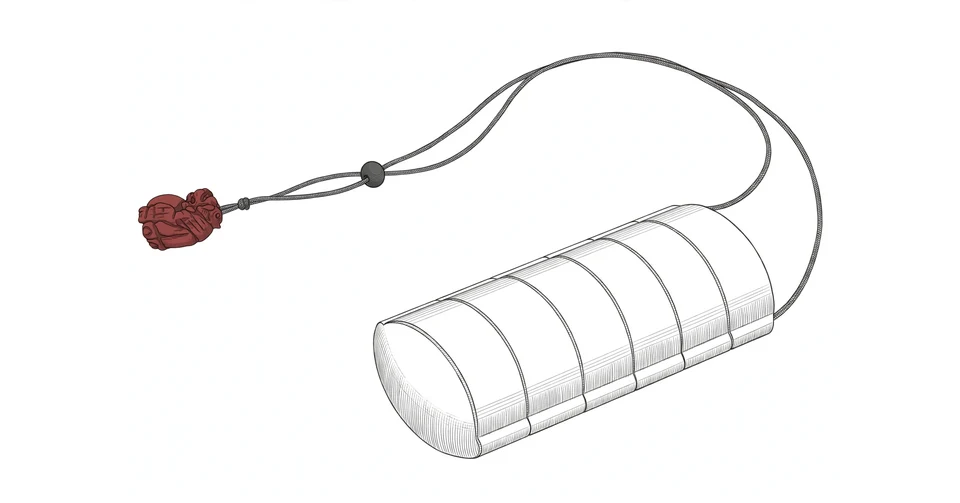
Look at an inro in a museum case and the first surprise is how small it is, about the height of a credit card stood on end, seven to ten centimeters tall and only about two centimeters deep. The second surprise is how much work went into something so small. The black lacquer is deep enough to see your face in, the gold is sprinkled on in a fine dust, and a whole landscape, a crane under a pine, a demon fleeing from roasted beans, a poet on a mountain, can play out across a surface no bigger than a matchbox. It was a medicine case that refused to look like one.
What an inro actually is
The word inro joins two kanji, in, meaning a seal or stamp, and ro, meaning a basket or container, so the name itself says "seal case." That was its first job. In the 17th century, Japanese men began using personal seals, called kakihan and jitsuin, as a kind of signature, and a seal needs a case that keeps it clean and close. The inro was that case, and then it became much more.
An inro is built as a stack of compartments, usually two to seven of them, each one a shallow tray with a rim that slides into the tray above it. The rims are cut so precisely that the joint, called the aikuchi, is nearly invisible when the stack is closed, and the fit is tight enough to keep out water and dust. A cord runs through channels on either side, down one side, under the bottom, and up the other, and the ends of the cord are tied to the netsuke. A small bead, the ojime, slides along the cord. Push it down to the top of the stack and the inro stays shut. Slide it up toward the netsuke and the compartments spread out along the cord, each one open and ready.
The size is the point. An inro had to hang at the waist without snagging on clothing or knocking against door frames, so it stayed flat, with rounded sides and no sharp corners. Most are rectangular, but makers also shaped them as circles, ovals, gourds, houses, and even small animals. There are inro with drawers that slide out from the side instead of stacking, and there are saya inro, where the whole stack slides into a lacquered sheath, like a sword into its scabbard. The sheath protected delicate raised decoration from rubbing, and it turned the simple act of taking out your medicine into a small ceremony of drawing and sheathing.
The cord, the bead and the toggle
No inro worked alone. It was one part of a hanging system the Japanese called sagemono, a word that means simply "hanging things," and the system solved a problem the kimono created. The kimono has no pockets, so everything a man needed had to hang outside his clothes, from his obi sash. Tobacco went in a pouch, a pipe went in a tube, writing tools went in a portable case, and the small necessities went in the inro. Each container had its own shape, but they all hung the same way.
The mechanics were simple and they had to be, because a man used them a dozen times a day. He slipped the netsuke under his obi from below and let it sit on top of the sash while the inro hung a few inches beneath it. The cord was braided silk, usually about one to one and a half meters long, long enough to let the compartments spread out when opened, and the knot was hidden inside the netsuke itself. The ojime bead sat between the inro and the netsuke, and sliding it was the whole lock. There was no clasp, no hinge, no lid to lose. The weight of the inro pulled the cord taut, the bead held it shut, and the toggle kept the lot from sliding to the floor.
I wrote about the toggle itself in Netsuke Held a Samurai's World on a Cord, and about the drawstring bag that used the same logic in Kinchaku Carries a Whole Festival in One Small Bag. The kinchaku is the soft cousin of the inro, a bag where the inro is a box, and both of them hung from the same cord and the same idea. What I keep coming back to is how much trust the system placed in a single carved toggle and a sliding bead. A man walked through a crowded street with his money, his seal and his medicine hanging off one small object, and it worked. Modern pockets solve the same problem with zips and Velcro, and none of it has half the grace. There is a lesson in that about how a constraint can make a thing beautiful. The kimono had no pockets, and because it had no pockets, Japan invented a pocket that was also a sculpture.
From seal case to medicine chest
The inro did not appear out of nowhere. The first mentions of similar objects come from the 14th century, describing containers of carved red lacquer built from fitted segments, used for food or cosmetics and carried by hand. Those early pieces were large, and they were not worn at the waist. Somewhere in the centuries that followed, someone had the idea of shrinking the segmented box and hanging it from a sash, and the inro as we know it was born.
The form took shape in the Sengoku period, from 1467 to 1615, when Japan was divided by civil war and men traveled with what they needed on their person. A portable seal and a portable medicine chest were not luxuries on a campaign, they were practical, and the inro served both. As the country settled into the long peace of the Edo period, from 1603 to 1868, the inro changed from a traveler's tool into a man's accessory. By the middle of the Edo period it was one of the most visible marks of taste a man could carry, and wealthy merchants and samurai collected inro decorated with lacquer as eagerly as they collected swords and tea bowls. The full story, including the Sengoku origins and the shift into an art object, is told clearly in the Wikipedia article on inro.
Medicine was the inro's most common cargo, and the compartments were made for it. Different remedies went in different trays so they would not mix, and some early inro had the ailments each compartment was meant for written out, a little pharmacy in miniature. A traveler might carry a remedy for stomach trouble in one tray, something for a headache in another, and a tonic in a third. It was the Edo period equivalent of a pill organizer, except that the organizer was lacquered in black and gold and cost more than a month's wages.
There was also a quieter cargo. Seals, charms, a folded paper, a tiny altar, a pinch of incense, the things a man wanted close but did not want seen. An inro kept its contents private by design. It hung at the waist in plain sight and revealed nothing, which is part of why it appealed to men who lived under watchful eyes. The outside was for everyone. The inside was for the owner alone.
How an inro was made
Making an inro was slow work, and the slowness was the point. The most common core was paper. A craftsman wound strips of washi paper, soaked in lacquer, around a wooden mold, four or five times, taking care to leave no gaps and no air bubbles, and then left the result to harden for days in a humid cabinet. Paper was favored because, unlike wood, it would not distort and crack over time. The top, the bottom and the floors of each compartment were cut from thin hinoki cypress to stiffen the structure, and then the whole stack was coated, dried, sanded and coated again, layer after layer.
Wood was the other standard core, worked from solid blocks hollowed with chisels, or from thin veneers wrapped around molds, and early inro were also made from lacquered leather, embossed on molds from thick cowhide. Leather was thought to suit medicine particularly well, though it was difficult to work and the results were not always satisfactory, so leather inro stayed rare. Bamboo, ivory, metal, ceramic, horn, tortoiseshell and even stone appear in old inro, sometimes combined in a single piece, and makers were so skilled at imitating materials in lacquer that a surface could look like wood grain or woven cloth until you touched it.
The hardest part, by the account of the makers themselves, was the fit. Each compartment had to slide into the next tightly yet smoothly, with the joint invisible all the way around, and the slightest error left a gap that was almost impossible to decorate away. The craftsman glued the adjoining edges together with removable glue or wax before decorating, so that gold powder and shell would not get inside, and after every coat of lacquer the compartments were gently separated and the edges smoothed, or they would never come apart again. It was patient, repetitive, exacting work, and it had to be repeated for every layer. A detailed account of the process, from the paper winding to the final fitting, is given in the Japanese lacquer guide to inro.
The decoration is where the inro became art. The most famous technique is maki-e, sprinkled gold, where gold or silver powder is dusted onto wet lacquer and then sealed under clear coats. In hiramaki-e the design lies flat, in takamaki-e it is built up in relief, and in togidashi the whole surface is polished down until the design sits level with the ground. Raden sets pieces of mother of pearl into the lacquer, cut thin enough to catch the light, and nashiji, a golden pear skin pattern, was often used for the insides of the compartments. A single inro could combine several of these techniques, and the design usually flowed from one side to the other, so that a rat's head on the front continued into a body on the side and a tail on the back, and you had to turn the little box in your hand to read the whole picture.
The makers who signed in lacquer
Two families dominated the making of fine inro. The Koma family served the shogun's court from the 15th century onward, and the Kajikawa family served the Tokugawa shoguns for generations. Both were lacquerers first and inro makers second, and their names on a piece were a guarantee the way a swordsmith's signature was. Later makers built their own reputations, and the best of them are still collected by name.
The most famous of all is Shibata Zeshin, who lived from 1807 to 1891 and worked through the end of the Edo period into Meiji. Zeshin was a lacquer artist of extraordinary range, and his inro are among the most sought after in the world. One of his best known pieces, called The Hatter, is a three segment inro with a mirror like black lacquer ground, showing a maker of court headgear at work in raised gold, his wife speaking to him on the other side, with an agate ojime and an ivory netsuke of a swordsman forging a weapon. It measures only six and a half centimeters tall. It is a whole scene from daily life, a workshop, a marriage, a trade, fitted onto a box smaller than a matchbox.
Other names recur in the collections: Ogata Korin, whose bold gold and mother of pearl deer still look modern three centuries later; Hara Yoyusai and Sakai Hoitsu, who painted blossoming plums across an inro's small face; Nomura Kyukoku, who told the Tanabata story of the weaver and the herdboy in lacquer and shell; and Koma Yasutada and Kajikawa Bunryusai, who carried the two great family workshops into the 19th century. The Metropolitan Museum of Art, the British Museum and the Victoria and Albert Museum all hold large groups of inro, and the finest late Edo and Meiji pieces are now concentrated in a small number of collections, including the Kiyomizu Sannenzaka Museum in Kyoto, built by the collector Masayuki Murata.
What moves me about these makers is that they signed work almost no one would ever see up close. An inro hung at a man's waist, half hidden by his sleeve, shown to friends for a moment over sake and then tucked away again. The inside of the compartments, the edges of the joints, the underside of the lid, all of it was finished to the same standard as the front, even though only the owner would ever see it. That is craft as a private ethic, not a performance. The maker did the work properly because the work deserved it, not because an audience was watching, and I think that is a standard worth keeping in mind in any trade, including this one.
A quiet way to show wealth
The inro flourished for the same reason the netsuke did, and the reason was the law. Under the strict social order of the Edo period, merchants stood at the bottom, below warriors, farmers and artisans, and sumptuary laws told them what houses they could build, what fabrics they could wear, and what they could display. A rich merchant could not wear silk brocade or build a grand gate, but the laws said nothing about the small box on a cord at his waist. An inro lacquered in black and gold, made by a famous workshop, cost more than the netsuke that held it up, and everyone on the street understood what it meant.
For a time in the Edo period, the inro was also used as a symbol of power, and the association has never quite gone away. Today, among sumo referees, the gyoji, only those of the higher ranks are allowed to wear an inro, a small survival of the old idea that the little box marks a man's standing. It is one of the last places where an inro is still worn for what it once meant rather than kept in a case for what it is worth.
The merchants were the great patrons, and they wanted wit, novelty and craftsmanship they could show to friends. An inro was shown the way a watch is shown today, slipped out from the sash, turned in the palm, handed over for a friend to admire, and then tucked away again. It was social, portable and personal, all at once, and because it was small, a collector could own dozens without needing a storehouse. That is why so many survive, and why so many of them ended up far from Japan.
The inro after the kimono
Everything changed when Japan opened its ports to foreign trade in 1854. Western suits and uniforms arrived, the kimono retreated into private life, and the inro stopped being a daily necessity. Demand for the container collapsed, but demand for the object exploded. Foreigners living in Japan bought inro as souvenirs, small enough to fit in a palm, exotic enough to show at home, and cheap enough at first to collect by the dozen. Compact and portable by design, they were exported in large numbers, and some of the greatest collections ended up outside Japan.
The Metropolitan Museum of Art acquired one hundred inro from the collection of John H. Webster of Cleveland in the early 20th century, and the gift of Mrs. Russell Sage added thousands of netsuke alongside them. The flow worried people in Japan, and with reason, because the finest pieces were leaving and few were left to see at home. The collector Masayuki Murata spent the 21st century buying back the best late Edo and Meiji inro he could find, and the Kiyomizu Sannenzaka Museum he manages now holds many of them, a small act of return for objects that had traveled so far.
The craft itself nearly died with the kimono. The best lacquer techniques of the late Edo and Meiji periods were almost lost in the westernization of Japanese life, and for decades almost no one made a new inro. Then in 1985 the lacquer craftsman Tatsuo Kitamura set up his own studio, Unryuan, and set out to recreate the old techniques from scratch. He succeeded, and his lacquer works are now collected by the Victoria and Albert Museum and the 21st Century Museum of Contemporary Art in Kanazawa, and bought by collectors around the world. An inro is still made by only a few craftsmen, and it is still rarely worn, but the knowledge of how to make one survived because one man decided it was worth relearning.
How to look at an inro
If you ever stand in front of a case of inro, do not rush past it. The pieces reward the slow look, and there are a few things worth noticing. First, the fit. Hold the idea of the stack in your mind and look at the seams. On a fine inro the joints are almost invisible, a thin dark line that runs around the box without wavering. On a lesser piece the line wanders, or a corner gapes. The seam is the maker's signature, more honest than any name written on the base.
Second, the design across the box. The best inro are not decorated on one side, they are decorated all the way around, with the scene continuing over the edges, so that turning the box is part of reading it. A crab's antennae stretch over the top, a rat's tail curls around the back, a landscape on the front is answered by a different season on the reverse. If the design stops at the edge, the maker was in a hurry. If it flows around, the maker was thinking in three dimensions.
Third, the set as a whole. An inro, its ojime and its netsuke were meant to match, in motif, in color, in feeling, and the ambition of the makers was to make the four elements, box, cord, bead and toggle, tell one story. Many sets were broken up over the years, sold piece by piece, and reassembled with strangers, so a matching set is rarer than a fine box alone. When you see one that still belongs together, a coral netsuke with a coral bead and a lacquered box in the same deep red, you are looking at the object as its owner saw it, and that is a rarer sight than it sounds.
Finally, look at the inside. Museum cases rarely show it, but the interiors of the compartments were often finished in nashiji, the golden pear skin lacquer, or in fundame, a dull gold that glows softly in low light. The inside was for the owner alone, and the fact that makers lavished work on a surface almost no one would see tells you what kind of people they were. Buy the carving, not the story, and if the price seems too good for the story being told, walk away.
A small box that outlived its world
An inro began as a seal case for a traveling warrior, became a medicine chest for a merchant, then a badge of taste, then a collector's prize, and now it sits in museum cases from New York to Kyoto, still shut tight, still waiting to be opened. The kimono changed, the cords were cut, and the little lacquered box remained, still smooth, still balanced, still holding a space for the small things a person carries through a day.
I think there is something quietly hopeful in that. We tend to assume that useful things and beautiful things are different categories, and that a thing must choose between working well and looking well. The inro refused the choice. It kept medicine dry and seals clean for two hundred years, and it did it in black lacquer and gold, with a crane under a pine tree on the lid. It did its job and it did it beautifully, and when the job disappeared, the beauty was enough to keep it alive. That is a good standard for anything we make, and a good reason to keep a little room in our lives for objects that are both.
An inro held a samurai's day on a cord, and then it held a merchant's pride, and then a collector's fortune, and now it holds a museum visitor's attention for a long minute. That is a lot of work for a box the size of a matchbox, and it is why the little container outlived the sash it hung from.
More in Culture & Society
- Maki-e Sprinkles Gold Dust Onto Wet Lacquer
- Urushi Is the Tree Sap Japan Turns Into Lacquer That Outlives Centuries
- Ojime Is the Tiny Bead That Keeps a Netsuke From Slipping Away
- Hachimaki Is the Headband Japan Ties On Before the Hard Part Begins
- Netsuke Held a Samurai's World on a Cord
- Kinchaku Carries a Whole Festival in One Small Bag
Latest posts
- Tenugui Is the Thin Cotton Cloth Japan Uses for Everything
- Takuan Turns a Humble Daikon Into Japan's Yellow Crunch
- Nukazuke Is the Living Pickle Bed Japan Feeds Every Day
- Tsukemono Is the Crunch Japan Puts Beside Every Meal
- Ochazuke Is Rice Tea and Comfort in One Bowl
- Aojiso Is the Green Leaf Japan Eats Fresh and Raw
- Akajiso Gives Umeboshi Its Deep Red Blush
- Umeshu Is the Liqueur Japan Makes From Unripe Plums
- Shiso Is the Leaf That Paints Umeboshi Red
- Hello Kitty and the Cat Who Conquered the World
- Umeboshi Is the Sour Plum Japan Puts in Every Bento
- Baikasai Serves Tea Under the Plum Blossom at Kitano Tenmangu
- Plum Blossom Opens Japan's Year Before the Cherry Trees Wake
- Tenjin Engi Emaki Paints a Storm God Into a Saint of Learning
- The Flying Plum Tree That Followed a Scholar Into Exile