Ojime Is the Tiny Bead That Keeps a Netsuke From Slipping Away
· 23 min read
An ojime is the small sliding bead on a sagemono cord that keeps an inro shut and a netsuke in place, and this tiny carving became a miniature art of its own.
An ojime is smaller than your smallest fingernail, and it holds a whole outfit together. It is the bead threaded on the cord of a sagemono, the hanging things a man once carried at his waist in Edo period Japan, and its job is simple. Slide it one way and the cord tightens, slide it the other way and the cord loosens, and that small movement is all that stands between a man's belongings and the street below. Without the ojime, the lacquered case would fall open, the pouch would gape, and the carved toggle above it would be a decoration with nothing to hold.
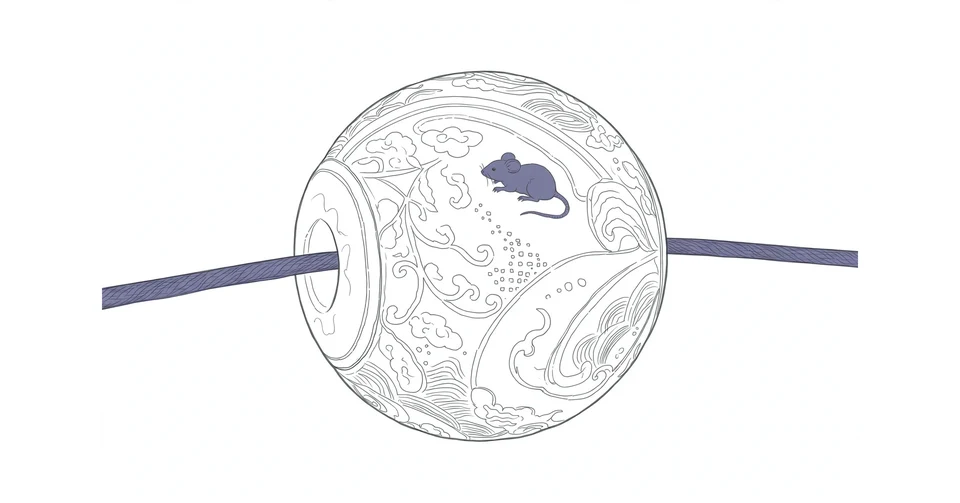
The Japanese name tells you the job before you see the object. Written with characters for cord and fastening, ojime means cord fastener, and it does exactly that. It sits on the doubled cord between the netsuke toggle at the top and the inro or pouch hanging below, and it grips by friction alone. The cord passes through the bead, sometimes through one hole, sometimes through two holes on opposite sides, and the ojime stays where you push it until you push it again. There is no clasp, no spring, no knot to tie. That is the whole mechanism, and it worked for more than two centuries.
It is easy to miss the bead, and that is the point of this article. The netsuke gets the exhibitions, the inro gets the lacquer, and the ojime gets overlooked because it is small and quiet. Yet it is the part the wearer touched most, dozens of times a day, every time he opened his case for a seal or his pouch for tobacco. The ojime is the working heart of the set, and once you notice it, you start to see how much care went into something most people never look at twice.
What an ojime actually does
A kimono has no pockets, so a man in Edo period Japan carried his daily things hanging from his sash, and the ojime is what made that arrangement practical. The cord ran from the container at the bottom, up through the bead, and then through the two small holes of the netsuke toggle at the top, and the toggle was tucked above the obi sash while the container hung below it. The ojime sat between them on the cord, and sliding it down toward the container pulled the whole assembly tight, while sliding it up loosened everything so the case could be opened.
The Wikipedia entry on ojime gives the plain definition: a bead used in Japanese inro cases, typically under an inch in length, carved into a particular shape and image similar to the netsuke though smaller, used to fasten the cord of the inro so that it does not unstack while carried. The key word there is unstack. An inro is a stack of small compartments that fit into each other, and without the bead pressing them together the stack would come apart at the waist and spill its contents. The ojime is a clamp, not a decoration, although it became a decoration as well.
The same bead served every kind of hanging container, not only the inro. Tobacco pouches, pipe cases, purses and medicine boxes all hung from the same arrangement, and each one needed the same sliding fastener. A pouch that could not be closed was useless, and a case that opened by itself on a crowded street was worse than useless. The ojime solved both problems with one small piece of carved material, and it solved them without any metal hardware at all.
The grip comes from friction and fit. The holes in the bead are only just wide enough for the cord, usually braided silk, so the ojime slides when pushed with a fingertip and holds when left alone. A bead with holes too wide would slip on its own and let the case open, while a bead with holes too narrow would jam and fray the cord. Getting that fit right was part of the maker's skill, and it is one reason an old bead that still slides smoothly is prized. It proves the maker understood the cord as well as the carving.
I find something quietly satisfying in a mechanism this honest. Modern life closes things with zips and magnets and plastic clips, and each of those hides its working parts from view. The ojime hides nothing. You can see the cord, see the holes, see the bead move, and understand the whole thing in one glance. There is a kind of respect in that, a respect for the person using it, as if the maker trusted the wearer to understand his own belongings.
A bead, a cord and a box
An ojime never worked alone. It was one part of a set of four, and each part had its own craft. At the bottom hung the container, most famously the inro, a stack of small nested compartments held together by the cord, first used for seals and later for medicine. Above it sat the ojime, sliding on the cord. Above the bead sat the netsuke, the carved toggle that hooked over the sash. And running through all of them was the cord itself, usually braided silk, strong and smooth, knotted at the end so it would sit flat and not snag on clothing.
I wrote about the toggle itself in Netsuke Held a Samurai's World on a Cord, and the ojime deserves the same attention, because the set only makes sense as a whole. The cord is the spine, the netsuke is the anchor, the inro is the cargo, and the ojime is the hand that tightens and loosens. Take any one part away and the rest stop working. That interdependence is what makes the set so charming to study, and it is why collectors so often want a complete set rather than a single piece.
The inro set the scale for everything else. An inro is small, roughly the size of a deck of cards, and the bead had to be smaller still, small enough to sit on the cord without pulling the whole set out of balance. Wikipedia puts a typical ojime at under an inch in length, and museum examples bear that out. The British Museum holds a coral ojime, sphere shaped with two carved circles, that measures only 1.20 centimetres across, paired with a 19th century inro decorated with a blossoming plum tree. A study of one private collection of 44 nineteenth century ojime found beads from 12 to 24 millimetres across, which is to say from the width of a pea to the width of a fingertip.
The cord channels on the inro ran along its sides, and the cord passed through them and up to the ojime, so the bead was always visible, always in the hand, always part of the picture. When a man opened his inro, he pushed the ojime up with his thumb, lifted the lid compartment, took what he needed, and pushed the bead down again to close it. It was a gesture he made without thinking, the way we press a phone button today, and the ojime had to feel right in that gesture. Too sharp and it would hurt the thumb, too smooth and it would slip, too heavy and it would drag the set down. The makers tuned all of that by hand, in a space smaller than a coin.
Ivory, coral, glass and a dozen other materials
If you think of a material, the makers of feudal Japan probably used it for an ojime. A jeweler's essay on ojime lists coral, silver, ivory, porcelain, jade, gold, wood, metal, copper, leather, and on and on, and then adds the telling line that you think of a material, the jewelers of feudal Japan used it for ojime. Glass, stone, bone, shell and lacquer belong on the list too, and each material gave the bead a different weight, a different shine and a different feeling in the hand.
Ivory was the luxury material, smooth and creamy, able to hold fine detail, and it came to Japan mostly through trade with China and India. Wood was the everyday material, honest and warm, and it shows the carver's hand most directly, because wood hides nothing. Boxwood was favored for its fine grain and durability, and other native woods such as cherry, camphor and persimmon appear in old beads. Coral gave a deep red accent that stood out against black lacquer and indigo silk, and glass beads brought color and shine at a lower price. Metal beads in gold, silver, copper and brass could be engraved, inlaid and enamelled, and porcelain beads carried painted scenes in miniature.
The material also decided how the ojime would age. Wood gains a soft shine from handling, ivory mellows to a warm tint, and both develop a quality the Japanese call aji, the agreeable feel of a thing that has been touched often and well. A bead that has never been handled feels dead in the hand, however pretty it looks in a case. The good ones ask to be picked up, and that is a rare quality in an object this small.
Some beads combined materials in ways that show off the maker's range. The Isabella Stewart Gardner Museum in Boston holds an ojime by Dosho Shibayama, active in the 19th century, made of ivory inlaid with tortoise shell, gold stone, mother of pearl and coral, only 2.1 centimetres across, decorated with blossoming plum branches and tea utensils, with two holes on opposite sides for the cord. Four materials, two subjects, one bead the size of a small grape. That is the scale of ambition we are talking about, and it is why a bead can hold a viewer's attention for a long time.
There is a harder side to the material story, and it should be said plainly. Ivory, the most prized material for these beads, is now restricted by international trade rules put in place in 1989, and old ivory carries an ethical weight that it did not carry when it was carved. A collector today has to think about provenance, about whether a piece left Japan legally, and about whether owning it does any good. My own view is that the old pieces in museums are best left where they are, studied and admired, and that a new collector can learn everything from wood, glass, lacquer and metal without touching ivory at all. The art is in the carving, not in the tusk.
The subjects carved into a fingertip
An ojime could show almost anything, and the range of subjects is a portrait of Edo Japan in miniature, compressed into a bead. Carvers made people, gods, animals, plants, masks, coins, tools and family crests, all of it small enough to hide in a closed fist. The subjects were often the same ones carved on netsuke, but the bead had less room, so the carving had to be simpler, bolder, and readable at a glance.
The twelve animals of the zodiac were a favorite subject, and the jeweler's essay on ojime notes that the ojimes were often carved into the Rat, Ox, Tiger, Rabbit, Dragon, Snake, Horse, Sheep, Monkey, Rooster, Dog and Boar. A man might carry the animal of his birth year, or the animal of a lucky match, and the essay even records the old folk wisdom about which signs marry well together. Whether or not anyone took that advice seriously, the zodiac gave the bead a personal meaning, a small private sign that the wearer chose for himself.
Other subjects carried their own meanings. Hotei, the laughing god with his cloth sack, stood for contentment and good fortune. The phoenix, the Japanese hoo bird, stood for peace and noble rule. The dragon, coiled among clouds, stood for power and rain. The oni demon, carved in ivory with a fierce face, was a joke and a charm at once, a monster small enough to control. The plum tree, the first to blossom while winter has not quite finished, stood for endurance and hope. In the private collection of 44 nineteenth century ojime mentioned earlier, all of these subjects appear, alongside flowers, figures and landscapes, which shows how wide the carvers ranged.
The carving had to work from every angle, because the ojime turned on its cord all day and was seen from all sides. A good ojime has no back, no side that the carver neglected, and the cord holes themselves were often worked into the design, hidden in the fold of a robe or the mouth of a fish, so the working parts did not interrupt the picture. That is a demanding standard for something so small, and it explains why the best beads feel like complete worlds rather than fragments. The carver could not add a tall hat or a long sword that would catch on clothing, so ingenuity went into the curve of a back, the tuck of a tail, the way a hole became part of the story.
I think there is a lesson in that constraint. A large canvas forgives a weak corner, and a big sculpture can hide its flaws by turning away from the viewer. A bead forgives nothing. Every surface is visible, every surface is touched, and the carver had to finish all of it. It is a humbling standard, and it is why the best small carvings still feel modern. They were made to a standard that has nothing to do with fashion, and everything to do with care.
Matching the bead to the netsuke and the inro
The finest sets were matched, and the matching was part of the pleasure. The ojime was often carved to echo the netsuke, so the whole set told one story, perhaps a monkey on the toggle and a peach on the bead, or a fisherman above and a fish below, or the same flower repeated in lacquer, wood and coral. A matching set was a point of pride, and assembling one took time, money and taste. The ojime was small, but it was never an afterthought, and a mismatched bead on a fine set would be noticed by anyone who knew the craft.
The same arrangement served the drawstring purse, and the Kinchaku Carries a Whole Festival in One Small Bag story shows how the bead, the cord and the toggle worked on a soft bag as well as a hard case. The kinchaku is a small cloth bag closed by a drawstring, and the ojime slid on that string in the same way, tightening the mouth of the bag and holding the toggle in place. The bead did the same job in both settings, which tells you how flexible the system was, and how deeply it belonged to daily life rather than to ceremony.
Matching also had a social meaning, and it is worth understanding. Under the strict social order of the Edo period, merchants stood at the bottom, below warriors, farmers and artisans, and sumptuary laws told them what houses they could build and what fabrics they could wear. Those laws said nothing about the small bead on a cord. A rich merchant could not wear silk brocade, but he could carry a bead carved by a famous master, in coral or gold, and everyone on the street would understand what it meant. The ojime became a quiet way to display wealth, and a public way to display taste, and the ojime was small enough to hide in a closed fist if an official walked by.
That history gives the bead a double character. It is a practical fastener and a social signal at the same time, a tool and a jewel in one object. I find that combination appealing, because it refuses the modern habit of sorting things into useful or beautiful, as if an object must choose. The ojime never chose. It did its job, and it did it beautifully, and the beauty was part of how well it did the job, because a man who loved his bead would handle it carefully and keep it for a lifetime.
How collectors judge an ojime
Sooner or later, anyone who loves these beads has to ask how to judge one, and the honest answer is to look slowly and touch carefully. The first test is the carving itself. A good ojime is carved on every side, with no flat or unfinished surface, and the subject is clear at a glance, even at a size of two centimetres. The details should be crisp, the proportions right, and the whole bead balanced in the hand. If the subject is muddled or the carving is shallow, the bead was probably made quickly for a buyer who did not look closely.
The second test is the cord holes. A genuine old bead shows wear where the cord passed through, with edges grown soft and sloped from centuries of sliding, and the holes themselves should be clean and even. A bead with sharp hole edges and no wear anywhere is hard to believe as a two hundred year old object, and that doubt is a good reason to walk away. The same test applies to netsuke, and it applies here for the same reason: a thing used every day cannot stay pristine.
The third test is the material and the patina. Real patina comes from time and from human oils, a skin that forms slowly as a piece is rubbed and handled, and it is uneven, with highs and lows. Machine polishing can imitate the shine, and resins can give a hard glossy finish, so shine alone proves nothing. The feel matters as much as the look. Wood should feel warm, ivory should feel smooth but not slippery, and a bead that feels cold and slick in the hand deserves a second look.
The fourth test is the slide. A bead that was made well should still move on a cord, gripping firmly when pushed into place and moving freely when pushed again. A bead that jams, or one that slips on its own, was either badly made or damaged, and neither is worth a high price. This test is also the most enjoyable, because it is the test the original wearer performed every day, and doing it yourself connects you to the ojime's real purpose.
Finally, there is the question of age and signature. Signatures only became common late in the 18th century, and many fine beads were never signed at all, so an unsigned bead is not automatically a fake, and a signed bead is not automatically genuine. Modern ojime appeared in the early years of the 20th century, when artists needed income as the old patronage faded, and the jeweler's essay is blunt that the quality of these modern pieces did not compare to those of earlier days. That is a useful warning. Buy the carving, not the story, and if the price seems too good for the story being told, walk away. The pleasure of these beads is in the looking and the holding, not in the certificate, and inexpensive faithful reproductions in museum shops are a fine way to start.
The makers behind the bead
The men who made ojime were usually the same carvers who made netsuke, working in the same workshops, in the same materials, for the same customers. The ojime was smaller and cheaper than the toggle, so it rarely carried a famous name, and the carvers who signed their netsuke often left their beads unsigned. That is one reason the bead has been studied less, and why it is harder to attribute a bead to a particular hand. The art is there, but the signature is not.
A few names survive because museums recorded them. Dosho Shibayama, active in Japan in the 19th century, is credited with the ivory bead inlaid with tortoise shell, gold stone, mother of pearl and coral in the Gardner Museum, decorated with blossoming plum branches and tea utensils. The record is brief, as such records often are, but it proves that a named artist put his skill into a bead two centimetres wide, and that a great collector thought it worth keeping. Other beads in museum collections are signed on the base or inside a fold of the carving, and those signatures, when they can be trusted, point back to the same schools that produced the famous netsuke.
Most of what we know about Edo period carvers comes from a single book, the Soken Kisho, published in Osaka in 1781 by Inaba Tsuryu, which lists more than 50 famous masters, most from Kyoto and Osaka. It was a book about sword fittings that happened to include carvers, which tells you how the craft was seen at the time, as part of the sword world as much as an art of its own. The names in that book are still the names collectors chase for netsuke, and the workshops those men founded made beads as well as toggles, because a customer who ordered a set wanted every part of it from the same hand.
I admire these carvers for the same reason I admire the netsuke makers: they worked without the safety net of size. A painter can hide a mistake in a corner of a canvas, and a sculptor can turn a statue so the weak side faces the wall. A bead carver had nowhere to hide. Every surface was visible, every surface was touched, and the bottom had to be as finished as the top. It is a humbling standard, and it explains why the best beads still feel modern. They were made to a standard that has nothing to do with fashion.
From daily tool to collector's prize
Everything changed when Japan opened its ports to foreign trade in 1854, and then again with the Meiji Restoration in 1868. Western suits and uniforms arrived, the kimono retreated into private life, and the ojime stopped being a daily necessity. Demand for the fastener collapsed, but demand for the carving exploded. Foreigners living in Japan bought beads as souvenirs, small enough to fit in a palm, exotic enough to show at home, and cheap enough at first to collect by the dozen. A whole collection of these tiny sculptures can fit into a jewelry box, as the jeweler's essay observes, and that portability made them ideal for export.
The bead also found a second life as jewelry. In London, Hancocks made a necklace of 24 gold ojime beads dating to 1890, in the Meiji period, each bead carved with floral motifs, and the piece shows how naturally the bead moves from the sash to the neck. The bead was always worn on the body, so wearing it as a necklace is not a betrayal of its purpose, only a change of address. It is still a bead on a cord, still small, still carved, still meant to be touched.
That second life has a cost, and it should be named. When beads are restrung as necklaces, they leave the sets they belonged to, and a set broken apart is a small loss of history. The bead, the toggle and the case told one story together, and separating them is like tearing a page from a book. Collectors argue about this, and there is no simple answer, because a bead on its own is easier to see, study and enjoy than a bead hidden on a cord behind glass. My own feeling is that complete sets deserve to stay complete when they survive intact, and that loose beads are best appreciated as the fragments they are, with honesty about what was lost when the set was broken.
Where to see ojime today
The best place to see an ojime is still a museum, where you can compare dozens side by side and train your eye. The great collections of Japanese art in London, New York and Boston all hold beads, usually displayed as part of complete sagemono sets, so look for the bead between the toggle and the case, and notice how small it is next to the inro it controls. The British Museum holds coral and ivory examples, the Victoria and Albert Museum holds inro sets with their beads intact, and the Gardner Museum in Boston holds the Shibayama bead with its plum branches and tea utensils.
In Japan, the Kyoto Seishu Netsuke Art Museum is the only museum in the country devoted entirely to netsuke, housed in a late Edo period samurai residence, with more than 5,000 pieces in its collection and about 400 on display at a time, changed every three months. The beads there appear alongside the toggles, as they should, because the museum understands that the set is the story. The Tokyo National Museum keeps netsuke and inro in its Japanese galleries, and its collection includes pieces given by collectors who feared too many were leaving the country.
If you go, do not rush past the bead to reach the toggle. Stand in front of a complete set and follow the cord from the top to the bottom, from the netsuke above the sash, through the bead in the middle, to the case hanging below. Push the bead in your imagination, up to open the case, down to close it, and feel how the whole set moves as one thing. Then look at the bead itself, at the tiny animal or flower or god carved into it, and notice how much smaller it is than you expected, and how much larger it feels once you understand what it did.
An ojime is the smallest part of the set, and it is the part that makes the set work. It tightened the cord, closed the case, held the toggle in place, and carried a small carving that its owner chose for himself, and it did all of that in a space smaller than a fingertip, for more than two hundred years, without ever asking for attention. That is a lot of work for a bead, and it is why the little fastener deserves its own story at last. The kimono changed, the cords were cut, and the bead remained, still smooth, still balanced, still waiting to be picked up.
More in Culture & Society
- Maki-e Sprinkles Gold Dust Onto Wet Lacquer
- Urushi Is the Tree Sap Japan Turns Into Lacquer That Outlives Centuries
- Inro Is the Little Lacquered Box That Carried a Samurai's Day
- Hachimaki Is the Headband Japan Ties On Before the Hard Part Begins
- Netsuke Held a Samurai's World on a Cord
- Kinchaku Carries a Whole Festival in One Small Bag
Latest posts
- Tenugui Is the Thin Cotton Cloth Japan Uses for Everything
- Takuan Turns a Humble Daikon Into Japan's Yellow Crunch
- Nukazuke Is the Living Pickle Bed Japan Feeds Every Day
- Tsukemono Is the Crunch Japan Puts Beside Every Meal
- Ochazuke Is Rice Tea and Comfort in One Bowl
- Aojiso Is the Green Leaf Japan Eats Fresh and Raw
- Akajiso Gives Umeboshi Its Deep Red Blush
- Umeshu Is the Liqueur Japan Makes From Unripe Plums
- Shiso Is the Leaf That Paints Umeboshi Red
- Hello Kitty and the Cat Who Conquered the World
- Umeboshi Is the Sour Plum Japan Puts in Every Bento
- Baikasai Serves Tea Under the Plum Blossom at Kitano Tenmangu
- Plum Blossom Opens Japan's Year Before the Cherry Trees Wake
- Tenjin Engi Emaki Paints a Storm God Into a Saint of Learning
- The Flying Plum Tree That Followed a Scholar Into Exile