Nashiji Scatters Gold Dust Like Pear Skin Across Black Lacquer
· 22 min read
Nashiji is the Japanese lacquer technique that scatters gold flakes across black lacquer until the surface glows like the skin of an Asian pear, a quiet ground that has lined the finest boxes in Japan for centuries.
Open a fine Japanese lacquered box and look at the inside of the lid. The outside may carry a painted landscape in gold, a crane, a pine, a poem in shell, but the inside is often something quieter: a field of tiny gold flecks scattered across black lacquer, even as starlight, warm as candlelight, and faintly rough to the touch in a way that catches the light. That field has a name. It is nashiji, and it is one of the oldest tricks in Japanese lacquerwork.
The word means pear ground, after the Asian pear, the nashi, whose skin is freckled with pale dots. A craftsman scatters flakes of gold, and sometimes silver, over wet lacquer, seals them under coats of clear lacquer, and polishes the surface until it glows like the skin of the fruit. There is no picture in nashiji, no scene and no story. It is a ground, a background, and its whole job is to make the box feel precious before you have even looked at the picture on the lid.
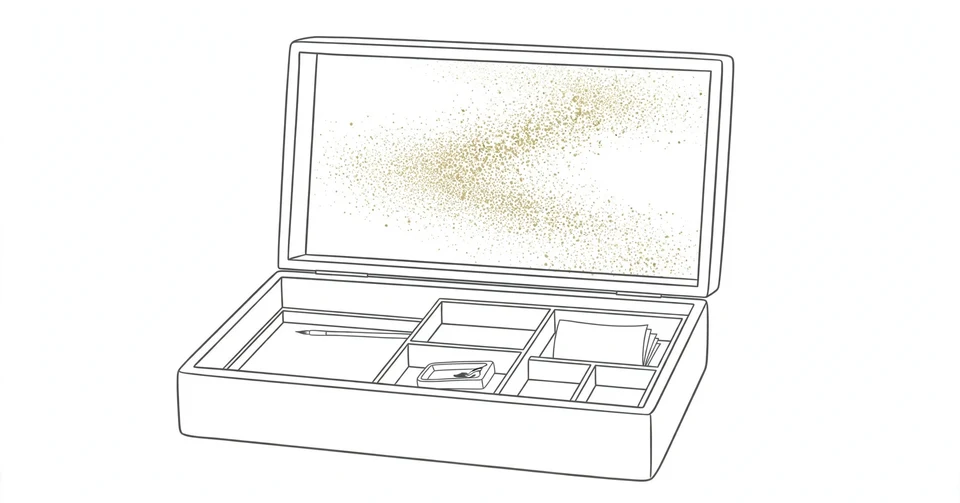
I first met nashiji the way most people do, without knowing its name. In an earlier article about the inro, the little lacquered box that carried a samurai's day, I noted that nashiji, a golden pear skin pattern, was often used for the insides of the compartments. It was a passing line in a long article, but it stayed with me, because it described a kind of luxury I had not thought about before: work lavished on a surface almost no one would ever see. The outside of the inro was for the street. The nashiji inside was for the owner alone. That is the whole spirit of the technique, and it is worth a closer look.
What nashiji actually is
At its simplest, nashiji is a ground made of metal flakes in lacquer. The Metropolitan Museum of Art, in its catalogue of Japanese lacquer from 1600 to 1900, defines it plainly: a decoration in which relatively large and irregular flakes of metal are uniformly scattered over wet lacquer, after which additional layers of translucent lacquer, often tinted yellow, are applied over the flakes and lightly polished. The polishing is deliberately light. It is not enough to expose the flakes, and the surface texture is often uneven. That unevenness is not a flaw. It is the point, and it is where the pear comes in.
The flakes are usually gold. Silver appears too, and on some pieces the two metals are mixed, gold for warmth and silver for a cooler sparkle. The ground beneath them is black lacquer, and the flakes sit in a layer of wet lacquer that is itself often tinted a warm orange or amber. Over the top go several coats of clear lacquer, and because those coats are translucent, the gold shows through them the way sunlight shows through thin paper. Inside a closed box the result looks orange gold, because the gold is seen through amber lacquer. On the outside of an old box, where wear and light have made the top coats more transparent, the same ground looks yellower, closer to the natural color of the gold itself. The Met catalogue notes exactly this difference on a single box from around 1647, orange inside and yellow outside, and it is one of the small pleasures of looking at old lacquer: the same surface tells you how it has lived.
There are two ways to make the ground, and the old glossary of lacquer terms describes both. In one, large irregular flakes of gold are scattered at differing angles, in many layers, in wet lacquer that has been tinted orange. A further coating is applied, and polishing exposes the flakes to produce an uneven surface texture. In the other, a fine metallic powder is sprinkled onto a lacquered surface, and when it is dry a coat of transparent lacquer is applied and lightly polished. The first gives a bolder, rougher sparkle, with flakes you can almost feel under your fingertip. The second gives a finer, dustier glow, like gold seen through mist. Both are nashiji, and a good workshop knew when to use which.
English speakers often call the effect aventurine, and the Met catalogue explains why. Nashiji resembles a type of Venetian glass called aventurine, or goldstone, which is glass filled with glittering copper flecks. The resemblance is real but the materials could not be more different. Venetian goldstone is glass with metal stirred in. Nashiji is metal laid by hand, flake by flake, into tree sap, and sealed under coats that took weeks to harden. One is an accident of the furnace. The other is an act of patience.
Why a pear gave its name to gold
The nashi, the Asian pear, is a round fruit with skin the color of pale bronze or green-gold, and its skin is covered in small pale dots called lenticels. Hold one up to the light and the dots catch it, hundreds of tiny pale points on a darker ground. A lacquerer looking at that skin would have seen his own work reflected back at him: small bright points scattered evenly over a dark field. So the technique took the fruit's name, nashi plus ji, ground, and the name stuck for eight centuries.
I find this naming quietly honest, and it tells you something about how Japanese craftsmen thought. The most expensive surface in their trade, a ground of gold flakes under lacquer, is named after a piece of fruit you can buy at a market stall. The name does not boast about the gold. It describes what the eye sees. There is a modesty in that, and a confidence too, as if the maker were saying that gold is only interesting when it behaves like something in nature.
The pear is not the only natural model in the lacquerer's vocabulary. Sharkskin lacquer copies the bumpy hide of a shark, and the ground called fundame, which I will come to below, is named for the fine powder that makes it. Japanese lacquer has always borrowed its language from the world outside the workshop, from fruit and fish and stone, and nashiji is the loveliest example of the habit. A fruit gave its skin to gold, and gold has worn it ever since.
How nashiji is made, flake by flake
Making nashiji is slow work, and the slowness is built into the material. Urushi, the lacquer itself, is the sap of the lacquer tree, and it does not dry the way paint dries. It hardens in warm, humid air, and each coat needs time in a humid cabinet before the next can go on. A box can take weeks or months to finish, and the nashiji ground is only one part of that long sequence.
It begins with the core, usually wood, sometimes paper wound in layers around a mold, sometimes both. Foundation coats of lacquer seal the core and fill every grain and joint, and each coat is dried, sanded, and recoated until the surface is perfectly smooth. Then comes the black ground, lacquer colored with iron or lampblack and polished to a deep gloss. Only when that black mirror is flawless does the gold work begin, because every fleck of gold will sit on it, and every flaw beneath will show through.
The craftsman brushes on a coat of wet lacquer, often tinted orange, and then scatters the flakes. The tool is a small tube or a brush, and the hand must be steady, because the flakes have to fall evenly, dense enough to glow, sparse enough that the black ground still breathes between them. Too few flakes and the ground looks thin and hungry. Too many and it looks crowded, and the pear skin turns into a gold sheet. The flakes fall at different angles, and that is deliberate, because a flake lying flat catches the light differently from a flake tilted on edge, and the mixture of angles is what gives nashiji its living shimmer. A flat, uniform sparkle would look printed. The uneven angles make it look grown.
Once the flakes are down, the lacquer is left to harden. Then come the covering coats, layers of translucent lacquer laid over the gold, each one hardened in turn, each one sanded lightly. The coats protect the flakes and deepen the color, and because they are tinted amber or yellow, they warm the gold beneath them. Finally the surface is polished, gently, with a fine abrasive and then with the palm of the hand, until it is smooth to the touch but still faintly uneven under the light. The flakes are never meant to break the surface. If you can feel a sharp edge, the polisher went too far. If the gold looks drowned and dull, the coats went on too thick.
The powder version follows the same rhythm with finer material. Fine metallic powder is dusted over the wet lacquer, the excess is brushed away, and a transparent coat seals what remains. It is quicker than laying flakes, and the glow it gives is softer, more like dust than stars. Workshops used it for large surfaces where the flake method would have taken too long, and for pieces where a quiet ground was wanted under a loud design. Both methods demand the same thing from the maker: a steady hand, a patient calendar, and a willingness to do the same coat five times when once would have been enough for anyone else.
Two kinds of nashiji, and its close cousins
Not all nashiji looks the same, and collectors have names for the differences. The two named variants are worth knowing, because they show how much control a good lacquerer had over a technique that looks, at first glance, like random scattering.
Gyobu nashiji is the dense kind. The flakes are larger and more irregular than ordinary nashiji, and instead of being sprinkled they are individually set into the wet lacquer, one by one, so that the spaces between them almost disappear. In some pieces the surface beneath is first covered with gold leaf, so that even the gaps glow. The result is a ground that looks almost solid, a sheet of gold broken only by the seams between flakes. It is the most expensive kind, because it takes the longest, and it appears on the insides of the finest boxes, where the owner would see it every time he opened them.
Muranashiji is the uneven kind. Here the flakes are not spread evenly at all, but applied in cloudlike concentrations, thick in one place and thin in another, so that the gold seems to drift across the surface like weather. It is a deliberate effect, and it takes a confident hand, because the maker has to know exactly where the clouds should gather and where the black ground should show through. A clumsy muranashiji looks like a mistake. A good one looks like a sky.
Around nashiji sits a family of related grounds, and telling them apart is part of learning to look at lacquer. Fundame, also called fundameji, is a powder ground, made by densely sprinkling fine metal powder over wet lacquer, covering it with a thin protective coat, and polishing it. It glows softly and evenly, without the visible flakes of nashiji, and old writers describe it as a dull gold that shines gently in low light. Before 1600 it was called ikakeji. When the powder is gold the ground is called kinji, and when it is silver it is called ginji. Hirameji is a flake ground of a different kind: relatively flat and thick flakes of metal are sprinkled in wet lacquer, covered with layers of lacquer, and polished until the flakes are exposed flush with the surrounding surface, so the gold and the lacquer sit level, like stones set in a pavement.
Raden is the other great companion of nashiji. It is not a ground at all but an inlay, pieces of mother of pearl cut thin and set into the lacquer, where they catch the light in blues and greens and pinks. Raden and nashiji are often combined, with a shell design laid over a gold flake ground, and the contrast is the whole pleasure: the cool shimmer of shell against the warm glitter of gold. A box that pairs them well is a box whose maker understood that lacquer is not one technique but a language, and that the grounds are its grammar.
Where nashiji lives, inside the inro and beyond
Nashiji was rarely the star of a piece. It was the stage, and it appears wherever a Japanese lacquerer wanted a surface to feel precious without showing a picture. Its most famous home is the inside of the inro, the little stacked box I wrote about before. The compartments of a fine inro were often finished in nashiji, so that the owner, opening his medicine case, found gold waiting inside the black shell. The inro article that started this one noted exactly that, and it is worth repeating here: the inside was for the owner alone, and the fact that makers lavished work on a surface almost no one would see tells you what kind of people they were. You can read the full story of that little box in Inro Is the Little Lacquered Box That Carried a Samurai's Day, and when you do, remember that the gold inside the compartments has its own story too.
Writing boxes are the other great home of nashiji. The suzuribako, the box that held a scholar's inkstone, brushes and paper, was a piece of furniture for the desk, and its lid and interior were often given a full nashiji ground. The Metropolitan Museum's catalogue describes one such set from around 1647, a rectangular box with bamboo, peony and family crests, nineteen centimeters long, whose nashiji ground covers all its surfaces, inside and out, with the design drawn in lacquer on top of the gold. The piece belonged to a bridal set, and the catalogue ties it to the great marriage sets of the seventeenth century, the most famous being the Hatsune set made by Koami Nagashige between 1637 and 1639 for the daughter of the shogun Iemitsu. A bride's lacquer was a family's statement, and nashiji was part of the vocabulary of that statement, a ground that said wealth without needing to shout.
Beyond boxes, nashiji appears on trays, on document boxes, on the insides of drawers, on the undersides of lids, on tea utensils and incense trays, and on the occasional piece of furniture. The old glossary is frank about why: the technique was often used to give a uniformly decorative surface to large but less important areas, such as the interior of drawers or the underside of boxes. Less important is the glossary's phrase, not mine, and I think it misses the point. Those were the surfaces the owner touched every day, the inside of the drawer he opened each morning, the underside of the lid he lifted each evening. A maker who gilded those surfaces was not decorating the unimportant parts. He was decorating the private parts, and there is a difference.
The technique is still alive. Modern lacquerers use nashiji on boxes, trays and vases, and on smaller objects too, including fountain pens and tea wares, where a gold flake ground turns an everyday tool into something worth keeping. The Design+Encyclopedia entry on nashiji lacquerwork notes that the craft has been passed down through generations of Japanese craftsmen and is still practiced today, with many artists and designers incorporating the technique into their work. It is a quiet survival, without fanfare, and that suits the technique. Nashiji was never loud. It does not need to be loud now.
Nashiji and maki-e are not the same thing
Visitors to a lacquer exhibition often confuse nashiji with maki-e, and the confusion is understandable, because both involve gold sprinkled onto wet lacquer, and the two often appear on the same object. But they are different things, and the difference is the difference between a picture and a background.
Maki-e means sprinkled design, and it is exactly that: a design drawn in wet lacquer, into which gold or silver powder is sprinkled before the lacquer hardens. The powder follows the drawing, so a pine tree in maki-e is a pine tree made of gold dust. I wrote about it in detail in Maki-e Sprinkles Gold Dust Onto Wet Lacquer, and the short version is that maki-e is a way of drawing with metal. It has its own families: hiramaki-e, where the design lies flat; takamaki-e, where it is built up in relief; and togidashi, where the whole surface is polished down until the design sits level with the ground.
Nashiji is not a design. It is a ground, an all-over field of flakes with no picture in it, and its job is to sit behind the design, or to stand alone on a surface that needs no picture. Some summaries call nashiji a type of maki-e, and in a technical sense that is true, because both use the same sprinkling action. But in the workshop the two were different jobs, done by different hands or at different stages, and a collector who calls a nashiji ground a maki-e design is like a person who calls the canvas a painting. The canvas matters, and it took as much skill as the painting, but it is not the painting.
The finest pieces use both, and the combination is where the craft shows its full range. On the Met's box from around 1647, the artist first laid the nashiji ground, then drew his bamboo and rocks on top of it in lacquer thickened with powders, then colored the design by sprinkling different alloys and densities of gold powder, and added highlights of gold foil and small gold nuggets at the bamboo joints. The nashiji underneath gives the whole scene a warm glow, as if the bamboo were growing in late afternoon light. Take the ground away and the design would still be fine, but it would be colder. The ground is what makes the gold feel like weather rather than decoration.
A short history, from medieval workshops to the present
How old is nashiji? The honest answer is that the sources do not quite agree, and the disagreement is worth stating plainly. The standard glossary of lacquer terms traces the technique to the Kamakura period, which ran from 1185 to 1333, and describes it as one of two widely used techniques invented in that era. Other summaries, including the Design+Encyclopedia entry, place its development in the Muromachi period, from 1336 to 1573. The two accounts differ by a century or more, and neither can be checked against a dated workshop record, because lacquerers did not keep the kind of records that let a historian settle the question. The conservative reading is the one I will keep: nashiji was already established in medieval Japan, it was old by the time the Edo period began in 1603, and it flourished for the next two and a half centuries as one of the standard grounds of the lacquerer's trade.
That flourishing is well documented, even if the beginning is not. By the seventeenth century, nashiji was part of the equipment of every serious lacquer workshop, and it appears on the great bridal sets, on writing boxes, on inro, and on the export lacquer made for Dutch and Portuguese merchants. The Met catalogue's box from around 1647 is one example, and there are hundreds more in museum collections in Tokyo, Kyoto, London and New York. The technique traveled too, in the sense that foreign collectors learned to ask for it by name, and the English word aventurine, borrowed from Venetian glass, became the trade term for it in the West.
The nineteenth century brought both a peak and a crisis. The late Edo and early Meiji periods produced some of the finest nashiji ever made, on writing boxes and incense trays whose grounds are so dense and even that they look like solid gold seen through amber. But the same century brought westernization, and with it a collapse in demand for the objects that carried nashiji. The kimono gave way to the suit, the inro gave way to the pocket, and the workshops that had made lacquer for centuries found their market shrinking. The best techniques of the late Edo and Meiji periods were almost lost, and for decades almost no one made a new nashiji ground.
The craft survived because a small number of lacquerers refused to let it go, and because collectors and museums kept the old pieces in view. Today nashiji is practiced again, by lacquerers in the old centers such as Wajima and Aizu and by younger makers who learned the technique from the surviving masters. The Design+Encyclopedia entry is right to say that it is still practiced today, and the modern pieces, pens and tea bowls and small boxes, carry the same ground that lined a shogun's daughter's bridal set four centuries ago. That is a long life for a technique named after a pear, and it is a reminder that a craft survives not by being fashionable but by being good.
How to judge good nashiji
If you ever stand in front of a lacquered box and want to know whether its nashiji is good, there are a few things worth looking for, and none of them requires an expert's eye, only a slow one. The first is evenness. On an ordinary nashiji ground the flakes should be spread evenly, dense enough to glow, with the black ground showing through in small gaps that let the gold breathe. If the flakes are clumped in one corner and thin in another, and the piece is not a deliberate muranashiji with its cloudlike drifts, the scattering hand was unsteady. The exception proves the rule: a good muranashiji is uneven on purpose, and the clouds should look placed, not accidental.
The second is density. The flakes should sit close together without crowding each other, like stars on a clear night rather than gravel on a path. Too sparse and the ground looks starved, with too much black showing through. Too dense and the flakes merge into a sheet, and the pear skin effect is lost. The best grounds keep a balance, and the balance is easier to feel than to describe: the surface should glow without glaring, and the black lacquer underneath should read as a color, not as a gap.
The third is tone. Old nashiji is warm, orange gold inside a box and yellower gold outside, because the translucent coats over the flakes change with age and light. A ground that looks cold and grey has usually been overpolished or badly restored, and a ground that looks harsh and brassy is often modern, made with flakes that are too large or too bright. The old gold has a softness to it, the way old brass has a softness that new brass does not, and once you have seen it you will recognize it again.
The fourth is the surface itself. Run your eye across it, and if the piece allows it, your fingertip. The flakes should not break the surface. The lacquer over them should be smooth, with only the faint unevenness that the Met catalogue describes as characteristic of the technique. If you can feel sharp edges, the polisher went too far and exposed the flakes, and the ground has crossed the line into hirameji. If the surface is dead flat and the gold looks printed, the coats went on too thick and the gold is drowned. Good nashiji feels like glass over sand: smooth, but with something living underneath.
Finally, look at the hidden places. The inside of the lid, the bottom of a drawer, the underside of a tray. Those are the surfaces a careless maker would rush, and a careful maker would finish to the same standard as the front. If the hidden nashiji is as good as the visible maki-e, you are looking at a piece made by someone who worked for the owner, not for the audience. That is the oldest test in lacquer, and it still works.
Why nashiji still matters
Nashiji will never be the most famous technique in Japanese lacquer. Maki-e has the pictures, raden has the shell, and both are easier to photograph and easier to explain. Nashiji has no picture at all. It is a field of gold dust on black lacquer, and it asks the viewer to slow down and look at a background, which is not something most of us are trained to do.
But I think that is exactly why it matters, and why it has lasted eight centuries. It is a technique built on restraint: gold used not to draw attention but to create a glow, labor spent on surfaces that would rarely be seen, a fruit's name given to the most precious material in the workshop. It is luxury without display, and that is a rarer thing than luxury with display. A society that can make a ground this beautiful for the inside of a drawer is a society that believes the hidden parts of a thing deserve as much care as the visible ones, and that belief is worth keeping, whether you collect lacquer or not.
Open a lacquered box, if you ever get the chance, and look inside the lid before you look at the picture on the outside. The gold dust scattered there is nashiji, and it has been waiting, quietly, for someone to notice it. It does not need you to notice it. It was made for the owner, not for the crowd. But if you do notice it, you will understand something about the people who made it, and about the patience that a small, beautiful, unnecessary thing can carry across the centuries.
More in Culture & Society
- Shibayama Turns Shell Ivory and Coral Into Small Paintings in Lacquer
- Togidashi Buries Gold in Lacquer and Polishes It Back Into the Light
- Raden Turns Mother of Pearl Into Lacquer That Catches the Light
- Maki-e Sprinkles Gold Dust Onto Wet Lacquer
- Urushi Is the Tree Sap Japan Turns Into Lacquer That Outlives Centuries
- Ojime Is the Tiny Bead That Keeps a Netsuke From Slipping Away
Latest posts
- Inro Is the Little Lacquered Box That Carried a Samurai's Day
- Hachimaki Is the Headband Japan Ties On Before the Hard Part Begins
- Netsuke Held a Samurai's World on a Cord
- Tenugui Is the Thin Cotton Cloth Japan Uses for Everything
- Kinchaku Carries a Whole Festival in One Small Bag
- Takuan Turns a Humble Daikon Into Japan's Yellow Crunch
- Nukazuke Is the Living Pickle Bed Japan Feeds Every Day
- Tsukemono Is the Crunch Japan Puts Beside Every Meal
- Ochazuke Is Rice Tea and Comfort in One Bowl
- Aojiso Is the Green Leaf Japan Eats Fresh and Raw
- Akajiso Gives Umeboshi Its Deep Red Blush
- Umeshu Is the Liqueur Japan Makes From Unripe Plums
- Shiso Is the Leaf That Paints Umeboshi Red
- Hello Kitty and the Cat Who Conquered the World
- Umeboshi Is the Sour Plum Japan Puts in Every Bento