Ujigami Is the Guardian God Who Watches Over One Neighbourhood
· 17 min read
An ujigami is the guardian kami of one neighbourhood in Japan, a local god whose shrine belongs to the people who live around it. This article explains where the idea came from, who the ujiko are, and why a small local shrine still matters.
An ujigami is the guardian kami of one particular place. In Japan, that place is usually a neighbourhood, a village, or one district of a town, and the god who watches over it lives in the small shrine at the centre of local life. The word itself points to that closeness. Uji once meant a clan or family, and gami is another form of kami, so an ujigami began as the god of one family group. Over time the meaning widened, and today an ujigami is best understood as the god of one patch of ground and the people who live on it.
If you walk through a quiet residential street in Japan, you will probably pass the shrine of an ujigami without realising how important it is. It may be small, shaded by one large tree, with a stone torii gate that looks plain beside the grand gates of famous shrines. Yet for the people who live nearby, this modest shrine is theirs in a way no famous shrine can be. They clean its grounds, they gather there for festivals, and they bring their newborn babies to be introduced to the god who will watch over them.
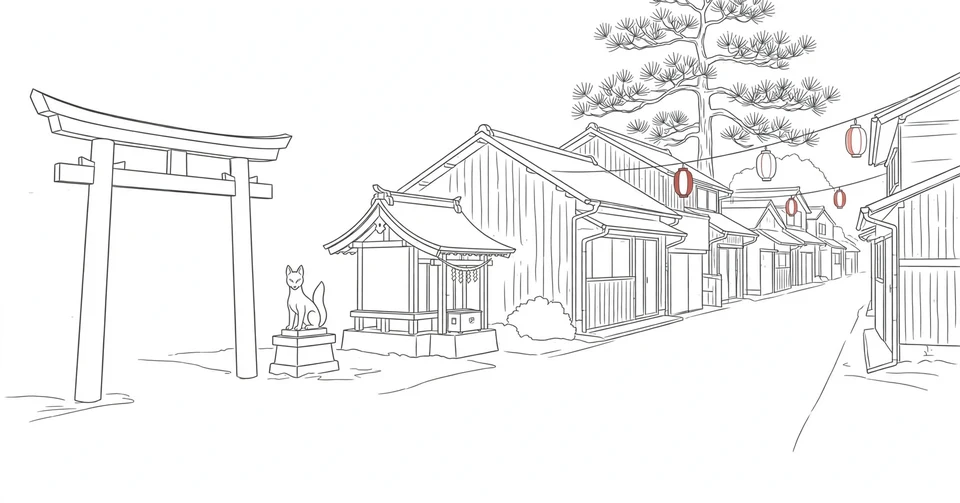
That sense of belonging is the heart of the idea. An ujigami does not belong to the whole country, and it does not belong to one famous family. It belongs to a street, a hillside, a farming village, or a block of houses, and the people who live there belong to it in return. When I first understood that, the small shrines I had walked past for years began to look different. They were not lesser versions of the great shrines. They were the original idea, kept at human scale, a god small enough in territory to know every house by name.
How an ujigami changed from clan god to neighbourhood god
The history of the ujigami is a story of a word that slowly changed its meaning while keeping its feeling. Kokugakuin University describes an ujigami as an ancient ancestral or tutelary deity of a clan or family, and notes that since the middle ages it has come to be viewed as the tutelary deity of a geographical area such as a village. That single sentence holds the whole shift. The god stayed, the people around the god changed, and the boundary moved from blood to place.
In the earliest form, an ujigami was the ancestor god of one clan. The clan believed that a founding ancestor watched over its descendants, protected their fields, and kept the family together. Worship was a family matter, tied to lineage and to the land the clan held. The exact origin is uncertain, and the term is believed to have first appeared in the eighth century, but the shape of the idea is clear enough. A group of related people shared one god, and that god gave the group its identity.
Then Japan changed. After the Heian period, the manorial system grew, and nobles, warriors, and temples held their own private land. The old family based society weakened, and belief in the ujigami as a clan god diminished for a time. Lords of the manors began to pray to deities to protect their land, and those guardian deities were called chinju. When the manorial system declined in the Muromachi period, those guardian deities were enshrined along with the ujigami, and the two ideas began to merge.
That merger is why the modern meaning feels both old and practical. An ujigami today is not usually the ancestor of everyone in the neighbourhood, because the people in a modern neighbourhood come from many families and many places. Instead, the ujigami is the god of the place itself, and anyone who lives there can belong to it. Kokugakuin puts it plainly, saying that ancestor worship continues to be a central characteristic of Shinto, and that it contributes to community solidarity with a spirit close to that of blood kinship. The blood tie has loosened, but the feeling of kinship has survived, transferred from the family to the street.
I find that transfer quietly hopeful. It suggests that belonging does not have to depend on being born into the right family. A newcomer who moves into a neighbourhood, learns its rhythms, and helps to sweep the shrine grounds can become part of the same circle of care. The god does not ask for a family tree. The god asks only that you live here, and that you take part.
What an ujigami actually does for a neighbourhood
An ujigami is prayed to for ordinary, practical things. People ask for protection from sickness, for success in their work and studies, and for good harvests. Those three requests, recorded in the standard account of the ujigami, sound old fashioned, but they translate easily into modern life. Protection from sickness is still a prayer for health. Success in endeavours is still a prayer for a job, an exam, or a small business. A good harvest is still a prayer that the work of the year will not be wasted.
The work of an ujigami is also social. The shrine gives a neighbourhood a centre that is not a shop, a school, or a government office. It is a place where people meet without needing a reason, where festivals mark the year, and where the same faces return again and again. In a farming village, that centre once organised the planting and the harvest. In a city district, it organises the festival, the clean up day, and the quiet visit on New Year morning. The god watches, but the people do the gathering, and the gathering is part of the protection.
There is a useful contrast here with the gods who visit the home. In the Japanese year, a household prepares carefully for Toshigami, the god who visits at New Year, and the family cleans the house and sets out offerings as if for a honoured guest. You can read about that careful preparation in Toshigami Is the Guest Japan Prepares the Whole House For. An ujigami is different in one simple way. Toshigami comes to the house for a season. An ujigami stays in the neighbourhood all year, in a shrine that belongs to everyone, and the relationship is steady rather than seasonal. One god visits, the other remains, and a household can honour both without confusion.
That steadiness matters in hard times too. When a neighbourhood faces illness, a bad harvest, or a disaster, the ujigami is the god people turn to together, not alone. The prayer is communal, and so is the work that follows. Neighbours check on each other, share food, and rebuild, and the shrine becomes a natural meeting point for that work. A god who belongs to one place gives that place a reason to act as one body, and that may be the most practical protection of all.
The ujiko, the people who belong to an ujigami
The people of an ujigami are called ujiko, which can be translated as children of the clan god, or more plainly as shrine parishioners. The word carries the same shift as the word ujigami itself. It once meant a member of a clan who claimed a common ancestral god. Kokugakuin explains that as the meaning of ujigami changed from a lineage to a more territorial idea, the term ujiko also came to refer to anyone who was born and lived in the area under the tutelage of the deity. Today, an ujiko is a person or a household that belongs to the parish of an ujigami, and that belonging brings both protection and obligation.
The relationship usually begins early. A baby is taken to the shrine of the family ujigami, or to a shrine in the region where the family lives, in a ritual called ujiko-iri, the entering into ujiko status. This is similar to miyamairi, the ritual that introduces a child to the ubusuna no kami, the kami of the region where the child was born, and it is common for one ubusunagami to also be the family ujigami. Because the distinction between the two has faded over time, it has become common for miyamairi to also serve as ujiko-iri, and shrines often issue an ujiko-fuda, a small slip that acts as proof that the child is an ujiko of that shrine.
Adults can enter the relationship too. It is common for a spouse who has newly entered a partner family to attend an ujiko-iri, so that the newcomer becomes an ujiko of the same ujigami as the new family. That detail matters, because it shows that ujiko status is not only inherited. It can be chosen, or at least accepted, when a person joins a household and a neighbourhood. A marriage does not only join two people. It joins one person to a place, a shrine, and a god.
Being an ujiko also means taking a share of the work. Traditionally, ujiko helped with shrine upkeep and with preparing festivals, and that duty was part of the bargain. Kokugakuin describes the ujiko kai as an organisation of ujiko for the purpose of shrine upkeep, usually joined by all residents of the parish, and governed by election from the membership, with a committee and a group of parish representatives called ujiko sodai. In practice, that means the shrine is not maintained by distant priests alone. It is maintained by the neighbours themselves, through a small local organisation that decides, collects, and organises together.
That arrangement has weakened in recent decades, and it is honest to say so. As worship of the ujigami has declined over the generations, it is common among families who are not actively engaged in shrine activities to stop thinking of themselves as ujiko at all. As the population engaged in shrine activities grows older and declines, fewer ujiko take part, and what had been an ujiko duty has in some places become little more than placing a kami seal or an ujiko charm in the household kamidana. The connection has thinned, but it has not disappeared, and the charm on the shelf is still a small sign that the household remembers which god watches its street.
How to recognise an ujigami shrine
Most ujigami shrines are not famous, and that is part of their character. They are the shrines you find at the end of a residential lane, behind a school, or on a small rise at the edge of a village. They are often called ujisha or ujiyashiro, a shrine dedicated to an ujigami, and their ujiko are generally from the local region. Some ujigami shrines do try to gather ujiko from further afield, through pilgrimages or through collaboration with companies for their matsuri, but most remain resolutely local.
A visitor can usually tell an ujigami shrine by its scale and its signs of daily care. The grounds are clean, but not polished for tourists. There is a small offering box, a rope and bell, and often a notice board with handwritten announcements about the next festival or clean up. The names on the stone lanterns and the plaques are local family names, repeated over generations. The sacred tree, if there is one, is old, and its rope marks a boundary that everyone in the neighbourhood understands without being told.
The enshrined kami varies. Some ujigami shrines honour a famous deity, such as Hachiman, the war god who is also the deified Emperor Ojin and the patron of the Minamoto clan. Others honour a local ancestor, a mountain kami, or a deity whose name is known only in that district. The identity of the kami matters less than the relationship. What makes the shrine an ujigami shrine is not the fame of its god, but the fact that the god watches one place and the people of that place watch the shrine in return.
If you visit, the respectful approach is simple, and it is the same as at any Shinto shrine. Bow once at the torii gate, wash your hands and mouth at the temizuya if there is one, bow twice, clap twice, make your wish quietly, and bow once more. Do not treat the shrine as a photo spot, and do not walk through the centre of the approach path, which is reserved for the kami. A small offering is welcome, but a quiet, unhurried visit matters more than the amount. The ujigami is a neighbour god, and neighbours notice tone more than ceremony.
Ujigami, ubusuna and chinju, three names that blur together
Anyone who reads about an ujigami soon meets two close cousins, ubusunagami and chinjugami, and the three names blur together in a way that can confuse a newcomer. The blur is not a mistake. It is the result of centuries of merging, and understanding it helps to understand the ujigami itself.
An ubusunagami is the god of the land of your birth. Kokugakuin defines the ubusuna no kami as the tutelary deity of your birthplace, and says that a newly born child is taken for a first visit to the shrine of this deity, who is believed to protect the person throughout life. People who move to other areas later still return to their native homes to participate in festivals for their ubusuna no kami, and they still consider themselves parishioners of that deity. Your ubusunagami follows you, in the sense that your birthplace stays yours even when you live far away.
A chinjugami is a god who has settled in a land to protect it and its people. In the manorial period, lords enshrined such guardian gods to protect their estates, and the name chinju marked that protective role. When the manorial system declined, those gods were enshrined alongside the ujigami, and over time the ubusunagami and the chinju came to be seen as the heart of the community, and were eventually referred to as ujigami. That is the careful summary given in the standard history, and it explains why a single local shrine can be described with any of the three words without being wrong.
In modern use, the terms are often treated as synonyms, and that is fine for everyday conversation. If you want to be precise, think of it this way. Your ubusunagami is the god of where you were born. Your chinjugami is the god who guards a piece of land. Your ujigami is the god of the community you belong to now, the one whose shrine stands in your neighbourhood and whose festival you are expected to join. The three can be the same kami, in the same shrine, under different names, and the overlap is a sign of how local religion grows, by layering new meanings onto old shrines rather than replacing them.
The detailed entry on the ujigami from Kokugakuin University keeps these definitions short, and that brevity is useful. It does not try to force the three ideas into a neat system, because Shinto itself does not force them. It lets them overlap, as they do in real neighbourhoods, where a family can honour a birthplace god, a land guardian, and a neighbourhood god in the same small shrine without feeling any contradiction.
The quiet work of keeping an ujigami alive
A shrine does not stay alive by itself. Someone has to sweep the leaves, repair the roof, organise the festival, and teach the children what the shrine is for. That work is usually done by the ujiko kai, and it is quieter than the work of a famous shrine. There is no large staff, no ticket office, and often no resident priest. There is a rota, a small fund, and a group of neighbours who take turns.
The festival is the most visible part of that work. On the shrine holy days, the ujiko gather, the portable shrine may be carried through the streets, and the god is understood to visit the dwellings of the ujiko. The festival is not only a religious event. It is a census of the neighbourhood, a moment when everyone can see who is still here, who has moved in, and who needs help. In that sense, the festival does the work of a village meeting, a reunion, and a prayer at the same time.
There are also smaller acts of care that outsiders rarely see. A neighbour leaves fresh water at the shrine in the morning. Another replaces the sacred rope when it frays. A family places the shrine charm in its kamidana, the household altar, and bows to it each morning before work. You can read about that household altar and its place in daily life in Kamidana, and the link between the home and the neighbourhood shrine becomes clear. The kamidana holds the charm of the ujigami, the shrine holds the god, and the street between them is the distance a prayer travels each day.
I think there is a lesson in that small distance. Modern life often measures importance by size, by visitor numbers, by fame. An ujigami measures importance by proximity. It matters because it is near, because it is yours, and because it has watched the same street through many seasons. That is a different kind of greatness, one that does not need to be famous to be real.
Why a small local god still matters in a big city
Since the 1960s, Japan has urbanised rapidly, and people have become less connected to their home shrine and their ujigami. Families move for work, apartment blocks fill with people from different regions, and the old parish boundaries blur. There have been attempts to reintroduce the ujigami to places such as apartment complexes, where many people live together who have come from different regions, and those attempts show that the idea is not dead, only displaced.
The challenge is real, and it is worth naming honestly. A person who rents a flat for two years, works long hours, and does not know the neighbours may never learn the name of the local ujigami, let alone join its festival. The shrine may sit one street away, unnoticed, while the resident travels across the city for work, shopping, and worship. The god has not moved, but the person has not arrived, in the deeper sense of belonging to a place.
Yet the need that created the ujigami has not gone away. Cities are full of people who want to belong somewhere smaller than a city and larger than a flat. A neighbourhood shrine offers exactly that scale. It gives a newcomer a first place to belong, a festival to join without needing an invitation, and a god who does not ask where you came from. The overview of the ujigami on Wikipedia notes this urban loosening, and also notes the attempts to bring the idea into apartment life, which suggests that the tradition is adapting rather than simply fading.
My own view is that the ujigami deserves that adaptation. A city that keeps its small shrines keeps a memory of what a neighbourhood is for. It keeps a place where a child can be welcomed, where a newcomer can be introduced, and where an old resident can be remembered. Those are not grand functions, but they are the functions that hold a street together, and a street that holds together is a safer, kinder place to live.
An ujigami is, in the end, a simple idea kept alive by simple acts. A god watches one neighbourhood. The people of that neighbourhood watch the shrine. A baby is introduced, a spouse is welcomed, a festival is held, a charm is placed in the home, and the year turns. Nothing in that list is spectacular, and that is the point. The ujigami does not promise the world. It promises one place, watched with care, and that promise, kept day after day, is enough to build a community on.
More in Culture & Society
- Japanese Pottery and the Six Kilns That Turned Clay into Culture
- Meijin Is the Title Every Karuta Player Dreams of Wearing
- Dazaifu Tenmangu Is Where Japan Still Prays to a Scholar God
- Sugawara No Michizane Became the God Students Still Pray To
- Wakamizu Is the First Water Japan Draws for Good Luck
- Kakizome Turns the First Brushstroke of the Year Into a Wish
Latest posts
- Japanese Kabuki and the Theatre That Paints Its Actors
- Omi Jingu Is Where Karuta Crowns Its Champions
- Hagoita-ichi Turns Asakusa Into a Forest of Paddles
- The Two Lives of Japanese Coffee
- Chihayafuru Made a Card Game Feel Like a Sport
- Oshi-e Hagoita Turns Silk Into a Picture You Can Touch
- Hyakunin Isshu Gave Karuta Its Hundred Poems
- Hagoita Is the Paddle Japan Turns Into New Year Art
- Takoage Sends New Year Wishes Up on a Paper Kite
- Hanetsuki Keeps New Year in the Air With a Wooden Paddle
- Japanese Stationery and the Small Tools Japan Takes Seriously
- Karuta Turns a Hundred Poems Into Japan's Fastest Card Game
- Hatsuyume Is the First Dream Japan Reads Like a Fortune
- Japanese Manga and How It Became the World's Most Read Comics
- Toshikoshi Soba Is the Long Noodle Japan Eats at Midnight