Kakizome Turns the First Brushstroke of the Year Into a Wish
· 13 min read
Kakizome is the Japanese tradition of writing the first calligraphy of the new year, usually on 2 January, when a single brushstroke becomes a wish for the months ahead.
On the second day of the new year, all across Japan, people pick up a brush and write. The paper is blank, the ink is freshly ground, and the first character they form is not a draft or a practice sheet. It is kakizome, the first writing of the year, and the words it carries are meant to last for twelve months.
Kakizome literally means first writing. Traditionally it is done on 2 January, and the writer chooses words that hold a hope for the year ahead: long life, spring, a dream, a fresh start. The act is slow and deliberate, because in calligraphy there is no undo button. Once the brush touches the paper, the stroke is final, and that finality is exactly the point.
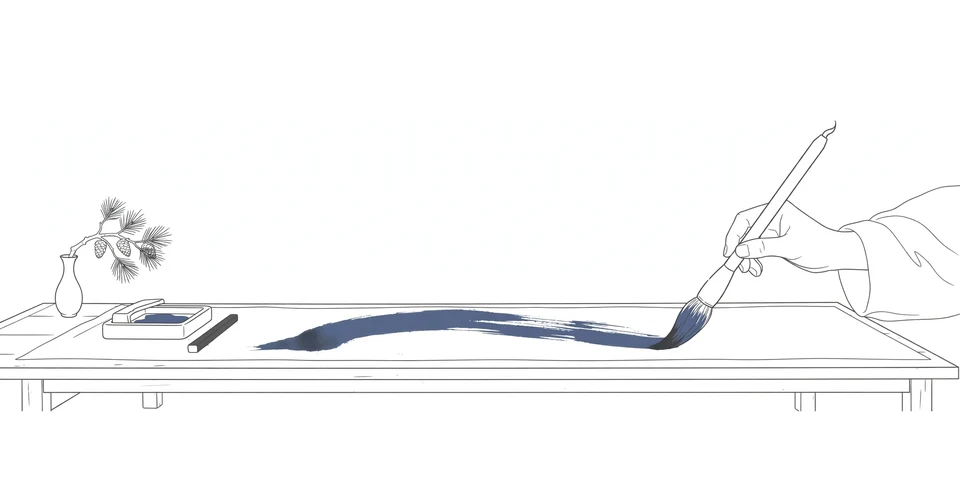
That is what makes kakizome different from a New Year resolution written on a phone. A resolution can be edited, deleted, or quietly forgotten by February. A sheet of kakizome sits on the wall or in a drawer, visible and unchangeable, and every time the writer sees it, the wish looks back. The tradition understands something that modern goal setting often forgets: a promise you can see is harder to abandon than a promise you only thought.
Where kakizome comes from
Kakizome began in the Imperial Court, long before it became a custom for ordinary people. Under the old lunisolar calendar, the kyureki, an official event marking the first day of work at court was held every 2 January, and writing poetry was part of how the court opened the year. The poems praised spring, long life, and the blooming of the world, and the writing itself was treated as a good omen for the months to come. The Wikipedia entry on kakizome gives the same outline, from the court ceremony to the school homework it later became.
The custom spread beyond the court during the Edo period, when terakoya temple schools taught reading and writing to the children of commoners. As literacy widened, so did kakizome, moving from palace halls into classrooms and family homes. What had been a court ceremony became a shared seasonal habit, and it has stayed one ever since.
In the early days, the writing was often done before an image of Sugawara no Michizane, the Heian period scholar and politician who came to be honoured as the god of scholarship. Michizane lived from 845 to 903, and after his death he was enshrined at Tenmangu shrines across Japan. Even today, kakizome events are held at Tenmangu shrines, and children's sheets are displayed on their walls, a quiet link between a thousand year old scholar and a child holding a brush for the first time.
The history of kakizome is therefore not only a story about calligraphy. It is a story about how a court ritual survived by becoming useful to ordinary people. The aristocrats wrote poems. Schoolchildren now write a single character. The form changed, but the idea did not: the first writing of the year should say something worth remembering.
How kakizome is traditionally done
The old way of doing kakizome began before the brush ever touched paper. The ink was rubbed with wakamizu, the first water drawn from the well on New Year's Day, which was believed to be pure and holy. The writer then sat facing eho, the fortunate direction for the year, a direction that changes with the zodiac. Only then did the writing begin.
The tools are the same four treasures used in all Japanese calligraphy: the fude brush, the sumi ink stick, the suzuri inkstone, and washi paper. The ink stick is ground against the stone with a little water, in slow circles, until the ink is dark and smooth. That grinding is part of the ritual, not a chore before it. It forces the writer to slow down, to breathe, and to arrive at the paper calm rather than rushed.
In the older tradition, the writer composed Chinese poetry full of auspicious words, phrases about long life, spring, or perennial youth. In modern times, most people write a single auspicious kanji character, or a short phrase, instead of a whole poem. The change suits the times. A poem needs training, but a single character needs only honesty, and honesty is what kakizome asks for.
There is a saying in Japan that calligraphy reflects the person. A shaky stroke shows a shaky hand, and a confident stroke shows a settled mind. Kakizome makes that saying literal. The first writing of the year is a portrait of the writer at the very start of the year, taken in ink, and it cannot be retouched. That is why the slow preparation matters. The grinding, the facing of the lucky direction, the choice of the word: all of it is the writer getting ready to be seen.
Kakizome in schools and in public today
For most Japanese schoolchildren, kakizome is not optional. Pupils up to senior high school are assigned kakizome as winter holiday homework, and they bring their best sheet back to school in January. The assignment is familiar enough that almost every adult in Japan has a memory of it, usually involving a kitchen table covered in newspaper, a parent warning them not to spill the ink, and a sheet that never looked quite as good as the one in their head.
The scale of the tradition is easy to underestimate. Tens of thousands of people take part each year, from elementary school pupils to professional masters of calligraphy, and the largest public gathering is the event organised by the All Japan Literature and Calligraphy Association at the Nippon Budokan in Tokyo. Several thousand calligraphers gather there each year in early January, writing together in a hall built for martial arts, and the event is widely covered by the media.
That public side of kakizome matters, because it keeps the tradition visible. A custom that only happened at home could fade quietly. A custom that fills a famous hall every January is hard to forget, and children who see it on television know that their homework is part of something much bigger than a school assignment.
I find something reassuring in the fact that kakizome survives as homework. Homework is rarely loved, and the calligrapher Ponte Ryurui, who has taken part in the Budokan event himself, admits that schoolchildren do not much enjoy the assignment. Yet the same children grow up, and many of them keep writing. A tradition does not need to be loved at ten years old to be valued at thirty. It only needs to be remembered, and a sheet of paper with your own handwriting on it is very hard to forget.
What people write, and why the word matters
The words chosen for kakizome are almost always hopeful. In the old poems, the favoured themes were long life, spring, and perennial youth. Today the most common choices are single kanji characters that name a wish: yume for dream, kibo for hope, ai for love, kenkō for health, or a word that names a personal goal, like a skill to master or a habit to build.
The choice is the heart of the practice. A kakizome sheet is small, usually a single sheet of paper, so there is no room for a long explanation. The writer must decide what matters most, and then say it in one or two characters. That forced brevity is a gift. Most of us carry a dozen vague wishes into a new year, and we act on none of them. Kakizome demands that we pick one, and picking one is the beginning of doing something about it.
There is also a quiet honesty in choosing a public word. A kakizome sheet is often displayed at home or at school, so the word is visible to family and classmates. Writing "health" on a sheet that hangs on the wall is a small act of accountability. It says, this is what I want, and I am willing to let other people see me want it. In a culture that often values restraint, that openness is part of the ritual's charm.
Some writers choose a word that describes the year they have just lived, and some choose a word for the year they want to live. Both are valid. The first kind is a record, the second kind is a promise, and kakizome holds both at once, because the brush does not distinguish between memory and hope. It only records what the hand does.
The fire that finishes kakizome
Kakizome does not end when the ink dries. Traditionally, the finished sheet is burned in the Sagicho festival, a bonfire held around the middle of January, where New Year decorations and old daruma figures are burned together with the calligraphy. The custom has different names in different regions, and one of the best known forms is the dondo-yaki fire, which closes the New Year season by burning the old year's decorations and carrying their smoke into the sky.
The belief attached to the burning is simple and lovely: if the paper flies high into the sky, the writer's handwriting will improve in the coming year. It is a superstition, of course, but it is a generous one. It turns the end of the ritual into a small moment of suspense, a sheet of paper rising on hot air while its writer watches from below, hoping it climbs.
The burning also gives kakizome a natural ending. The wish is written, displayed, and then released, which is a healthier cycle than keeping a resolution taped to a mirror until it yellows and becomes a reproach. The fire says that the wish has been made and the year has begun, and now the work belongs to the writer, not to the paper. That is a wise design for a ritual: it honours the wish without letting the wish do the work for you.
If you want to understand the fire itself, the story of dondo-yaki tells how the New Year season closes in flame, and the sheet of kakizome is one of the last things the fire takes. The two customs belong together, the writing and the burning, the wish and its release.
Choosing a word for your own year
You do not need to be a calligrapher to try kakizome. You need a brush or even a thick marker, a sheet of paper, and a word you can stand behind. The tradition is forgiving about tools and strict about only one thing: the word should be yours, not borrowed from someone else's list.
A few words that people often choose, and what they can mean in practice:
- Yume, dream, for a year when you want to aim at something larger than comfort.
- Kibo, hope, for a year that follows a hard one, when the wish itself is the achievement.
- Ganbaru, to do one's best, for a year of steady effort rather than a single big event.
- Yasuragi, peace of mind, for a year when calm matters more than ambition.
The list above is only a starting point, and it should not be treated as a menu. The right word is usually the one that makes you slightly uncomfortable, because it names something you have been avoiding. If every word on a list feels safe, none of them is the word yet. Keep thinking until one of them feels like a promise you are a little afraid to keep, and then write that one.
That advice sounds simple, but it is the hardest part of kakizome, and it is the part that has nothing to do with brush technique. Choosing the word is the ritual. The writing is only how you say it out loud. Anyone can learn the strokes of a character in an afternoon. Learning what you actually want takes longer, and January is a good month to do that learning, because the year is still empty enough to hold it.
Why one character can carry a whole year
There is a reason kakizome has survived for more than a thousand years while countless other New Year customs have faded. It is small, it is cheap, and it asks for something real. It does not require a shrine visit, a purchase, or a crowd. It requires a brush, a sheet of paper, and a moment of honesty, and those are available to almost anyone.
The tradition also understands how memory works. We forget lists, we forget apps, and we forget the resolutions we whisper to ourselves on New Year's Eve. We remember things we make with our hands. A sheet of kakizome is a handmade object, and handmade objects lodge in the memory in a way that typed text does not. Months later, when the year has become busy and the wish has become distant, the sight of that sheet can bring it back in a single glance.
I think there is also something quietly brave about writing a wish where it cannot be erased. Modern life trains us to keep our options open, to draft and revise and never commit. Kakizome goes the other way. It says: choose, write it down, and live with the choice. The ink dries, the paper is displayed, and the writer must meet their own words every day until the fire takes them. That is not a punishment. It is a form of respect, for the wish and for the person who made it.
The same spirit runs through the rest of the New Year season. The pine branches of the kadomatsu guard the door while the year is welcomed in, and the kadomatsu stands watch until the same fire that burns the kakizome closes the season. The decorations, the writing, and the burning are all part of one long sentence, spoken by a whole country at the start of the year, and kakizome is the word in that sentence that belongs to you alone.
If you ever spend a New Year in Japan, try it. Grind the ink slowly, pick a word that scares you a little, and write it as well as you can. Then hang the sheet where you will see it. You may find, as many writers before you have found, that the first brushstroke of the year is not a decoration. It is a decision, made in ink, and the year that follows has a way of remembering what you decided.
More in Culture & Society
- Japanese Pottery and the Six Kilns That Turned Clay into Culture
- Meijin Is the Title Every Karuta Player Dreams of Wearing
- Dazaifu Tenmangu Is Where Japan Still Prays to a Scholar God
- Sugawara No Michizane Became the God Students Still Pray To
- Wakamizu Is the First Water Japan Draws for Good Luck
- Ujigami Is the Guardian God Who Watches Over One Neighbourhood
Latest posts
- Japanese Kabuki and the Theatre That Paints Its Actors
- Omi Jingu Is Where Karuta Crowns Its Champions
- Hagoita-ichi Turns Asakusa Into a Forest of Paddles
- The Two Lives of Japanese Coffee
- Chihayafuru Made a Card Game Feel Like a Sport
- Oshi-e Hagoita Turns Silk Into a Picture You Can Touch
- Hyakunin Isshu Gave Karuta Its Hundred Poems
- Hagoita Is the Paddle Japan Turns Into New Year Art
- Takoage Sends New Year Wishes Up on a Paper Kite
- Hanetsuki Keeps New Year in the Air With a Wooden Paddle
- Japanese Stationery and the Small Tools Japan Takes Seriously
- Karuta Turns a Hundred Poems Into Japan's Fastest Card Game
- Hatsuyume Is the First Dream Japan Reads Like a Fortune
- Japanese Manga and How It Became the World's Most Read Comics
- Toshikoshi Soba Is the Long Noodle Japan Eats at Midnight