Hagoita-ichi Turns Asakusa Into a Forest of Paddles
· 12 min read
Every December, hagoita-ichi fills the grounds of Senso-ji temple in Asakusa with around 50 stalls selling nothing but decorated New Year paddles, a year-end market that has run for centuries.
For three days in December, the grounds of Senso-ji temple in Asakusa stop looking like a temple courtyard and start looking like a forest. Row after row of stalls rise under the winter sky, and every one of them is hung with paddles. Painted faces stare out from the wood, silk kimonos catch the light, and the whole market hums with the sound of people choosing a piece of luck to carry into the new year. That is hagoita-ichi, the paddle market, and it is one of the clearest signs in Tokyo that the year is ending.
The market runs every year from December 17 to 19, and it draws around 300,000 visitors across those three days. About 50 stalls take part, and they sell nothing but hagoita, the decorated wooden paddles that began life as the rackets of hanetsuki, a New Year game a little like badminton. The paddles are no longer really for playing. They have become ornaments, gifts, and good luck charms, and the market is where Japan comes to buy them.
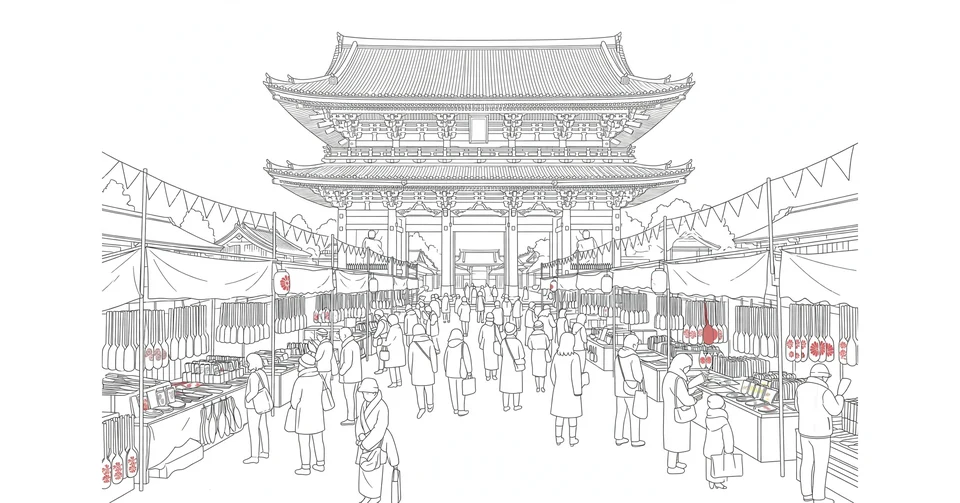
What makes the market worth a visit is not only the shopping. It is the feeling that a whole neighbourhood has agreed to slow down and look at beautiful things together. Asakusa is always busy, but during hagoita-ichi the crowd moves differently. People stop, point, compare one paddle with the next, and talk to the stallholders about the faces on the wood. In a city that usually hurries, that unhurried attention feels like part of the tradition itself.
What hagoita-ichi actually is
The full name of the event is Senso-ji Toshi-no-Ichi, which means the year-end market of Senso-ji, and hagoita-ichi is the paddle market at its heart. Toshi-no-ichi are the fairs that temples and shrines hold as the year closes, selling New Year decorations and lucky charms, and Senso-ji has held one for centuries. The market grew up around December 18, the last Kannon fair day of the year at the temple, a day known as Osame no Kannon. The fair day of Kannon, the temple's principal image, falls on the 18th of every month, and the December one closes the year, so the market gathered around it like a crowd around a fire.
The market began around 350 years ago, during the Edo period, and one account puts its unbroken history at about 360 years, continuing even through the Great Kanto Earthquake and the war years. That kind of continuity is rare, and it is worth pausing over. Markets come and go with fashion, but hagoita-ichi has survived earthquakes, wars, and every change in how Tokyo shops. The reason, I think, is that it never tried to be anything other than what it is: a place where a neighbourhood buys its luck for the year ahead, face to face, from people who made the thing they are selling.
In the Edo period, paddles painted with the faces of kabuki actors were already being sold at hagoita-ichi, and by the late Edo period the hagoita stalls had become the most visible part of it. The custom of giving a hagoita to a family where a girl had been born spread through those years, and by the middle of the Showa era the fair was widely known as the paddle market, and hagoita-ichi was the name that stuck. People came for the paddles, and the paddles carried the year with them.
A forest of paddles, from kabuki to the evening news
Step into hagoita-ichi and the first thing you notice is the scale of the display. The Tokyo craft registry describes the stalls as holding an amazing number of colourful paddles that look out on interested visitors, and that is exactly right. The paddles are hung in dense rows, face after face, until the stall itself seems to be made of portraits. A paddle can be as long as 180 centimetres or as short as 18 centimetres, and prices run from 1,000 yen to hundreds of thousands of yen. The most popular size is around 60 centimetres, and those typically cost around 60,000 yen.
The stars of hagoita-ichi are the oshi-e hagoita, the padded collage paddles. Their pictures are built up from silk and cotton cloth stuffed with cotton wadding, so the figures stand out from the wood in soft relief. Kabuki actors are the classic subject, and the most beautiful paddles still show famous scenes from the stage, with the actor's face rendered in fine detail. The oshi-e technique is what turns a flat piece of paulownia wood into something that looks alive, and at the market you can see the full range of it, from small desk ornaments to grand wall pieces.
But the market is not a museum. Next to the kabuki actors you will find faces from the year's films, television shows, and sporting triumphs. The stalls carry novelty paddles that show the year's news and celebrities, and each stall has different designs and kimono patterns, so simply browsing is a pleasure. This is the part of hagoita-ichi that I find most charming. The craft is old, but the subject matter is always new, and a paddle bought this year will record who mattered in this particular year. Collectors return every December for exactly that reason, and a wall of old paddles reads like a small, silent history of Japanese popular culture.
There is something honest about a tradition that updates itself this way. Many old crafts freeze at the moment they became famous, and then slowly turn into souvenirs of themselves. The paddle makers of hagoita-ichi do the opposite. They keep the technique and change the subject, so the market stays a record of the present rather than a performance of the past.
How an oshi-e paddle is made
The craft behind the finest paddles at hagoita-ichi is Edo oshi-e hagoita, a designated traditional craft of Tokyo since July 15, 1985. The paddle itself is paulownia wood, light and fine grained, and the picture is built on it layer by layer. Cotton wadding is stuffed between a stencil outline and a fabric base to create the raised collage, and the finished oshi-e is fixed to the paddle with paste applied by spatula. Silk and cotton textiles make the clothes, silk thread makes the hair, and the face is smoothed with successive layers of gofun, a powder made from crushed seashell, before a fine brush paints in the eyes, the mouth, and the nose.
The work is slow and exacting, and the makers study the real thing before they draw it. According to the Tokyo craft registry, design craftsmen work on their plans after seeing the actual dramas staged, because it is difficult to reproduce scenes from traditional dance and kabuki and to express their movement. They use the full area of the near-trapezoidal board, and they concentrate on the face, because the face is where the paddle comes alive. Fashions change on the dolls' faces from year to year, and the makers chase beauty and vivid expression rather than settling into a single formula.
This is also why the best paddles at hagoita-ichi cost what they do. A 60-centimetre paddle is not expensive because of the wood. It is expensive because a person spent days building a small, three-dimensional picture out of cloth and cotton, painting a face the width of a thumb, and getting the expression right. When you stand in front of a stall at hagoita-ichi and look closely, you can see that labour in the curve of a sleeve and the tilt of a head. The price is simply the honest cost of that kind of attention.
The market as a mirror of the year
There is an old idea in the paddle trade that an actor's likeness on a hagoita was once a measure of popularity. The Tokyo craft registry puts it plainly: as each year drew to a close, there used to be competitive demand for the role depictions of that year's popular kabuki stars, and the sale of actor paddles acted as a barometer of how popular an actor was in any particular year. Walk through hagoita-ichi with that in mind and the market changes. It stops being a row of shops and becomes a kind of vote, cast in silk and wood, for who the year belonged to.
That is the deeper pleasure of hagoita-ichi, and it is why I think it has lasted so long. Japan has no shortage of ways to look back at a year. There are awards shows, best-of lists, and retrospectives on every channel. But hagoita-ichi does it differently. It does not rank the year or argue about it. It simply shows you the faces, hung side by side, and lets you feel which ones the crowd gathered around. A paddle is a strange object for that job, a wooden board with a padded picture on it, yet it works, because the choice of a face is a choice made with money and with the wall of a home in mind. Nobody buys a paddle of someone they do not care about.
The habit of giving hagoita as a gift fits the same pattern. The paddles began as a prayer for the sound health of girls, presented on birthdays and at New Year, and they are still given to celebrate a baby girl and to wish a household well. The shuttlecock of the old game was thought to resemble a dragonfly, an insect that eats harmful pests, so the paddle carried a wish that evil would be kept away. A gift bought at hagoita-ichi is not really about the object. It is about saying, in a form that can hang on a wall, that you want the year ahead to be kind to someone.
Going to hagoita-ichi
The practical details of visiting hagoita-ichi are simple, and that is part of the appeal. The market is held in the grounds of Senso-ji temple, about five minutes on foot from Asakusa station, and entry to the grounds is free. Hours are 9:00 to 19:30, with the last day closing at 19:00, so an early visit is the calmest way to see the stalls properly. The full listing of dates and hours is worth checking before you go, since details can change, and the last day is always the busiest.
| Dates | December 17 to 19, every year |
| Hours | 9:00 to 19:30, last day to 19:00 |
| Place | Grounds of Senso-ji temple, Asakusa, Tokyo |
| Nearest station | Asakusa, about 5 minutes on foot |
| Entry | Free |
| Stalls | Around 50, selling hagoita and New Year goods |
| Visitors | Around 300,000 across the three days |
Go with no plan beyond looking. The stalls of hagoita-ichi are not laid out like a shop, and the best way to enjoy them is to drift from one to the next and let a face stop you. Prices vary by stall and size at hagoita-ichi, and there is no official price list, so ask the stallholder if you are curious. If you do buy a paddle, the sellers send you off with rhythmic hand-clapping, a small ceremony that turns a purchase into a farewell. There are also demonstrations and workshops by traditional craftspeople, and the preservation society sells a zodiac hagoita that is available only during the market. The zodiac paddle is a good reminder that the market is not only a place to shop. It is also a place where the craft is kept alive in public, by the people who practise it.
One piece of advice is worth carrying into the crowd. Do not rush the first stall you reach at hagoita-ichi. The paddles repeat their subjects from stall to stall, but the quality of the work does not repeat, and the difference between a good face and a great one is visible once you have looked at ten of them. Give yourself an hour, look at everything, and then go back to the paddle that stayed in your mind. That is the one worth carrying home.
A market that keeps the year honest
Hagoita-ichi endures because it does two things at once that rarely sit together. It preserves a craft that is centuries old, with techniques that have barely changed since the Edo period, and it stays current, because every December the stalls must answer the same question: who mattered this year? The paddle makers cannot hide behind tradition. They have to watch the stage, the screen, and the sports pages, and then make something beautiful out of what they saw.
The paddle itself began as a toy for a New Year game, became a gift for a newborn girl, and then became a small record of popular culture. That is a lot of history for a wooden board to carry, and the market carries it lightly, with noise and colour and crowds and hand-clapping. If you are in Tokyo in mid-December, go to hagoita-ichi and stand in the grounds of Senso-ji while the paddles look out at you. You will leave with a clearer sense of the year that is ending, and of the one about to begin, than any list of the year's events could give you.
More in Culture & Society
- Japanese Pottery and the Six Kilns That Turned Clay into Culture
- Meijin Is the Title Every Karuta Player Dreams of Wearing
- Dazaifu Tenmangu Is Where Japan Still Prays to a Scholar God
- Sugawara No Michizane Became the God Students Still Pray To
- Wakamizu Is the First Water Japan Draws for Good Luck
- Kakizome Turns the First Brushstroke of the Year Into a Wish
Latest posts
- Japanese Kabuki and the Theatre That Paints Its Actors
- Ujigami Is the Guardian God Who Watches Over One Neighbourhood
- Omi Jingu Is Where Karuta Crowns Its Champions
- The Two Lives of Japanese Coffee
- Chihayafuru Made a Card Game Feel Like a Sport
- Oshi-e Hagoita Turns Silk Into a Picture You Can Touch
- Hyakunin Isshu Gave Karuta Its Hundred Poems
- Hagoita Is the Paddle Japan Turns Into New Year Art
- Takoage Sends New Year Wishes Up on a Paper Kite
- Hanetsuki Keeps New Year in the Air With a Wooden Paddle
- Japanese Stationery and the Small Tools Japan Takes Seriously
- Karuta Turns a Hundred Poems Into Japan's Fastest Card Game
- Hatsuyume Is the First Dream Japan Reads Like a Fortune
- Japanese Manga and How It Became the World's Most Read Comics
- Toshikoshi Soba Is the Long Noodle Japan Eats at Midnight