Omi Jingu Is Where Karuta Crowns Its Champions
· 15 min read
Omi Jingu in Otsu, Shiga Prefecture, is the shrine where Japan crowns its karuta champions every January, in honour of Emperor Tenji and the first poem of the Hyakunin Isshu.
Every January, the fastest card game in Japan slows down to a single sound. A reader's voice, one syllable, and then a hand moving across tatami before the other player has time to think. The place where that sound matters most is Omi Jingu, a shrine in Otsu, in Shiga Prefecture, where the national karuta championships decide who wears the titles of Meijin and Queen.
The shrine is not ancient in the way most famous Japanese shrines are ancient. It was built in 1940, which makes it younger than many of the houses around it. Yet the emperor Omi Jingu honours lived more than thirteen centuries ago, and the poem that ties the shrine to the game was written in the seventh century. Omi Jingu is a modern building holding a very old idea, and that contrast is part of its charm.
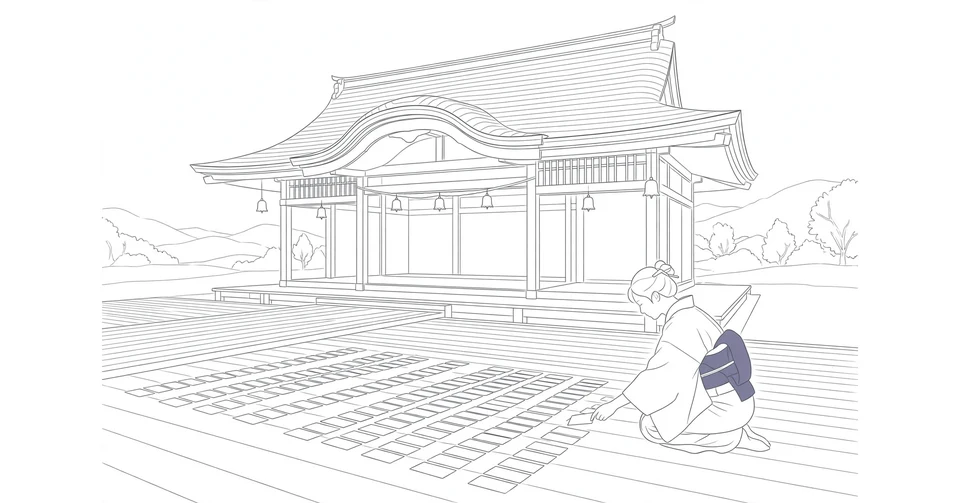
This article looks at the shrine itself, the emperor it honours, the championship that fills its hall each January, and the quieter reasons the place is worth a visit in any season. The game Omi Jingu hosts is played with a hundred poems, and those poems are the reason Omi Jingu exists in this form at all.
The shrine that holds the first poem
Omi Jingu is dedicated to Emperor Tenji, who reigned from 661 to 672. Tenji moved the Japanese capital from Asuka to Otsu in 667, to the western shore of Lake Biwa, and the shrine stands near the site of that short lived capital. He is also the author of the first poem in the Hyakunin Isshu, the anthology of one hundred waka poems by one hundred poets that forms the basis of the card game. The connection is simple and complete. The anthology opens with Tenji, so Omi Jingu, the shrine that honours Tenji, became the natural home of the game.
The poem itself is about an autumn field. In translation it runs: "In autumn paddies under the temporary dwelling made of rushes, my sleeves are wet with the dew." It is a ruler imagining the hardship of farmers, and it has opened the anthology for eight centuries. For the full story of how that collection was made, and why one poem from each of one hundred poets proved so durable, see Hyakunin Isshu Gave Karuta Its Hundred Poems.
The link between the poem and Omi Jingu is carved into the grounds. Among the thirteen poem monuments at Omi Jingu, one carries Tenji's verse in stone, so a visitor can stand in front of the words that open the game. It is a small thing, a stone with writing on it, and it does more than any signboard could. It shows that the shrine treats the poem as part of its history, not as a decoration borrowed from somewhere else.
I find that grounding worth pausing on. A championship needs a place, and most places are chosen for size or convenience. Omi Jingu was chosen, in a sense, by a poem. The first verse of the anthology pointed at Tenji, Tenji pointed at Otsu, and Otsu pointed at the shrine. The chain is eight centuries long and Omi Jingu still holds it.
A shrine built in 1940 for a seventh century emperor
The idea of a shrine to Emperor Tenji was first considered by the Japanese Diet in 1908, but the building itself came much later. Construction started in 1937 and was finished on November 7, 1940. That makes Omi Jingu a twentieth century shrine with a seventh century subject, and the gap is visible in the architecture. The main gate and buildings are painted a warm red, the halls are built in the Omi-zukuri style, and the complex of Omi Jingu sits inside a large forest that softens the whole place. According to the history of Omi Shrine, the shrine was formerly an imperial shrine of the first rank, and its pavilions are listed among the Registered Tangible Cultural Properties of Japan.
The forest around Omi Jingu matters more than it might sound. A shrine surrounded by trees is a quiet place, and karuta needs quiet. The game is played in the gap between hearing and touching, and noise would ruin it. The trees were not planted for the game, but they serve it, and I suspect that is one reason the championship feels so different from a tournament in a sports hall. The setting does half the work of the atmosphere.
Tenji is remembered at Omi Jingu for more than poetry. He also presided over the establishment of the first rokoku, or Japanese water clock system, which was installed in 671. The shrine keeps that memory alive in a clock museum on its grounds, the Tokei Museum, which displays clocks centred on the water clock and on traditional Japanese timekeeping. There is a replica of the rokoku itself, along with sundials and an ancient fire clock, so a visitor can walk from a poem to a piece of engineering in the space of a few minutes.
That pairing, a poem and a clock, says something about how the shrine sees its emperor. Tenji is honoured as a ruler who measured things: the seasons in a verse, the hours in dripping water, and the law in the Omi Code, the first Japanese legal code, which is also associated with his reign. A shrine that keeps both a poem monument and a clock museum is telling you that its deity was interested in how time passes, and that the two ways of measuring it, verse and water, belong together. I think that is a generous way to remember a ruler, and a more honest one than a statue alone.
How the title matches work
The national championship at Omi Jingu decides the two great titles of competitive karuta. The men's champion is awarded the title of Meijin, given since 1955, and the women's champion is awarded the title of Queen, given since 1957. A challenger who has won through the qualifying rounds faces the reigning champion, and the two play a series of matches until one of them has won the title. The format is simple to describe and hard to survive, because a single mistake, touching the wrong card at the wrong moment, can hand a card to the opponent.
The game itself is played on tatami, with the cards laid in three rows before each player. Fifty cards are chosen at random from the hundred, and each player takes twenty five of them. The players are given fifteen minutes to memorise the position of every card on both sides of the mat, and then the reader begins. The reader reads the first half of a poem aloud, and the players race to find the card carrying the second half. For the full rules, the history of the game, and the famous trio of poems that begin with the sound chi, see Karuta Turns a Hundred Poems Into Japan's Fastest Card Game.
What makes the title matches at Omi Jingu different from an ordinary tournament is the weight of the occasion. A challenger does not just have to be faster. The challenger has to beat a champion who has already won this match before, in this hall, in front of these people, and who knows exactly how the silence feels. The champion, meanwhile, has to defend a title that the whole sport is watching. That pressure is visible in the way the players sit, still and low, waiting for a syllable they have heard a thousand times in practice and never quite like this.
A seven time grand champion is known as an Eternal Master, a title that shows how rare sustained dominance is in this game. The names that reach that level are few, and they are remembered the way other sports remember their greats. The difference is that karuta crowns its champions in Omi Jingu, in January, in silence, with a hundred poems as the only equipment that matters.
Omi Jingu in January
The championship at Omi Jingu takes place every January, on the first Saturday and Sunday after the New Year holiday, when the shrine is also busy with first visits of the year. The title matches are played in the Omi Kangakukan, a hall beside the shrine, and the high school championship follows in July. The January dates matter. The game began as a New Year pastime, played in homes when families gathered, and the championship keeps that season even at the highest level of the sport.
The most recent champions show how young the top of the sport can be. Seira Yajima, a first year student at Keio University, won the 70th Queen title match and defended her title for the first time, a result reported by Keio University as the pinnacle of competitive karuta. She had won the Queen title as a high school senior in the 69th title match, held on January 11, 2025, and then held it against a challenger who had won through the qualifiers. Her comment after the win was modest and practical. She thanked the seniors who prepared her practice environment and the teachers who supported her, and she said she wanted to keep sharing the appeal of the game. That is the voice of a champion who is nineteen and already defending a national title.
January at Omi Jingu is cold, and the hall is quiet in a way that makes the cold easy to forget. The players kneel, the reader reads, and the audience watches without speaking. A visitor who comes for the matches should expect that silence and respect it. It is not the silence of an empty room. It is the silence of hundreds of people paying attention to the same sound at the same time, and it is one of the most impressive things about the place.
The clock museum and the water clock festival
The water clock is not a footnote at Omi Jingu. It has its own museum, its own festival, and its own place in the shrine's calendar. The Rokoku-sai, the water clock festival, takes place around June 9 and 10, the days when the first water clock is thought to have been installed, and the preceding day features a tea ceremony performed by the grand tea master of the Urasenke school. A shrine that holds a tea ceremony for a clock is a shrine that takes time seriously in more than one sense.
The museum at Omi Jingu is worth a slow visit. The rokoku worked by dripping water from one vessel to another at a steady rate, and the level of the water told the time. It is a simple idea and a hard one to make reliable, which is why the first installation in 671 was an achievement worth remembering. Standing in front of the replica, it is easy to forget how new the idea of measured hours was in seventh century Japan. People had the sun, the seasons, and the temple bell. A clock that dripped was something else entirely, a machine for dividing the day into pieces small enough to plan around.
There is a quiet parallel here with the game Omi Jingu hosts. Karuta is also a game about small divisions of time, about hearing a syllable and moving before the other player does. The difference between winning and losing can be a fraction of a second, and the players train for years to shorten it. A shrine that honours the man who brought the water clock to Japan, and that crowns the fastest listeners in the country, has chosen its two subjects well. Both are about paying attention to a moment as it passes, and both reward the person who notices first.
July belongs to the high school players
If January belongs to the champions, July belongs to the students. The national championship for high school students is held every July at Omi Jingu, and it is often called the karuta Koshien, after the famous high school baseball tournament. The comparison is fair. Both are national school championships with long histories, devoted followings, and finals that people remember for years. The difference is that the karuta championship is played in silence, with poems instead of pitches.
The high school tournament is the event dramatised in Chihayafuru, the manga by Yuki Suetsugu that brought competitive karuta to a new generation. Serialised from December 2007 to August 2022 and collected in fifty volumes, the series has more than twenty seven million copies in circulation. It follows a high school girl, Chihaya Ayase, who takes up the game after a classmate introduces her to it, and it treats the sport with the seriousness of any other sports story: training, rivals, injuries, and the long road to the national championship at Omi Jingu.
The title comes from poem 17 in the Hyakunin Isshu, by Ariwara no Narihira, which begins with the word chihayaburu. It is one of three poems in the collection that begin with the sound chi, and players must wait to hear more before they can tell the three apart. Naming a manga after a single word from a single poem was a bold choice, and it worked, because readers learned the poems alongside the heroine. Some of those readers went on to join clubs and play for real, and the first international tournament was held in September 2012, with players from the United States, China, South Korea, New Zealand, and Thailand taking part.
The July tournament at Omi Jingu has a different energy from the January matches. The players are younger, the cheering is louder in the corridors outside the match rooms, and the stakes are personal in a way that a professional title is not. A high school player has three summers, at most, and then the team is gone. That limit gives the tournament its feeling. It is a championship and a farewell at the same time, and the shrine holds both without making a fuss about either.
Visiting Omi Jingu
Omi Jingu is located near Omijingumae Station, on the Keihan Ishiyama-Sakamoto Line, and Otsu is a short ride from Kyoto, which makes the shrine an easy day trip. The grounds are open and walkable, and a visit does not need a match day to be worthwhile. The romon tower gate, the poem monuments, the clock museum, and the forest paths are there all year, and on an ordinary weekday the place is quiet enough to hear the gravel underfoot.
A good visit starts at the first torii and follows the approach through the trees to the main hall. The thirteen poem monuments are scattered around the grounds, and finding them is a slow pleasure, a little like the game itself. Each stone carries a verse, and each verse rewards a reader who stops to sound it out. The clock museum is a short walk from the main hall, and the Omi Kangakukan stands beside the shrine, its tatami rooms empty and waiting between tournaments.
Omi Jingu also holds its annual Reisai festival on April 20, the anniversary of Otsu becoming the capital during Tenji's reign, and the Kangaku-sai festival on March 1, which honours Tenji as a promoter of learning. These are quieter occasions than the karuta championships, and they show the other side of the shrine, the side that belongs to the neighbourhood rather than to the sport. A visitor who comes for the poems and stays for a festival will see both.
If you visit, go without a schedule and let the grounds set the pace. Sit for a while near the main hall, walk the forest path, and read the poem stones one by one. The shrine is not large, and it does not need to be. Its subject is a single emperor, a single poem, and a single game, and it treats all three with the same care.
A shrine, a clock, and a hundred poems
Omi Jingu works because it does not try to be more than it is. It honours one emperor, keeps one clock, and hosts one game, and it does all three with a seriousness that would be easy to miss on a quick visit. The shrine was built in 1940, which is recent by Japanese standards, but the things it protects are old: a poem from the seventh century, a way of telling time from the same century, and a game that has carried a hundred poems from a villa wall to a championship hall.
The lesson of the place is a quiet one. Traditions do not survive because they are guarded. They survive because they are used, and Omi Jingu is a place where an old tradition is used every year, in public, by people who have given their youth to it. The champions kneel on the tatami, the reader reads, and a syllable decides who takes the card. Then January ends, the hall empties, and the shrine goes back to being a quiet place in a forest above Lake Biwa, waiting for July, and then for January again.
That rhythm is worth respecting. Omi Jingu crowns champions and keeps a water clock, and it is telling its visitors the same thing in two ways: that time passes, that it can be measured, and that the best use of it is to pay attention. A hundred poems, a dripping clock, and a silent hall are three ways of saying the same thing, and Omi Jingu keeps all three in one place.
More in Culture & Society
- Japanese Pottery and the Six Kilns That Turned Clay into Culture
- Meijin Is the Title Every Karuta Player Dreams of Wearing
- Dazaifu Tenmangu Is Where Japan Still Prays to a Scholar God
- Sugawara No Michizane Became the God Students Still Pray To
- Wakamizu Is the First Water Japan Draws for Good Luck
- Kakizome Turns the First Brushstroke of the Year Into a Wish
Latest posts
- Japanese Kabuki and the Theatre That Paints Its Actors
- Ujigami Is the Guardian God Who Watches Over One Neighbourhood
- Hagoita-ichi Turns Asakusa Into a Forest of Paddles
- The Two Lives of Japanese Coffee
- Chihayafuru Made a Card Game Feel Like a Sport
- Oshi-e Hagoita Turns Silk Into a Picture You Can Touch
- Hyakunin Isshu Gave Karuta Its Hundred Poems
- Hagoita Is the Paddle Japan Turns Into New Year Art
- Takoage Sends New Year Wishes Up on a Paper Kite
- Hanetsuki Keeps New Year in the Air With a Wooden Paddle
- Japanese Stationery and the Small Tools Japan Takes Seriously
- Karuta Turns a Hundred Poems Into Japan's Fastest Card Game
- Hatsuyume Is the First Dream Japan Reads Like a Fortune
- Japanese Manga and How It Became the World's Most Read Comics
- Toshikoshi Soba Is the Long Noodle Japan Eats at Midnight