Fuchi Is the Collar That Frames a Katana Grip
· 17 min read
A fuchi is the small metal collar at the front of a katana handle, and though it is only a few centimetres wide, it protects the grip, frames the wrapping, and often carries the finest art on the whole sword.
Hold a katana by its handle and run your hand from the guard toward the grip. The first thing your fingers meet after the metal of the guard is a slim metal collar, a ring only a few centimetres wide that sits at the very front of the handle. That collar is the fuchi, and it is one of the most quietly important parts of the whole sword.
The fuchi frames the wrapped grip the way a picture frame frames a painting. It marks where the guard assembly ends and the handle begins, it protects the mouth of the wooden handle core, and it gives the first turns of the cord wrapping a clean edge to start from. Without it, the front of the handle would look raw and unfinished, and the grip itself would be weaker.
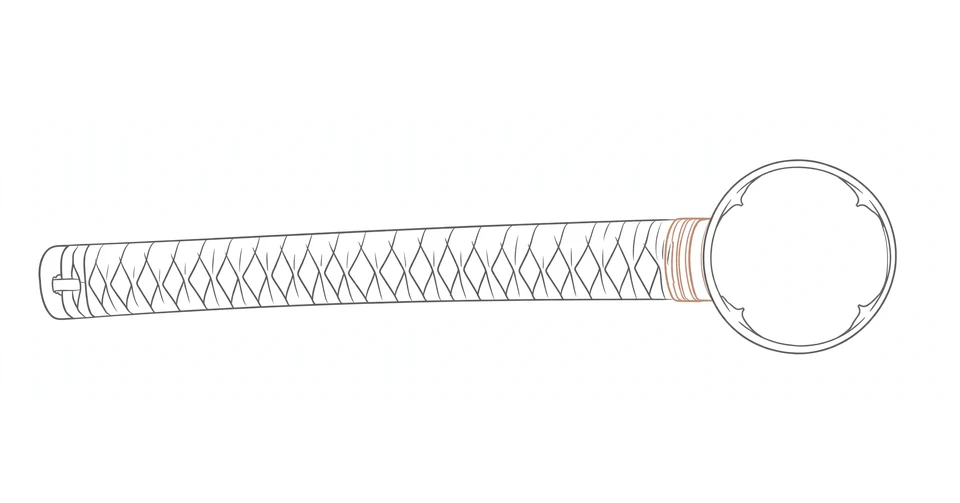
Most people who admire a katana start with the blade, and that is fair. The blade is the soul of the sword. But the collar is where the sword shows how much its makers cared about the parts nobody was meant to stare at, and that is exactly why it is worth a closer look. This little collar rewards the person who slows down and studies the small things, because in a few centimetres of metal it holds the whole philosophy of Japanese sword mounting: strength and beauty in the same piece, with nothing wasted.
What a fuchi actually does
A fuchi is the metal collar fitted at the front of the tsuka, the wrapped handle of a Japanese sword. It sits directly behind the tsuba, the hand guard, and it forms the transition point between the guard assembly and the wrapped grip. The standard description of Japanese sword mountings puts it plainly: the fuchi is a hilt collar between the tsuka and the tsuba, and it is a cap type collar or ferrule which covers the opening in the tsuka, with the tang of the sword passing into the handle through the opening in the fuchi.
Its first job is protection. The wooden core of the handle must fit securely around the tang of the blade, and the front opening of that core is a vulnerable point. The collar covers that opening and strengthens it, so the mouth of the handle does not split or fray with use. At a point where pressure, handling, and wear naturally concentrate, the collar acts as a small shield for the wood beneath it.
Its second job is to create a clean transition. Without it, the front of the handle would look unfinished, a raw wooden edge meeting a metal guard with nothing in between. The fitting gives the sword a strong visual break between the guard assembly and the wrapped tsuka, and it makes the handle look tight and intentional rather than assembled from loose parts.
Its third job is to support the handle wrapping. The first turns of the tsuka-ito, the cord that wraps the handle, begin just behind the fuchi. That means the collar helps establish the front edge of the wrap and gives the grip a more secure and refined finish. Every turn of cord behind it, every visual line along the grip, and every transition from guard to handle depends in some way on that little metal collar doing its job well.
Where the fuchi sits on the sword
Understanding where the fuchi sits is one of the easiest ways to understand its purpose. Moving from the blade toward the handle, the order of the mounted parts is generally the blade, the habaki, a seppa washer, the tsuba, another seppa, and then the fuchi, followed by the tsuka itself. The fuchi effectively frames the mouth of the handle and visually separates the wrapped tsuka from the metal fittings at the guard.
Because it sits at this exact junction, the collar plays both a structural and a visual role. It helps keep the handle looking tight and intentional, and it prevents the front edge of the wooden tsuka core from appearing raw or vulnerable. It is the first fitting of the tsuka and the collar that defines the front boundary of the wrapped handle.
This position also explains why this collar is so often overlooked. It is sandwiched between the tsuba, which is large and dramatic, and the wrapped grip, which is long and textured. The eye passes over it on the way to something bigger. Yet if you remove it, the whole handle falls apart visually, and the sword looks as though a piece is missing. That is the test of a good fitting: you barely notice it until it is gone, and then you cannot stop noticing its absence.
The fuchi and the kashira, a matched pair
The fuchi is almost always made as part of a matching set with the kashira, the cap at the end of the handle. Together the two fittings are known as the fuchi-kashira set, and they are one of the most important matched fittings on the sword. The article on the kashira puts the relationship plainly: "It works with the fuchi, the collar at the front of the handle, to frame the wrapped grip, and together the two fittings are known as the fuchi-kashira set."
When the two are made together they usually share the same metal, surface finish, and decorative theme. The collar may show the beginning of a design while the kashira completes it. A branch may begin at the front of the tsuka and continue to the end cap. Birds may appear on one piece and flowers on the other. A mythological figure may occupy the collar while a related symbol or secondary subject appears on the kashira.
The pairing is practical as well as artistic. The fuchi and the kashira are the two metal ends that stop the wood of the handle from splitting, one at each end of the grip, and that shared structural job is the origin of the pair. The published article on the tsuka puts it plainly: "at each end of the handle sit the fuchi and the kashira, the metal collar and the end cap" and "The fuchi and kashira are the metal ends that stop the wood splitting." That sentence is the whole idea in miniature. Two small pieces of metal, one at each end, holding a wooden handle together across centuries of use.
For collectors, a strong fuchi-kashira set creates visual unity across the handle. It turns the tsuka from a simple wrapped grip into a carefully framed composition. This is one of the reasons antique matched sets are so admired. They reflect the Japanese preference for harmony between fittings rather than isolated decoration on individual parts, and a sword whose two fittings do not match is a sword that has probably lost a part of its history along the way.
How a fuchi is made
A fuchi was made in several ways, but the most common technique was to beat sheet metal into an elliptical tube. The metalworker shaped the tube to match the oval cross section of the handle, with an opening on one side for the insertion of a copper part cut out of the blade base in profile. The fit had to be exact. If the collar was too loose it would rattle and wear the cord, and if it was too tight it could split the wooden core it was meant to protect. The fit was tested by hand and by eye, and a good fit felt like the collar grew there rather than being pushed on.
The kashira was made in a similar range of ways, including being hammered out of sheet metal, carved from a lump, or cast, with hammering from sheet metal the most common technique. In many cases there is an inscription in the base of the strong metal reinforcing bolts attached to the fuchi-kashira set, a small signature of the maker hidden where only a person taking the sword apart would find it.
Because the tsuka-ito begins just behind the fuchi, the collar cannot simply be pulled off while the handle is wrapped. Removing it is part of taking the whole handle apart, and putting it back means retying the wrap through the same openings and knotting it off to lock everything in place. That sequence is worth remembering for anyone who handles antique swords. A collar that comes away easily on a fully wrapped handle is a warning sign, not a convenience, because it means the wrap is no longer doing its job. A sound collar stays put until the wrap itself is undone, and that is exactly how it should be.
Materials that make a fuchi
One reason the fuchi fascinates collectors is the range of metals and alloys that Japanese fittings artists used on a piece only a few centimetres across. Even at that scale, the choice of material changes the whole character of the sword.
Shakudo was one of the most prized materials for this collar. This copper based alloy, finished to a deep blue black or purple black patina, created a dramatic dark ground that made gold and silver details stand out beautifully. Shibuichi, a copper and silver alloy known for its subtle grey tones, was also used to great effect, and it gave fittings a softer and often more understated character. Copper appears frequently in both plain and decorated fuchi, while iron examples often lean toward a more restrained, martial look. On more elaborate pieces, artists added details in gold, silver, and contrasting alloys to create scenes with real depth and variation.
Because the collar sits at the front of the handle where it is handled, seen, and framed by the tsuba, the choice of material affects not only its beauty but its entire presence on the sword. A dark shakudo collar against a bright wrapping reads very differently from a plain iron one, and the maker chose the metal with the whole sword in mind, not just the collar on its own.
My own feeling is that the material matters less than the honesty of the work. A plain iron collar, well shaped and well fitted, has a dignity that a flashy but careless gold inlaid piece can never match. The metal should serve the sword, not show off at its expense, and the best makers understood that restraint is itself a kind of decoration. A collar that tries too hard to be noticed has already failed at its job, which is to frame the grip quietly and let the handle speak.
Decoration, from nanako to iroye
The decoration of this collar is where a small fitting becomes a small sculpture. The most recognisable finish on a high quality collar is nanako, a surface formed from countless tiny punched dots arranged with remarkable precision. In the light, nanako shimmers and gives the fitting a jewel like richness, and it is usually used as a background texture so that raised motifs stand out clearly. Crisp and even nanako is one of the signs of careful workmanship, because producing it evenly across a curved fitting takes a high level of control and patience.
Relief work is the second great technique. The design is raised above the background, so a bird, flower, dragon, wave, or figure projects from the surface with surprising depth. Some relief is shallow and elegant, while other pieces are deeply modelled for dramatic effect, and the best examples keep the design readable even at a very small scale. A well made collar can reward close study in the same way a larger sculptural object does, even though it was made to sit at the front of a sword handle.
Iroye, often translated as a coloured picture effect in metal, is the third technique worth knowing. Rather than using paint, the artist combines different alloys and patinas to create visual contrast, so gold, silver, shakudo, shibuichi, and copper may all appear together on one small collar. The result can look almost painterly, with a bird in copper and silver highlights set against a shakudo ground with gold flowers, and everything is accomplished through metalworking alone. On this collar, iroye turns a structural collar into something closer to jewellery for the sword.
The subjects are as varied as those found elsewhere in Japanese sword furniture. Nature themes are especially common, with flowers, grasses, bamboo, waves, and seasonal plants appearing frequently, often carrying poetic or symbolic meaning. Birds and animals are also popular. Sparrows, swallows, cranes, shorebirds, dragons, and shishi all appear on the collar, and they could suggest vigilance, prosperity, seasonal beauty, strength, or protection. Mythological and religious subjects also appear, especially on more elaborate fittings, where temple guardians, gods of fortune, heroes, sages, and folklore characters gave the sword a deeper symbolic identity and could reflect the taste or aspirations of its owner. Because the collar is positioned so prominently at the front of the handle, even a small motif can make a strong impression.
Museum collections show how far this art could go. The Walters Art Museum holds a dragon fuchi by Akihiro and one with crouching lions by Hagiya Katsuhira, and the Tokyo Fuji Art Museum holds a fuchigashira set by Ishiguro Masayoshi from the late Edo period, designated as a Special Important Fitting by the NBTHK, the Society for the Preservation of Japanese Art Swords. These are not curiosities. They are proof that a collar a few centimetres wide could carry the same ambition as a painting or a sculpture.
The fuchi in the Edo period
Many of the finest collars seen in collections today date from the Edo period, from 1603 to 1868. During this long era of relative peace, swords remained powerful symbols of status, identity, and culture, but fittings evolved beyond purely battlefield needs. As sword furniture developed artistically, the fuchi became one of the key places where metalworkers could display refinement. Its narrow form challenged the artist to create balanced compositions in a limited space, and the result was often extraordinary. By the late Edo period, some fuchi were so delicately worked that they feel closer to fine personal ornament than to simple structural hardware.
This does not diminish their function. It highlights the remarkable Japanese ability to unite practical design with artistic sophistication. The fuchi still reinforced the tsuka and framed the grip, but it also became a place for subtle luxury and masterful craftsmanship. From the Edo period onwards, both parts of the fuchi-kashira set were predominantly made of metal as a matching set, and that pairing became one of the signatures of a well mounted sword.
There is a lesson in that history that goes beyond swords. Peace did not make the craft weaker. It gave the craft room to become more refined, and the collar at the front of the handle became a place where a metalworker could prove that usefulness and beauty are not enemies. The fuchi is small, but the Edo period treated it as worthy of the same attention as the blade, and that attitude is what separates a good mounting from a great one.
How to judge a fuchi
Judging a fuchi is a skill that grows with looking, and there are a few reliable signs to start with. Look first at the fit. A strong fuchi should appear cleanly integrated with the tsuka and should not look loose, awkward, or oversized. A collar that sits flush against the handle with no visible gap is doing its structural job, and a collar that rocks or gaps is not, whatever its decoration may be.
Study the edges next. Well made fuchi usually have crisp borders and deliberate shaping. Soft, rounded, or muddy details can signal lower quality casting or finishing. Examine the interior and the opening as well. On better pieces, the inner walls and openings show precision and intention rather than roughness. This is often overlooked, but it tells a great deal about workmanship, because the inside of a fitting is where a careless maker stops trying.
Check the relationship to the kashira. If the sword has a matched fuchi-kashira set, the two pieces should feel related in motif, scale, and finish. Consider the surface last. Crisp nanako, well controlled relief, thoughtful inlay, and good patina all suggest higher quality. Even a plain fuchi can be excellent if the shape, finish, and proportion are right, and a plain collar that fits perfectly is a better fitting than a decorated one that does not.
One of the easiest ways to tell a refined antique inspired fitting from a cheaper reproduction is to compare the treatment of the fuchi. On mass produced pieces, the collar is often treated as little more than a decorative ring. It may be overly thick, weakly cast, or disconnected from the rest of the tsuka furniture. On better reproductions and antique examples, the fuchi feels like a necessary architectural part of the sword. It fits naturally with the tsuba and the wrap, and its decoration, whether simple or rich, feels proportionate to its role. A detailed guide to the collar and its techniques is available from Reliks, and a full overview of Japanese sword mountings is on Wikipedia. Both are good places to see how much craft sits inside this one small fitting.
Age and condition complicate all of this, and an honest collector learns to tell wear from damage. A fuchi that has been carried for two centuries will show softening on its highest points, and that is history, not a flaw. What matters is whether the wear is even and honest, or whether the piece has been polished, repaired, or replaced in a way that hides its story. The first kind of wear adds character. The second kind takes it away.
A small collar with a large lesson
The fuchi may not be the largest or most dramatic part of a Japanese sword, but it is one of the most important. It reinforces the mouth of the tsuka, creates a clean transition from tsuba to grip, supports the visual structure of the handle, and often serves as one half of a beautifully matched fuchi-kashira set. Whether plain and practical or richly decorated with nanako, relief carving, and mixed metal detail, the fuchi reveals how carefully a sword was mounted and how strongly Japanese craftsmanship valued both function and beauty.
For collectors, learning to notice the fuchi is an important step in learning how to read a sword. It is not just a collar at the front of the handle. It is the fitting that begins the grip, frames the tsuka, and quietly tells you how much care went into the sword as a whole.
The fuchi will never be the most famous part of a katana, and it does not need to be. It frames the grip, holds the wrap, and carries a small piece of art at the place where the guard ends and the hand begins. That is a modest job, done beautifully, and modesty done beautifully is worth more attention than it usually gets. If you ever hold a katana, let your hand find the front of the handle and pause there for a moment. The small collar under your fingers has more to say than its size suggests.
More in Culture & Society
- Tsuka-Ito Is the Cord That Binds a Katana Grip
- Kashira Is the Small Cap That Finishes a Katana Grip
- Sageo Is the Cord That Ties a Katana to Its Samurai
- Menuki Are the Small Ornaments Hidden Under a Katana Grip
- Habaki Is the Copper Collar That Locks a Katana in Its Sheath
- Maedate Is the Crest That Turned a Samurai Helmet Into a Banner
Latest posts
- Samegawa Is the Ray Skin Hiding Under Every Katana Grip
- Tatara Is the Clay Furnace Where Tamahagane Begins
- Tsuka Is the Wrapped Grip That Lets a Katana Speak
- The Tanto Was the Small Blade a Samurai Trusted With His Life
- Tamahagane Is the Jewel Steel Behind Every Katana
- Seppuku Was the Ritual a Samurai Chose Over Disgrace
- Saya Is the Lacquered Sheath That Guards the Katana
- Daisho Was the Pair of Swords That Marked a Samurai
- Hamon Is the Wavy Line That Proves a Katana Is Real
- Ikebana and the Quiet Discipline Behind Japan's Flower Art
- The Wakizashi Was the Short Sword a Samurai Never Left Behind
- The Tsuba Turned a Sword Guard Into a Small Work of Art
- Omiyage and the Japanese Art of Bringing Something Back
- How the Katana Became the Soul of the Samurai
- The Menpo Gave the Samurai a Face Worth Fearing