Habaki Is the Copper Collar That Locks a Katana in Its Sheath
· 14 min read
The habaki is the small copper collar at the base of a katana blade that wedges into the mouth of the saya and holds the sword still, and its quiet precision is what makes the whole mounting work.
A katana at rest looks perfectly still, yet nothing inside its scabbard actually grips the blade along its length. The edge never touches the wood. The spine barely rests. What holds two feet of steel in place is a collar of copper about an inch long, fitted so precisely to one blade that it belongs to no other. That collar is the habaki, and it is the reason a sheathed sword can be carried, worn, and drawn without rattling loose or sliding free.
The habaki sits at the base of the blade, just above the tang and just below the small shoulders called the machi. It is wedge shaped, slightly thicker toward the guard, and when the sword slides home it presses into the koiguchi, the mouth of the saya, and stops. The friction of that single meeting point is the whole lock. It is a modest piece of engineering, easy to miss, and the sword would not work without it.
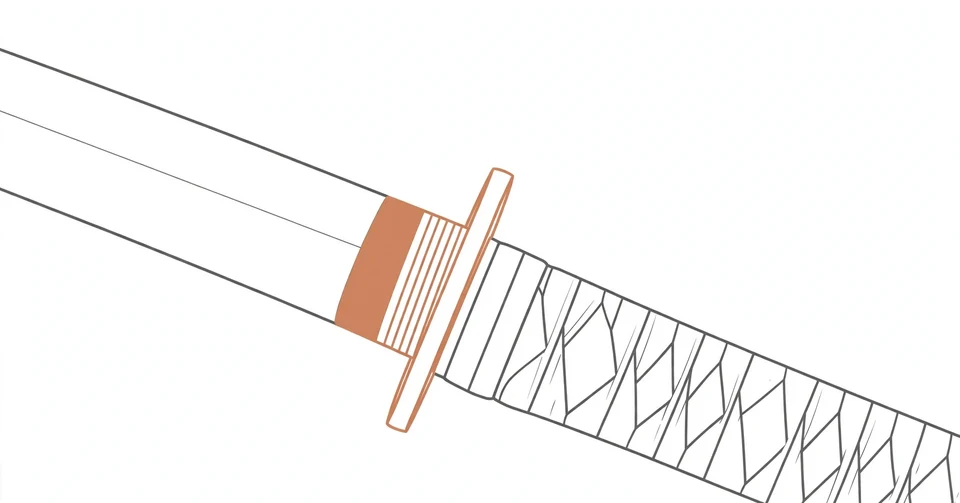
I find it fitting that the most important part of a katana mounting is also the least showy. The blade gets the poetry, the guard gets the art, and the collar gets the work. Once you know what it does, though, you start to see the sword differently. It is not decoration pretending to be useful. It is usefulness so refined that it looks like decoration, and that distinction says a lot about how Japanese craftsmen thought about their tools.
What a habaki is and where it sits
A habaki is a metal collar wrapped around the base of a Japanese sword blade, at the point where the blade meets the fittings. In Japanese it is written with the characters for the collar, and older names for it include saya-bashiri-dome, which roughly means the thing that stops the blade from running out of the scabbard. That name alone tells you its job. It is the stop, the wedge, and the seal, all in one small sleeve of metal.
Look at a mounted katana from the side and you can trace the order of the parts. The tang disappears into the handle. Above the handle sits the guard, the tsuba, flanked on each side by thin washers called seppa. Just above the guard, where the polished steel of the blade begins, sits the collar. Its lower edge, called the daijiri, presses against the seppa, and its upper edge tapers into the blade. The collar therefore anchors the whole stack of fittings, holding the guard and washers in tension so the mounting feels solid instead of loose.
The collar is not a generic sleeve that any blade can wear. Each habaki is made for one specific blade, matched to the exact geometry at the base of that blade, including the width, the thickness of the spine, the taper, and the shape of the two machi shoulders. If the blade has a groove called a hi running along its side, the collar must be shaped to respect where that groove begins and ends. A sword can change its guard over the centuries, but a well made collar tends to stay with its blade for life, because no other blade has quite the same dimensions at that point.
How the habaki locks the sword in its saya
The lock works through a precise friction fit at the koiguchi. The saya, the lacquered wooden scabbard, is hollowed out slightly wider than the blade, so the edge floats free inside it and never scrapes the wood. Only the habaki touches the mouth of the scabbard, wedging gently into it and holding the sword still. Saya Is the Lacquered Sheath That Guards the Katana describes the same meeting point from the scabbard side: "the collar at the base of the blade, the habaki, wedges gently into the mouth and holds the sword still". That single sentence captures the whole mechanism. The blade hangs suspended, and the habaki is the only thing doing the holding.
This design is more clever than it first appears. Because the sword is retained at one precise point near the base of the blade, the rest of the blade can rest safely inside the saya with almost no friction and almost no wear. The edge stays sharp, the polish stays clean, and the inside of the scabbard stays dry and uncontaminated. If the edge touched the wood, it could be scratched, and moisture or residue inside the saya could start rust on the steel. The habaki keeps the blade suspended so none of that happens, and a detailed guide at Reliks explains how this friction fit at the koiguchi is what turns a loose blade into a sword that can be worn and carried with confidence.
You can feel a good habaki the moment you handle a properly mounted sword. The blade seats with a quiet, confident click rather than a clatter, and it stays put when the sword is tipped or shaken. A poor or mismatched collar betrays itself just as quickly. The sword rattles, binds, sits too loose, or feels wrong on the draw. Collectors often say that the collar is part of the sword's behaviour, not just part of its furniture, and that is exactly right. It decides how the sword feels in the hand before the blade is even visible.
Copper, gold, and the craft of the perfect fit
Copper is the classic material for a habaki, and for good reason. It is durable, it hardens well when hammered, and it is workable enough to be shaped to the tiny variations of a single blade. Most practical collars in the Edo period were copper, and copper remains the standard for swords meant to be used. Brass appears too, particularly on later or less elaborate examples, and it can offer a striking contrast against polished steel. Iron collars exist as well, made from the same iron as the blade and called tomohabaki, though they were gradually phased out because iron risks damaging the blade it touches.
Precious metals enter the picture when status matters. Gold and silver habaki were used on the swords of daimyo and high ranking samurai, and the finest were solid gold or solid silver, known as kinmuku and ginmuku. Below those came gold plated and silver plated versions. Gold and silver are soft and easy to deform, so they were not ideal for a fighting sword, and the practical compromise became a copper body covered with a thin sheet of gold or silver. That way the collar kept the strength of copper and gained the glow of a precious metal, a solution that suited stylish samurai who wanted both.
Making a habaki is the work of a specialist called a shirogane-shi, a silversmith of sword fittings. The process starts with a sheet of metal cut to the dimensions of the blade, heated until malleable, then hammered and bent around the tang so it hugs the steel. A small rod called machigane is slipped inside to hold the shape while the ends are joined with solder, using borax as a flux and a silver and brass alloy as the joining metal. Then comes the slow part: the collar is taken off the blade, filed, tested, hammered tighter or looser, and filed again, until the fit is exact to a fraction of a millimetre. A guide at Romance of Men walks through these stages in detail, from forging and soldering to the final filing that makes the collar sit perfectly against the machi.
That patience is the point. A habaki that is too loose lets the sword wobble in its saya and fails at its one job. One that is too tight binds on the draw, wears the mouth of the scabbard, and puts uneven stress on the blade. The craftsman is aiming for a fit that is secure enough to hold and free enough to release, and there is no gauge for that. It is judged by hand, by eye, and by the sound the sword makes when it seats. I admire that kind of standard, because it cannot be faked with a machine or hurried with a deadline. The collar either fits or it does not, and the sword tells you immediately.
The draw begins at the habaki
Every iaido student learns that the draw starts before the blade moves. The thumb of the left hand presses the guard forward, just enough to break the seal between the habaki and the koiguchi. That small push, called koiguchi o kiru, cutting the mouth of the scabbard, frees the blade from the friction fit, and only then does the right hand pull the sword clear. Without the collar there would be nothing to break, and without the break there would be no clean, controlled draw. The whole technique is built around the collar.
The balance matters here. The habaki must hold firmly enough that the sword never slips out on its own, because a loose sword is dangerous. An inexperienced person who grabs at a falling blade can be badly cut, and a sword that slides free while being worn is a hazard to everyone nearby. At the same time, it must release with a little deliberate pressure, not a struggle. If the fit is too tight, the draw becomes a wrestle, and the swordsman fights the scabbard instead of the opponent. The craftsman tunes the collar to that narrow middle ground, firm at rest and free on demand, and the swordsman learns to trust it without thinking about it.
There is a quiet lesson in that tuning. A good habaki does not announce itself. It holds when it should hold and lets go when it should let go, and the person using the sword rarely notices it at all. That is the nature of the best engineering: it disappears into the experience and leaves only the result. The swordsman feels a clean draw, not a clever collar, and that is exactly how the habaki wants it.
Decoration, status, and the quiet luxury of a habaki
For all its practical work, the habaki is rarely the place for loud decoration. The tsuba carries the pictures and the stories, while the collar keeps its beauty quiet. Even so, a close look reveals plenty of refinement. Some collars carry fine file marks in straight lines, a technique called yasurime, that catch the light as the sword moves. Others are textured, wrapped, foil covered, or finished in layered metals. On the finest mountings, the surface might be covered in gold or silver leaf over a copper core, a style called kise, with the covered gold version known as kinkise and the silver version as ginkise.
The most elaborate form is the double habaki, or niju, in which an outer layer called the uwagai bulges over an inner layer called the shimogai that touches the blade. The outer layer is usually the decorated one, and the extra work signals that the mounting was made with greater expense and care. Double collars became popular on the swords of daimyo in the early Edo period, and they remain one of the quiet signals collectors look for. A double habaki does not automatically mean the blade is older or finer, but it often means the owner cared enough to pay for the extra handwork.
Regional styles add another layer of meaning. Once the Edo period settled into its feudal order, silversmiths in different domains developed their own habaki styles, and collectors still recognise Owari, Osaka, Mito, Kaga, Shonai, Higo, and Satsuma collars by their shapes and finishes. These regional marks are not branding in the modern sense. They are the fingerprints of workshops and traditions, and they let a knowledgeable eye place a sword in a time and a place from a piece of metal most people never notice. The tsuba may be the most visually celebrated fitting, and a companion piece on this site shows how the tsuba turned a sword guard into a small work of art, but the collar expresses status through restraint instead of display. That contrast is part of what makes the mounting interesting: one fitting speaks loudly, the other speaks softly, and both are saying something about the owner.
Decorative collars can go further still. In peaceful times, when swords were worn more as symbols than as weapons, craftsmen made variation pieces, or kawari, shaped like Mount Fuji, chrysanthemums, or waves, and decorated with crests such as the triple hollyhock of the Tokugawa family. These are beautiful objects, and they show how even a purely functional part could become a canvas when the times allowed it. I think there is something honest about that. The habaki never stops being a lock, no matter how pretty it becomes, and the decoration never gets in the way of the job. Form follows function here, and then function politely makes room for a little beauty.
Care, wear, and replacement
A collar is built to last, but it is not immune to time. The koiguchi wears wider with repeated drawing, and as the mouth of the scabbard loosens, the habaki no longer wedges as firmly. The sword begins to rattle, or it seats too easily, or it feels loose when carried. When that happens, a craftsman can shim the mouth of the saya with thin shavings of magnolia wood, restoring the tight fit without touching the collar itself. That repair is part of the normal life of a sword, and it shows how the collar and the saya age together as a pair.
The collar itself can also need attention. Copper oxidises and dulls, and a collar that has been handled for decades may need cleaning and repolishing by someone who knows the fitting. Gold and silver covered collars need even gentler care, because the thin covering can wear through if polished too aggressively. The general rule is simple: the habaki should not be removed unless the sword is fully disassembled, and any work on it belongs to a specialist. An amateur with a pair of pliers can ruin in a minute what a craftsman spent hours fitting.
When a collar is truly worn out or mismatched, a new one must be made from scratch for that blade. There is no catalogue of standard sizes, because no two blades share the same base geometry. The replacement is fitted the same way as the original, measured, hammered, soldered, filed, and tested until the sword seats with that quiet click again. That is why an old habaki is worth keeping when it still fits: it is evidence of the blade's history. A sixteenth century blade wearing a nineteenth century collar is not a mismatch or a flaw. It is a record of the sword being maintained, remounted, and carried forward by new owners across the centuries, and the collar is part of that story.
A small collar with a large job
The habaki asks for almost nothing and gives the sword its manners. It holds the blade still in its scabbard, protects the edge from the wood, anchors the guard and the washers, and releases cleanly when the swordsman needs the blade. It does all of this while measuring about an inch long and weighing almost nothing, and it does it without a spring, a catch, or a latch. The whole mechanism is a wedge, a fit, and a craftsman's patience.
That is why the collar deserves more attention than it usually gets. The katana is often admired as a single object, a beautiful blade with a beautiful mounting, but it is really a system of parts that trust each other. The habaki is the part that makes the trust work. It holds the sword when the sword should be held, and it lets go when the sword should be drawn, and it has been doing that job for centuries without ever asking to be noticed. The next time you see a katana at rest, look for the small collar at the base of the blade. It is the quietest part of the sword, and it is the one holding everything together.
More in Culture & Society
- Menuki Are the Small Ornaments Hidden Under a Katana Grip
- Maedate Is the Crest That Turned a Samurai Helmet Into a Banner
- Samegawa Is the Ray Skin Hiding Under Every Katana Grip
- Tatara Is the Clay Furnace Where Tamahagane Begins
- Tsuka Is the Wrapped Grip That Lets a Katana Speak
- The Tanto Was the Small Blade a Samurai Trusted With His Life
Latest posts
- Tamahagane Is the Jewel Steel Behind Every Katana
- Seppuku Was the Ritual a Samurai Chose Over Disgrace
- Saya Is the Lacquered Sheath That Guards the Katana
- Daisho Was the Pair of Swords That Marked a Samurai
- Hamon Is the Wavy Line That Proves a Katana Is Real
- Ikebana and the Quiet Discipline Behind Japan's Flower Art
- The Wakizashi Was the Short Sword a Samurai Never Left Behind
- The Tsuba Turned a Sword Guard Into a Small Work of Art
- Omiyage and the Japanese Art of Bringing Something Back
- How the Katana Became the Soul of the Samurai
- The Menpo Gave the Samurai a Face Worth Fearing
- Japan Goes Maple Hunting Every Autumn and Calls It Momijigari
- Kabuto Gave the Samurai a Helmet Worthy of His Sword
- Christmas in Japan and the Fried Chicken Dinner That Started It All
- Kiso Yoshinaka Rode Out of the Mountains and Nearly Took Japan