Sageo Is the Cord That Ties a Katana to Its Samurai
· 20 min read
A sageo is the braided cord that ties a katana to its wearer, and it is far more than decoration. This is the story of its materials, its knots, its colours, and the quiet jobs it still does in the dojo today.
A katana hangs from a single cord. Not a strap, not a belt loop, not a clip, but a braided length of silk or cotton about as thick as a shoelace. That cord is the sageo, and it is the only thing tying a razor sharp blade to the man or woman carrying it. If it fails, the sword falls. If it is tied badly, the draw snags. If it is tied well, you never notice it at all, which is exactly the point.
The sageo is a braided cord that passes through the kurikata, the small knob on the side of the saya, and ties the scabbard to the wearer’s obi, the sash at the waist. It holds the sword at the hip so it stays put on the draw, and it does a surprising number of other jobs besides. This article follows that cord from the loom to the dojo, through its materials, its knots, its colours, and the small acts of care that keep it working.
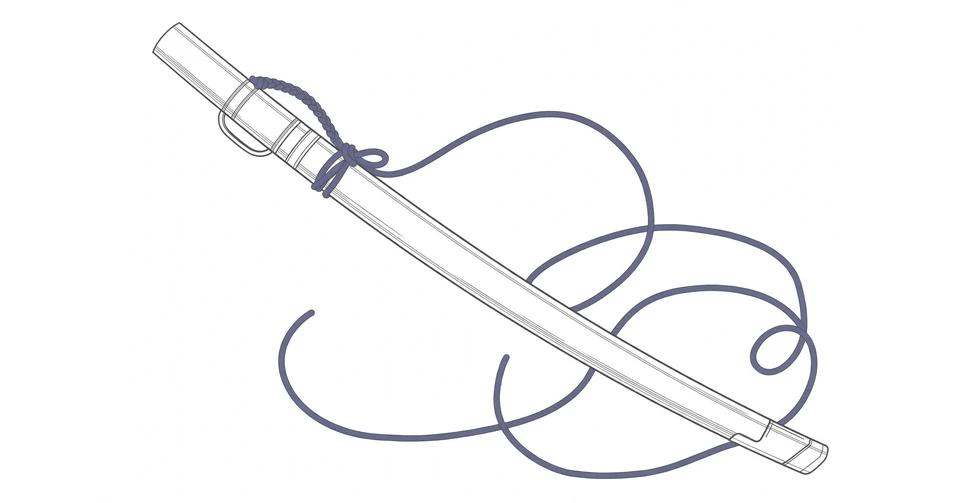
The published article on the saya describes it plainly, and the line is worth keeping in mind as we go: “The sageo, a braided cord of silk or cotton, passes through the kurikata and ties the saya to the wearer's sash, the obi, holding [the sword] at the hip so it stays put on the draw.” Everything else in this story grows out of that one sentence. The cord is simple, but the way it is made, tied, coloured, and cared for turns out to be a small craft of its own, and one that says a lot about how the samurai thought about their swords.
What a sageo is, and where it sits
A sageo, written 下緒, means hanging cord, and the name is honest about the job. The cord threads through the hole in the kurikata, the horn or wood knob fixed to the side of the scabbard, and its two ends are then tied to the obi. On a katana worn edge up through the sash, the sageo keeps the saya from sliding forward or dropping away when the wearer walks, bows, or draws. It is the quiet partner in the whole system: the saya protects the blade, the tsuka gives the hand its grip, and the sageo keeps the whole assembly where it belongs.
The cord belongs to the koshirae, the complete mounting of a sword, and it is listed among its parts alongside the tsuba, the menuki, and the kurikata itself. That matters, because it means the sageo was never an afterthought or an accessory added by the owner. A swordsmith or a mounting specialist chose it to match the rest of the mounting, the way a tailor chooses thread to match a coat. When you look at a katana in a museum and the cord catches your eye, that is not an accident. Someone chose that colour, that braid, and that length on purpose.
The cord is longer than most people expect. Modern sources give a wide range, commonly 120 to 240 centimetres, with about 220 centimetres often quoted for a katana and 120 for a shorter wakizashi. Older guidance is shorter: Donn Draeger, in his classic book on Japanese swordsmanship, puts the standard length at approximately 165 centimetres, and notes that in the Edo period the sageo would measure about 160 to 166 centimetres. The honest answer is that there is no single correct length. A longer sageo gives more freedom for knots and for the practical tricks described later in this article, while a shorter one stays out of the way. Practitioners today choose by school, by sword, and by habit, and a good teacher will tell a beginner to stop worrying about the number and learn to tie the cord they have.
Silk, cotton, and leather
The three traditional materials for a sageo are silk, cotton, and leather, and each one changes how the cord behaves. Silk is the premium choice. It is smooth, cool to the touch, and holds a tight braid beautifully, and a silk sageo on a formal mounting looks quietly expensive in the way only silk can. It is also the most demanding material: moisture and abrasion damage it faster than they damage cotton, and it needs to be kept dry and handled gently. For that reason silk is often reserved for ceremonial swords and fine display mountings, where the cord will be admired more than it is pulled.
Cotton became the workhorse material once Japanese cotton production took off in the late sixteenth century, and it has stayed the standard for practice ever since. A cotton sageo is strong, durable, affordable, and easy to wash and replace, which is exactly what a student in a dojo needs. It grips a little better than silk when tied, so a knot stays where it is put, and it forgives the repeated handling that a training sword goes through. For anyone learning iaido, cotton is the sensible first choice, and many experienced practitioners never see a reason to change.
Leather, usually deer leather, is the third traditional option. It is tough and has a warm, matte look that suits some mountings, but it is less common than the other two and it behaves differently under tension, stretching a little with use. Modern synthetic fibres such as rayon and polyester also appear on entry level swords, and they are cheap and hard wearing, though a purist would say they lack the feel of the natural materials. My own feeling is that the material matters less than the honesty of the choice: a cotton sageo on a training sword is not a compromise, it is the right tool for the job, and a silk one on a sword that never leaves its stand is not vanity, it is respect for the mounting as a whole.
How a sageo is braided
A sageo is not twisted like a rope. It is braided, using the same kumihimo tradition that makes the cords for obi, armour, and temple fittings, and the braid is what gives the cord its character. A braided cord lies flat against the scabbard, resists kinking, and keeps its shape when it is tied and untied again and again. The braid also lets the maker control the look: a round braid feels different in the hand from a flat one, and the pattern of the weave can be as simple or as elaborate as the mounting demands.
Named braiding patterns for sageo include kainokuchi, kakucho, sasanamigumi, ryukogumi, shigeuchi, kikiogumi, and karagumi, among others. A practitioner writing about his own swords notes that the shigeuchi style, while extremely pretty, frays very quickly, and that the kakucho is a far better choice for a functional sageo. That is a useful rule for anyone choosing a cord: the prettiest braid is not always the one that survives a year of practice. A tight, simple braid that stays whole is worth more than a fancy one that unravels at the ends.
The colour of the braid is usually chosen to match or complement the tsuka-ito, the wrapping of the handle, so the sword reads as one object rather than a collection of parts. A black sageo with a black handle wrap is the standard, formal look, and it is the one most students will start with. A coloured sageo against a dark saya can be striking, but the effect works best when it echoes something else on the mounting, a menuki, a tsuba, or the lacquer itself. A cord that clashes with everything else on the sword looks like a mistake, and in a tradition this careful about appearance, that is a judgement worth listening to.
The colours of a sageo and what they once meant
Colour is where the sageo stops being a piece of cord and starts being a piece of social history. In the Edo period, the colour of a samurai’s sageo could signal his rank and his domain, and at least one domain, Aizu, ran a formal cord system that set colours by office. Under that system, purple was reserved for very high ranks such as chief retainers and senior elders. A dark blue green called onando iro was for chief retainers, senior elders, castle stewards, major inspectors, and military and school commissioners. Black was for general upper class samurai, navy for the samurai stationed at Inawashiro Castle, and peacock blue for stable masters, chief accountants, and other second tier officials. Brown was for middle class samurai, light green for middle class samurai on annual service, and light blue, asagi iro, for middle class samurai on monthly service. Wearing a colour above one’s rank was not allowed.
How much of this system was truly enforced, and how much is later storytelling, is genuinely hard to pin down. Writers on the subject warn that many stories about sageo and handle wrap colours and rank are of disputed historical accuracy, and they should be treated with care. One fact that is better documented is the Tokugawa shogunate’s ruling by 1645 that the tsuka-ito, the handle wrap, should be black, and that some samurai got around it with very dark blue or very dark brown. Since the sageo was expected to match the handle wrap, most standard sageo were black too, and that is why black remains the default today.
Today, the old rank rules no longer apply, and a practitioner can choose any colour they like when customising a sword. But the tradition has not vanished entirely. In iaido, some unwritten customs survive, and white sageo is often treated as reserved for instructors. A beginner who turns up with a white cord on a first lesson may find themselves gently corrected, not because a rule book says so, but because the dojo remembers what the colour used to mean. I think there is something admirable in that: a community keeping a piece of manners alive long after the law that created it has gone.
Threading the kurikata and tying the knot
Fitting a sageo begins at the kurikata. The cord is folded, passed through the hole in the knob, and pulled until the two ends hang evenly, with the fold sitting neatly against the scabbard. From there the cord can be tied in a surprising variety of ways, and the choice of knot is where a swordsman’s school, taste, and purpose all show at once.
The knots have names, and most of them are used when the sword is at rest rather than when it is being worn. The cho musubi, the butterfly knot, is a bow that can be undone with a single pull, so the sword can be freed in an emergency. The ronin musubi and the daimyo musubi are display knots, tied close to the kurikata and wrapped near the end of the saya, often seen on swords resting in an alcove. The formal knot, also called a bow knot, was the standard for formal occasions in the Edo period. The noshi musubi is the simplest and most commonly used knot, straightforward and functional. The myoga musubi is used to stop the ends of the cord from unravelling, and its name comes from its resemblance to the myoga plant. The wrap knot, maki musubi, winds the cord around the scabbard and ties it off tightly to secure it. The tachi knot passes the cord through the hangers of a tachi and ties it around the saya to form loops on both sides.
When the sword is actually worn, the sageo is tied to the obi, and here the schools differ in ways that an experienced eye can read at a glance. In Muso Jikiden Eishin Ryu, the sageo is tied over the saya and onto the left side himo band of the hakama, while Muso Shinden Ryu ties it across the body on the right hand side himo band. In the Tosa-Ota branch of the same tradition, the cord is simply draped over the saya, and in the Yamauchi branch it is said that higher ranked samurai let the sageo drape while lower ranked samurai tied it to the himo. A beginner does not need to memorise all of this, but it is worth knowing that the knot you tie is a small statement about where you learned, and that your teacher will notice it before you notice it yourself.
There are also special ways of tying for special situations. When a samurai needed to ride on horseback or fire a long gun, the katana could be tied on in the manner of a tachi, edge down and suspended from the obi rather than pushed through it, a method called tenshinzashi. The sageo made that change of carry possible without any extra equipment, which is a neat reminder that the cord was a tool before it was a decoration.
The draw, and why the cord matters
The practical heart of the sageo is the draw. When a katana is drawn, the left hand pulls the saya back while the right hand pulls the blade forward, and for that instant the scabbard is under real force. Without the sageo tying the saya to the obi, the scabbard could slide forward with the blade, or drop, or twist in the sash. With the cord tied properly, the saya stays exactly where it should be, the blade clears the mouth cleanly, and the draw becomes one smooth motion instead of a struggle.
That is also why the fit of the cord matters on a daisho, the matched pair of katana and wakizashi. Both swords must sit securely in the obi, and the shorter sword must be fixed in a position where it can be drawn single handed in an emergency. A loose sageo on either sword is not a cosmetic problem, it is a safety problem, and a teacher will correct it the way a driving instructor corrects a loose seatbelt. The cord is small, but the job it does at the moment of the draw is not small at all.
In tameshigiri, the cutting practice on rolled tatami mats, the sageo plays a quieter role. The sword is drawn and cut in the same motion, and the cord must stay out of the way while still holding the saya in place after the cut, when the blade is returned to the scabbard. A sageo that is too long can catch on the hand or the mat, and one that is tied in a bulky knot can snag at the worst moment. Practitioners who cut regularly tend to favour a simple, short tie, and they check the cord before every session, because a frayed sageo is a cord that might fail when the sword is moving fastest. The lesson generalises well beyond the dojo: the parts you never think about are the ones that fail at the worst time.
A sageo in the dojo today
Walk into an iaido dojo today and you will see the sageo doing the same jobs it did centuries ago, with a few modern differences. Most students practise with an iaito, a blunt practice sword, and the sageo on an iaito is usually cotton, plain, and black, chosen for durability and for the fact that it matches the handle wrap. The cord is tied according to the school’s method before practice begins, and it is part of the reiho, the etiquette of the art, which means it is checked, adjusted, and treated with the same care as the bow at the start of class.
Some schools leave the sageo loose during training, draping it over the saya, while others tie it firmly to the hakama. Neither is wrong. What matters is that the choice is deliberate and consistent with the school, and that the student understands why. A teacher who dismisses the sageo entirely is, in the words of one senior instructor, making a mistake: the practice of not fitting a sageo at all is undesirable from the point of view of etiquette and of respect toward the sword fittings. That is strong language, and it tells you how seriously the tradition takes a piece of cord.
There is also a spiritual side to the sageo that the martial arts writers do not hide. Within Japanese tradition, everyday objects are understood to hold a spirit of their own, a reflection of long held Shinto belief, and the sageo is treated as a sacred cord connecting the student to the tool by which they perfect their character. The comparison made is to the shimenawa, the thick sacred rope tied around rocks, trees, and waterfalls, and around the small shrines in a dojo. A sageo is a small thing, but it is tied in the same spirit, and a student who understands that will handle it differently from one who sees only a piece of string. I find that idea moving, and it is the part of the story I keep coming back to: a culture that finds meaning in a cord is a culture that pays attention.
The seven techniques
The most surprising chapter in the life of the sageo comes from the Bansenshukai, the old ninja manual, which records seven sageo rope tying methods, the sageo shichi no jutsu. These were recorded by Naoya Meiwa, the tenth headmaster of the Masaki Ittoryu school, and they turn the cord into a piece of field equipment. The travel pillow method tied the katana and wakizashi together and laid them under the head while sleeping at an inn, so that a thief could not take the swords without waking the sleeper. The inn caution method tied the cord to barriers as a makeshift alarm. The gate entry method adjusted the swords with the cord when passing through a gate, so the wearer stayed ready for a sudden attack. The four directions block covered the awkward case of a toilet or other confined space, where drawing a sword is difficult and the cord was used to keep the sword deployable. The spear stop wrapped the cord around an opponent’s spear shaft to control it. The hanging sword method suspended the sword from the mouth, or another hold, to free the hands for climbing a wall.
There were other uses too. The cord could be used to stop bleeding, as a replacement belt, or to restrain a prisoner, a technique from hojojutsu, the art of tying with rope, which some schools built into their formal preparation. One technique, called the sitting search, was used in complete darkness: the swordsman pulled the sword slightly from the sheath, held the long cord in his mouth, and moved quietly, ready to spit the cord out and strike if he bumped into someone. Another, the sageo tobashi, is said to involve throwing the cord to entangle an enemy’s weapon, though it is rarely documented and should be taken as lore rather than fact. Not all of these uses are practical today, and some of them sound more like stories than techniques, but they show how the samurai thought: a piece of cord two metres long is a tool, and a tool should earn its place.
Decoration, or something more
It is tempting to look at a sageo on a display sword, tied in an elaborate knot with a coloured braid, and call it decoration. That is not wrong, but it is incomplete. The cord is decorative in the same way that the lacquer on the saya is decorative: the beauty is real, and it is also the visible sign of a job done well. A neatly tied knot tells you the owner knows the sword. A frayed, dirty cord tells you the opposite. In a culture where the sword was both a weapon and a badge of status, the cord could not be merely pretty, because everything about the sword was read by other people.
The difference between a sageo and a mere decorative cord is that the sageo has to work. A tassel on a curtain never holds anything up. A sageo holds a sword to a man’s waist, frees his hands on a wall, wakes him if a thief touches his swords, and comes undone with one pull when he needs his blade. Take the working jobs away and the beauty remains, but the object loses its meaning. That is why the best mountings treat the cord as part of the sword and not as an extra: it is chosen, braided, coloured, and tied with the same seriousness as the blade itself.
Care and replacement
A sageo does not last forever, and knowing when to replace it is part of owning a sword. Silk frays at the ends and weakens with moisture, and a silk sageo that has been handled often should be inspected for thin spots, especially near the kurikata, where the cord bends every time it is threaded. Cotton lasts longer under daily use, but it too will wear, fade, and lose its grip, and a cotton cord that has gone soft and fuzzy is telling you it is time for a new one. Leather stretches with use and can crack if it dries out. Any cord that shows broken strands, a flattened braid, or ends that will not stay tied is past its useful life.
Care is simple. Keep the cord dry, keep it clean, and do not leave the sword in damp air. A silk sageo should be handled with clean hands and stored away from sunlight, which fades the colour. A cotton sageo can be washed gently and dried flat, though many practitioners simply replace it when it looks tired, since a new cord is inexpensive. When replacing a sageo, match the new cord to the handle wrap in colour and to the mounting in quality, and take the time to learn your school’s knot properly rather than copying a photograph. A cord tied by habit is a cord tied well, and a cord tied in a hurry is a cord that will come undone when you least want it to.
Replacement is also a good moment to think about length. If the old cord was always too long and getting in the way, or too short to tie the knot your school uses, the replacement is the time to fix it. Measure against the sword and against your own body, not against a number in a book, because the right length is the one that works for you and for the way you wear the sword. The old Edo period lengths and the modern ranges in the shops are both useful guides, but neither one knows your height, your obi, or your school.
The cord that stays
A sageo is easy to overlook. It is thin, it is quiet, and it spends most of its life hanging against a black scabbard where nobody looks. But take it away and the sword stops being wearable, the draw stops being clean, and a whole set of small, clever techniques vanish with it. The cord ties the sword to the samurai, and in a way it also ties the samurai to his school, his rank, his history, and the craft that made the sword in the first place.
The next time you see a katana, look past the blade for a moment and find the cord. Notice its colour, its braid, and the way it is knotted. It will tell you something about the sword, and about the person who chose it. A small cord, tied well, is a quiet kind of mastery, and it deserves the same attention as the steel it serves.
More in Culture & Society
- Tsuka-Ito Is the Cord That Binds a Katana Grip
- Fuchi Is the Collar That Frames a Katana Grip
- Kashira Is the Small Cap That Finishes a Katana Grip
- Menuki Are the Small Ornaments Hidden Under a Katana Grip
- Habaki Is the Copper Collar That Locks a Katana in Its Sheath
- Maedate Is the Crest That Turned a Samurai Helmet Into a Banner
Latest posts
- Samegawa Is the Ray Skin Hiding Under Every Katana Grip
- Tatara Is the Clay Furnace Where Tamahagane Begins
- Tsuka Is the Wrapped Grip That Lets a Katana Speak
- The Tanto Was the Small Blade a Samurai Trusted With His Life
- Tamahagane Is the Jewel Steel Behind Every Katana
- Seppuku Was the Ritual a Samurai Chose Over Disgrace
- Saya Is the Lacquered Sheath That Guards the Katana
- Daisho Was the Pair of Swords That Marked a Samurai
- Hamon Is the Wavy Line That Proves a Katana Is Real
- Ikebana and the Quiet Discipline Behind Japan's Flower Art
- The Wakizashi Was the Short Sword a Samurai Never Left Behind
- The Tsuba Turned a Sword Guard Into a Small Work of Art
- Omiyage and the Japanese Art of Bringing Something Back
- How the Katana Became the Soul of the Samurai
- The Menpo Gave the Samurai a Face Worth Fearing