Kashira Is the Small Cap That Finishes a Katana Grip
· 17 min read
A kashira is the small metal cap at the end of a katana handle, and though it is only a few centimetres across, it protects the grip, anchors the wrapping, and often carries the finest art on the whole sword.
Hold a katana by its handle and your little finger will eventually find the end of the grip. There, where the wrapping stops and the hand runs out of handle, sits a small metal cap. That cap is the kashira, and it is one of the most quietly important parts of the whole sword.
The kashira closes the end of the tsuka, the wrapped handle, and it does far more than make the grip look finished. It protects the wooden core of the handle from splitting, it anchors the final knot of the cord wrapping, and on a fine sword it carries a miniature work of art that rewards anyone patient enough to look closely.
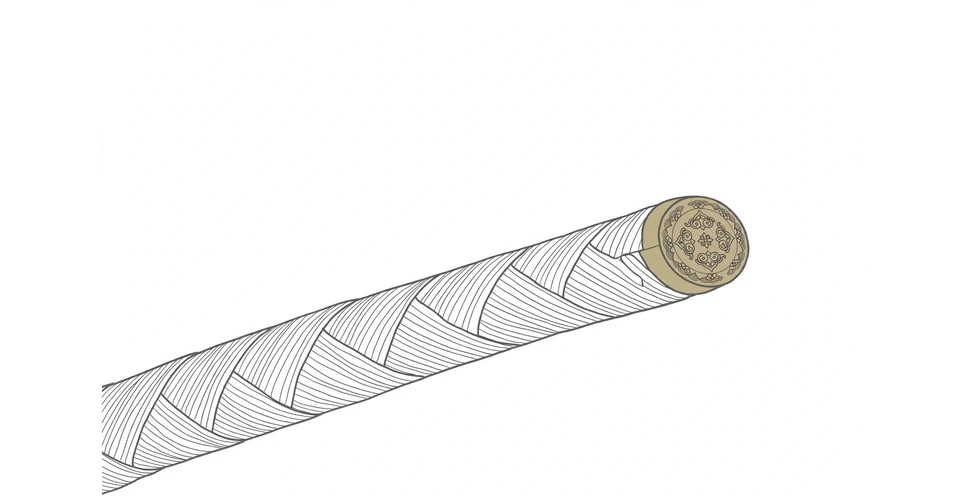
Most people who admire a katana start with the blade, and that is fair. The blade is the soul of the sword. But the cap is where the sword shows how much its makers cared about the parts nobody was meant to stare at, and that is exactly why it is worth a closer look.
What a kashira actually does
A kashira is the metal end cap mounted at the butt of the sword handle. It works with the fuchi, the collar at the front of the handle, to frame the wrapped grip, and together the two fittings are known as the fuchi-kashira set. It sits at the end farthest from the blade, and its first job is simple protection. It closes the end of the tsuka and reinforces the spot where the wrapping is pulled tightest, so the wooden core underneath does not split or fray with use.
Its second job is to hold the wrapping in place. The cord that wraps the handle, the tsuka-ito, passes through small openings on either side of the kashira so the wrap can be tied off securely. On finer examples those openings are fitted with small metal eyelets called shitodome, which protect the cord from wear and add a subtle decorative accent of their own. Without the cap, the final knot of the wrap would have nothing solid to anchor against, and the whole grip would slowly work loose.
Its third job is visual. A kashira completes the theme of the sword, carrying part of the same decorative idea seen on the fuchi, the menuki beneath the wrap, and sometimes the tsuba guard as well. On a plain working sword the cap may be unadorned and purely functional. On a finer sword it becomes a small stage for the metalworker's skill, and that contrast tells you a great deal about the sword you are holding.
The kashira is not a pommel
Visitors from a European sword tradition often call the kashira a pommel, because it sits where a pommel sits. The comparison is understandable, and it is also wrong in an interesting way. A European pommel is often a heavy structural part of the hilt that helps counterbalance the blade and holds the whole assembly together. The kashira was never designed to do that job.
The katana handle was built around a wooden core, ray skin, wrapping, and carefully fitted hardware rather than a heavy pommel meant to counterbalance the blade. The cap is light by design. Its purpose is to finish the handle, protect the end of the tsuka, and give the wrap a place to end, not to shift the balance point of the sword. Anyone who picks up a katana expecting the cap to feel like the pommel of a longsword will be surprised by how little weight sits at the end of the grip, and that surprise is a useful lesson. Japanese sword construction solved the problem of balance in its own way, through the proportions of blade and handle, and the cap was free to be small, precise, and beautiful instead of heavy.
That distinction matters because it changes how you judge the fitting. A cap does not need to be massive to be good. It needs to fit perfectly, hold the wrap firmly, and belong to the sword it finishes.
The kashira and the fuchi, a matched pair
The kashira is almost always made as part of a matching set with the fuchi, the collar at the front of the tsuka beside the tsuba. When the two are made together they usually share the same motif, the same metal, and the same artistic style, and collectors look for that unity when they judge quality. A strong fuchi-kashira set feels like one idea expressed twice, with a subject that flows from one piece to the other, such as birds moving through grasses or blossoms spreading across both fittings.
The pairing is practical as well as artistic. The fuchi and the kashira are the two metal ends that stop the wood of the handle from splitting, one at each end of the grip, and that shared structural job is the origin of the pair. The published article on the tsuka puts it plainly: "at each end of the handle sit the fuchi and the kashira, the metal collar and the end cap" and "The fuchi and kashira are the metal ends that stop the wood splitting." That sentence is the whole idea in miniature. Two small pieces of metal, one at each end, holding a wooden handle together across centuries of use.
On many antique swords the kashira is not decorative filler at the end of the grip. It is the second half of a complete artistic statement, and a sword whose two fittings do not match is a sword that has probably lost a part of its history along the way.
Materials that make a kashira
One reason the kashira fascinates collectors is the range of metals and alloys that Japanese fittings artists used on a piece only a few centimetres across. Even at that scale, the choice of material changes the whole character of the sword.
Shakudo was one of the most prized materials for a kashira. This copper based alloy, darkened to a deep blue black or purple black patina, gave the maker a rich dark ground against which gold and silver details could shine. Shibuichi, a copper and silver alloy, was valued for its soft grey tones and was often chosen for quieter, more understated work. Copper appears often both as a base metal and as part of relief decoration, while iron gives a cap a more restrained, martial appearance. On higher end pieces, gold and silver were used for inlays, overlays, highlights, and fine details.
Horn was sometimes used as well, and the Victoria and Albert Museum notes that fittings were generally made of iron or copper alloy but some makers used horn and other materials. Buffalo horn was a practical choice because its dark colour stayed dark even as a lacquered surface wore, so a horn kashira kept its looks through years of handling.
The Victoria and Albert Museum holds a fine example of what these materials can do together. A fuchi-kashira pair signed Nobutatsu, of the Murakami school and dated to about 1800 to 1850, is made of shakudo with a hammered stone effect ground and inlaid with two butterflies in gold and mother of pearl. You can see the pair in the V and A collection, and it shows how much artistry could be packed into a fitting smaller than a matchbox.
My own feeling is that the material matters less than the honesty of the work. A plain iron cap, well shaped and well fitted, has a dignity that a flashy but careless gold inlaid piece can never match. The metal should serve the sword, not show off at its expense, and the best makers understood that restraint is itself a kind of decoration.
Decoration, from nanako to iroye
The decoration of a kashira is where a small fitting becomes a small sculpture. The most recognisable finish on a high quality cap is nanako, a surface formed from countless tiny punched dots arranged with remarkable precision. In the light, nanako shimmers and gives the fitting a jewel like richness, and it is usually used as a background texture so that raised motifs stand out clearly. Crisp and even nanako is one of the signs of careful workmanship, because producing it evenly across a curved fitting takes a high level of control and patience.
Relief work is the second great technique. The design is raised above the background, so a bird, flower, dragon, wave, or figure projects from the surface with surprising depth. Some relief is shallow and elegant, while other pieces are deeply modelled for dramatic effect, and the best examples keep the design readable even at a very small scale. A well made cap can reward close study in the same way a larger sculptural object does, even though it was made to sit at the end of a sword handle.
Iroye, often translated as a coloured picture effect in metal, is the third technique worth knowing. Rather than using paint, the artist combines different alloys and patinas to create visual contrast, so gold, silver, shakudo, shibuichi, and copper may all appear together on one small cap. The result can look almost painterly, with a bird in copper and silver highlights set against a shakudo ground with gold flowers, and everything is accomplished through metalworking alone.
The subjects are as varied as those found elsewhere in Japanese sword furniture. Nature motifs are especially common, with chrysanthemums, cherry blossoms, bamboo, grasses, waves, and flowing water appearing again and again. Birds and animals were also popular, from sparrows and cranes to mythical creatures, and they could suggest longevity, vigilance, good fortune, or seasonal change. Mythological and religious figures appear on finer fittings as well, giving the fitting a deeper symbolic identity and connecting the sword to larger themes of protection, status, or cultural taste. A good example is another V and A pair, decorated with crabs and water weeds by a stream, which turns a fitting into a small riverside scene.
What lies beneath the wrap
A kashira never works alone. Beneath the cord wrapping of the tsuka sits a layer of samegawa, ray skin, whose rough texture grips the cord and stops it from slipping. Pressed into the handle under the wrap are the menuki, small ornaments that give the palm something to hold and the grip its shape. The menuki are the hidden ornaments of the handle, and a fuller account of them is in the article on menuki hidden under a katana grip.
The relationship between these parts is a quiet piece of engineering. The samegawa gives the wrap its grip, the menuki give the hand its purchase, the cord binds everything tight, and the cap locks the end of the whole assembly. Take any one of them away and the handle becomes a different object, less secure and less comfortable. The cap is the last piece in that chain, and it is the piece you notice first when the chain fails, because a loose kashira means a loose wrap, and a loose wrap means a handle you cannot trust.
I think this is the most admirable thing about the tsuka as a whole. Nothing in it is there for show alone, and nothing is there for structure alone. Every part earns its place twice, once for the hand and once for the eye, and the kashira is perhaps the clearest proof of that double duty.
Fitting and removing a kashira
Fitting a kashira is a job for a patient craftsperson, not a hurried one. The cap must match the oval cross section of the handle end exactly, sitting flush against the wood and the ray skin without a gap on any side. If it is too loose it will rattle and wear the cord, and if it is too tight it can split the wooden core it is meant to protect. The fit is tested by hand and by eye, and a good fit feels like the cap grew there rather than being pushed on.
Because the tsuka-ito passes through the openings on either side of the kashira, the cap cannot simply be pulled off while the handle is wrapped. Removing it is part of taking the whole handle apart. The wrap must be unwound first, the cord freed from the shitodome eyelets, and only then does the cap slide free from the end of the wooden core. Putting it back reverses the process, with the wrap re-tied through the same openings and knotted off to lock everything in place.
That sequence is worth remembering for anyone who handles antique swords. A cap that comes away easily on a fully wrapped handle is a warning sign, not a convenience, because it means the wrap is no longer doing its job. A sound cap stays put until the wrap itself is undone, and that is exactly how it should be.
How a kashira affects balance and feel
Because the kashira is light, its effect on the balance of a katana is small, and that is the point. The balance of a katana comes from the blade, the length of the handle, and the weight of the fittings as a whole, not from a single cap at the end of the grip. A cap made of iron weighs a little more than one made of shakudo or horn, but the difference is measured in grams, and no swordsman ever won or lost a cut because of it.
What the kashira does affect is the feel of the grip in the hand. The end of the handle is where the little finger rests and where the hand registers the end of the sword, and a well shaped cap gives that finger a smooth, rounded stop instead of a sharp wooden edge. The curve of the cap, the polish of its surface, and the way it meets the wrapping all feed into the sense that the handle is one continuous object rather than a stack of parts. A rough or poorly fitted cap breaks that illusion every time the hand reaches the end of the grip.
Collectors sometimes overstate this, and it is worth being honest about the scale. The cap will not transform a bad sword into a good one, and a fine kashira on a clumsy mounting is still a clumsy mounting. But on a sword that is already well made, the cap is the detail that tells you the maker finished the job instead of stopping one step early, and that kind of thoroughness is something a hand can feel even before the eye notices it.
Signs of a good kashira
Judging a kashira is a skill that grows with looking, and there are a few reliable signs to start with. Look first at the quality of the surface. A good cap should have clean shaping and clear detail, with no soft edges where the design has been worn or poorly cast. If the piece uses nanako, the texture should appear deliberate and even rather than muddy or inconsistent, with the dots holding their pattern across the curve of the cap.
Study the relief next. Better work has stronger depth, cleaner edges, and more separation between the subject and the ground, so the design stays readable at arm's length as well as close up. Look closely at the side holes where the tsuka-ito passes through, and if the piece has neatly fitted shitodome, that is often a sign of a more refined mounting. Check the fit as well. The cap should sit flush against the handle with no visible gap and no rocking when pressed, and its theme should belong to the same visual language as the fuchi and the menuki rather than feeling borrowed from another sword.
Age and condition complicate all of this, and an honest collector learns to tell wear from damage. A cap that has been carried for two centuries will show softening on its highest points, and that is history, not a flaw. What matters is whether the wear is even and honest, or whether the piece has been polished, repaired, or replaced in a way that hides its story. The first kind of wear adds character. The second kind takes it away.
How modern makers and collectors judge a kashira
Many of the finest kashira seen in museums and collections today date to the Edo period, from 1603 to 1868, when a long era of relative peace changed the role of sword mountings. Swords remained symbols of rank and identity, but fittings were no longer shaped only by battlefield needs, and metalworkers elevated the cap into a place where tiny scenes, delicate textures, and symbolic motifs could be explored with extraordinary skill. A detailed guide to the cap and its techniques is available from Reliks, and it is a good place to see how much craft sits inside this one small fitting.
Modern makers of traditional swords still work in that tradition, and they judge a cap by the same standards their Edo period predecessors used. The fit must be exact, the decoration must suit the rest of the mounting, and the piece must survive the wrapping process without damage. A modern cap made for a working sword will usually be simpler than a museum piece, with plain iron or brass and little or no inlay, because a sword that is used for practice does not need a miniature sculpture at the end of its handle. What it needs is a cap that stays put, protects the wood, and feels right in the hand, and a plain cap that does those jobs well is a better fitting than a decorated one that does them badly.
Collectors, meanwhile, judge a kashira as part of the whole mounting rather than as a standalone object. They ask whether the fuchi and the kashira match, whether the theme runs through the menuki and the tsuba, and whether the piece is original to the sword or a later replacement. A mismatched cap is not necessarily a bad one, but it changes the story of the sword, and a collector who cannot tell the difference will pay for a story that is not true.
That is the deeper lesson of the kashira, and it is the reason I keep coming back to small fittings like this one. Japanese sword furniture rewards the person who looks twice, and the cap is the fitting that most rewards a second look. It is easy to walk past it on the way to the blade, but once you stop and study it, you start to see the whole sword differently, not as a weapon with decoration added on, but as a single object in which every part, down to the last few centimetres of the handle, was made with the same care.
The kashira will never be the most famous part of a katana, and it does not need to be. It finishes the grip, holds the wrap, and carries a small piece of art at the place where the hand ends and the sword begins. That is a modest job, done beautifully, and modesty done beautifully is worth more attention than it usually gets. If you ever hold a katana, let your hand find the end of the handle and pause there for a moment. The small cap under your little finger has more to say than its size suggests.
More in Culture & Society
- Tsuka-Ito Is the Cord That Binds a Katana Grip
- Fuchi Is the Collar That Frames a Katana Grip
- Sageo Is the Cord That Ties a Katana to Its Samurai
- Menuki Are the Small Ornaments Hidden Under a Katana Grip
- Habaki Is the Copper Collar That Locks a Katana in Its Sheath
- Maedate Is the Crest That Turned a Samurai Helmet Into a Banner
Latest posts
- Samegawa Is the Ray Skin Hiding Under Every Katana Grip
- Tatara Is the Clay Furnace Where Tamahagane Begins
- Tsuka Is the Wrapped Grip That Lets a Katana Speak
- The Tanto Was the Small Blade a Samurai Trusted With His Life
- Tamahagane Is the Jewel Steel Behind Every Katana
- Seppuku Was the Ritual a Samurai Chose Over Disgrace
- Saya Is the Lacquered Sheath That Guards the Katana
- Daisho Was the Pair of Swords That Marked a Samurai
- Hamon Is the Wavy Line That Proves a Katana Is Real
- Ikebana and the Quiet Discipline Behind Japan's Flower Art
- The Wakizashi Was the Short Sword a Samurai Never Left Behind
- The Tsuba Turned a Sword Guard Into a Small Work of Art
- Omiyage and the Japanese Art of Bringing Something Back
- How the Katana Became the Soul of the Samurai
- The Menpo Gave the Samurai a Face Worth Fearing