Menuki Are the Small Ornaments Hidden Under a Katana Grip
· 17 min read
Menuki are tiny metal sculptures tucked under the cord wrapping of a katana handle, guiding the grip and carrying centuries of Japanese art in the palm of the hand.
Hold a katana by its handle and you will feel something under the cord. It is not a lump or a flaw. It is a small raised shape, firm against your palm on one side and against your fingers on the other, and it tells your hands exactly where they belong. That shape is a menuki, a small metal ornament hidden under the wrapping of the handle, and it is one of the most quietly clever details in the whole history of the Japanese sword.
A menuki is a miniature sculpture, usually only a few centimetres long, placed under the silk or cotton cord that wraps the handle. Menuki come in pairs, one on each side of the handle, and they are almost always different from each other in small ways. They may show animals, plants, deities, or scenes from legend, and they are made by specialist metalworkers whose names are still collected and studied today.
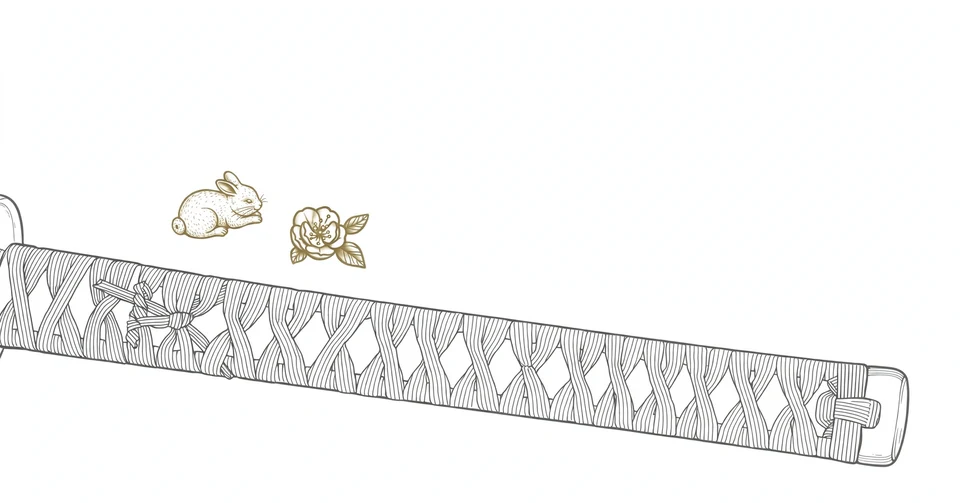
That hidden quality is what makes menuki so easy to overlook and so rewarding to learn about. The blade gets the poetry and the museum glass. The guard is admired in display cases. The ornaments sit in the dark, pressed against the wood of the handle, doing their work unseen. Yet collectors pay serious money for a fine pair, museums keep them in careful records, and the greatest metalworking school in Japanese history built much of its reputation on them.
What menuki are and where they sit
A menuki is one of a pair of small metal ornaments fixed to the handle of a Japanese sword, known as the tsuka. The handle is a wooden core covered in ray skin and then wrapped in cord, and the menuki sit between the ray skin and the cord, one on each side. They are held in place by the tension of the wrapping itself, and when the handle is correctly wrapped they cannot move at all. You can feel them through the cord as raised shapes under your hand, but you cannot see them without unwrapping the handle.
The position of the menuki is not random. One sits on the side of the handle that faces outward when the sword is worn, and the other sits on the side that faces the body. When you take a grip, one presses against the palm of your hand and the other rests against your fingers, and the pair together give the hand two fixed points to find without looking. A sword handle must feel the same every time you pick it up, in the dark, in the rain, or in a hurry, and the pair makes that possible. The Victoria and Albert Museum, which holds a pair in its East Asia collection, describes them exactly this way, as ornaments positioned so that they fitted the palm when the sword was used, giving a better grip.
There is a second, less certain part of their job. The same museum label notes that in some cases they also hid the peg that secures the handle to the blade. That peg, called the mekugi, passes through the handle and the tang of the blade, and it is the one small pin that keeps the whole sword together. Whether a given pair was placed to cover that peg or simply happened to sit near it varies from sword to sword, and honest writing should say so rather than claim a single rule.
The handle the menuki sit on is itself a small assembly of wood, ray skin, cord, and metal, and understanding it helps to understand them. The tsuka, the wrapped grip of the katana, is built from a wooden core shaped to one blade alone, and the ray skin beneath the cord gives the wrapping something to bite into. A pair of menuki sits on top of that skin, and the cord is then wrapped over them in a careful pattern that leaves their shapes readable through the diamonds of the wrap.
How menuki help the grip
The grip of a katana is a two handed grip, and it depends on small, exact details. The hands do not slide along the handle. They lock into place, the right hand near the guard and the left hand near the pommel, and the sword is controlled by the pressure of the palms and fingers rather than by brute force. A menuki gives each hand a landmark. The raised shape under the palm stops the hand from drifting toward the pommel during a cut, and the raised shape under the fingers gives the curled fingers something to close around.
This matters most when the hands are wet. A swordsman training for hours will sweat, and a sword used in rain or in the heat of a Japanese summer is held with wet palms. The ray skin under the cord already helps, because its small hard nodes give the wrapping a texture that resists sliding. The ornaments add a second layer of security, a solid metal shape that the hand can find by touch alone. It is a small thing, and that is the point. The best design in a weapon is often the design you never notice until it is missing.
There is also a subtler effect that is harder to prove and worth mentioning as opinion rather than fact. When I think about a tool that must be used without looking at it, I think the shape under the hand does more than stop slipping. It tells the hand that it is in the right place, and that confidence lets the swordsman stop thinking about the grip and start thinking about the cut. A handle with a menuki under the palm answers the question before it is asked, and that is not a claim I can measure, but it matches how craftsmen talk about their work.
The size of a menuki matters here too. Most pairs are only a few centimetres long, small enough to sit comfortably under the palm without digging in, and large enough to be felt clearly through the cord. A pair that is too large would bruise the hand. A pair that is too small would vanish under the wrapping and do nothing at all. The metalworkers who made them understood this balance, and the finest pairs are the ones where the sculpture is as bold as possible while the shape under the hand stays gentle.
The art inside the handle
If menuki were only grip aids, they could be plain lumps of metal. They are not. They are among the smallest sculptures in Japanese art, and they carry subjects that would fill a painting. Animals are common, especially dragons, lions, horses, and rats, along with birds, fish, and insects. Plants appear too, including plum, bamboo, pine, and chrysanthemum. Deities and heroes from legend appear as well, and so do everyday objects such as fans, arrows, and musical instruments. A dragon suggested power, a plum branch suggested endurance through winter, and a pair of matching subjects could turn a sword handle into a small statement about its owner.
The materials are as varied as the subjects. Many menuki are made from shakudo, an alloy of copper and gold that is chemically treated to turn a rich blue black, and then decorated with gold and silver. Others are made from shibuichi, a softer silver grey alloy of copper and silver, or from solid gold, silver, copper, or iron. The Victoria and Albert Museum pair, signed by a member of the Goto family, is made of shakudo covered with gold and silver, and it shows almost identical designs of a bow and a quiver of arrows on each piece. A bow and a quiver are tools of war, but they are also tools of hunting and ceremony, and on a sword handle they read as a wish for skill rather than a boast of violence.
The techniques used to make menuki read like a catalogue of Japanese metalwork. High relief carving, called takabori, lifts the design boldly from the surface. Low relief, katachibori, keeps it close and fine. Coloured metals are inlaid into the surface, a technique called iroe, so that a gold dragon can coil across a black shakudo ground, or silver leaves can sit beside gold flowers. Tiny circles are punched into the surface in a regular pattern, a finish called nanako, which gives the metal a granular texture and makes the raised design stand out. A fine pair of menuki may combine three or four of these techniques in a space smaller than a thumb.
What strikes me most about this art is its audience of one. A painting hangs on a wall for anyone to see. A menuki is hidden under cord, inside a hand, for the life of the sword. The only people who ever see it are the craftsman who made it, the wrapper who fitted it, and the occasional owner or restorer who takes the handle apart. That is an extraordinary amount of effort for an audience that may never arrive, and it says something generous about the culture that produced it. The maker worked as if the piece would be seen and judged, even knowing it would spend its life in the dark.
The Goto school and its masters
No story about menuki is complete without the Goto school, the family of metalworkers who set the standard for sword fittings for centuries. The school was founded in the fifteenth century by Goto Yujo, who is said to have been patronised by the shogun Ashikaga Yoshimasa, who ruled from 1449 to 1473. The Goto masters worked in soft metals, carving painterly designs in high relief on a ground of shakudo, finished with nanako and accented in gold and silver. They concentrated on the smaller fittings, the ornaments, the kozuka handles, and the kogai skewers, and they left the larger sword guards to other masters.
The school organised its output into matching sets called mitokoromono, a set of three kinds of fitting made to go together, a kozuka, a kogai, and a pair of menuki. The Metropolitan Museum of Art holds a collection of these sets assembled by Count Mito Tokugawa in the nineteenth century, with each of the first fifteen generations of masters of the main Goto school represented by a mitokoromono. That collection is described as the most complete representation of the famous Goto school, and it is a reminder that menuki were never made alone in the world of high craft. They were part of a matched set, designed to sit beside the other fittings and share one subject.
The most famous name in the later history of the school is Goto Ichijo, who was born in Kyoto in 1791 and died in 1876. He was the last and one of the greatest masters of the Goto school, and his life reads like a summary of the craft at its highest level. He took over the head of his family line at fifteen, and in 1824 he made fittings to decorate the mounting of a Masamune sword belonging to Emperor Kokaku, for which he received the rank of Hokyo. In 1851 he was commissioned by the Tokugawa Shogunate and moved to Edo to work under its employment, and late in his life he made a tachi mounting for Emperor Komei and was promoted to the rank of Hogen.
Ichijo worked in every medium the school used, including gold, shakudo, shibuichi, copper, and even iron, which was an unconventional material for the Goto school. His early work followed the traditional family style called iebori, and his favourite designs were dragons and shishi lions. Later he moved toward a realistic depiction of nature, with motifs that included grasses, flowers, insects, birds, and landscapes, rendered in a highly elaborate and precise manner. A surviving daisho set by his hand, a pair of tsuba and a pair of menuki made for the long and short swords of a matched pair, shows the Four Noble Ones, plum, orchid, bamboo, and chrysanthemum. The set was awarded the status of Juyo Tosogu, an important sword fitting, at a judging in 2016, and the full story of that set, including a translation of its certificate, is documented by the Nihonto site.
The Four Noble Ones are worth pausing over, because they show how a menuki could carry a whole philosophy. In Chinese brush painting the four plants are called the Four Gentlemen, and they compare the plants to the ideal gentleman of Confucian teaching. Bamboo stands for modesty and longevity, because it is evergreen. The plum tree is the first to blossom, flowering before its leaves emerge, and it stands for winter and purity. The orchid stands for love and beauty, and it is associated with spring. The chrysanthemum flourishes at the end of the year, and it stands for autumn, longevity, and endurance. A swordsman carrying these four plants was carrying a reminder of the character he was supposed to show, and he carried it in the palm of his hand.
How menuki are made and fitted
Making a menuki starts with the metal, and the choice of metal decides almost everything that follows. Shakudo begins as copper with a small amount of gold, and it is the alloy most associated with fine pieces because of the deep blue black colour it takes when it is treated. Shibuichi mixes copper with silver for a softer grey. Gold and silver are used for inlay and for whole pieces made for the highest ranking owners, while iron appears in the work of makers who wanted a rougher, more martial feeling. The maker would shape the blank, carve the design in relief, add the inlay, punch the nanako ground if the design called for it, and then finish the surface by hand. The finest makers, such as Ichijo, are recorded as doing every step themselves, from the basic shaping through the nanako to the finished piece.
The back of a menuki is as important as the front, even though nobody sees it. Small loops or pins on the reverse are used to secure the piece, and the maker shapes the back so that it sits flat against the curved surface of the handle core. A piece that rocks or sits proud of the wood will shift under the cord, and a shifting ornament will loosen the wrapping over time. The craft is therefore half sculpture and half engineering, and the engineering is invisible by design. A collector who turns a menuki over will look at the back first, because the back tells the truth about how carefully the piece was made.
Fitting the menuki is the job of the wrapper, the craftsman who performs tsukamaki, the wrapping of the handle. The wrapper places the menuki on the ray skin that covers the wooden core, checking the position against the hand that will hold the sword. The pair must sit where the palm and the fingers will find them, and they must sit firmly enough that the cord can be pulled tight over them without moving them. Then the cord is wrapped in its crossing pattern, and the diamonds of the wrap close over the ornaments. The ray skin beneath them, the samegawa that hides under every katana grip, gives the cord its bite and the ornaments their seat, and the three layers, skin, ornament, and cord, work together as one surface.
Collecting and caring for menuki today
Today most menuki are collected apart from their swords. Old handles are taken apart for restoration, and the fittings are kept, studied, and sold as small works of art in their own right. A fine pair by a named Goto master can be a serious purchase, and pairs are often kept in fitted paulownia wood boxes, sometimes with the signature of the maker written inside the lid. Collectors look for the same things the original owners looked for, a clear design, crisp carving, honest patina, and a signature that can be read. They also look at the back, because a piece that was made well will show its loops and its flat seat, and a modern copy will often betray itself there first.
The market has its own traps, and a buyer should know them. Menuki are small, they are easy to copy, and a copy can be aged to look old. Signatures can be added to unsigned pieces, and a pair that claims to be a matched set may have been put together from two unrelated pieces. The safest route is to buy from a dealer or auction house that guarantees its pieces, and to have an important purchase checked by an expert before the money changes hands. The Juyo Tosogu status awarded to the Ichijo daisho set is an example of how the trade polices itself. Pieces are submitted to judging, examined by specialists, and given a rank that follows them for the rest of their life.
Care is simple, and it is mostly about leaving the metal alone. Menuki should be handled with clean, dry hands, kept away from moisture, and stored in a dry box rather than left out in humid air. The patina on shakudo, the dark surface that gives the metal its colour, is a chemical layer, not dirt, and polishing it away destroys both the colour and the value. A soft cloth is enough for dust, and anything more should be left to a professional restorer. If a handle is taken apart, the ornaments should be photographed in place before they are removed, so that the wrapper can put them back exactly where they were.
What I like about collecting these small pieces is the scale of it. A katana is a large, expensive, and regulated object, and most people will never own one. A menuki is a small piece of the same craft, made by the same hands, and it fits in a box on a shelf. It is a way to hold a piece of the sword without holding the sword, and for many people that is enough. The art was made to be hidden, and there is something fitting about the fact that it now lives in small boxes, taken out and looked at quietly, one pair at a time.
A small art that fits in the hand
A menuki is a grip aid, a sculpture, a signature, and a small piece of moral teaching, all fitted into a space smaller than a thumb. It sits under the cord of a katana handle, one on each side, where the palm and the fingers can find it without looking, and it does its work for the whole life of the sword without ever being seen. The makers who carved them knew that almost nobody would look at their work, and they carved it as carefully as if it would hang in a gallery. That is the detail that stays with me. A culture that puts its finest art where no one can see it is a culture that believes the work matters for its own sake, and the hand that holds the sword is the only audience it ever needed.
More in Culture & Society
- Habaki Is the Copper Collar That Locks a Katana in Its Sheath
- Maedate Is the Crest That Turned a Samurai Helmet Into a Banner
- Samegawa Is the Ray Skin Hiding Under Every Katana Grip
- Tatara Is the Clay Furnace Where Tamahagane Begins
- Tsuka Is the Wrapped Grip That Lets a Katana Speak
- The Tanto Was the Small Blade a Samurai Trusted With His Life
Latest posts
- Tamahagane Is the Jewel Steel Behind Every Katana
- Seppuku Was the Ritual a Samurai Chose Over Disgrace
- Saya Is the Lacquered Sheath That Guards the Katana
- Daisho Was the Pair of Swords That Marked a Samurai
- Hamon Is the Wavy Line That Proves a Katana Is Real
- Ikebana and the Quiet Discipline Behind Japan's Flower Art
- The Wakizashi Was the Short Sword a Samurai Never Left Behind
- The Tsuba Turned a Sword Guard Into a Small Work of Art
- Omiyage and the Japanese Art of Bringing Something Back
- How the Katana Became the Soul of the Samurai
- The Menpo Gave the Samurai a Face Worth Fearing
- Japan Goes Maple Hunting Every Autumn and Calls It Momijigari
- Kabuto Gave the Samurai a Helmet Worthy of His Sword
- Christmas in Japan and the Fried Chicken Dinner That Started It All
- Kiso Yoshinaka Rode Out of the Mountains and Nearly Took Japan